Answer engine optimization checklist: the page-level AEO workflow
A practical answer engine optimization checklist for fixing one page: prompt ownership, target URL, direct answer, proof block, schema, internal links, and re-measurement.
Answer engine optimization checklist work starts with one painful problem: your page exists, but ChatGPT, Perplexity, Gemini, Claude, Bing Copilot, or Google AI Overviews still pulls the answer from someone else. The fastest path is not a bigger article. It is one prompt, one target URL, one direct answer, one proof block, matching schema, internal links, and a re-measurement loop.
Use this checklist when you already know the topic but need the page to become a source an answer engine can select. If you do not yet know which prompts, citations, or source pages are failing, start with the answer engine optimization audit checklist. If you need the category definition first, start with answer engine optimization. If you need copyable page patterns, use the answer engine optimization examples guide. Teams already targeting Google answer boxes should first compare AEO vs featured snippet optimization. If the writer needs the plan before drafting, start with the answer engine optimization content brief.
What is an answer engine optimization checklist?
An answer engine optimization checklist is a page-level workflow for making a specific URL easier for answer engines to retrieve, understand, cite, and recommend. It turns a broad goal like "show up in AI answers" into visible checks: prompt ownership, direct answers, extractable proof, schema, internal links, source credibility, and measurement.
Answer engine optimization is the practice of structuring content so answer engines can select it as the direct answer to a user's question. The checklist version is narrower: it tells you exactly what to fix on one page before you publish or refresh it.
The useful test is simple. If a human cannot copy one paragraph, table, or checklist from your page and use it to answer the prompt, an answer engine probably cannot either.
When should you use this checklist?
Use this checklist when a buyer prompt already produces an AI answer and your site is absent, uncited, misdescribed, or beaten by a competitor source. It is most useful for commercial prompts where the answer can influence a shortlist, comparison, workflow, or next step.
| AI answer pattern | What it usually means | Best first fix |
|---|---|---|
| Competitor named, your brand absent | The assistant found a clearer source for the category | Improve or create the target page |
| Brand named but no citation | The brand is known, but the source page is weak | Add answer block, proof, FAQ, and schema |
| Your domain cited, wrong URL | Internal topology is unclear | Link older related pages to the intended URL |
| Old third-party article cited | Freshness or authority gap | Update proof, date, and source links |
| Answer says something wrong about you | Source-of-truth page is stale | Correct product facts and entity language |
Do not use this checklist to justify dozens of near-duplicate pages. If an existing URL can honestly own the prompt, fix that URL first. Duplicate intent makes answer engines choose the wrong page.
How do you run an answer engine optimization checklist?
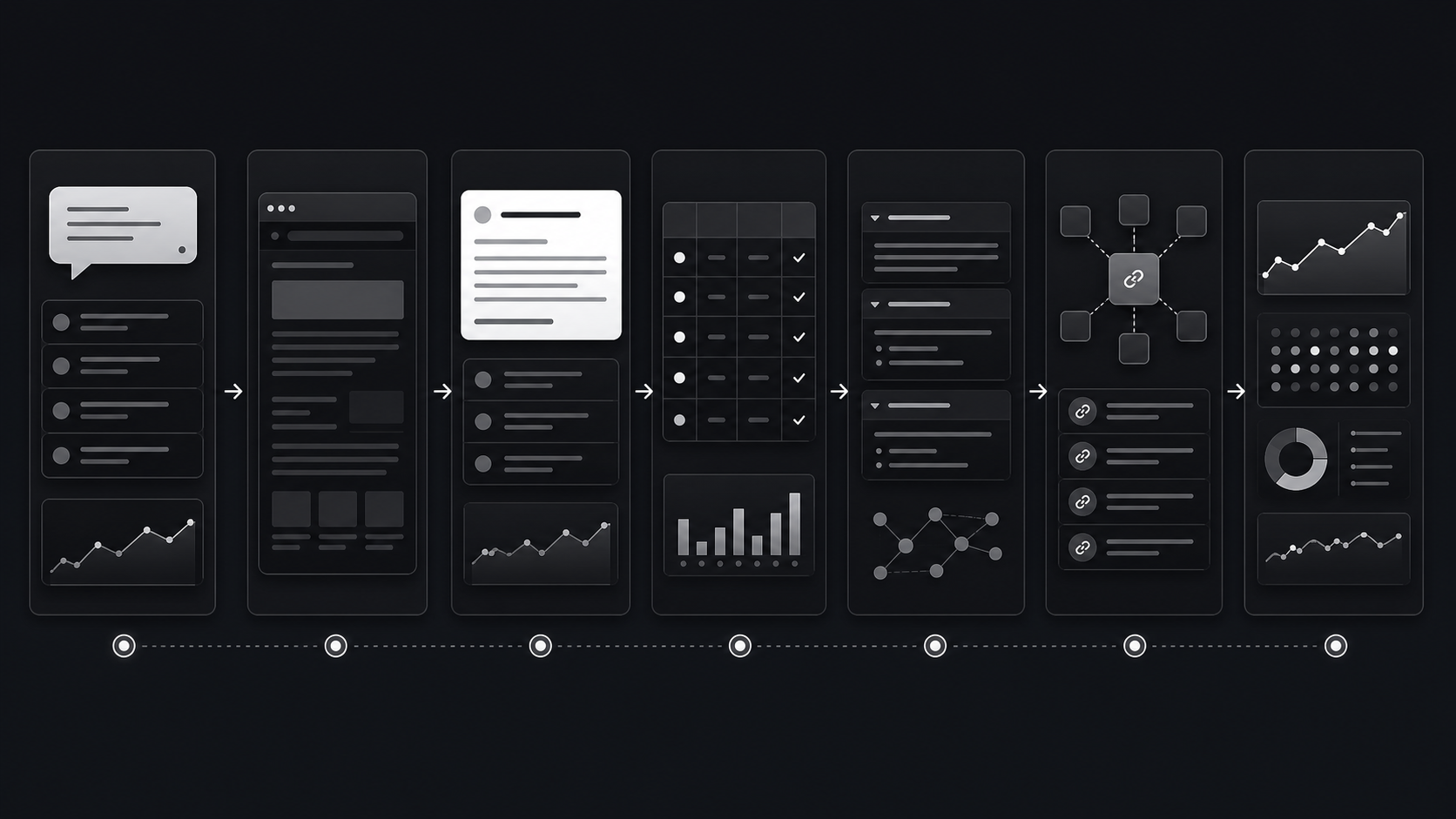
Run the checklist in seven steps: lock the prompt, assign the target URL, inspect the current AI answer, add a direct answer, add extractable proof, align schema with visible content, then link and re-measure. The goal is not more words. The goal is a page that can be selected as a source.
1. Lock one buyer prompt
Choose one prompt before editing. Good prompts sound like real questions a buyer would ask an assistant:
- "what is the best way to track AI search visibility"
- "how do I optimize an existing page for answer engines"
- "why does ChatGPT cite competitors instead of my site"
- "when should I create a new AEO page instead of updating an old one"
- "best AI visibility workflow for a B2B SaaS team"
Keep the wording stable. If you change the prompt every time you test, you cannot tell whether the page improved or the test changed.
2. Assign one target URL
Pick the URL that should own the answer. If two pages could answer the same prompt, make one the owner and make the other support it with an internal link.
Use this routing rule:
| Prompt intent | Best target page |
|---|---|
| "What is..." | Glossary, definition, or pillar guide |
| "How do I..." | Checklist or workflow page |
| "Best X for Y" | Buyer guide or comparison page |
| "X vs Y" | Honest comparison page |
| "Why does..." | Troubleshooting or failure-mode page |
| "How do I measure..." | Metrics or reporting guide |
For example, broad category prompts should point to what answer engine optimization means, while page-fix prompts should point to a checklist like this one.
If the target URL is an ecommerce product detail page, use the product-specific version of this workflow in product page answer engine optimization. Product pages need extra checks for price, availability, variants, Merchant Center data, reviews, and Product schema consistency.
3. Inspect the current answer
Run the prompt across the AI surfaces your buyers use. Record the brands mentioned, cited URLs, answer accuracy, citation order, and whether the answer suggests a next step that helps or hurts you.
Separate surfaces. ChatGPT, Perplexity, Gemini, Claude, Bing Copilot, and Google AI Overviews do not behave the same way. A page can win citations in Perplexity and still be invisible in ChatGPT.
If you need the measurement workflow first, use answer engine optimization metrics, AI visibility tracking, ChatGPT citation tracking, or Perplexity citation tracking.
4. Add a 40-80 word direct answer
Put the answer directly under the first important H2. It should name the entity, audience, use case, surface, and next action without a long setup.
Use this shape:
[Term] is [plain-English definition] for [audience/use case]. It matters because [specific consequence]. The fastest way to improve it is [page-level action], then [measurement step].
That paragraph should be useful even if it is the only part of the page an assistant reads.
5. Add one extractable proof block
Answer engines need support for the claim they are about to make. Add one block that can be lifted cleanly:
- a decision table
- a numbered checklist
- a before/after example
- a failure-mode matrix
- a source-backed definition
- a short measurement methodology
Vague proof loses. Specific nouns win: product names, surfaces, prompt types, URLs, dates, authors, schema types, and measurable outcomes.
6. Add schema that matches visible content
Use Article schema for the page. Use FAQPage only when the FAQ answers are visible on the page. Use HowTo only when the visible article contains actual ordered steps.
Google's structured data documentation says markup helps Search understand page content, and its structured data policies require markup to describe content visible to users. Treat that as the floor for AEO: schema is a clarity layer, not hidden content.
7. Link the page into the topic graph
The checklist page should link to the pillar, examples, measurement pages, and the conversion path. It should also receive links from older pages so it is not orphaned.
For this page, the natural graph is:
- Category: answer engine optimization
- Examples: answer engine optimization examples
- Website workflow: AI search optimization
- Citation loss: AI citation decay
- Measurement: measure share of voice in AI
- Conversion: run the free Tracemetry audit or review Tracemetry pricing
What should the final AEO checklist include?
A final answer engine optimization checklist should include prompt ownership, one target URL, answer-first copy, a definition block, a table or checklist, visible FAQ, matching schema, reliable source links, internal links, and a re-measurement plan. Missing any one item does not doom the page, but the weakest item usually explains why the page is not cited.
Use this before publishing:
| Item | Pass condition |
|---|---|
| Prompt | One primary AI query is selected and kept stable |
| URL ownership | One target page is assigned to the prompt |
| Direct answer | First important H2 has a 40-80 word answer |
| Definition | One paragraph starts with "[Term] is..." |
| Extractable block | Page includes a table, checklist, or ordered workflow |
| Entity clarity | Copy names the category, product, surface, audience, and use case |
| Proof | Platform, schema, or standards claims cite reliable sources |
| FAQ | Questions match visible buyer prompts |
| Schema | Article and FAQ schema match visible content |
| Internal links | Page links to related resources and receives backlinks |
| Measurement | Same prompt is rechecked after crawl/update window |
The decision rule: if you can only fix three things today, fix the direct answer, the proof block, and the internal links. Those three usually produce the fastest page-level movement. If the team first needs to grade the whole site, use the AI optimization for websites scorecard before assigning page-level fixes.
How do you measure whether the checklist worked?
Measure whether the same prompt starts producing a better answer. Track brand mention rate, domain citation rate, target URL citation rate, answer accuracy, competitor source share, and AI referral traffic where clicks are available. Compare the same wording before and after the page change.
| Metric | What it tells you |
|---|---|
| Brand mention rate | Whether the assistant recognizes you as relevant |
| Domain citation rate | Whether any page on your site is used as a source |
| Target URL citation rate | Whether the intended page owns the answer |
| Answer accuracy | Whether the assistant describes you correctly |
| Competitor source share | Whether competitors still control the evidence |
| AI referral traffic | Whether cited answers are creating visits |
Do not judge success from one run. AI answers vary. Recheck after 7-14 days on fast-crawled sites and again after 30 days. If the answer still does not move, the missing ingredient is usually stronger proof, clearer entity language, or more authority, not more generic copy.
What are the most common AEO checklist mistakes?
The common mistakes are predictable: optimizing multiple pages for the same prompt, hiding the useful answer in schema, opening with vague category context, skipping measurement, and treating brand mentions as if they were source ownership. The fix is to keep the checklist page-level and measurable.
Avoid these:
- Writing for a keyword instead of a prompt. Keywords reveal vocabulary; prompts reveal the job.
- Publishing overlapping URLs. If two pages can own the same answer, answer engines may cite the wrong one.
- Burying the answer. Put the direct answer near the top, not after 900 words of setup.
- Shipping schema-only answers. The useful Q&A must be visible to readers.
- Ignoring source URLs. Brand mentions are not enough if a competitor page controls the citation.
- Measuring too broadly. Track the prompt and target URL, not just the domain.
For a broader business-case view, use answer engine optimization ROI. It separates visibility, source ownership, referral traffic, conversions, and assisted pipeline so the report stays credible.
For ecommerce implementations, apply the checklist at the page type that should own the answer: use product page AEO for one-SKU questions and ecommerce category page AEO for shortlist, budget, and use-case questions.
Before rolling the checklist across the site, use the 90-day answer engine optimization roadmap to baseline one buyer journey, prioritize fixes, and scale only the patterns that produce repeated movement.
FAQ
What is an answer engine optimization checklist? An answer engine optimization checklist is a page-level workflow for making a specific URL easier for AI answer systems to retrieve, extract, cite, and recommend. It includes prompt ownership, direct-answer copy, extractable proof, visible FAQ, schema, internal links, and re-measurement.
What is the fastest AEO fix for an existing page? The fastest fix is to add a 40-80 word direct answer under the first relevant H2, add one decision table or checklist, include visible FAQ answers, add Article and FAQ schema that matches the page, and link to the page from older related posts.
Should I create a new AEO page or update an old one? Update an old page when it already matches the prompt intent. Create a new page only when no existing URL can honestly answer the prompt. Too many overlapping pages can make answer engines cite the wrong source.
Does FAQ schema help answer engine optimization? FAQ schema helps when it matches visible Q&A content and clarifies the page for parsers. It does not replace useful copy. The FAQ answers should be readable on the page and should match real buyer questions.
How long should I wait before rechecking an AI answer? Recheck 7-14 days after publishing or updating a page, then again after 30 days. Keep the prompt wording stable and compare brand mention rate, domain citation rate, target URL citation rate, and answer accuracy.
What metric matters most for an AEO checklist? Target URL citation rate is the most actionable page-level metric. It shows whether the specific page you intended to own the prompt is being cited, not just whether your brand or domain appears somewhere in the answer.
Start with one prompt
Do not turn AEO into a giant content calendar before proving the loop. Pick the prompt where losing hurts most, assign the URL that should own it, apply the checklist, and re-measure.
Local and multi-location teams can apply this workflow with the local business AEO playbook, which adds location-specific prompt testing, business-fact governance, and qualified recommendation measurement.
Run the free Tracemetry audit to find the first source gap. Use Tracemetry Pro when you want weekly prompt tracking, competitor citation monitoring, and source-grounded briefs for the pages that should win.
Sources: Google AI features and your website, Google structured data introduction, Google structured data policies, Google helpful content guidance, OpenAI ChatGPT Search announcement, and OpenAI ChatGPT Search Help Center. Use this checklist inside a broader answer engine optimization strategy so every page fix maps to a commercially relevant prompt, intended source URL, baseline, and retest date.
Frequently asked questions
What is an answer engine optimization checklist?
An answer engine optimization checklist is a page-level workflow for making a specific URL easier for AI answer systems to retrieve, extract, cite, and recommend. It includes prompt ownership, direct-answer copy, extractable proof, visible FAQ, schema, internal links, and re-measurement.
What is the fastest AEO fix for an existing page?
The fastest fix is to add a 40-80 word direct answer under the first relevant H2, add one decision table or checklist, include visible FAQ answers, add Article and FAQ schema that matches the page, and link to the page from older related posts.
Should I create a new AEO page or update an old one?
Update an old page when it already matches the prompt intent. Create a new page only when no existing URL can honestly answer the prompt. Too many overlapping pages can make answer engines cite the wrong source.
Does FAQ schema help answer engine optimization?
FAQ schema helps when it matches visible Q&A content and clarifies the page for parsers. It does not replace useful copy. The FAQ answers should be readable on the page and should match real buyer questions.
How long should I wait before rechecking an AI answer?
Recheck 7-14 days after publishing or updating a page, then again after 30 days. Keep the prompt wording stable and compare brand mention rate, domain citation rate, target URL citation rate, and answer accuracy.
What metric matters most for an AEO checklist?
Target URL citation rate is the most actionable page-level metric. It shows whether the specific page you intended to own the prompt is being cited, not just whether your brand or domain appears somewhere in the answer.
See your own AI visibility today.
Free public report. 60 seconds. No signup. Or get started on Pro to track 250 prompts continuously.