Answer engine optimization vs featured snippets: what changes?
Compare AEO with featured snippet optimization, see which tactics overlap, what AI answers require, and how to measure both without duplicating content.
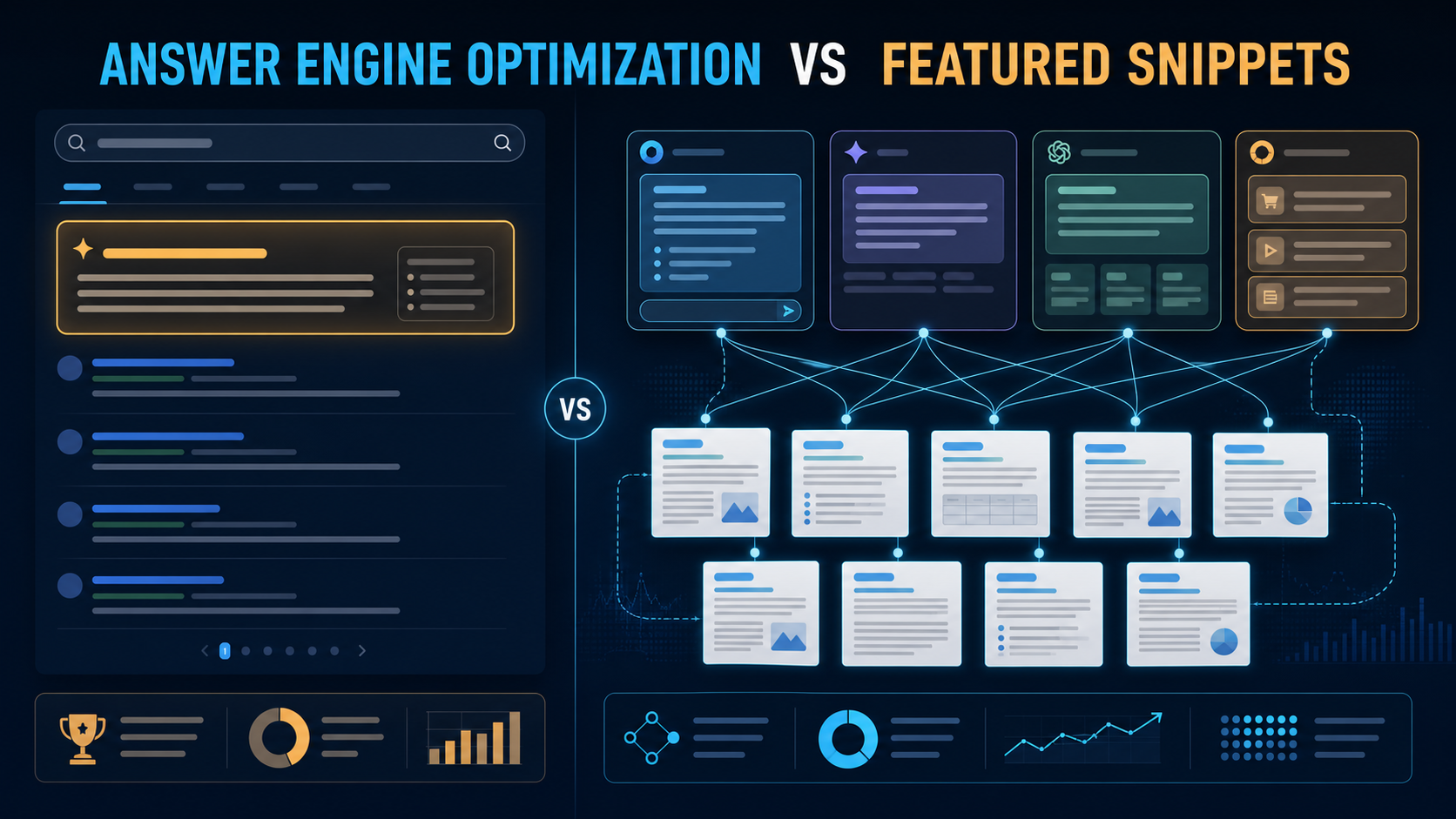
Answer engine optimization and featured snippet optimization overlap, but they are not the same job. Featured snippet optimization targets one extracted answer in a traditional Google result. AEO targets mentions, citations, recommendations, and source ownership across ChatGPT, Perplexity, Gemini, Google AI Overviews, and other answer systems. Build extractable answers once, then measure each surface separately.
Use the fast rule: keep your proven featured-snippet formatting, but add source credibility, entity clarity, comparison logic, answer accuracy, and prompt-level tracking. That turns a one-SERP tactic into an answer engine optimization program.
What is the difference between AEO and featured snippet optimization?
Featured snippet optimization aims to make a page eligible for Google's prominent paragraph, list, table, or video answer. Answer engine optimization aims to make a brand or page retrievable, understandable, cited, and recommended across multiple AI-generated answer surfaces. The content patterns overlap; the surfaces, outcomes, and measurement systems differ.
Answer engine optimization is the practice of improving how answer systems find, interpret, cite, and recommend your content or brand for a defined set of questions. It includes page structure, factual support, entity signals, technical accessibility, internal links, third-party authority, and repeatable monitoring.
Google describes featured snippets as special boxes where the description appears before the link, and explains that its systems decide whether a page makes a useful featured snippet. Google's guidance for AI features says the same foundational SEO practices remain relevant, but AI features may use a query fan-out technique and present a wider set of supporting links. That is why one clean paragraph helps both jobs without making them identical.
| Dimension | Featured snippet optimization | Answer engine optimization |
|---|---|---|
| Primary surface | Google Search | ChatGPT, Perplexity, Gemini, Google AI features, other answer engines |
| Desired outcome | Own the highlighted answer box | Earn mentions, citations, recommendations, and accurate answers |
| Typical unit | Keyword and ranking URL | Prompt, surface, answer, cited URL, and brand outcome |
| Common format | Paragraph, list, table, video | Direct answer, comparison, evidence, entity facts, FAQ, source links |
| Main competitor | Other ranking pages | Brands, publishers, forums, databases, and other cited sources |
| Measurement | Snippet ownership and organic performance | Mention rate, recommendation rate, citation rate, accuracy, source share |
| Failure mode | Another result wins the snippet | Your brand is absent, misdescribed, or supported by a competitor's URL |
Do featured snippet tactics still work for AI answers?
Yes, the best featured-snippet tactics remain useful because answer systems also benefit from clear headings, concise definitions, ordered steps, and compact tables. But formatting alone is insufficient. AI answers can synthesize multiple sources, compare brands, and answer conversational prompts that do not map neatly to one keyword or one ranking page.
Keep these snippet-era habits:
- Put a self-contained 40–80 word answer directly under the relevant question heading.
- Use an ordered list when sequence matters and a table when criteria matter.
- Make the subject explicit instead of relying on pronouns or surrounding context.
- Keep important facts visible in HTML and consistent across the page.
- Match structured data to what readers can actually see.
Then add what AEO requires:
- Cite primary or credible sources for claims an answer system may need to verify.
- State who the product, method, or recommendation is for—and when it is a poor fit.
- Keep brand, product, pricing, compatibility, and policy facts consistent across public pages.
- Map conversational prompts to one intended source page.
- Track mentions and cited URLs across each answer surface on a fixed cadence.
For reusable page patterns, the answer engine optimization examples guide shows definition, comparison, troubleshooting, workflow, and FAQ blocks.
When is featured snippet optimization enough?
Featured snippet optimization is enough when the business objective is narrowly tied to a stable Google query, the result regularly shows a snippet, the page already ranks competitively, and success can be judged through Search Console and SERP observation. It is not enough when buyers use AI assistants to compare, shortlist, or validate vendors.
| Situation | Best first move |
|---|---|
| A page ranks on page one and a stable snippet exists | Improve the exact paragraph, list, or table likely to win the snippet |
| ChatGPT names competitors for a buyer prompt | Inspect the answer and cited sources, then fix the intended source page |
| Perplexity cites your domain but the wrong URL | Clarify page ownership with headings, copy, canonicals, and internal links |
| Google AI Overview appears while clicks fall | Track AI Overview presence, cited sources, brand inclusion, ranking, and CTR |
| Your product is described incorrectly | Correct public facts and monitor answer accuracy, not just visibility |
| The query has no matching page | Create the page that honestly satisfies the intent; do not bolt an answer onto an unrelated URL |
The mistake is treating every lost answer as a writing problem. Sometimes the page is blocked, stale, contradictory, poorly linked, or weaker than an independent source. Use the AEO checklist before commissioning more content.
How do you turn a featured-snippet page into an AEO source?
Start with the page that already matches the question. Preserve its useful short answer, then strengthen the evidence and decision support around it. Assign a fixed prompt set, record current answers and citations, publish the smallest credible improvement, and rerun the same prompts after discovery. The loop matters more than adding words.
- Choose one target page. Pick the URL that should own the question based on user intent, not whichever post is easiest to edit.
- Lock 20–40 prompts. Include the exact search term plus natural questions such as “why does…,” “how do I…,” “what is the best way to…,” and “when should I…”.
- Capture the baseline. Record the surface, answer, brand position, cited domains, cited URLs, accuracy, and strongest competitor.
- Keep the extractable answer. Retain or add a concise paragraph, list, or table immediately after the matching heading.
- Add proof and boundaries. Cite reliable sources, define entities, show tradeoffs, and say when the advice does not apply.
- Strengthen page ownership. Link from relevant older pages and connect the article to the appropriate product or conversion path.
- Validate technical access. Check indexability, canonical, rendered HTML, metadata, structured data, and crawler controls.
- Re-measure unchanged prompts. Compare repeated runs rather than celebrating one favorable screenshot.
Do not create separate “snippet copy” and “AI copy.” One strong reader-facing answer should serve both. The difference belongs in distribution and measurement.
Why does a page win a featured snippet but lose AI citations?
A page can win a featured snippet because it provides the clearest extract for one Google query, yet lose AI citations because another source offers stronger evidence, better entity coverage, fresher facts, clearer comparison criteria, or more direct support for the conversational prompt. Snippet ownership proves usefulness on one surface—not universal source authority.
- The prompt is broader than the keyword. A snippet may answer “what is X,” while the AI prompt asks whether X is appropriate for a specific company.
- The answer lacks support. The paragraph is clean but its claims are unsourced or too generic to defend.
- A third party owns the comparison. Review sites, forums, and industry publications may supply the tradeoffs the product page avoids.
- Entity facts conflict. Pricing, features, audience, or availability differ across your homepage, docs, directories, and older posts.
- The wrong URL looks authoritative. Internal links and repeated language may make an older or less useful page appear to own the topic.
- The answer changed. Generative outputs vary by model, date, location, and prompt wording, so a single run can mislead.
When volatility is the problem, track repeated outcomes with the AI answer volatility workflow instead of rewriting the page after every loss.
How should AEO and featured snippets be measured together?
Use one report with separate scoreboards. For Google, track ranking, snippet ownership, impressions, clicks, and CTR. For answer engines, track prompt-level mentions, recommendations, citations, target-URL citations, answer accuracy, and competitor source share. Join them at the page level, but never collapse them into one vague visibility score.
| Metric | Question it answers |
|---|---|
| Featured snippet ownership | Does this URL own Google's highlighted extract? |
| Organic impressions and CTR | Is the Google result creating or losing measurable clicks? |
| Brand mention rate | How often does an AI answer name us? |
| Recommendation rate | How often are we presented as a viable choice? |
| Domain citation rate | How often is any page on our domain used as a source? |
| Target URL citation rate | Does the intended page own the answer? |
| Answer accuracy | Are product and brand facts represented correctly? |
| Competitor source share | Which domains supply the answers we lose? |
Google notes that traffic from AI features is included in Search Console's overall Web search reporting, rather than exposed as a clean standalone AI-feature filter. That makes controlled prompt and citation monitoring useful alongside Search Console—not a replacement for it. For the Google-specific workflow, use AI Overview tracking.
What should teams optimize first?
Optimize the highest-intent question where a page already has a plausible right to win. If a featured snippet exists and your page ranks near it, improve the extract. If AI assistants are shaping vendor selection, establish the prompt-and-citation baseline first. Most mature teams should do both on the same source pages.
- Fix inaccurate brand or product answers.
- Fix high-intent competitor recommendations.
- Fix target pages that are mentioned but not cited.
- Win stable featured snippets for valuable Google queries.
- Expand into lower-intent informational coverage only after the measurement loop works.
This order reduces wasted effort because it starts with buyer risk and source ownership, not raw content volume.
FAQ
Is AEO just featured snippet optimization with a new name? No. Both reward concise, structured answers, but AEO covers multiple answer systems and tracks brand mentions, recommendations, citations, cited URLs, and accuracy. Featured snippet optimization focuses on winning a specific Google search-result feature.
Can a page win both a featured snippet and an AI citation? Yes. A clear answer, useful structure, reliable support, and strong page relevance can make the same URL competitive for both. Measure the outcomes separately because winning one does not guarantee the other.
Does schema guarantee a featured snippet or AI citation? No. Structured data must represent visible content and does not guarantee a special search appearance. Schema can clarify entities and page meaning, but it cannot replace useful copy, credible evidence, accessibility, and relevance.
Should I create a separate page for every AI prompt? No. Group prompts that share the same intent and answer into one authoritative page. Create a new URL only when the user job, audience, comparison, or required answer is meaningfully different.
What is the best metric for answer engine optimization? For a specific page, target URL citation rate is the clearest source-ownership metric. Pair it with recommendation rate and answer accuracy so a technically cited but commercially weak or incorrect answer does not count as a clean win.
How often should I check snippets and AI answers? Check priority prompts weekly and review lower-priority groups monthly. Keep prompt wording and test conditions stable, and use repeated observations because AI answers and search-result features can change between runs.
Build one answer, then measure every surface
Do not throw away featured-snippet discipline. Expand it. Give the reader a direct answer, support it with evidence and decision logic, make the right page easy to discover, and measure how that source performs in every answer environment that matters to buyers.
Run the free Tracemetry AI visibility audit to see where your brand appears, which sources win, and where competitors own the answer. Use Tracemetry Pro when you need recurring prompt tracking, citation evidence, source-grounded briefs, and re-measurement in one workflow.
Sources: Google featured snippets, Google AI features and your website, Google guidance for AI features, Google structured data policies, OpenAI ChatGPT Search.
Frequently asked questions
Is AEO just featured snippet optimization with a new name?
No. Both reward concise, structured answers, but AEO covers multiple answer systems and tracks brand mentions, recommendations, citations, cited URLs, and accuracy. Featured snippet optimization focuses on winning a specific Google search-result feature.
Can a page win both a featured snippet and an AI citation?
Yes. A clear answer, useful structure, reliable support, and strong page relevance can make the same URL competitive for both. Measure the outcomes separately because winning one does not guarantee the other.
Does schema guarantee a featured snippet or AI citation?
No. Structured data must represent visible content and does not guarantee a special search appearance. Schema can clarify entities and page meaning, but it cannot replace useful copy, credible evidence, accessibility, and relevance.
Should I create a separate page for every AI prompt?
No. Group prompts that share the same intent and answer into one authoritative page. Create a new URL only when the user job, audience, comparison, or required answer is meaningfully different.
What is the best metric for answer engine optimization?
For a specific page, target URL citation rate is the clearest source-ownership metric. Pair it with recommendation rate and answer accuracy so a technically cited but commercially weak or incorrect answer does not count as a clean win.
How often should I check snippets and AI answers?
Check priority prompts weekly and review lower-priority groups monthly. Keep prompt wording and test conditions stable, and use repeated observations because AI answers and search-result features can change between runs.
See your own AI visibility today.
Free public report. 60 seconds. No signup. Or get started on Pro to track 250 prompts continuously.