Answer engine optimization metrics: what to track weekly
The seven AEO metrics that matter: recommendation rate, first-named rate, target URL citation rate, answer accuracy, AI share of voice, conversions, and fix-to-win rate.
Answer engine optimization metrics are the numbers that tell you whether AI answer systems mention your brand, cite your pages, describe you correctly, and send qualified buyers toward a conversion path. The painful problem is that most teams still measure AEO with screenshots: one ChatGPT answer, one Perplexity citation, one AI Overview example, and no operating system for what changed.
Use the fast rule: track seven metrics only at the start. Recommendation rate, first-named rate, target URL citation rate, answer accuracy, AI share of voice, AI referral conversions, and fix-to-win rate. If a dashboard does not connect those numbers to a prompt, a URL, a competitor, and a next fix, it is not measuring answer engine optimization. It is collecting trivia.
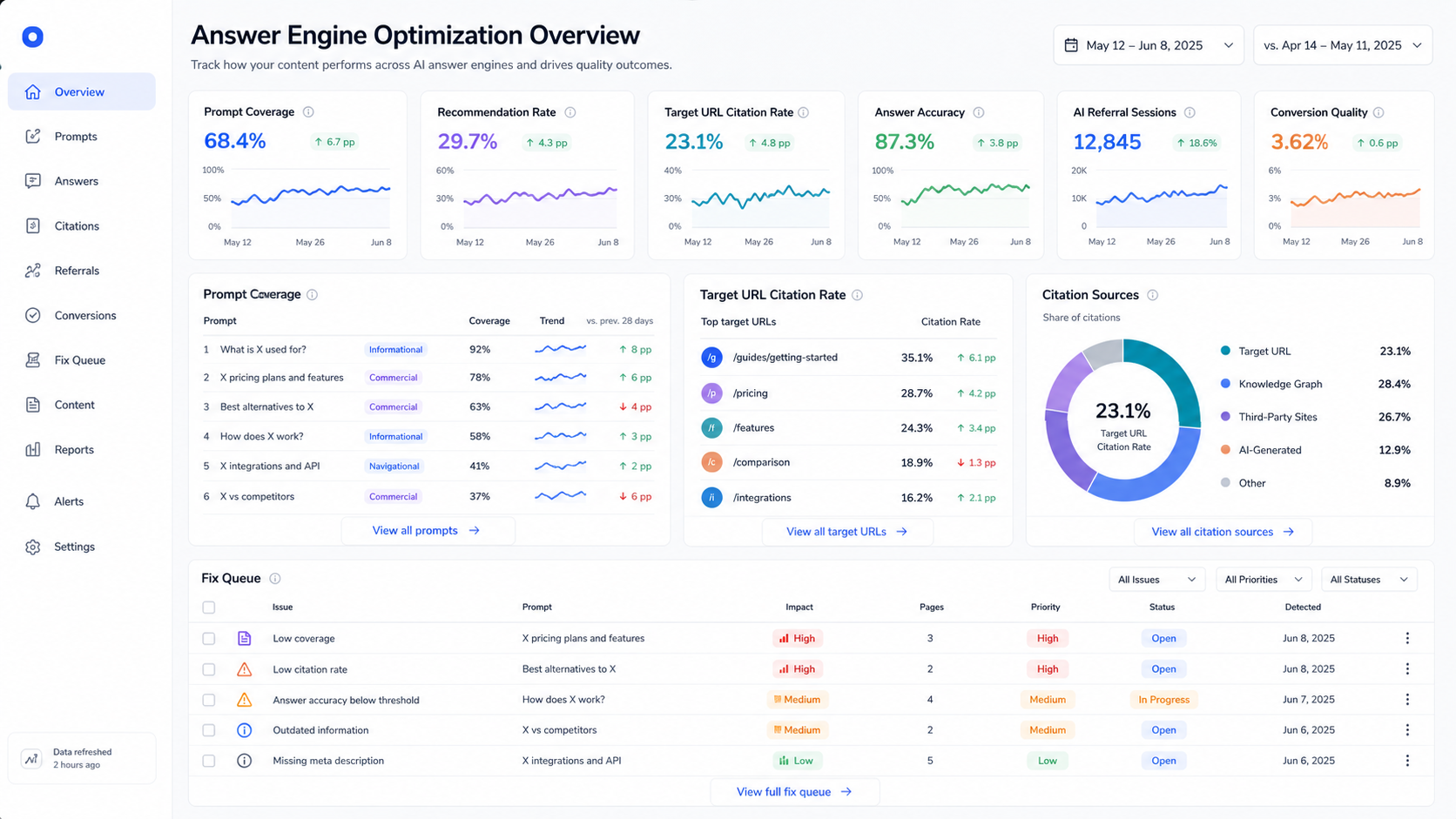
This guide sits between answer engine optimization, AI visibility score, AI search visibility reports, and answer engine optimization ROI. Use it when the question is not "what should we publish?" but "how do we know whether AEO is working?"
When those metrics need to become a recurring operator and leadership deliverable, use the answer engine optimization report template to structure the scorecard, evidence, and action queue.
For external research numbers and the limits behind common claims, use the companion guide to generative engine optimization statistics before treating an industry benchmark as your target.
What are answer engine optimization metrics?
Answer engine optimization metrics measure how often AI answer systems select, mention, cite, and correctly describe your brand across buyer-relevant prompts. The useful metrics separate brand visibility, source ownership, answer quality, competitive position, traffic, conversion quality, and the rate at which page fixes improve prompts.
Answer engine optimization metrics are the measurement layer for AEO. They turn generated answers into rows you can compare week over week: prompt, surface, brand outcome, cited URL, competitor outcome, answer accuracy, landing page, conversion signal, and next fix.
OpenAI describes ChatGPT Search as a search experience that can include source links. Google says AI features in Search are connected to its normal Search systems and can send traffic to sites. GA4 can report traffic-source dimensions, but it cannot show every no-click AI answer that influenced a buyer. That is why AEO metrics need prompt-level measurement beside analytics.
Which AEO metrics matter most?
The core AEO metrics are recommendation rate, first-named rate, target URL citation rate, answer accuracy, AI share of voice, AI referral conversion rate, and fix-to-win rate. Track them by surface and prompt intent before building a blended score.
Use this scorecard:
| Metric | What it measures | Formula or rule | Best use |
|---|---|---|---|
| Recommendation rate | Whether your brand is suggested as an option | Brand-recommended prompts / eligible buyer prompts | Shortlist visibility |
| First-named rate | Whether your brand appears first in a list | First-position recommendations / recommendation prompts | Preference strength |
| Target URL citation rate | Whether the right page is cited | Prompts citing target URL / tracked prompts | Source ownership |
| Answer accuracy | Whether the answer describes you correctly | Accurate brand-present answers / brand-present answers | Sales risk control |
| AI share of voice | Your share of approved brand mentions | Your mentions / all approved competitor-set mentions | Competitive trend |
| AI referral conversion rate | Whether AI visits turn into action | Conversions from AI-referred sessions / AI sessions | Commercial quality |
| Fix-to-win rate | Whether shipped fixes move prompts | Improved fixed prompts / re-measured fixed prompts | Operating velocity |
Do not collapse these into one number too early. A page can win a citation while the AI answer recommends a competitor. A brand can be mentioned first with no source link. AI traffic can convert well while the prompt set still shows competitor risk. Each metric answers a different business question.
How should you group AEO metrics by buyer intent?
Group AEO metrics by prompt intent because a win on "what is answer engine optimization" is not worth the same as a win on "best AI visibility tool for B2B SaaS." Weight the prompts that can change discovery, comparison, and budget decisions.
Use this intent map:
| Prompt intent | Example AI query | Primary metric | Why it matters |
|---|---|---|---|
| Definition | "what is answer engine optimization" | Target URL citation rate | Builds category authority |
| Workflow | "how do I track AEO metrics weekly" | Citation rate and answer accuracy | Captures operators looking for a process |
| Tool shortlist | "best answer engine optimization tools for SaaS" | Recommendation rate and first-named rate | Shapes the vendor list |
| Comparison | "Tracemetry vs Profound for AI visibility tracking" | First-named rate and answer accuracy | Shapes preference |
| Alternative | "best Otterly alternative for AEO reporting" | Recommendation rate and competitor SOV | Captures switching demand |
| Failure mode | "why does ChatGPT cite competitors instead of my site" | Target URL citation rate and fix-to-win rate | Finds urgent page gaps |
| Pricing-adjacent | "is an AI visibility tool worth it" | Referral conversion rate and ROI tier | Connects visibility to revenue |
The mistake is reporting a category-wide average without intent. If low-intent definition prompts improve while comparison prompts still recommend competitors, the program is not healthy. The dashboard should make that uncomfortable, fast.
How do you calculate recommendation rate?
Recommendation rate is the percentage of eligible buyer prompts where an AI answer recommends your brand as an option. Count only prompts where a recommendation could naturally appear, such as shortlist, comparison, alternative, tool, workflow, and failure-mode questions.
Use this formula:
Recommendation rate = buyer prompts recommending your brand / eligible buyer prompts tested
Keep the denominator honest. Do not include prompted brand queries like "is Tracemetry good?" in the same score as neutral category prompts. Branded prompts test answer accuracy. Neutral prompts test whether the answer engine would have chosen you without being led.
Record these fields for every prompt run:
| Field | Example |
|---|---|
| Prompt | "best AI visibility tools for B2B SaaS startups" |
| Surface | ChatGPT, Perplexity, Gemini, Claude, Google AI Overview |
| Recommendation status | Recommended, mentioned only, absent, competitor only |
| Brand order | First, second, third, not ranked |
| Competitors named | Profound, AthenaHQ, Otterly, Peec |
| Cited URL | Your URL, competitor URL, publisher URL, none |
| Answer quality | Accurate, incomplete, stale, wrong |
If the prompt produces a list, first-named rate matters beside recommendation rate. Being option five in a generated shortlist is not the same as being the default answer.
How do you measure target URL citation rate?
Target URL citation rate measures whether the exact page that should own a prompt is cited by the answer engine. It is stricter than domain citation rate because it catches cases where your site appears, but the wrong page is being used as the source.
Use this formula:
Target URL citation rate = prompts citing intended URL / prompts mapped to that URL
Run this at the page level. If the prompt is "how do I calculate AEO ROI," the target page should be the answer engine optimization ROI guide, not the generic AEO pillar. If the prompt is "which AEO metrics should I track," the target page should be this metrics guide.
When the wrong URL is cited, diagnose the routing problem:
| Citation pattern | Likely issue | First fix |
|---|---|---|
| Generic pillar cited for a specific metric prompt | The supporting page is weak or missing | Publish or strengthen the supporting guide |
| Blog home or tag page cited | Page titles and internal anchors are unclear | Link with specific anchor text from related posts |
| Competitor cited, you absent | Your page lacks direct answer or proof | Add answer block, table, sources, and FAQ |
| Publisher cited, no vendor cited | Third-party authority dominates | Add source-backed proof and earn external mentions |
| Your page cited but answer wrong | Source facts are stale or ambiguous | Update product facts, date, schema, and FAQ |
Target URL citation rate is the metric that prevents "we got cited" from becoming sloppy. The question is not only whether your domain appeared. The question is whether the right source page won the right buyer question.
How do you measure answer accuracy?
Answer accuracy measures whether AI-generated answers describe your brand, product, pricing, category, use case, and limitations correctly. A mention is not a win if the answer sends the buyer into a confused sales conversation.
Score accuracy with simple labels:
| Label | Meaning | Action |
|---|---|---|
| Accurate | Answer matches current public facts | Defend and monitor |
| Incomplete | Answer is directionally right but misses key context | Add clearer product and use-case copy |
| Stale | Answer repeats old pricing, feature, or positioning | Update source pages and schema dates |
| Wrong | Answer states an incorrect fact | Fix public source-of-truth pages immediately |
| Unsupported | Answer claims something your pages do not prove | Add evidence or remove the claim |
Track answer accuracy especially for branded, comparison, pricing-adjacent, and alternative prompts. Those are the answers buyers repeat back to sales teams.
The useful workflow is simple: save the answer, identify the public page likely feeding the claim, update the visible copy, add FAQ text if the confusion maps to a question, and re-measure the same prompt after the page is crawled again. For a deeper operating model, use AI answer accuracy monitoring.
How do you connect AEO metrics to traffic and conversions?
Connect AEO metrics to traffic and conversions by joining prompt outcomes with cited URLs, landing pages, known AI referrers, conversion events, and CRM notes. Analytics alone undercounts AEO because many AI answers influence buyers without a click.
Use three evidence tiers:
| Evidence tier | What counts | Confidence |
|---|---|---|
| Direct | AI-referred sessions that convert or start a trial, audit, demo, signup, or form fill | High |
| Assisted | Later conversion after an AI referral, branded search, or sales-reported AI discovery | Medium |
| Leading | High-intent prompt win, first-named recommendation, or target URL citation with no conversion yet | Directional |
The metric stack should look like this:
- Prompt outcome: did the answer mention, recommend, cite, or misdescribe you?
- Source outcome: which URL was cited, and was it the target URL?
- Traffic outcome: did ChatGPT, Perplexity, Gemini, Claude, Copilot, or other AI referrers send sessions?
- Conversion outcome: did those sessions use the audit, demo, pricing, signup, or contact path?
- Pipeline outcome: did the account later show qualified sales activity?
For direct traffic measurement, pair this guide with AI referral traffic. For business reporting, use the AEO ROI model so direct, assisted, and leading indicators stay separate.
What is a good AEO benchmark?
A good AEO benchmark is the score from your own locked prompt set before and after page fixes. Category-wide averages are less useful than week-over-week movement on the prompts that match your buyer journey.
Use these operating labels:
| Benchmark state | What it usually means | What to do |
|---|---|---|
| Invisible | Low recommendation rate and low citation rate | Fix entity clarity and publish missing buyer pages |
| Mentioned but uncited | Brand appears, but source ownership is weak | Strengthen target pages with answer blocks and proof |
| Cited but not preferred | Your page is useful, but competitors win recommendation | Add comparison, fit criteria, and stronger positioning |
| Recommended but inaccurate | Brand visibility exists with sales risk | Fix public source-of-truth content |
| Recommended and cited | Strong answer ownership | Defend with freshness, internal links, and monitoring |
| Recommended, cited, and converting | Commercial AEO is working | Expand prompt coverage and link wins to pipeline |
For a wider baseline, use the LLM visibility benchmark. For a single rollup number, use an AI visibility score. But keep the benchmark tied to your own prompt set, competitors, and target pages. Otherwise, the number is too easy to game.
How often should you review AEO metrics?
Review AEO metrics weekly for operators and monthly for leadership. Weekly is frequent enough to catch answer drift, competitor movement, and whether shipped fixes changed target prompts. Monthly is better for revenue, pipeline, and executive trend reporting.
Use this cadence:
| Cadence | Audience | Include |
|---|---|---|
| Weekly | Content, SEO, product marketing | Prompt movement, citations, accuracy issues, fix queue |
| Monthly | Leadership | Weighted visibility score, high-intent wins, AI referrals, conversions, pipeline influence |
| 7-14 days after publish | Page owner | Re-measure exact prompts tied to the updated page |
| Daily during launches | Product marketing and sales | Branded prompt accuracy, pricing facts, competitor claims |
The cadence only works if prompt wording stays stable. If the team changes prompts every week, the metric becomes anecdote. If the team never adds new prompts, the benchmark goes stale. Review the core prompt set quarterly, and keep a changelog when prompts are added or retired.
What mistakes make AEO metrics misleading?
AEO metrics become misleading when teams cherry-pick prompts, blend all AI surfaces into one score, count every mention as a win, ignore cited URLs, or report traffic without measuring no-click answer influence.
Avoid these mistakes:
- Counting branded prompts as neutral recommendation wins.
- Mixing ChatGPT, Perplexity, Gemini, Claude, and Google AI Overviews before reviewing each surface separately.
- Reporting domain citation rate when target URL citation rate is the actual problem.
- Treating AI referral sessions as the whole value of AEO.
- Ignoring answer accuracy because the brand was mentioned.
- Changing prompt wording after a page update and calling the movement a win.
- Publishing new pages without linking them from existing AEO, GEO, citation, and reporting posts.
- Adding FAQ schema that says more than the visible page.
- Measuring content output instead of prompt movement after fixes.
Google's structured data policies are a useful floor here: markup should describe what users can actually see on the page. The same principle applies to AEO measurement. If the answer, proof, FAQ, or claim is not visible to a human reader, do not treat it as a durable AI source.
How can Tracemetry track these AEO metrics?
Tracemetry tracks AEO metrics by running fixed prompt sets across AI surfaces, recording mentions and citations, comparing competitors, checking answer accuracy, generating source-grounded briefs, and re-measuring prompts after page fixes. The point is not a pretty chart. The point is knowing what to fix next.
A practical Tracemetry workflow looks like this:
- Run the free AI visibility audit to find the first gaps.
- Build a buyer prompt set across category, shortlist, comparison, alternative, workflow, failure-mode, and pricing-adjacent intent.
- Track recommendation rate, first-named rate, target URL citation rate, answer accuracy, and competitor SOV weekly.
- Pair prompt outcomes with AI search visibility reports and AI referral traffic.
- Turn the highest-intent losses into source-grounded briefs, page edits, and internal links.
- Re-measure the same prompts after the page is published.
- Use pricing or demo when the team is ready to move from audit snapshots to continuous tracking.
The buying question is not "do we have an AEO dashboard?" The buying question is "can we see which answer losses are costing us attention, and can we prove our fixes moved them?" That is the metric that matters.
FAQ
What are answer engine optimization metrics? Answer engine optimization metrics measure whether AI answer systems mention your brand, cite your pages, recommend you against competitors, describe you accurately, send qualified traffic, and improve after page fixes. The core metrics are recommendation rate, first-named rate, target URL citation rate, answer accuracy, AI share of voice, AI referral conversion rate, and fix-to-win rate.
What is the most important AEO metric? For commercial programs, target URL citation rate on high-intent prompts is usually the most important leading metric. It shows whether the page that should own a buyer question is actually being used as the source. Pair it with recommendation rate and answer accuracy so source wins do not hide weak positioning.
How do you calculate AEO recommendation rate? Calculate AEO recommendation rate by dividing the number of eligible buyer prompts where your brand is recommended by the total number of eligible buyer prompts tested. Exclude branded prompts from the neutral recommendation score because they test answer accuracy more than category discovery.
Is AI referral traffic an AEO metric? Yes, but it is only one layer. AI referral traffic shows measurable clicks from AI assistants, while prompt metrics show no-click influence, competitor recommendations, cited URLs, and answer accuracy. Report AI referrals beside prompt wins instead of using traffic as the whole AEO score.
How many prompts do you need for AEO measurement? Start with 40-80 buyer prompts across category, shortlist, comparison, alternative, workflow, failure-mode, pricing-adjacent, and surface-specific intent. Smaller sets are useful for a quick audit, but weekly measurement needs enough prompts to avoid cherry-picking.
How often should AEO metrics be reported? Report AEO metrics weekly for operators and monthly for leadership. Re-measure page-level fixes 7-14 days after publishing or refreshing a URL, and use daily checks only for launches, rebrands, pricing changes, or urgent answer-accuracy problems.
Start with one metric tied to one fix
Pick the highest-intent prompt where a competitor is recommended or cited, map it to the page that should win, and track target URL citation rate before and after the fix. Then connect the page to a conversion path: free audit, features, pricing, or demo. AEO metrics become useful when they force a better next action.
Sources: OpenAI ChatGPT Search, Google AI features and your website, Google AI optimization guidance, GA4 traffic-source dimensions, Google structured data policies. Choose metrics after defining the answer engine optimization strategy: the audience, prompt cohort, intended source pages, surfaces, and commercial outcome determine which denominators are honest.
Frequently asked questions
What are answer engine optimization metrics?
Answer engine optimization metrics measure whether AI answer systems mention your brand, cite your pages, recommend you against competitors, describe you accurately, send qualified traffic, and improve after page fixes. The core metrics are recommendation rate, first-named rate, target URL citation rate, answer accuracy, AI share of voice, AI referral conversion rate, and fix-to-win rate.
What is the most important AEO metric?
For commercial programs, target URL citation rate on high-intent prompts is usually the most important leading metric. It shows whether the page that should own a buyer question is actually being used as the source. Pair it with recommendation rate and answer accuracy so source wins do not hide weak positioning.
How do you calculate AEO recommendation rate?
Calculate AEO recommendation rate by dividing the number of eligible buyer prompts where your brand is recommended by the total number of eligible buyer prompts tested. Exclude branded prompts from the neutral recommendation score because they test answer accuracy more than category discovery.
Is AI referral traffic an AEO metric?
Yes, but it is only one layer. AI referral traffic shows measurable clicks from AI assistants, while prompt metrics show no-click influence, competitor recommendations, cited URLs, and answer accuracy. Report AI referrals beside prompt wins instead of using traffic as the whole AEO score.
How many prompts do you need for AEO measurement?
Start with 40-80 buyer prompts across category, shortlist, comparison, alternative, workflow, failure-mode, pricing-adjacent, and surface-specific intent. Smaller sets are useful for a quick audit, but weekly measurement needs enough prompts to avoid cherry-picking.
How often should AEO metrics be reported?
Report AEO metrics weekly for operators and monthly for leadership. Re-measure page-level fixes 7-14 days after publishing or refreshing a URL, and use daily checks only for launches, rebrands, pricing changes, or urgent answer-accuracy problems.
Make your next SEO decision with better evidence.
Explore practical guides to AI visibility, source citations, and choosing the right tools for your team.