Answer engine optimization ROI: how to prove AI search value
How to measure answer engine optimization ROI with prompt wins, source ownership, AI referral traffic, conversions, assisted pipeline, and page-level fixes.
Answer engine optimization ROI is the business value created when answer engines cite, recommend, or send qualified buyers to your pages. The hard part is that the value rarely appears as one clean channel in analytics: some wins show up as referrals, some stay inside Google Search, and some influence a buyer who converts later through brand search, direct, or sales.
Use the fast rule: do not measure AEO ROI from traffic alone. Measure prompt wins, source ownership, assisted sessions, conversion quality, and the page fixes that move those numbers. AEO becomes defensible when every tracked prompt connects to a URL, a buyer intent, and a next action.
For a reproducible proof format, use the answer engine optimization case study template to preserve the baseline, intervention, repeated results, and limitations behind the ROI claim.
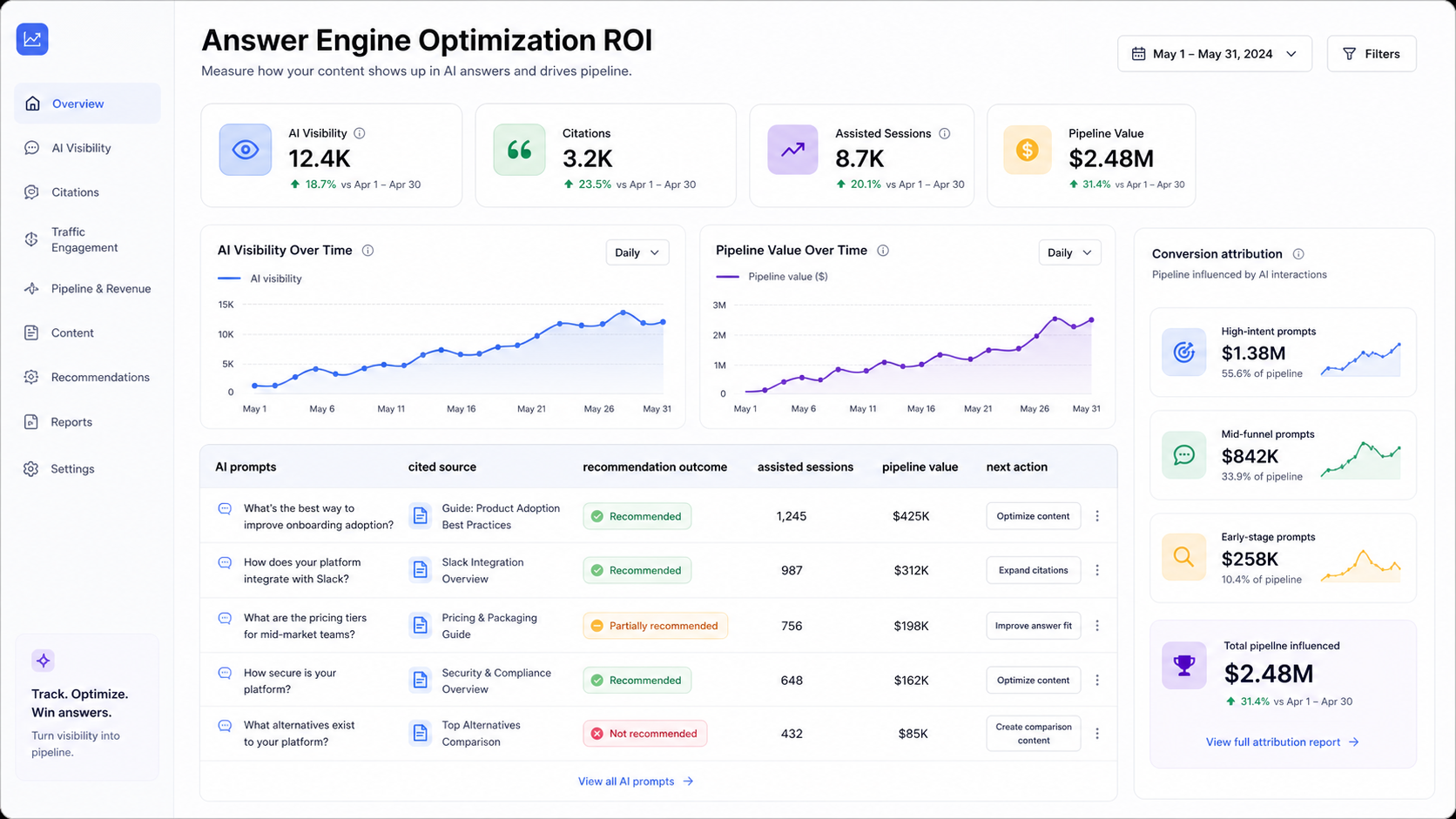
This guide builds on answer engine optimization, answer engine optimization metrics, AI referral traffic, AI visibility score, and ChatGPT recommendation tracking. Use it when leadership asks the right question: "Is this AI search work creating pipeline, or are we just collecting screenshots?"
What is answer engine optimization ROI?
Answer engine optimization ROI is the return from improving how AI answer systems mention, cite, recommend, and route buyers to your brand. It includes measurable referral sessions, assisted conversions, sales-qualified opportunities, and the strategic value of replacing competitor answers with your own source pages.
Answer engine optimization ROI is the link between answer visibility and commercial outcomes. It does not mean every ChatGPT mention gets a direct revenue number. It means your team can show which prompts changed, which pages won citations, which sessions arrived, which conversions followed, and which page fixes produced the movement.
For the measurement layer behind those claims, use the AI search attribution model to separate sourced revenue, assisted influence, and prompt-level visibility.
OpenAI's ChatGPT Search documentation says search answers can include inline citations and a sources panel. Google says its AI features are part of Search and that site owners should keep applying helpful, technically sound SEO practices. GA4 reports traffic-source dimensions such as session source and medium, which is where measurable AI referrals usually appear.
Why is AEO ROI hard to prove?
AEO ROI is hard to prove because answer engines influence buyers before a trackable click. A user may see your brand in an AI answer, search your name later, visit directly, ask a sales rep, or click a source link that analytics classifies as generic referral traffic.
The measurement failure usually comes from blending four different things:
| Layer | What it proves | What it misses |
|---|---|---|
| Prompt visibility | AI named or recommended your brand | Whether the buyer clicked |
| Citation ownership | AI used your domain or target URL as evidence | Whether your brand was the preferred choice |
| AI referral traffic | A user clicked from an AI surface | No-click influence and Google AI exposure |
| Assisted pipeline | AEO-influenced users later converted | Which exact answer caused the movement |
| Page fix velocity | Your team shipped fixes tied to prompt losses | Revenue impact until those fixes compound |
Clicks are real, but they are the smallest visible part of the system. If you only report sessions from ChatGPT or Perplexity, you undercount AEO. If you only report prompt wins, you fail to prove business value. The useful answer is a joined report.
Which AEO metrics should you track for ROI?
Track the smallest set of metrics that connects visibility to revenue: recommendation rate, target URL citation rate, answer accuracy, AI referral sessions, conversion rate, assisted opportunities, and fix-to-win movement. Everything else is secondary.
Start with this operating scorecard:
| Metric | Formula or rule | ROI use |
|---|---|---|
| Recommendation rate | Prompts where your brand is recommended / buyer prompts | Shows whether AI puts you on the shortlist |
| Target URL citation rate | Prompts citing the intended URL / tracked prompts | Shows whether the right page owns the answer |
| Accurate answer rate | Correct brand/product answers / brand-present answers | Prevents false wins from bad facts |
| AI referral sessions | Sessions from known AI assistant sources | Shows measurable click volume |
| AI conversion rate | Conversions from AI-referred sessions / AI sessions | Shows whether the traffic is qualified |
| Assisted opportunity value | Pipeline where AI touchpoints appeared before conversion | Connects influence to sales |
| Fix-to-win rate | Prompt losses that improved after page updates / fixed losses | Shows whether the content workflow works |
The executive number is not "AEO score went up." The executive number is "we improved 14 high-intent prompt outcomes, won 9 target URL citations, and those pages assisted 6 qualified opportunities." That is a boardroom sentence. "We got cited by ChatGPT" is not.
How do you connect AEO to conversions?
Connect AEO to conversions by joining prompt monitoring, cited URLs, analytics landing pages, and CRM outcomes. The unit of work is not a keyword. It is a prompt-to-page-to-conversion path.
Use this workflow:
- Pick 40-80 buyer prompts across shortlist, comparison, alternative, pricing-adjacent, workflow, and failure-mode intent.
- Map each prompt to one target URL that should answer it.
- Run the prompts weekly across ChatGPT, Perplexity, Claude, Gemini, and Google AI surfaces where relevant.
- Record brand outcome, cited URLs, first-named brand, answer accuracy, and competitor source wins.
- Pull GA4 landing pages and session source/medium for known AI referrers.
- Tag conversions from AI-referred sessions and later return visits where your analytics stack supports it.
- In the CRM, mark opportunities influenced by AI-referred sessions, branded searches after AI answer wins, or sales calls that mention AI recommendations.
- Ship page fixes for the highest-intent losses and re-measure the exact same prompts after 7-14 days.
Do not overbuild attribution on day one. Start with a weekly spreadsheet if needed: prompt, target URL, answer outcome, cited URL, landing-page sessions, conversions, opportunity notes, next fix. The first win is visibility into the system.
What is the AEO ROI formula?
The practical AEO ROI formula is: attributable value from AI-influenced traffic and pipeline minus content, tooling, and operating cost, divided by cost. Because AEO includes no-click influence, report the formula with confidence tiers instead of pretending every dollar is perfectly attributed.
Use three tiers:
| ROI tier | Include | Confidence |
|---|---|---|
| Direct | AI-referred sessions that converted in the same or later tracked journey | High |
| Assisted | Opportunities with AI-referred visits, AI-cited landing pages, or sales-reported AI discovery | Medium |
| Strategic | High-intent prompt wins where competitors were displaced but no conversion is visible yet | Directional |
The simplest model:
AEO ROI = (direct value + assisted value + weighted strategic value - AEO cost) / AEO cost
Use conservative weights. For example, count direct value at 100%, assisted value at 25-50%, and strategic prompt wins at 0-10% until they create measurable sessions or pipeline. The point is not fake precision. The point is to keep AEO from being dismissed just because answer engines do not expose a perfect click log.
Which pages usually create the fastest AEO ROI?
The fastest AEO ROI usually comes from pages that already sit close to a buying decision: comparison pages, alternatives pages, category pages, pricing-adjacent guides, integration pages, product-led workflow guides, and troubleshooting pages that name a painful problem.
Use this decision table:
| Page type | Best prompt shape | First fix |
|---|---|---|
| Category guide | "best [category] tools for [team]" | Add direct answer, shortlist criteria, and proof |
| Comparison page | "[brand] vs [competitor]" | Add fair tradeoffs, screenshots, and decision table |
| Alternatives page | "best [competitor] alternative" | Clarify who should switch and who should not |
| Pricing-adjacent guide | "is [category] worth it" | Add ROI model, cost ranges, and payback logic |
| Workflow guide | "how do I [job] weekly" | Add step-by-step process and tool CTA |
| Failure-mode guide | "why does ChatGPT cite competitors" | Add diagnosis table and page-level fixes |
Definition pages are useful for authority, but they rarely carry the first ROI proof. If the goal is pipeline, start where buyers compare, choose, diagnose, or justify spend.
How should you report AEO ROI weekly?
Report AEO ROI as a short operating dashboard: prompt movement, source wins, AI traffic, conversion quality, pipeline influence, and the fix queue. The report should make the next sprint obvious.
Use this weekly template:
| Section | Include |
|---|---|
| Executive score | High-intent recommendation rate, target URL citation rate, AI sessions, conversions, assisted pipeline |
| Biggest wins | Prompts where your brand moved up, got cited, or replaced a competitor |
| Biggest losses | Prompts where competitors still win or answer accuracy is wrong |
| Revenue view | AI-referred conversions, CRM notes, assisted opportunities, pages with best conversion quality |
| Fix queue | Target URL, prompt, loss reason, owner, publish date, recheck date |
| Watchlist | Volatile prompts, stale facts, crawler access issues, newly appearing competitors |
Every row needs a next action. If the report ends with "monitoring continues," the AEO program is too passive. The job is to turn answer losses into page fixes, product proof, third-party citations, and cleaner conversion paths.
How can Tracemetry help prove AEO ROI?
Tracemetry helps prove AEO ROI by connecting prompt tracking, citation tracking, competitor mentions, source-grounded briefs, publishing workflows, and re-measurement. That keeps the team focused on pages that can change buyer answers, not generic blog output.
The clean workflow is:
- Run the free AI visibility audit to see the first prompt gaps.
- Use AI visibility tracking to monitor a fixed prompt set weekly.
- Pair AI referral traffic with prompt and citation data.
- Turn losses into briefs, page updates, and internal links.
- Re-measure the same prompt after publishing.
- Report the prompt movement beside conversions and assisted pipeline.
For teams evaluating the category, the buying question is not "which tool has the nicest dashboard?" It is "which tool can tell us what to fix next and whether the fix moved commercial prompts?" That is where AEO ROI actually comes from.
FAQ
What is AEO ROI? AEO ROI is the return from answer engine optimization: the value created when AI answer systems mention, cite, recommend, or send buyers to your brand. It combines prompt visibility, citation ownership, AI referral traffic, conversions, assisted pipeline, and page improvements.
How do you measure answer engine optimization ROI? Measure AEO ROI by joining prompt tracking, cited URLs, analytics landing pages, conversion events, and CRM outcomes. Track recommendation rate, target URL citation rate, answer accuracy, AI referral sessions, conversion rate, assisted opportunity value, and fix-to-win movement.
Can GA4 show AEO ROI by itself? No. GA4 can show measurable visits from AI referrers and conversion behavior, but it cannot show no-click AI influence, prompt-level recommendations, competitor citations, or Google AI exposure cleanly by itself. Pair GA4 with prompt and citation monitoring.
What AEO metric is closest to revenue? AI-referred conversions are closest to revenue when they exist. For early programs, the best leading indicator is high-intent target URL citation rate because it shows whether the correct page owns buyer prompts that can later drive clicks, branded search, and pipeline.
How long does it take to see AEO ROI? You can see prompt and citation movement within 7-30 days on fast-crawled pages, but revenue impact usually takes one or more buying cycles. For B2B SaaS, report leading indicators weekly and pipeline influence monthly or quarterly.
Should I count AI mentions as revenue? No. Count AI mentions as visibility. Count citations as source ownership. Count referrals and conversions as direct evidence. Count sales-qualified opportunities with AI touchpoints as assisted evidence. Keep the tiers separate so the report stays credible.
Start with the prompt that should make money
Pick one buyer prompt where a competitor currently wins, map it to one page, fix that page, and re-measure. Then connect the winning page to a specific conversion path: free audit, features, pricing, or demo. AEO ROI starts when the answer win has somewhere useful to send the buyer.
Sources: OpenAI ChatGPT Search, Google AI features and your website, Google guidance for generative AI features in Search, GA4 traffic-source dimensions.
Frequently asked questions
What is AEO ROI?
AEO ROI is the return from answer engine optimization: the value created when AI answer systems mention, cite, recommend, or send buyers to your brand. It combines prompt visibility, citation ownership, AI referral traffic, conversions, assisted pipeline, and page improvements.
How do you measure answer engine optimization ROI?
Measure AEO ROI by joining prompt tracking, cited URLs, analytics landing pages, conversion events, and CRM outcomes. Track recommendation rate, target URL citation rate, answer accuracy, AI referral sessions, conversion rate, assisted opportunity value, and fix-to-win movement.
Can GA4 show AEO ROI by itself?
No. GA4 can show measurable visits from AI referrers and conversion behavior, but it cannot show no-click AI influence, prompt-level recommendations, competitor citations, or Google AI exposure cleanly by itself. Pair GA4 with prompt and citation monitoring.
What AEO metric is closest to revenue?
AI-referred conversions are closest to revenue when they exist. For early programs, the best leading indicator is high-intent target URL citation rate because it shows whether the correct page owns buyer prompts that can later drive clicks, branded search, and pipeline.
How long does it take to see AEO ROI?
You can see prompt and citation movement within 7-30 days on fast-crawled pages, but revenue impact usually takes one or more buying cycles. For B2B SaaS, report leading indicators weekly and pipeline influence monthly or quarterly.
Should I count AI mentions as revenue?
No. Count AI mentions as visibility. Count citations as source ownership. Count referrals and conversions as direct evidence. Count sales-qualified opportunities with AI touchpoints as assisted evidence. Keep the tiers separate so the report stays credible.
See your own AI visibility today.
Free public report. 60 seconds. No signup. Or get started on Pro to track 250 prompts continuously.