Answer engine optimization content brief: template for AI-search pages
How to write an answer engine optimization content brief that maps one buyer prompt to one target URL, direct answer, proof block, FAQ, schema, links, and re-measurement plan.
An answer engine optimization content brief solves the problem that kills most AI-search content before anyone writes a draft: the team knows a page should "show up in ChatGPT," but the brief still looks like an old SEO outline. It names a keyword, lists headings, and forgets the generated answer the page is supposed to win.
Use a different rule: every AEO brief should map one buyer prompt to one target URL, one direct answer, one proof block, one schema plan, and one re-measurement step. If the writer cannot see the answer, evidence, internal links, and conversion path before drafting, the final page will be harder for ChatGPT, Perplexity, Gemini, Claude, and Google AI experiences to cite.
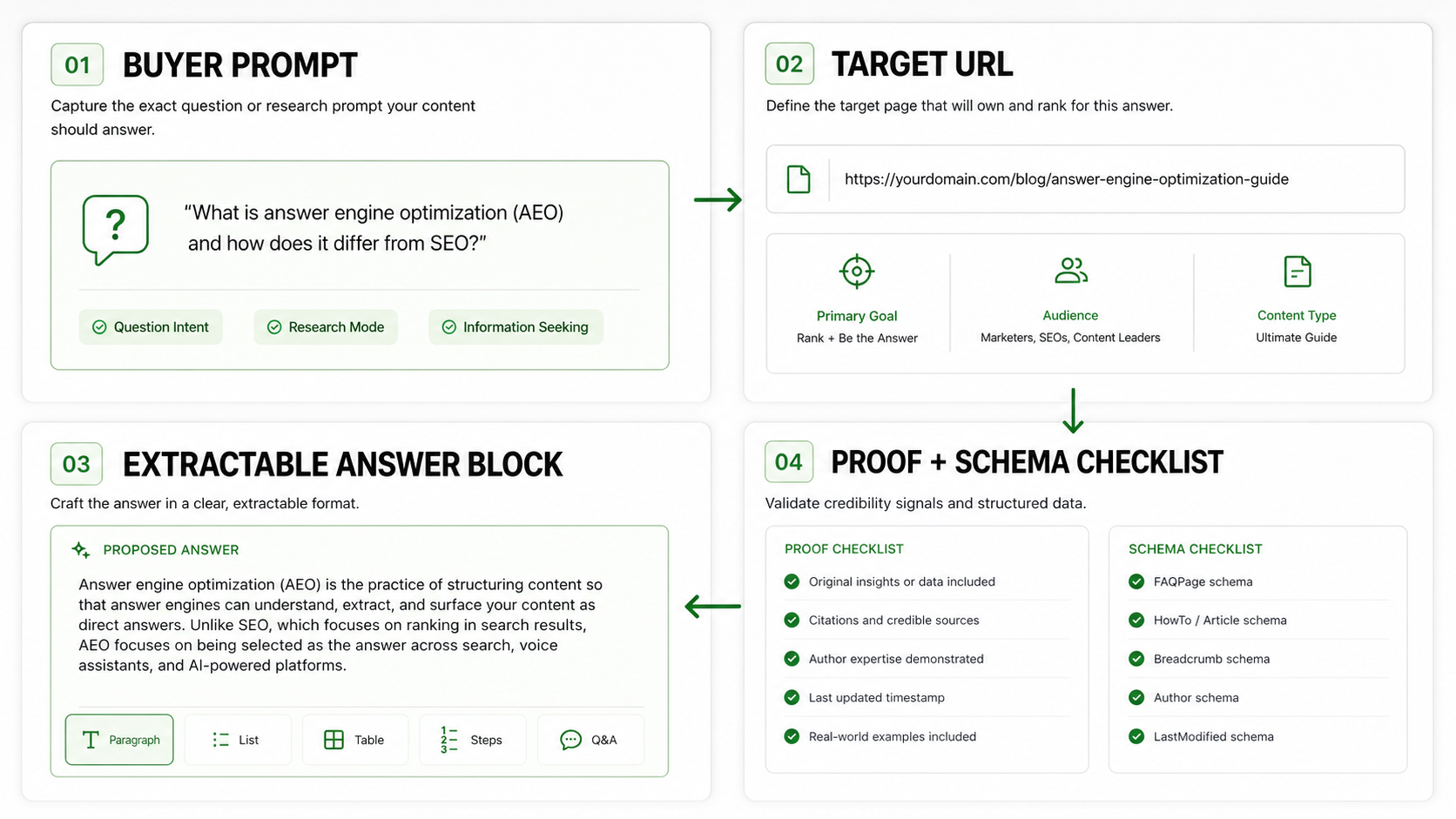
This guide sits between content that AI assistants cite, the answer engine optimization checklist, and answer engine optimization metrics. Use it when the question is not "what should we fix on the page?" but "what should the writer, editor, and SEO lead agree on before the page is drafted?" If the team has not identified the lost prompt and target URL yet, start with AEO content gap analysis first.
What is an answer engine optimization content brief?
An answer engine optimization content brief is a writing plan that tells a page how to win a specific AI-generated answer. It defines the buyer prompt, search intent, target URL, direct answer, source-worthy proof, entity language, internal links, FAQ, schema, and measurement plan before the draft starts.
An answer engine optimization content brief is a page-level source plan for AI answers. It is not just an outline. A normal SEO brief says what headings to cover; an AEO brief says which generated answer the page should become eligible to support, what evidence makes that answer credible, and how the team will check whether the page improved.
Google says its generative AI features in Search rely on normal Search systems, useful content, technical accessibility, and supporting links. OpenAI describes ChatGPT search as a way to answer with links to relevant web sources. That means the brief has to prepare a page for retrieval, extraction, citation, and reader trust, not only keyword matching.
When should you use an AEO brief instead of a normal SEO brief?
Use an AEO brief when the page is meant to change an AI answer: a brand recommendation, cited source, comparison answer, failure-mode answer, or workflow answer. A normal SEO brief is enough for simple glossary coverage. AEO briefs are for prompts where the source, facts, competitors, and next action matter.
Use this decision table:
| Situation | Normal SEO brief is enough | AEO content brief is better |
|---|---|---|
| Definition query | The term is stable and low risk | The definition affects category positioning |
| How-to query | Steps are simple and generic | The answer should cite your method or product workflow |
| Comparison query | You are not part of the market | Your brand or competitors may be recommended |
| Failure-mode query | The issue is informational only | The answer can route buyers toward a competitor fix |
| Product query | The page only needs organic traffic | The answer must describe pricing, features, fit, or limitations correctly |
| Existing URL refresh | The page already owns the answer | The wrong URL, competitor, or stale source is being cited |
The fastest rule is brutal: if the prompt could influence a buyer shortlist, use an AEO brief. If the prompt only needs background education, use a lighter SEO outline.
SaaS teams can apply that decision at the page level with the answer engine optimization for SaaS playbook, which separates product, integration, comparison, pricing, documentation, and educational page ownership.
If the team first needs a shared practical foundation, compare programs with the answer engine optimization course curriculum and scorecard before assigning live briefs.
Editorial teams can adapt the same fields with the answer engine optimization for publishers playbook, which adds source ownership, attribution, corrections, and newsroom maintenance decisions.
What should an answer engine optimization brief include?
An AEO brief should include the prompt set, primary page owner, direct-answer requirement, proof plan, entity terms, internal links, source links, FAQ questions, schema notes, and success metric. The brief should make the page's job obvious before drafting starts.
Use this template:
| Brief field | What to write | Example |
|---|---|---|
| Primary prompt | The exact AI query the page should answer | "how do I write an answer engine optimization content brief" |
| Search keyword | The natural query language to include | "answer engine optimization content brief" |
| Target URL | The page that should own the answer | /blog/answer-engine-optimization-content-brief |
| Direct answer | 40-80 words that can stand alone | A plain definition under the first H2 |
| Reader job | The task the reader needs done | Turn AI-search findings into a writer-ready brief |
| Proof block | Evidence the answer can cite | Table, checklist, before/after brief, or source-backed rule |
| Entity language | Names that remove ambiguity | AEO, AI search, ChatGPT, Perplexity, Gemini, Claude, Google AI Overviews |
| Internal links | Related source pages and conversion page | Checklist, metrics, content shape, demo |
| FAQ | Questions that match real prompts | "Should I create a new page or update an old one?" |
| Schema | Visible content to mark up | Article plus FAQPage when FAQ is visible |
| Re-measurement | How success will be checked | Target URL citation rate after 7-14 days |
If the brief has no proof block, the article will likely become generic advice. If it has no target URL, the article can become another orphan page. If it has no re-measurement step, the team cannot tell whether the work changed anything.
How do you write the direct answer for an AEO brief?
Write the direct answer before the outline. It should define the topic, name the audience, describe the outcome, and point to the next action in 40-80 words. The paragraph should be useful even if an AI system extracts only that block.
Use this fill-in structure:
[Topic] is [plain definition] for [audience]. It helps [reader] achieve [specific outcome] by [method]. The fastest way to use it is to [first action], then [proof/action], then [measurement step].
For this article, the direct answer is:
An answer engine optimization content brief is a source plan for a page that should be cited in AI-generated answers. It helps SEO, content, and product marketing teams turn a buyer prompt into one target URL, a clear answer, source-worthy proof, visible FAQ, schema, internal links, and a re-measurement plan.
That is the bar. The answer names the term, audience, outcome, method, and page-level work. A weaker version would say, "An AEO brief helps you optimize content for AI search," which is true but too vague to be useful.
How should the brief map prompts to pages?
The brief should assign one intended source URL to every important prompt. If multiple pages could answer the same prompt, choose the strongest existing URL and make the others support it with internal links. Create a new page only when no current URL honestly matches the prompt intent.
Use this prompt-to-page map:
| Prompt type | Example AI query | Best page owner |
|---|---|---|
| Definition | "what is answer engine optimization" | Pillar or glossary page |
| Workflow | "how do I write an AEO content brief" | Template or process guide |
| Checklist | "what should I check before publishing for AI search" | Checklist page |
| Measurement | "which AEO metrics matter weekly" | Metrics guide |
| Failure mode | "why does ChatGPT cite competitors" | Troubleshooting page |
| Product fit | "best AI visibility workflow for SaaS" | Product or buyer guide |
This is where many content teams create their own mess. They publish a glossary page, checklist, examples page, product page, and metrics page that all answer the same prompt with slightly different wording. Answer engines then have to guess which page is the source of truth. The brief should remove that ambiguity.
For Tracemetry's own topic graph, this page supports the AEO cluster instead of replacing the pillar. The pillar stays answer engine optimization. The execution page stays the answer engine optimization checklist. This page owns the brief-writing workflow.
What proof should an AI search content brief require?
An AI search content brief should require one extractable proof block: a table, checklist, methodology, before/after example, benchmark, source-backed definition, or failure-mode matrix. The proof block gives the generated answer something specific to cite instead of forcing it to paraphrase generic advice.
Use this proof checklist before the writer starts:
- The article has at least one table or checklist that can answer the prompt without surrounding context.
- Claims about Google AI features, schema, analytics, or ChatGPT search cite official or primary sources.
- Product claims name the exact feature, audience, limitation, or workflow.
- Comparisons include fit criteria, not only adjectives.
- Measurement claims define the numerator, denominator, cadence, and surface.
- FAQ answers match visible page text and do not add hidden claims.
Google's structured data policies are a good discipline here: markup should describe content visible to users. Treat the whole brief the same way. If the answer, proof, or FAQ would not help a human reader, do not hide it in schema or metadata.
How do you turn research into a writer-ready AEO brief?
Turn research into a writer-ready brief by separating vocabulary, intent, answer gaps, evidence gaps, and page ownership. Keywords show how people phrase the topic. AI prompt tests show the answer you need to change. Competitor pages show what evidence the current answer trusts.
Use this seven-step workflow:
- Pick the buyer prompt where losing hurts most.
- Record the current answer across the surfaces that matter: ChatGPT, Perplexity, Gemini, Claude, and Google AI experiences.
- Save the cited URLs, mentioned brands, missing facts, and competitor framing.
- Decide whether an existing page should be updated or a new page is needed.
- Write the direct answer and proof block before the section outline.
- Add internal links to related source pages and a conversion path such as features, pricing, or demo.
- Re-measure the same prompt after the page is crawled or updated.
This workflow reduces time because the writer does not have to reverse-engineer the strategy from a pile of keywords. It reduces effort because every section has a job: answer, prove, compare, troubleshoot, or convert.
What should the final brief look like?
The final brief should be short enough for a writer to use and specific enough for an editor to reject vague copy. A strong AEO brief fits on one page plus source notes. It should not be a 30-page research dump.
Use this copyable format:
Page goal:
Win the prompt "[exact buyer prompt]" with [target URL].

Primary keyword:
[natural search phrase]

Secondary keyword:
[one supporting phrase]

Reader job:
[what the reader is trying to decide or do]

Direct answer:
[40-80 word answer block]

Required proof:
[table/checklist/example/methodology]

Entity terms:
[brand/category/platform/audience/use-case terms]

Internal links:
[2-5 related URLs] + [conversion URL]

FAQ:
[4-6 questions that match visible buyer questions]

Schema:
Article. FAQPage only if visible FAQ is included. HowTo only if visible steps exist.

Measurement:
Recheck [prompt] on [surfaces] after [date/crawl window].
Keep it boringly operational. The best brief makes the article easier to write, easier to edit, and easier to measure.
When an existing source already matches the prompt, hand the brief to the answer engine optimization content refresh workflow instead of creating another overlapping page.
What mistakes make AEO briefs fail?
AEO briefs fail when they copy old keyword-first SEO habits into an AI-answer workflow. The common failures are unclear page ownership, generic answer blocks, hidden schema claims, no proof, no backlinks, and no success metric.
Avoid these:
- Starting with headings instead of prompts. The prompt defines the answer job.
- Choosing too many keywords. One primary phrase and one secondary phrase is enough for most supporting pages.
- Creating a new page when an old one should be updated. Duplicate intent weakens source clarity.
- Skipping competitors. If a competitor is cited today, the brief should explain why their page is winning.
- Forgetting the conversion path. AEO pages should route readers to a next step, not end in theory.
- Adding schema-only answers. The FAQ and steps must be visible on the page.
- Reporting publication as success. Success is prompt movement, citation movement, or answer-accuracy improvement.
If the team already knows the page needs a fix, use the answer engine optimization checklist. If the team needs to score the whole site first, start with AI optimization for websites. If leadership needs the reporting layer, use answer engine optimization metrics.
How can Tracemetry help create AEO briefs?
Tracemetry helps create AEO briefs by connecting prompt tracking, cited URLs, competitor mentions, answer accuracy, and page-fix workflows. The useful output is not "write more content." It is a brief that says which prompt is lost, which page should own it, what proof is missing, and how to re-measure the fix.
A practical Tracemetry workflow looks like this:
- Run a prompt set across the AI surfaces your buyers use.
- Find prompts where competitors are cited, your brand is absent, or the wrong page is sourced.
- Generate a source-grounded brief for the page that should win.
- Update or publish the page with a direct answer, proof block, FAQ, schema, and internal links.
- Re-measure target URL citation rate, recommendation rate, and answer accuracy.
Use Tracemetry features when you want to move from manual briefs to a repeatable source workflow. Use demo when you want to see how prompt evidence becomes page-level actions.
For comparison-led briefs, use the evidence-first guide to answer engine optimization for comparison pages to define criteria, source claims, and write a fair decision rule before drafting.
FAQ
What is an answer engine optimization content brief? An answer engine optimization content brief is a writing plan for a page that should win a specific AI-generated answer. It maps a buyer prompt to one target URL, direct answer, proof block, entity terms, internal links, visible FAQ, schema, and re-measurement plan.
How is an AEO brief different from an SEO brief? An SEO brief usually focuses on keyword coverage, headings, competitors, and search intent. An AEO brief adds prompt ownership, cited URL analysis, answer extraction, source-worthy proof, entity clarity, FAQ/schema alignment, and a metric for whether the page changed an AI answer.
Should an AEO brief use keywords or prompts? Use both, but let prompts lead. Keywords reveal vocabulary and demand. Prompts reveal the actual generated answer the page should influence. The brief should include one natural primary keyword, one secondary keyword, and several conversational prompts for sections and FAQ.
Should I create a new page or update an existing page for AEO? Update an existing page when it already matches the prompt intent. Create a new page only when no current URL can honestly answer the question. Publishing overlapping pages can make answer engines cite the wrong source or ignore the new page.
What is the most important part of an AEO content brief? The most important part is the prompt-to-URL map. If the brief does not say which exact prompt the page should win and which URL should own it, the draft can become generic content that is hard to cite and hard to measure.
How do you measure whether an AEO brief worked? Re-run the same prompt after publishing or updating the page. Track target URL citation rate, domain citation rate, brand recommendation rate, answer accuracy, competitor source share, and any AI referral traffic tied to the page.
Start with the brief before the draft
Do not ask a writer to "make this more AEO-friendly" after the page is already written. Write the brief first. Pick the prompt, assign the page, draft the direct answer, require proof, add links, and define the recheck. Then the page has a real job.
Start with one prompt and one URL. When the team needs a repeatable system, use Tracemetry to turn lost prompts into briefs, fixes, and measured wins across the whole AI-search program.
Sources: Google AI features and your website, Google's generative AI search optimization guidance, Google structured data policies, OpenAI ChatGPT Search Help Center, and OpenAI ChatGPT Search for Enterprise and Edu.
Frequently asked questions
What is an answer engine optimization content brief?
An answer engine optimization content brief is a writing plan for a page that should win a specific AI-generated answer. It maps a buyer prompt to one target URL, direct answer, proof block, entity terms, internal links, visible FAQ, schema, and re-measurement plan.
How is an AEO brief different from an SEO brief?
An SEO brief usually focuses on keyword coverage, headings, competitors, and search intent. An AEO brief adds prompt ownership, cited URL analysis, answer extraction, source-worthy proof, entity clarity, FAQ/schema alignment, and a metric for whether the page changed an AI answer.
Should an AEO brief use keywords or prompts?
Use both, but let prompts lead. Keywords reveal vocabulary and demand. Prompts reveal the actual generated answer the page should influence. The brief should include one natural primary keyword, one secondary keyword, and several conversational prompts for sections and FAQ.
Should I create a new page or update an existing page for AEO?
Update an existing page when it already matches the prompt intent. Create a new page only when no current URL can honestly answer the question. Publishing overlapping pages can make answer engines cite the wrong source or ignore the new page.
What is the most important part of an AEO content brief?
The most important part is the prompt-to-URL map. If the brief does not say which exact prompt the page should win and which URL should own it, the draft can become generic content that is hard to cite and hard to measure.
How do you measure whether an AEO brief worked?
Re-run the same prompt after publishing or updating the page. Track target URL citation rate, domain citation rate, brand recommendation rate, answer accuracy, competitor source share, and any AI referral traffic tied to the page.
See your own AI visibility today.
Free public report. 60 seconds. No signup. Or get started on Pro to track 250 prompts continuously.