Product page answer engine optimization for ecommerce
How to make ecommerce product pages citable in AI answers: direct product-fit copy, Product schema, Merchant Center consistency, internal links, and prompt-level measurement.
Product page answer engine optimization is the work of making a product detail page easy for ChatGPT, Perplexity, Google AI Overviews, Gemini, Claude, and other answer engines to retrieve, understand, cite, and recommend. The painful problem is that many ecommerce teams have thousands of indexed product pages, but AI answers still cite marketplaces, review sites, or competitors because the product page does not give the answer engine a clean source.
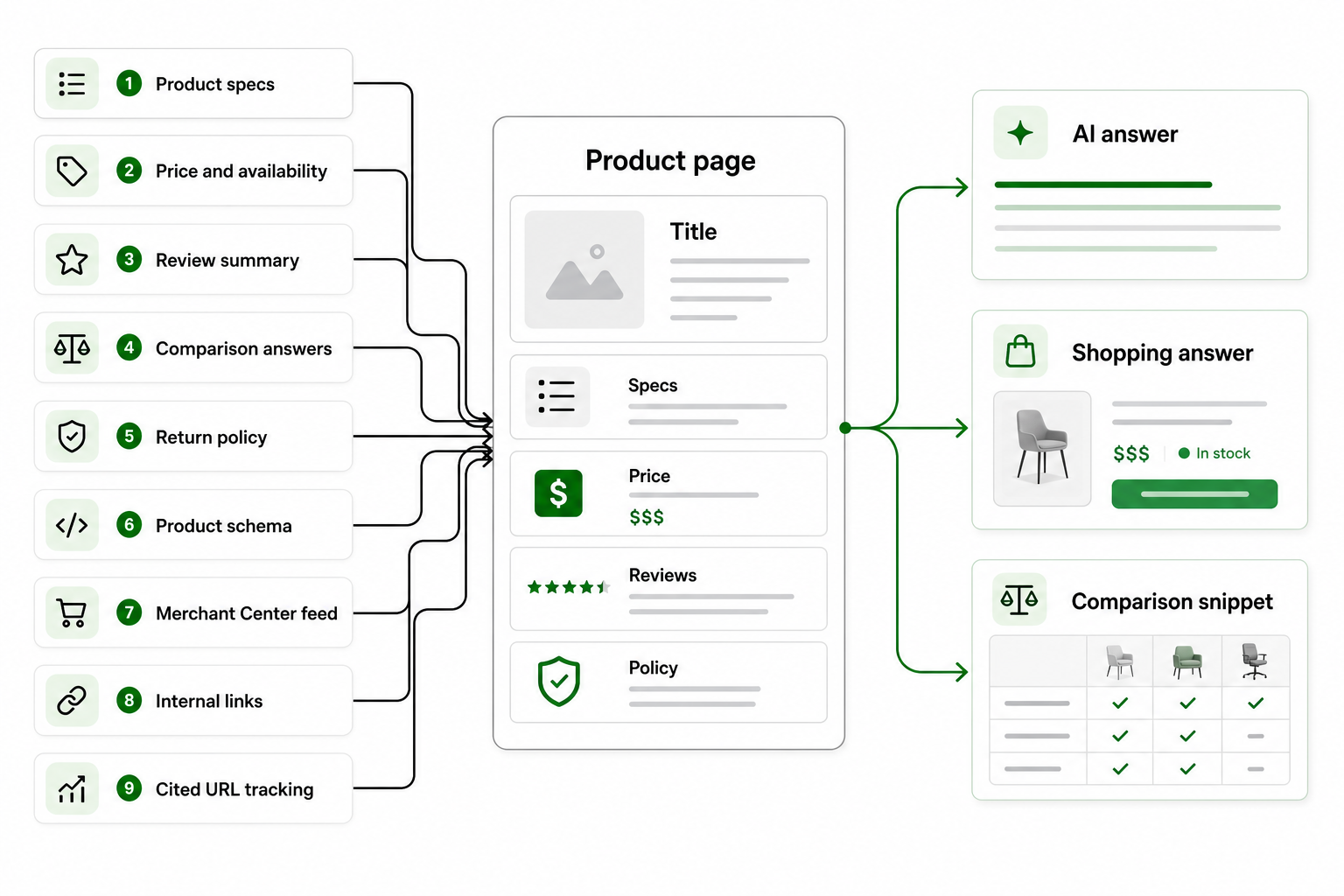
Use the fast rule: a product page should answer the buyer's next question in the first screen, prove the answer with structured product facts, expose price and availability in machine-readable formats, and connect the page to a measurement loop. If the page only has a title, gallery, variant picker, and generic description, it is a weak answer source.
This guide sits under the store-wide ecommerce answer engine optimization playbook, beside the answer engine optimization checklist, and after the technical foundation in schema markup for AI search. Use it when the page that should win is a product page, not a blog post.
If the buyer still needs to compare multiple products, subtypes, budgets, or use cases, use the ecommerce category page AEO guide instead.
For software products, use the SaaS answer engine optimization playbook to map capability, integration, comparison, pricing, and implementation questions to the right source pages.
What is product page answer engine optimization?
Product page answer engine optimization is the page-level process of making an ecommerce product page eligible to answer buyer questions in AI search. It combines clear visible copy, Product schema, feed consistency, comparison-friendly details, review summaries, internal links, and prompt-level tracking so answer engines can cite the product page instead of a weaker third-party source.
Product page answer engine optimization is answer engine optimization applied to product detail pages. The goal is not to stuff more keywords into a description. The goal is to make one URL the clearest source for questions like "which running shoe is best for flat feet under $150" or "does this protein powder have added sugar?"
The practical difference from normal ecommerce SEO is the answer shape. Traditional SEO often optimizes for category rank, image results, product snippets, and conversion rate. Product-page AEO optimizes for generated answers that need a short recommendation, fit explanation, price/availability confidence, source citation, and a next step.
Google's guidance for generative AI features says its AI experiences are grounded in the normal Search index and quality systems. For ecommerce, Google also says product listings and product information can appear in AI responses, and that Merchant Center feeds and business profiles can help products and services be visible in Search experiences. That makes product-page AEO boring in the best way: fix the real product source of truth.
When does an ecommerce product page need AEO work?
An ecommerce product page needs answer engine optimization when AI answers mention the product category, cite competitor pages, recommend marketplace listings, or answer product-fit questions without using your URL. The signal is not only traffic loss. The signal is source loss: the answer engine found someone else's page easier to trust.
Start with these prompts:
| Buyer prompt | What the answer engine needs | Best product-page fix |
|---|---|---|
| "Which [product] is best for [use case]?" | Fit criteria and recommendation logic | Add best-for/not-for copy and comparison table |
| "Does [product] work for [constraint]?" | Specific ingredient, material, size, compatibility, or policy facts | Add direct answer and spec table |
| "Is [product] worth it compared with [competitor]?" | Positioning, tradeoffs, proof, price, and reviews | Add comparison section and source-backed claims |
| "Where can I buy [product] with fast delivery?" | Price, availability, shipping, returns, location | Fix Offer schema and feed consistency |
| "Why is [product] not showing in Google AI Overviews?" | Crawlability, indexability, product data, page quality | Audit schema, feed, canonical, noindex, and internal links |
The decision rule: if the product page cannot answer the buyer's question without relying on a blog post, Amazon page, review site, or marketplace listing, it needs AEO work.
What should a product page include to be citable?
A citable product page should include a direct product-fit answer, clean product facts, current price and availability, variant details, review summaries, comparison context, shipping and return clarity, visible FAQ content, Product schema, and a route back to the page from related category, guide, and comparison pages.
Use this product-page block checklist:
| Page block | Why answer engines use it | Example visible copy |
|---|---|---|
| Direct fit answer | Gives the model one extractable recommendation | "Best for runners who need a stable daily trainer, not for race-day speed." |
| Spec table | Reduces ambiguity around materials, ingredients, sizing, compatibility, or dimensions | Weight, size, color, material, battery life, allergen, fabric, SKU |
| Price and availability | Helps answer commercial questions without guessing | Current price, stock status, shipping window, return window |
| Variant explanation | Prevents wrong answers when SKUs differ | "The 1 kg pouch has 33 servings; the 500 g pouch has 16 servings." |
| Review summary | Converts scattered reviews into evidence | "Most positive reviews mention fit, durability, and delivery speed." |
| Comparison note | Helps shortlist prompts | "Choose this over X if you need..., choose X if..." |
| FAQ | Matches conversational AI questions | "Is this product safe for...?", "Does it include...?", "When should I choose..." |
| Product schema | Clarifies product identity for parsers | Product, Offer, AggregateRating where real, Review where eligible |
| Internal links | Tells crawlers which page owns the answer | Category, buyer guide, comparison, and collection links |
Do not fake proof. If you do not have real ratings, do not invent AggregateRating. If a product claim depends on a certification, ingredient, warranty, or performance test, put the evidence on the page where a human can read it.
How should Product schema and Merchant Center data work together?
Product schema and Merchant Center data should tell the same story as the visible product page. Product schema clarifies the page entity and offer details. Merchant Center data helps Google understand products across shopping surfaces. The product title, price, availability, image, GTIN, brand, variants, shipping, and return details should not conflict.
Google's merchant listing documentation says Product and Offer structured data can make pages eligible for merchant listing experiences, including product snippets and shopping-oriented results. Google's ecommerce documentation also explains that Search can use both structured data embedded on web pages and Merchant Center product data for product rich results, Images annotations, and other experiences.
Use this consistency audit before asking why an answer engine skipped the product page:
| Field | Product page | Structured data | Merchant feed | Failure if inconsistent |
|---|---|---|---|
| Product name | Visible H1 | name | title | AI answers may merge variants or cite the wrong product |
| Brand | Visible brand text | brand | brand | Entity confidence drops |
| Price | Visible price | offers.price | price | Buyer answers may avoid price claims |
| Availability | Stock badge | offers.availability | availability | AI may cite marketplace pages instead |
| Image | Product gallery | image | image_link | Visual product answers may pick another source |
| Variant | Size/color/pack selector | Product variant markup where relevant | item group data | Wrong SKU or pack-size answers |
| Shipping/returns | Policy text or linked module | Offer/merchant return properties where supported | shipping/return settings | Delivery and trust prompts cite other sites |
Structured data is not a hidden ranking hack. Google's structured data policies require markup to describe content visible to users. Treat that as the AEO standard too: if the page says one thing and the markup says another, the page is not a reliable source.
How do you write product copy for answer engines without hurting conversion?
Write product copy for answer engines by making the sales answer more specific, not longer. Keep the product page persuasive, but add extractable decisions: who it is for, who should not buy it, what problem it solves, how it compares, and what facts support the claim.
Use this copy pattern near the top:
[Product] is best for [specific buyer/use case] who needs [outcome] without [constraint].
Choose it if [decision rule].
Choose another option if [honest exclusion].
The key proof is [specific product fact, review pattern, certification, ingredient, material, measurement, or policy].
Example:
Acme Everyday Jacket is best for commuters who need a water-resistant shell for light rain without the weight of a technical hiking jacket. Choose it if you want packability, neutral styling, and machine-washable fabric. Choose a heavier rain shell if you need storm protection. The key proof is the recycled nylon shell, sealed zipper flap, 390 g weight, and 30-day return window.
That paragraph is still buyer-facing. It also gives an answer engine a clean recommendation, use case, exclusion, and evidence set.
What internal links help product-page AEO?
The strongest internal links for product-page AEO come from category pages, buying guides, comparison pages, related product pages, support articles, and blog posts that already answer the same buyer job. The anchor should describe the product's answer role, not just say "shop now."
Use a small link graph:
- Category page links to the product with use-case anchor text.
- Product page links back to the category and one guide that explains the decision.
- Buying guide links to the product when it is the best fit for a named use case.
- Comparison page links to the product and competitor alternative.
- FAQ or support page links to the product when it answers compatibility, sizing, shipping, warranty, or ingredient questions.
For Tracemetry's own content model, the equivalent is: a product-page AEO guide links to the AEO checklist, the schema guide, AI Overview tracking, and the AI visibility report. Then those older pages link back so this page is not orphaned.
How do you measure whether product-page AEO worked?
Measure product-page AEO by tracking the prompts mapped to each product URL before and after the page change. Watch target URL citation rate, product answer accuracy, competitor source share, AI referral traffic, and product-page conversion quality. A traffic lift is useful, but source ownership is the first leading indicator.
Use this measurement loop:
| Step | What to record |
|---|---|
| Lock prompts | 10-30 product-fit, comparison, delivery, price, availability, review, and failure-mode prompts |
| Map target URLs | One intended product page per prompt |
| Run surfaces | ChatGPT Search, Perplexity, Gemini, Claude, Google AI Overviews where available |
| Label outcomes | Product recommended, domain cited, target URL cited, competitor cited, answer accurate |
| Ship fixes | Direct answer, table, FAQ, Product schema, feed cleanup, internal links |
| Re-measure | Same prompt wording after crawl/update window |
| Connect to revenue | AI-referred sessions, product-page conversion rate, assisted branded searches, support/sales notes |
Google's newer generative AI performance reporting in Search Console can help with Google Search generative features, but it will not replace prompt-level tracking across ChatGPT, Perplexity, Gemini, Claude, and other surfaces. Keep Search Console beside the prompt table, not instead of it.
For the metric layer, use answer engine optimization metrics. For the weekly operating report, use the AI search visibility report. Product-page AEO gets easier when every prompt loss becomes a page fix instead of a vague "AI visibility" complaint.
What mistakes make ecommerce AEO fail?
Product-page AEO fails when teams optimize generic category copy while the actual product source is thin, inconsistent, blocked, stale, or unsupported by the feed. AI answers do not need another paragraph of brand positioning. They need a reliable source for product identity, fit, price, availability, proof, and next step.
Avoid these:
- Using Product schema that does not match visible product details.
- Letting Merchant Center feed titles conflict with product-page H1s.
- Hiding critical shipping, return, compatibility, allergen, or warranty answers behind accordions that are not rendered server-side.
- Publishing dozens of overlapping buyer guides while product pages stay thin.
- Writing "best for everyone" copy instead of fit and exclusion criteria.
- Using fake review or rating markup.
- Blocking important product pages with noindex, robots rules, faceted canonical mistakes, or login-gated content.
- Measuring only Google rankings while ChatGPT, Perplexity, and Gemini cite competitor pages.
- Treating marketplace citations as harmless because the buyer can still find the product there.
The uncomfortable truth: if Amazon, Reddit, a review publisher, or a competitor page explains your product better than you do, answer engines have a rational reason to cite them.
FAQ
What is product page answer engine optimization? Product page answer engine optimization is the process of making an ecommerce product page easy for AI answer systems to retrieve, extract, cite, and recommend. It includes visible product-fit answers, Product schema, Merchant Center consistency, FAQ content, comparison context, internal links, and prompt-level measurement.
Is product-page AEO different from ecommerce SEO? Yes. Ecommerce SEO usually optimizes category rank, product rich results, technical crawlability, and conversion. Product-page AEO focuses on generated answers: whether AI systems cite the product page, describe the product accurately, recommend it for the right use case, and avoid sending buyers to competitor or marketplace sources.
Does Product schema help with answer engine optimization? Product schema helps when it accurately reflects visible product content and offer details. It clarifies the page entity, price, availability, brand, image, and rating data for parsers. It does not compensate for thin copy, fake reviews, blocked pages, or product data that conflicts with Merchant Center feeds.
How many AI prompts should ecommerce teams track per product? Start with 10-30 prompts for priority products. Include product-fit, comparison, alternative, price, availability, delivery, review, compatibility, ingredient, sizing, and failure-mode questions. Track fewer prompts for long-tail SKUs and more for products that drive margin or category leadership.
What is the fastest product-page AEO fix? Add a 40-80 word direct fit answer near the top, a spec or decision table, visible FAQ answers, clean Product and Offer schema, current price and availability, and internal links from the relevant category and buyer guide. Then re-measure the same prompts after the page is crawled.
Should ecommerce sites create blog posts or improve product pages for AEO? Improve the product page when the prompt asks about a specific product, fit, price, availability, delivery, or comparison. Create a blog or buying guide when the prompt is broader, such as choosing a category, understanding tradeoffs, or comparing several products. The guide should link to the product page that owns the buying step.
Start with one product URL
Pick one high-margin product where AI answers currently cite a marketplace, review site, or competitor. Run the free Tracemetry audit, map the losing prompts to that product URL, apply the page checklist, and re-measure. If you operate a multi-seller catalog, use the marketplace AEO playbook to govern listing, seller, offer, category, and policy sources. Use Tracemetry Pro when you want weekly prompt tracking, competitor source monitoring, and source-grounded briefs for every product page that should win.
Sources: Google AI features and your website, Google generative AI optimization guidance, Google merchant listing structured data, Google ecommerce product data guidance, Google structured data policies, Google generative AI performance reports.
Frequently asked questions
What is product page answer engine optimization?
Product page answer engine optimization is the process of making an ecommerce product page easy for AI answer systems to retrieve, extract, cite, and recommend. It includes visible product-fit answers, Product schema, Merchant Center consistency, FAQ content, comparison context, internal links, and prompt-level measurement.
Is product-page AEO different from ecommerce SEO?
Yes. Ecommerce SEO usually optimizes category rank, product rich results, technical crawlability, and conversion. Product-page AEO focuses on generated answers: whether AI systems cite the product page, describe the product accurately, recommend it for the right use case, and avoid sending buyers to competitor or marketplace sources.
Does Product schema help with answer engine optimization?
Product schema helps when it accurately reflects visible product content and offer details. It clarifies the page entity, price, availability, brand, image, and rating data for parsers. It does not compensate for thin copy, fake reviews, blocked pages, or product data that conflicts with Merchant Center feeds.
How many AI prompts should ecommerce teams track per product?
Start with 10-30 prompts for priority products. Include product-fit, comparison, alternative, price, availability, delivery, review, compatibility, ingredient, sizing, and failure-mode questions. Track fewer prompts for long-tail SKUs and more for products that drive margin or category leadership.
What is the fastest product-page AEO fix?
Add a 40-80 word direct fit answer near the top, a spec or decision table, visible FAQ answers, clean Product and Offer schema, current price and availability, and internal links from the relevant category and buyer guide. Then re-measure the same prompts after the page is crawled.
Should ecommerce sites create blog posts or improve product pages for AEO?
Improve the product page when the prompt asks about a specific product, fit, price, availability, delivery, or comparison. Create a blog or buying guide when the prompt is broader, such as choosing a category, understanding tradeoffs, or comparing several products. The guide should link to the product page that owns the buying step.
See your own AI visibility today.
Free public report. 60 seconds. No signup. Or get started on Pro to track 250 prompts continuously.