Ecommerce category page AEO: win AI citations without burying products
Optimize ecommerce category pages for AI answers with decision copy, useful facets, ItemList structure, internal links, and prompt-level citation tracking.
An ecommerce category page can rank for a broad product term and still be useless to an AI answer engine. The painful outcome is predictable: ChatGPT, Perplexity, Gemini, or Google cites a marketplace, publisher, or competitor because your collection page shows a grid but never explains how a buyer should choose.
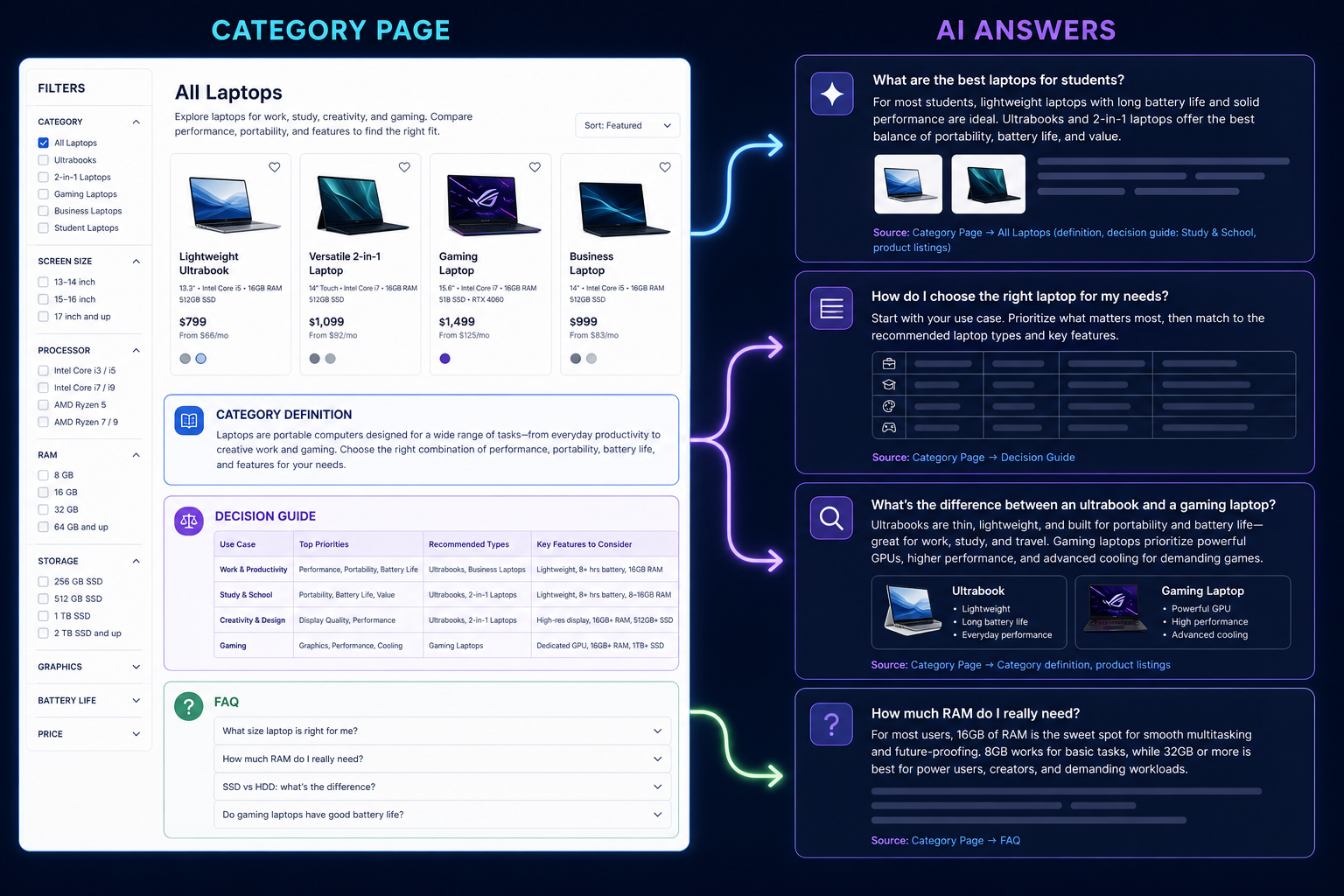
Use the fast rule: keep the product grid, then add a short category definition, a buyer decision table, useful filter explanations, and answers to the five questions shoppers ask before choosing. That creates one page that can rank, help a human decide, and give an answer engine a source worth citing.
This guide extends the store-wide ecommerce answer engine optimization playbook and product page answer engine optimization. Use the product-page playbook when a query should resolve to one SKU; use this category-page playbook when the buyer still needs to compare types, features, prices, or use cases.
What is ecommerce category page answer engine optimization?
Ecommerce category page answer engine optimization is the process of making a collection page easy for AI systems to retrieve, understand, cite, and recommend for a category-level buying question. It combines crawlable product listings with clear category guidance, comparison criteria, useful facets, structured data, internal links, and prompt-level measurement.
Category page AEO is answer engine optimization applied to product-listing and collection pages. The goal is not to paste a long SEO essay above the products. The goal is to make the category page the clearest source for questions such as “what type of office chair is best for a small room?” or “which carry-on luggage should I choose under $200?”
Traditional category SEO often prioritizes head-term rankings, faceted navigation, crawl control, and product discovery. AEO adds the answer layer: the page must define the category, expose meaningful differences, state decision rules, and point the buyer to the right product set without inventing a universal “best.”
When should an AI answer cite a category page instead of a product page?
An AI answer should cite a category page when the question requires a choice among several products, subtypes, budgets, or use cases. A product page is better when the buyer asks about one named item, its specifications, availability, compatibility, or fit. The target URL should match the decision stage.
| Buyer question | Best target | Why |
|---|---|---|
| “What are the best trail shoes for wet weather?” | Category page | The buyer needs a shortlist and selection criteria |
| “Is the Ridge 4 waterproof?” | Product page | The question concerns one product fact |
| “Hard-shell vs soft-shell carry-on luggage?” | Category or buying guide | The buyer needs a tradeoff explanation |
| “Does the Cabin Pro fit a 55 cm limit?” | Product page | The answer depends on one model's dimensions |
| “Which coffee grinder should I buy under $150?” | Category page | Budget and use case define a product set |
Do not force every informational query onto a revenue page. If the question needs a full tutorial, safety explanation, or independent comparison, publish a guide and link it to the relevant collection. Searchers and answer engines both notice when a category page pretends to answer something it cannot support.
What should an AI-citable ecommerce category page include?
An AI-citable category page should include a direct category definition, best-for guidance, a compact decision table, meaningful filter explanations, visible product facts, current inventory, concise FAQs, and links to deeper product or buying-guide pages. Every block should reduce a real buying uncertainty.
Use this minimum page structure:
| Page block | Question it answers | Useful implementation |
|---|---|---|
| 40–80 word category answer | “What is this category and who is it for?” | Plain definition below the H1 |
| Decision table | “Which type should I choose?” | Compare 3–5 attributes that change the purchase |
| Best-for pathways | “Show me products for my use case” | Links to filtered, indexable subcategories where appropriate |
| Explained facets | “What does this filter mean?” | Human-readable size, material, capacity, or compatibility guidance |
| Product cards | “What can I buy now?” | Name, image, price, availability, differentiating fact |
| FAQ | “What could stop me buying?” | Shipping, fit, compatibility, care, returns, or terminology |
| Evidence and policies | “Can I trust the claim?” | Visible source, testing method, warranty, shipping, and return links |
The easiest path is to add these blocks around the existing collection template. Do not rebuild the storefront. Start with the ten categories that drive the most revenue or where AI answers currently cite competitors.
How should category copy be written without burying the product grid?
Write category copy in layers: a short answer near the top, decision support beside or immediately below the first product set, and deeper FAQs after the grid. Keep the commercial experience intact. A buyer should understand the category in seconds and reach products without scrolling through an article-sized wall of text.
Use this answer pattern near the H1:
[Category] includes [clear definition]. Choose [type A] when [use case], [type B] when [different use case], and filter by [two or three decisive attributes]. For most [audience], start with [honest decision rule].
Then turn vague filters into actual guidance. “Material” is merely a label; “choose stainless steel for durability, plastic for low weight, and glass when odor retention matters” is a decision. The second version gives both shoppers and answer systems an extractable relationship between an attribute and an outcome.
Avoid these familiar failures:
- A 1,000-word generic category essay written only for a keyword.
- “Best” claims with no test, review evidence, or qualification.
- Filter pages that generate endless crawlable URL combinations.
- Important buying guidance hidden in client-only UI that is absent from rendered HTML.
- Product cards with no differentiating facts beyond title and price.
- Copy that contradicts product availability, specifications, feeds, or policies.
How should faceted navigation work for category-page AEO?
Faceted navigation should help buyers narrow products without creating an uncontrolled index of duplicate combinations. Keep valuable, stable subcategory URLs crawlable when they serve distinct demand; canonicalize, noindex, or prevent crawl waste for low-value combinations according to your technical SEO strategy. The visible filter state must remain understandable.
Google's ecommerce guidance recommends clear site structure and crawlable links from navigation to categories and products. Google's faceted-navigation documentation also warns that filter combinations can create extremely large URL spaces and waste crawling resources. AEO does not cancel those fundamentals; an answer engine cannot reliably use a page that search systems struggle to discover or consolidate.
Apply this decision rule:
- Index a facet page when it represents a durable product set, has distinct buyer demand, contains enough products, and can provide unique decision guidance.
- Consolidate a facet when it only reorders or slightly narrows the same inventory.
- Prevent empty and nonsensical combinations from becoming discoverable URLs.
- Use normal crawlable links for important category-to-subcategory and category-to-product paths.
- Keep canonicals, sitemaps, breadcrumbs, and internal links consistent with the URL you want cited.
For broader implementation checks, use the schema markup for AI search guide and the AEO checklist.
What structured data belongs on an ecommerce category page?
Category-page structured data should describe what users can actually see. BreadcrumbList can clarify hierarchy, while ItemList can represent a visible list of products. Individual product pages should carry complete Product and Offer data. Do not place misleading product, price, rating, or availability markup on a collection page merely to chase a rich result.
Structured data is supporting evidence, not a replacement for visible guidance. Keep these layers aligned:
- The H1, intro, breadcrumbs, canonical, and navigation describe the same category.
- Product names, prices, availability, and destinations match the visible cards.
- Item order in markup reflects a meaningful visible list when ItemList is used.
- Product pages contain the authoritative SKU, variant, Offer, and policy detail.
- Ratings or reviews are marked up only when genuine and eligible under applicable policies.
Google's structured data policies require markup to represent visible page content and not mislead users. That is the right reliability standard for AI search too: if a machine-readable claim is not supported by the page, it should not be published.
How do you measure category-page AEO?
Measure category-page AEO with a fixed set of category, shortlist, comparison, budget, use-case, and failure-mode prompts. Map each prompt to the collection URL that should answer it, record recommendations and citations before editing, then repeat the same runs after the page is crawled. Track source ownership before expecting traffic lift.
| Metric | Calculation or label | What it tells you |
|---|---|---|
| Target category citation rate | Runs citing the intended category URL / relevant runs | Whether the right collection owns the answer |
| Recommendation rate | Runs recommending an in-stock product from the category / relevant runs | Whether visibility becomes a useful shortlist |
| Answer accuracy | Accurate category, feature, price, and availability claims / checked claims | Whether the answer can be trusted |
| Competitor source share | Competitor citations / all category source citations | Who supplies the answer instead |
| AI referral quality | Engaged sessions and conversions from measurable AI referrals | Whether cited traffic finds the right products |
| Fix-to-win rate | Updated losing prompts that become target-page wins / updated prompts | Which page changes actually work |
Start with 20–40 prompts for one priority category. Keep wording, market, language, surface, and run frequency stable. Segment results by intent because a definition citation and a purchase-shortlist recommendation do not have equal value. The AI search attribution model explains how to connect measurable referrals and assisted journeys without pretending every mention caused a sale.
What is the fastest category-page AEO workflow?
The fastest workflow is to choose one commercially important category, find the prompts where another source wins, add only the missing decision blocks, and re-measure. One category with a clean prompt-to-page loop teaches more than a sitewide copy rollout based on assumptions.
If those prompts are specifically product-recommendation questions in ChatGPT, use the ChatGPT shopping SEO workflow to audit OAI-SearchBot access, product identifiers, price and availability consistency, feeds, and recommendation outcomes alongside the category page.
Use this seven-step sprint:
- Select one high-margin category with enough inventory.
- Lock 20–40 buyer prompts across definition, use case, shortlist, comparison, budget, and failure mode.
- Assign the category page as target only where it genuinely fits the question.
- Capture current answers, citations, competitors, accuracy, and cited URLs.
- Add a direct answer, decision table, useful facet copy, FAQs, and internal links.
- Validate crawlability, canonical, product-card facts, structured data, and mobile UX.
- Re-run the same prompt set after the next crawl window and prioritize the remaining losses.
FAQ
What is ecommerce category page answer engine optimization? Ecommerce category page answer engine optimization makes a collection page easier for AI systems to retrieve, understand, cite, and recommend. It combines clear category guidance, decision criteria, useful facets, visible products, structured data, internal links, and prompt-level measurement.
Is a category page or product page better for AI search? Use a category page when a buyer needs to compare types, products, prices, or use cases. Use a product page when the question concerns one named item's specifications, fit, availability, compatibility, or policies. Match the target URL to the job behind the prompt.
How much copy should an ecommerce category page have? Use enough copy to remove buying uncertainty, not to hit a word count. Start with a 40–80 word definition, one compact decision table, short explanations for decisive facets, and visible FAQs below the product grid. Longer guidance belongs in a buying guide when it interrupts shopping.
Should filtered category pages be indexed? Index a filtered page when it serves durable demand, offers a meaningful product set, and has distinct guidance. Consolidate or control crawl access for thin, empty, duplicate, or endlessly combinable filter URLs. Technical treatment should follow the store's crawl and canonical strategy.
What schema should an ecommerce category page use? BreadcrumbList is commonly useful for hierarchy, and ItemList may describe a visible product list. Complete Product and Offer data belongs on individual product pages. All structured data must match visible content and should not imply ratings, prices, or availability that the collection does not support.
How quickly can category-page AEO results be measured? Recheck after search systems have crawled the update, often beginning with a 7–14 day comparison and continuing weekly or monthly. Keep prompts and test conditions stable. AI answers vary, so judge repeated movement rather than one favorable screenshot.
Turn one category into a measurable answer source
Choose the collection where competitor citations hurt most. Run a free Tracemetry audit, map the losing buyer prompts to the correct category URL, ship the smallest useful decision layer, and measure again. Use Tracemetry Pro when you need continuous monitoring across AI surfaces, competitor source tracking, and a prioritized page-fix queue.
Sources: Google ecommerce site structure, Google faceted navigation guidance, Google structured data policies, Google carousel and ItemList structured data.
Frequently asked questions
What is ecommerce category page answer engine optimization?
Ecommerce category page answer engine optimization makes a collection page easier for AI systems to retrieve, understand, cite, and recommend. It combines clear category guidance, decision criteria, useful facets, visible products, structured data, internal links, and prompt-level measurement.
Is a category page or product page better for AI search?
Use a category page when a buyer needs to compare types, products, prices, or use cases. Use a product page when the question concerns one named item's specifications, fit, availability, compatibility, or policies. Match the target URL to the job behind the prompt.
How much copy should an ecommerce category page have?
Use enough copy to remove buying uncertainty, not to hit a word count. Start with a 40–80 word definition, one compact decision table, short explanations for decisive facets, and visible FAQs below the product grid.
Should filtered category pages be indexed?
Index a filtered page when it serves durable demand, offers a meaningful product set, and has distinct guidance. Consolidate or control crawl access for thin, empty, duplicate, or endlessly combinable filter URLs.
What schema should an ecommerce category page use?
BreadcrumbList is commonly useful for hierarchy, and ItemList may describe a visible product list. Complete Product and Offer data belongs on individual product pages. All structured data must match visible content.
How quickly can category-page AEO results be measured?
Recheck after search systems have crawled the update, often beginning with a 7–14 day comparison and continuing weekly or monthly. Keep prompts and test conditions stable and judge repeated movement rather than one screenshot.
Make your next SEO decision with better evidence.
Explore practical guides to AI visibility, source citations, and choosing the right tools for your team.