Local business answer engine optimization: the practical playbook
A practical local business AEO workflow for tracking nearby buyer questions, correcting business facts, strengthening source pages, and measuring AI recommendations.
Local customers increasingly ask ChatGPT, Gemini, Perplexity, and Google AI results to recommend a nearby provider, compare options, confirm hours, or explain which business fits a specific need. If those answers omit your company—or repeat the wrong location, service, or opening time—the problem is bigger than a missing blue link.
Use this fast rule: choose 30 high-intent local questions, make one authoritative page or profile own each answer, correct inconsistent business facts, and recheck the same questions by location every week. That turns local AI visibility into a measurable workflow instead of another vague content project.
This guide builds on the answer engine optimization checklist, AI search prompt taxonomy, and AI visibility audit workflow. Law practices should use the more specific law-firm AEO playbook for jurisdiction, attorney-advertising claims, and intake-safe measurement. The goal is not to publish dozens of city pages. It is to make your real-world business easier to identify, verify, compare, and cite.
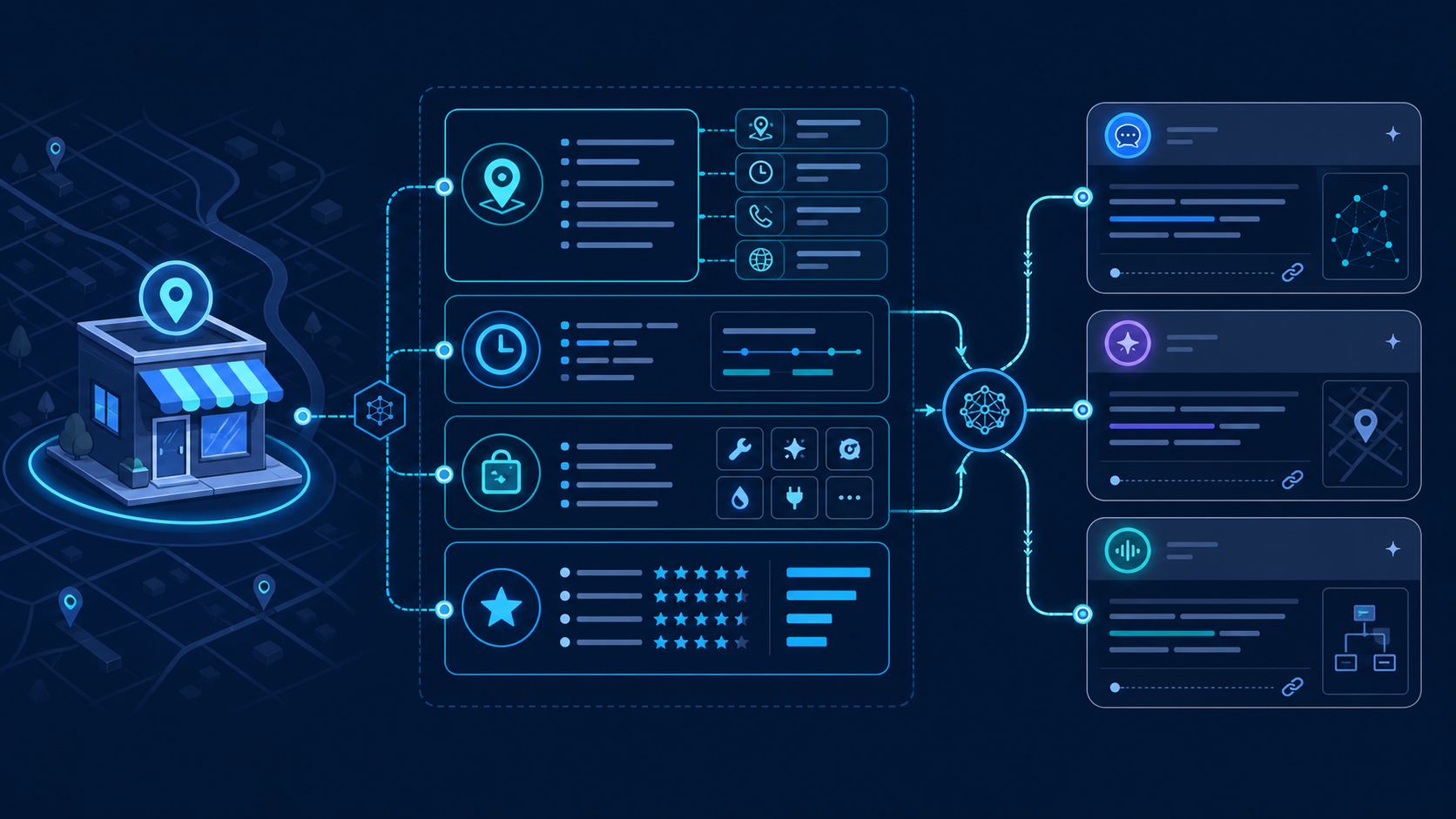
What is local business answer engine optimization?
Local business answer engine optimization is the process of improving how AI systems identify, describe, compare, and recommend a business for location-specific questions. It aligns business facts, local landing pages, profiles, reviews, service evidence, and third-party mentions, then measures whether generated answers become more accurate and commercially useful.
Local business AEO is source-of-truth management for AI-assisted local discovery. It complements local SEO rather than replacing it. Rankings, maps visibility, reviews, crawlability, and useful location pages still matter; AEO adds direct observation of generated recommendations, cited sources, competitors, factual errors, and changes across locations.
Which local AI questions should you track first?
Track questions that can cause a call, booking, visit, or quote request. Start with service-plus-location discovery, urgent needs, comparisons, suitability, price expectations, opening hours, accessibility, and failure modes. Keep the first cohort stable so a weekly change represents the answer—not a rewritten test.
A practical 30-question baseline includes:
- 8 discovery questions, such as “best emergency plumber near Indiranagar”;
- 6 suitability questions, such as “which dentist nearby is good for anxious patients?”;
- 5 comparison questions about options, evidence, or tradeoffs;
- 4 operational questions about hours, availability, parking, or service area;
- 4 price and process questions;
- 3 failure-mode questions, such as “who can fix a same-day boiler leak?”
Test natural phrasing: “how do I find a reliable physiotherapist near me?”, “why does ChatGPT recommend this restaurant?”, “what is the best way to compare local accountants?”, and “when should I call an emergency electrician?” Record the test location because the same prompt can produce a different answer across cities or neighborhoods.
What information must be consistent for local AI visibility?
Your business name, category, address, phone, hours, service area, services, and canonical website should agree across the pages and profiles people rely on. Conflicting facts weaken confidence and can produce wrong answers. Treat each important fact as maintained data with an owner, source, and review date.
| Business fact | Primary owner | Evidence to maintain |
|---|---|---|
| Name, address, phone | Location page and major business profiles | Exact current details and canonical URL |
| Hours and availability | Location page/profile | Regular hours, holiday exceptions, emergency availability |
| Services and service area | Service and location pages | Specific services, neighborhoods, eligibility, limitations |
| Price or booking process | Pricing, service, or booking page | Starting assumptions, what is included, next step |
| Credentials and suitability | About, team, or service page | Verifiable licenses, experience, accessibility, languages |
| Reputation and outcomes | Review platforms and case evidence | Recent, authentic feedback and specific customer context |
Google advises businesses to keep profile information accurate and complete, including address, hours, category, and verification status, in its local ranking guidance. That is good operational hygiene even when the answer surface is not Google.
Which page should own each local answer?
Give every important question one best source. A location page should own branch facts, a service page should own the service, and a focused service-location page should exist only when the business genuinely serves that place and can provide distinctive local evidence. Profiles support discovery; they should not contradict the website.
Use these ownership rules:
- Send brand-and-location questions to the canonical location page.
- Send detailed capability questions to a service page with visible limitations and process.
- Use a service-location page only when it adds real staff, availability, proof, directions, or local detail.
- Keep booking, pricing, accessibility, and emergency information on stable pages.
- Link supporting articles and profiles back to the intended source with descriptive language.
Do not generate near-identical neighborhood pages with swapped place names. Thin duplication makes maintenance harder and gives both search engines and answer engines weaker evidence.
How do you measure a local AEO baseline?
Run the unchanged question cohort from the markets that matter and preserve the answer, cited URLs, timestamp, location, language, device or account conditions, and named competitors. Separate discovery, recommendation, citation, and accuracy metrics because a business can be mentioned while the answer still sends the customer elsewhere.
For every test, capture:
- whether the business is absent, mentioned, shortlisted, or recommended;
- which location and service the answer attributes to it;
- every cited domain and URL;
- whether hours, address, phone, service area, and claims are accurate;
- the competitors shown and the apparent selection evidence;
- the intended source page and the next corrective action.
Repeat valuable questions enough times to see variation. One screenshot is an example, not a trend. The AI answer volatility tracking guide explains how to use stable cohorts and repeated observations without inventing certainty.
How can a local business become easier to cite?
Make the intended page answer the local question immediately, then support the answer with specific facts, proof, and maintained details. The strongest page names the service, location, audience, process, limitations, and next step clearly. It does not force a system—or a customer—to infer what the business actually does.
Use this local source-page checklist:
- Put a 40–80 word direct answer beneath the main service question.
- State the real service area and meaningful exclusions.
- Show current hours, contact options, booking steps, and location details.
- Add staff credentials, original photos, case examples, or process evidence where appropriate.
- Answer price, timing, accessibility, and suitability questions honestly.
- Keep author, business, and update information visible.
- Link the location, service, about, pricing, and booking pages descriptively.
- Maintain canonical tags, indexability, sitemaps, and valid structured data.
Structured data can clarify visible information, but it does not guarantee an AI citation or ranking. Follow Google's structured data policies and keep markup consistent with what customers can see on the page.
Do reviews influence local AI recommendations?
Reviews can provide fresh third-party evidence about service quality, suitability, and customer experience, but review count alone is a weak strategy. AI answers may draw from multiple sources, and platforms apply their own retrieval and ranking systems. Focus on authentic, specific, recent feedback and resolve recurring operational problems.
Ask customers for honest reviews without dictating sentiment or offering prohibited incentives. Respond constructively, preserve privacy, and use recurring language as product research: if customers repeatedly praise same-day availability or complain about parking, the business should verify and clarify those facts on its own pages.
How should multi-location businesses organize local AEO?
Give every real location a unique canonical page and a shared fact-management system. Centralize the schema, templates, analytics, and monitoring rules, but let each branch maintain its staff, hours, services, accessibility, proof, and local updates. Consistency should protect facts, not erase genuine local differences.
A clean operating model is:
- headquarters owns naming standards, templates, analytics, and prompt definitions;
- each location owns hours, contacts, staff, availability, and local proof;
- marketing owns page quality, internal links, profiles, and review workflows;
- operations validates changes before they become public facts;
- one AEO owner reviews answer errors and assigns fixes weekly.
Segment results by location. A national average can hide one branch that is repeatedly omitted or described incorrectly.
What local AEO mistakes waste the most time?
The biggest mistakes are testing vague prompts, changing locations between runs, creating thin city pages, treating a profile as the only source of truth, and counting any mention as a win. Businesses also fail when nobody owns holiday hours, discontinued services, moved addresses, or old third-party listings.
Avoid these failure modes:
- tracking only “[category] near me” without recording test location;
- publishing fake local pages for places the business does not serve;
- letting branch pages, profiles, and directories disagree;
- using generic claims such as “best” without inspectable evidence;
- adding schema that is absent or misleading in visible content;
- chasing citations while the booking path is broken;
- measuring recommendation rate without checking factual accuracy;
- changing prompts every week and calling the movement improvement.
FAQ
Does local business AEO replace local SEO?
No. Accurate profiles, useful location pages, reviews, links, crawlability, and local rankings still support discovery. Local business AEO adds direct measurement of AI-generated recommendations, citations, competitors, source ownership, and factual accuracy.
How many local AI prompts should a business track?
Start with about 30 high-intent questions for one service area and customer group. Expand only after the team can preserve raw answers, record test locations, assign source pages, fix errors, and repeat the stable cohort consistently.
What is the best local AEO metric?
Qualified recommendation rate is the clearest commercial metric: the percentage of relevant answers that recommend the business accurately for the tested need and location. Pair it with target-page citation rate and factual accuracy.
How often should local business information be checked?
Review core facts whenever operations change and run a scheduled check at least monthly. During holidays, moves, service changes, or an active AEO pilot, check important facts and high-value questions weekly.
Do local business reviews guarantee AI recommendations?
No. Reviews can strengthen third-party evidence, but no review count guarantees inclusion. Accuracy, relevance, proximity, authority, source quality, availability, and the answer system's own retrieval process can all affect results.
What is the first local AEO action to take?
Choose 30 high-intent local questions, record the current answers and citations from the relevant location, and flag every wrong business fact. Fix inconsistent names, hours, services, locations, and source pages before publishing new content.
Build a local AI visibility operating loop
The local business that wins is not the one with the most city pages. It is the one whose facts stay accurate, whose service evidence is easy to inspect, and whose high-value local questions are measured repeatedly. Run a Tracemetry AI visibility audit to find missing recommendations and incorrect facts, or book a demo to monitor locations, citations, competitors, and answer changes in one recurring workflow.
Frequently asked questions
Does local business AEO replace local SEO?
No. Accurate profiles, useful location pages, reviews, links, crawlability, and local rankings still support discovery. Local business AEO adds direct measurement of AI-generated recommendations, citations, competitors, source ownership, and factual accuracy.
How many local AI prompts should a business track?
Start with about 30 high-intent questions for one service area and customer group. Expand only after the team can preserve raw answers, record test locations, assign source pages, fix errors, and repeat the stable cohort consistently.
What is the best local AEO metric?
Qualified recommendation rate is the clearest commercial metric: the percentage of relevant answers that recommend the business accurately for the tested need and location. Pair it with target-page citation rate and factual accuracy.
How often should local business information be checked?
Review core facts whenever operations change and run a scheduled check at least monthly. During holidays, moves, service changes, or an active AEO pilot, check important facts and high-value questions weekly.
Do local business reviews guarantee AI recommendations?
No. Reviews can strengthen third-party evidence, but no review count guarantees inclusion. Accuracy, relevance, proximity, authority, source quality, availability, and the answer system's own retrieval process can all affect results.
What is the first local AEO action to take?
Choose 30 high-intent local questions, record the current answers and citations from the relevant location, and flag every wrong business fact. Fix inconsistent names, hours, services, locations, and source pages before publishing new content.
See your own AI visibility today.
Free public report. 60 seconds. No signup. Or get started on Pro to track 250 prompts continuously.