Answer engine optimization roadmap: a 90-day plan
Build a 90-day AEO roadmap that moves from prompt baselines to source-page fixes, repeated measurement, accountable owners, and proven scale.
Most answer engine optimization programs fail for a boring reason: the team publishes scattered “AI-friendly” content before it knows which buyer questions matter, which pages should answer them, or whether citations changed. Ninety days later, there is more content but no defensible evidence of progress.
Before sequencing the work, use the answer engine optimization strategy framework to define the commercial scope, fixed prompt cohort, source ownership, and success measures the roadmap will execute.
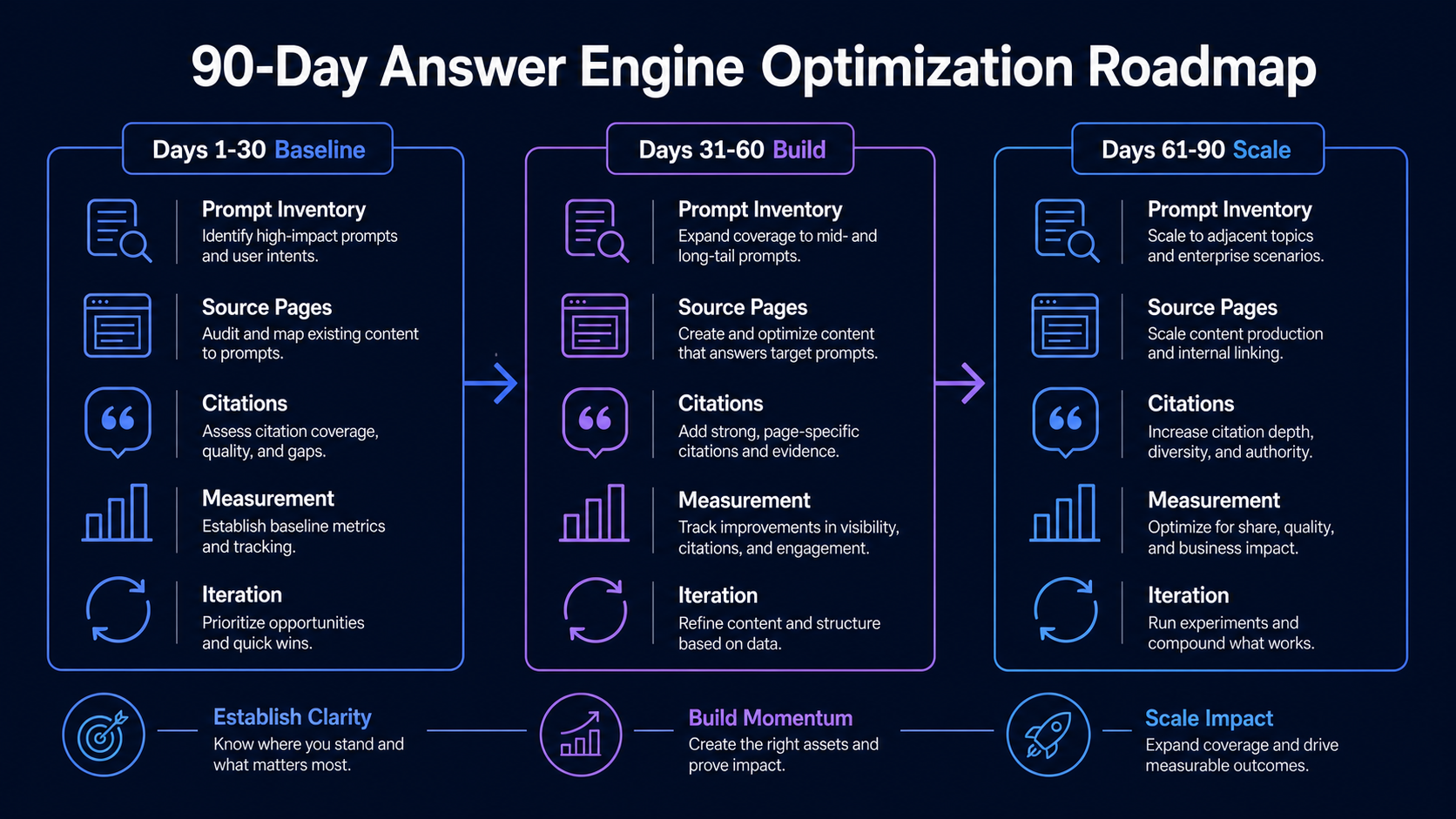
Use this fast rule: spend the first 30 days measuring, the next 30 fixing the highest-value source pages, and the final 30 scaling only what moved. That sequence reduces wasted production and gives leadership a roadmap tied to citations, recommendations, accuracy, and pipeline—not vanity screenshots.
For the measurement model and source-ownership decisions behind this schedule, start with the answer engine optimization strategy, then use this roadmap to sequence the work.
What is an answer engine optimization roadmap?
An answer engine optimization roadmap is a prioritized plan for improving how a brand appears in AI-generated answers. It connects buyer prompts to intended source pages, measures current mentions and citations, assigns page fixes, and schedules repeat tests so a team can prove which changes improve visibility and accuracy.
An AEO roadmap is a measurement-led sequence of source improvements, not a content calendar with a new label. It should state what question the team wants to win, which URL deserves to be cited, what evidence is missing, who owns the fix, and when the exact prompt cohort will be measured again.
The easiest useful roadmap fits on one operating table:
| Field | Decision it captures |
|---|---|
| Prompt cohort | Which buyer questions matter? |
| Intent and value | Which questions can influence a real decision? |
| Intended source URL | Which page should own the answer? |
| Current winner | Which domain and URL are cited now? |
| Failure mode | Missing, weak, wrong, stale, or uncited? |
| Page fix | What is the smallest credible improvement? |
| Owner and due date | Who ships it, and when? |
| Re-test date | When will the same prompts run again? |
| Outcome | Did citations, recommendations, or accuracy improve? |
What should happen before the 90-day AEO roadmap starts?
Before day one, choose a narrow commercial scope, name one accountable owner, and confirm that the team can edit the target pages. Do not begin with the entire site. Start with one product line, audience, region, or buyer journey where better AI answers could plausibly affect consideration or revenue.
Complete this setup checklist:
- Select one business objective, such as more shortlist inclusion or fewer wrong product claims.
- Choose the AI surfaces buyers actually use: ChatGPT, Perplexity, Gemini, Claude, or Google AI features.
- Define 40–80 prompts across discovery, workflow, comparison, alternatives, pricing-adjacent, and failure-mode intent.
- Assign one intended source page to every important prompt.
- Name the content, product, technical SEO, analytics, and approval owners.
- Record the measurement settings: prompt wording, market, language, account state, model or surface, and date.
For a software product, the SaaS answer engine optimization playbook shows how to assign those prompts across feature, integration, comparison, pricing, and documentation pages.
If a lean team cannot support a full 90-day program yet, the answer engine optimization for startups playbook reduces the first cycle to one audience, 20–40 prompts, and ten priority source-page gaps.
If the prompt universe is still vague, build it with the AI search prompt taxonomy. If leadership needs a common definition first, use the answer engine optimization guide.
Teams that need a shared foundation before running this plan can use the answer engine optimization course curriculum and scorecard to choose training built around a live, measurable project.
Large organizations should pair the pilot with an enterprise answer engine optimization governance model so prompt definitions, source ownership, regional measurement, approvals, and reporting stay consistent as the program expands.
What should you do in days 1–30: baseline and diagnose?
Days 1–30 should produce a trustworthy baseline and a ranked fix queue. Run the locked prompts repeatedly, capture the answers and cited URLs, label whether the brand is mentioned or recommended, and score factual accuracy. Then classify why the intended page loses before proposing content.
Measure at least these outcomes:
| Metric | Practical calculation | Why it matters |
|---|---|---|
| Recommendation rate | Runs recommending the brand / relevant runs | Shows shortlist visibility |
| Target-page citation rate | Runs citing the intended URL / relevant runs | Shows source ownership |
| First-named rate | Runs naming the brand first / relevant runs | Adds position context |
| Answer accuracy | Correct checked claims / all checked claims | Protects buyer trust |
| Competitor source share | Competitor citations / all category citations | Shows who supplies the answer |
| AI referral outcomes | Qualified visits, conversions, and pipeline | Connects measurable demand to business value |
For every loss, assign a failure mode: no eligible page, wrong target page, weak direct answer, unsupported claim, stale facts, poor crawlability, weak internal discovery, or a competitor source with better evidence. One prompt can have several symptoms, but the roadmap needs one primary bottleneck so the first fix remains testable.
Do not treat one response as a benchmark. AI answers vary by run, surface, time, and context. Repeat important prompts and preserve the raw evidence. The LLM visibility benchmark gives a fuller protocol for sampling and comparison.
Day-30 deliverable: a baseline report, prompt-to-page map, top competitor sources, accuracy incident list, and a backlog ranked by business value, visibility gap, effort, and confidence.
What should you do in days 31–60: fix source pages?
Days 31–60 should turn the highest-value losses into small, evidence-based page improvements. Work on the intended source before creating another URL. Add direct answers, decision criteria, proof, definitions, comparison language, FAQs, and internal links only where they help a buyer resolve the prompt.
Use this priority formula:
Priority = buyer value × visibility gap × confidence in the fix ÷ effort
The score does not need fake mathematical precision. Its purpose is to stop a loud stakeholder from pushing a low-value keyword above a high-intent question with a clear fix.
For each selected page:
- Put a 40–80 word direct answer below the relevant heading.
- State the entity, audience, use case, and constraints explicitly.
- Add a decision table, worked example, or failure-mode checklist when it reduces uncertainty.
- Support factual claims with primary or authoritative sources.
- Make pricing, features, policies, and product facts consistent across the site.
- Add two to five natural internal links and one conversion path.
- Validate crawlability, canonical signals, rendered HTML, and appropriate structured data.
- Record the exact change and schedule a re-test after the next crawl window.
Schema can clarify visible information, but it cannot rescue thin or contradictory copy. Follow the schema markup for AI search checklist after the page itself answers the question well.
Day-60 deliverable: the first 10–20 priority fixes shipped, an experiment log, crawl and metadata validation, and early re-tests for pages changed during the first sprint.
What should you do in days 61–90: measure and scale?
Days 61–90 should prove which fixes worked and turn successful patterns into a repeatable operating system. Re-run the locked prompt cohorts, compare distributions rather than screenshots, and scale only the page patterns that improve target citations, recommendations, or accuracy without harming the user experience.
Separate outcomes into four buckets:
- Won: the intended page gained repeated citations or recommendations.
- Improved: visibility or accuracy moved, but the intended outcome is not yet stable.
- Unchanged: the page was recrawled but the prompt distribution did not materially move.
- Unknown: the change has not been discovered, the sample is too small, or test conditions changed.
For wins, document the reusable pattern and apply it to adjacent pages. For unchanged prompts, inspect retrieval, source eligibility, evidence quality, and whether the target URL truly matches intent. For unknowns, wait or repair the measurement rather than manufacturing a success story.
Connect prompt movement to outcomes with appropriate confidence. Direct AI referrals and tracked conversions are strong evidence; citations and assisted journeys show influence, not automatic causation. Use the AI search attribution model to avoid double-counting revenue.
Day-90 deliverable: a before-and-after AEO report, fix-to-win rate, validated playbook, next-quarter backlog, and a decision to scale, revise, or stop each initiative.
Who should own the AEO roadmap?
One growth, SEO, or content leader should own the roadmap, but delivery is cross-functional. Content shapes the answer, product and legal validate claims, technical SEO protects discovery and canonicalization, analytics connects measurable outcomes, and executives resolve priorities. Shared contribution is useful; shared accountability is usually a graveyard.
| Role | Primary responsibility |
|---|---|
| AEO owner | Prompt scope, backlog, cadence, and final prioritization |
| Content or subject expert | Accurate answers, evidence, and page improvements |
| Technical SEO or engineering | Rendering, crawlability, canonicals, schema, and internal discovery |
| Product, legal, or compliance | Product facts and claim approval |
| Analytics or RevOps | Referrals, conversions, pipeline, and evidence tiers |
| Executive sponsor | Business scope, resources, and escalation decisions |
Run a 30-minute weekly operating review. Look at new accuracy incidents, prompt movement, shipped fixes, blocked pages, and the next seven days of work. Use a monthly leadership report for trends and business outcomes; do not drag executives through every prompt row.
What are the most common AEO roadmap mistakes?
The most common mistakes are measuring random prompts, publishing before mapping target URLs, counting mentions as citations, scaling unproven templates, and claiming revenue from visibility alone. These errors create activity while making the result impossible to reproduce or defend.
Avoid these failure modes:
- Choosing broad awareness prompts because they generate impressive screenshots.
- Changing prompt wording or market settings between baseline and re-test.
- Creating a new article when an existing product or category page should own the answer.
- Tracking only brand mentions while ignoring cited domains, cited URLs, and answer accuracy.
- Shipping dozens of simultaneous edits, then guessing which one mattered.
- Reporting a single favorable answer instead of repeated observations.
- Treating every AI-influenced deal as sourced revenue.
- Letting stale pricing or feature facts remain live after an accuracy incident is found.
The AEO report template provides the weekly and monthly scorecard structure once the roadmap is running.
FAQ
How long does answer engine optimization take? Use 90 days to establish a baseline, ship priority fixes, and gather initial repeated evidence. Some pages may move after the next crawl; other AI surfaces lag or vary. Treat 90 days as the first learning cycle, not a promise of universal rankings.
How many prompts should an AEO roadmap track? Start with 40–80 prompts for one commercial scope. Include discovery, workflow, comparison, alternatives, pricing-adjacent, and failure-mode questions. Keep a locked core cohort for trend measurement and a smaller discovery set for emerging questions.
What should be the first AEO task? Map important buyer prompts to the pages that should answer them, then measure the baseline. Without that map, a team cannot distinguish a missing page from a weak page or know whether a citation landed on the correct URL.
Should AEO focus on content or technical SEO first? Fix blockers first. If the intended page cannot be crawled, rendered, consolidated, or discovered, solve the technical issue. If it is eligible but fails to answer the question with clear evidence, improve the content. Most programs require both.
How often should AEO results be measured? Review operational changes weekly and leadership trends monthly. Re-test page-level prompt cohorts roughly 7–14 days after a page is published or recrawled, while keeping wording, market, language, and AI surface consistent.
What is a good AEO success metric? Use target-page citation rate for source ownership, recommendation rate for shortlist visibility, answer accuracy for trust, and fix-to-win rate for execution quality. Pair these with qualified AI referrals, conversions, and assisted pipeline when measurable.
Start with one measurable 90-day cycle
Do not approve a year-long “AI optimization” content plan based on guesses. Choose one valuable buyer journey, lock the prompts, identify the pages that should win, and measure the baseline. Run a free Tracemetry audit to find the first citation and accuracy gaps, then use Tracemetry Pro to monitor repeated prompts, competitors, cited URLs, and roadmap progress across AI surfaces.
Frequently asked questions
How long does answer engine optimization take?
Use 90 days to establish a baseline, ship priority fixes, and gather initial repeated evidence. Treat 90 days as the first learning cycle, not a promise of universal rankings.
How many prompts should an AEO roadmap track?
Start with 40–80 prompts for one commercial scope across discovery, workflow, comparison, alternatives, pricing-adjacent, and failure-mode intent. Keep a locked core cohort for trend measurement.
What should be the first AEO task?
Map important buyer prompts to the pages that should answer them, then measure the baseline. This distinguishes a missing page from a weak page and identifies whether citations land on the correct URL.
Should AEO focus on content or technical SEO first?
Fix blockers first. Solve crawl, rendering, canonical, or discovery problems when the intended page is ineligible; improve its answer and evidence when the page is eligible but unhelpful.
How often should AEO results be measured?
Review operations weekly and leadership trends monthly. Re-test exact page-level prompt cohorts roughly 7–14 days after a page is published or recrawled while keeping test settings consistent.
What is a good AEO success metric?
Use target-page citation rate, recommendation rate, answer accuracy, and fix-to-win rate. Pair these with qualified AI referrals, conversions, and assisted pipeline when measurable.
See your own AI visibility today.
Free public report. 60 seconds. No signup. Or get started on Pro to track 250 prompts continuously.