Answer engine optimization strategy: a focused 90-day pilot
Plan a focused AEO pilot: choose buyer questions, map source pages, assign owners and review citations, visits and conversions with clear evidence limits.
An answer engine optimization strategy is a plan that connects buyer questions to useful source pages, assigns owners to improvements, and measures mentions, citations, visits and business actions separately. This guide proposes a focused 90-day pilot for a marketing team deciding what to improve first and what evidence would justify expanding the work.
Before approving the roadmap, use the answer engine optimization audit checklist to preserve a baseline and map intended sources. The pilot below is an operating recommendation, not a tested promise of rankings, citations or conversions.
Before scaling that roadmap, define the AEO team structure and decision rights so measurement, factual approval, publishing, technical access, and revenue reporting each have a named owner.
Use the answer engine optimization case study template to document questions, page changes and repeated observations. A before-and-after comparison alone does not establish that the edit caused the result.
Start with one valuable buyer journey and a question set small enough to review completely. Assign an intended source page to each question, then select a manageable batch of evidence-backed fixes. The right scope depends on your team’s review capacity; a fixed question count does not guarantee representative coverage.
When the strategy is approved, use the 30-day AEO implementation plan to assign owners, sequence five controlled fixes, and set comparable re-test dates.
What is an answer engine optimization strategy?
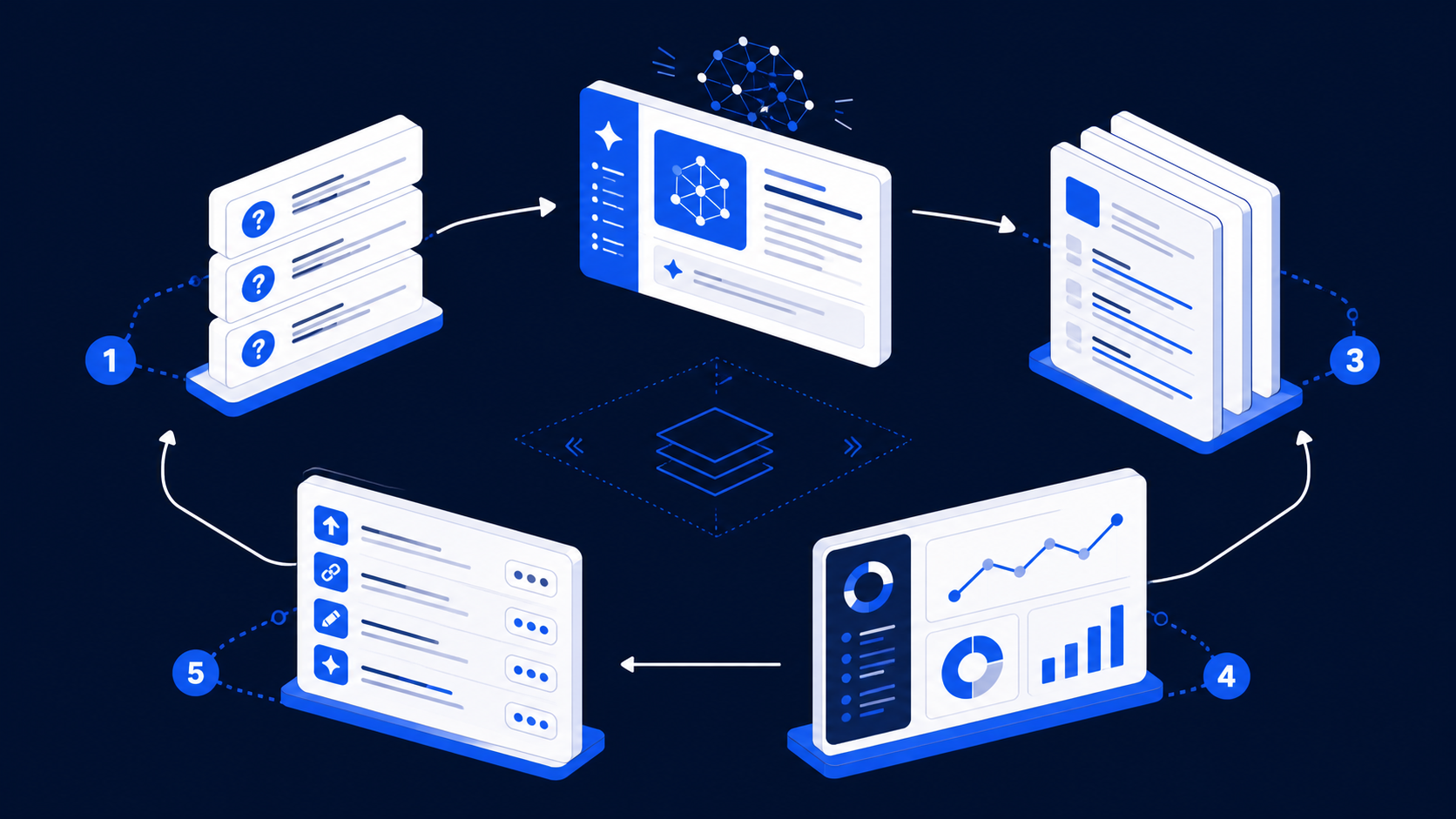
An answer engine optimization strategy is a plan for influencing how AI systems describe, recommend, and cite your brand by improving the sources those systems can retrieve and trust. It connects buyer questions to intended pages, measures answer outcomes by AI surface, and turns losses into specific content, evidence, or technical fixes.
Answer engine optimization (AEO) is the practice of making a brand's useful, defensible information easier for answer engines to find, understand, and cite. The strategy defines where to compete, which sources should win, how results will be measured, and who owns each fix.
AEO builds on SEO work. Google’s guidance for AI features says existing SEO fundamentals apply to AI Overviews and AI Mode, with no special optimization or schema required. A supporting page must be indexed and eligible for a Search snippet; eligibility does not guarantee inclusion.
For the broader answer engine optimization discipline, add a documented buyer-question set, answer and citation evidence, source ownership, and repeated review. Keep results from different products and modes separate.
What should an AEO strategy accomplish?
A useful AEO strategy should improve four outcomes: whether the brand appears, whether it is described accurately, whether it is recommended for the right use case, and whether the intended website page is cited. If the program cannot connect work to one of those outcomes, it is probably generating activity rather than advantage.
| Outcome | Question to answer | Useful measure |
|---|---|---|
| Presence | Does the brand appear for priority questions? | Mention rate |
| Accuracy | Are material product claims correct? | Claim accuracy rate |
| Preference | Is the brand included or named first in relevant shortlists? | Recommendation and first-named rate |
| Source ownership | Does the intended page receive the citation? | Target-page citation rate |
| Improvement | What changed after a shipped source fix? | Matched before-and-after observations with other changes recorded |
Keep raw answers, cited URLs, timestamps, model or surface names, and prompt wording behind every score. State which complete observations enter each denominator and report failed or unknown captures separately. The AI visibility measurement guide explains these counting rules.
A citation is also not a correctness label. OpenAI’s ChatGPT search documentation distinguishes cited sources from other relevant links in Sources and advises checking whether a cited page supports the answer. Record the link’s role and verify the adjacent claim before treating it as useful evidence.
How do you choose where to compete in AI answers?
Choose one product, audience, market, and buyer journey where an AI answer can materially affect discovery or evaluation. Start with questions tied to a real decision—category selection, comparison, implementation, pricing, risk, or troubleshooting—and avoid broad prompts that your team cannot map to a source or business outcome.
Industry context changes what counts as a material error. For destinations, hotels, airlines, and tour operators, use the travel brand AEO playbook to separate durable guidance from volatile prices, availability, routes, policies, and entry requirements.
A strong first scope might be “US B2B SaaS marketing teams evaluating AI visibility software,” not “everything people ask about marketing.” Build the initial cohort from:
- category and comparison search terms;
- sales-call objections and lost-deal notes;
- support questions and product documentation gaps;
- competitor pages already receiving citations;
- current AI answers that contain wrong or stale claims.
The AEO keyword research workflow shows how to turn those inputs into definition, selection, comparison, workflow, and failure-mode prompts. Keep the wording stable so later tests remain comparable.
How do you map AI questions to source pages?
Assign every priority question to the page that should provide the strongest complete answer. Improve an existing page when it already serves the same audience and intent. Create a new page only when no current URL can answer the question without changing its purpose or competing with another page.
Use this decision rule:
- A relevant page exists: strengthen its direct answer, evidence, entities, limitations, and internal links.
- The topic exists but the decision differs: create a focused comparison, use-case, pricing, or troubleshooting page.
- Two pages claim the same question: consolidate them or clearly separate their jobs.
- The claim lacks proof: build the evidence asset before adding more copy.
- The page is inaccessible: fix crawling, rendering, canonicalization, or indexing before rewriting it.
An intended-source map converts vague visibility losses into an executable queue. “ChatGPT did not mention us” is not a task; “our integration comparison page lacks current compatibility evidence for this buyer question” is.
What makes a page citable by answer engines?
A citable page answers the question directly, names the relevant entities, supports material claims with evidence, makes its scope and limitations clear, and remains technically accessible. Structure helps retrieval, but no schema trick can rescue an unsupported claim or a page written for a different audience.
Use the page-level AEO checklist to review each intended source. In practice, high-priority pages should include:
- a concise answer near the relevant heading;
- specific product, audience, platform, region, and use-case language;
- original data, examples, methodology, or verifiable proof;
- visible dates and accountable authors or reviewers where relevant;
- descriptive internal links from related authoritative pages;
- consistent facts across product pages, documentation, profiles, and third-party sources;
- valid canonical, metadata, and structured data that match visible content.
Write for the buyer first. Short answer blocks and clear tables work because they reduce ambiguity, not because an AI system rewards a magic word count.
How should you measure an answer engine optimization strategy?
Measure a locked prompt cohort across each priority AI surface, preserve the complete evidence, and report results by buyer journey and intended source. Track mentions, recommendations, citations, accuracy, competitor share, and movement after fixes separately; combining them into one score hides what actually changed.
The practical weekly view is:
- prompts tested and successful runs;
- brand mention and qualified recommendation rates;
- cited domains and cited URLs;
- intended-source citation rate;
- material claim errors;
- competitor wins by question;
- fixes shipped and matched observations after re-testing;
- referral visits and defined business actions, reported separately from answer presence.
See the full answer engine optimization metrics framework before choosing a dashboard. Record observable conditions such as location, account context and search mode; ChatGPT’s documentation describes location and saved-memory effects. Repeating a question does not control every hidden condition or make the sample representative.
Keep the conversion question explicit. An answer can name your brand without sending a visit; a visit can occur without a recorded conversion. Define a meaningful action and how it is recorded before reviewing results. Report missing referral or attribution evidence as a limitation rather than assigning every conversion to AEO.
What is the best 90-day AEO strategy?
A practical 90-day strategy is a narrow pilot with a saved baseline, an owned source-improvement queue and scheduled reviews. The schedule below is a planning example, not an estimate of when an answer engine will change its results. Reduce the scope if the team cannot inspect the evidence or maintain the sources.
Days 1–30: establish the baseline
- Select one buyer journey and a manageable question cohort.
- Record answers and citations across priority AI surfaces.
- Map every prompt to an intended source page and owner.
- Classify losses: absent brand, wrong claim, competitor recommendation, wrong citation, or no citation.
- Choose an initial batch of fixes by business value, factual risk, evidence of a gap, confidence in the proposed correction, and effort. Five is a possible scope, not a required threshold.
Days 31–60: improve the sources
- Strengthen direct answers and entity clarity.
- Add missing comparisons, evidence, limitations, and freshness signals.
- Repair crawl, rendering, canonical, and internal-discovery problems.
- Update supporting pages so they link naturally to the intended source.
- Log every meaningful change and its deployment date.
Days 61–90: re-test and scale
- Repeat the unchanged prompt cohort over multiple runs.
- Compare cited URLs and material claims with the baseline.
- Compare complete observations using the same definitions and record other changes that could explain differences.
- Document repeated patterns and contradictory evidence without treating correlation as causation.
- Expand to the next journey only when owners can maintain the first one.
For a week-by-week operating plan, use the 90-day AEO roadmap. Keep this strategy document focused on choices: which audience matters, which source should answer, who approves the facts, and what would change the next decision.
What evidence should change the next decision?
Use a review table before expanding the pilot. The examples below describe proposed responses, not results from a Tracemetry customer or a controlled experiment.
| Observation | Useful next action | Evidence still needed |
|---|---|---|
| The intended page cannot be accessed or indexed | Investigate the access or indexing issue before another copy edit | Successful access and relevant inspection evidence |
| A cited page does not support a material claim | Correct the source or record the inaccurate attribution | Saved answer, linked passage and reviewer’s claim check |
| An owned citation appears, but visits do not | Keep citation and traffic reporting separate; examine the reader’s next step | Comparable answer observations and available visit evidence |
| Visits rise, but the defined action does not | Review intent, landing-page accuracy and the action path | Qualified visits, action counts and tracking limitations |
| An answer changes after an edit | Preserve both observations and repeat the review | Other changed conditions and evidence against alternative explanations |
For Google-facing source updates, use the recrawl verification workflow to distinguish a deployed page from a revision visible in crawl evidence. That check does not establish a corresponding update in another answer engine.
Which AEO mistakes waste the most time?
The costliest mistakes are tracking too broadly, treating mentions as citations, publishing a new article for every loss, changing prompts between tests, and reporting a single composite visibility score. These choices prevent teams from learning which source change affected which answer.
Also avoid:
- prompting AI systems with leading questions that force the brand into the response;
- comparing surfaces without accounting for different citation behavior;
- optimizing only blog posts while product, pricing, documentation, and third-party facts conflict;
- adding FAQ schema that does not match visible page content;
- claiming revenue attribution when the evidence supports only influence;
- scaling prompt volume faster than the team can inspect answers and ship fixes.
The durable unit of work is a question-to-source hypothesis: for this buyer question, this page should provide the best defensible answer. Test it, improve it, and test it again.
How can you start the pilot without buying a tool?
Use the free manual citation-review worksheet to save answers, source links, claim checks and follow-up actions. The blank CSV downloads make no generation API calls. Access to any search product you choose to inspect remains subject to that product’s availability and usage limits.
Choose one buyer decision, assign a reviewer and a source-page owner, and complete the first evidence review before expanding the question list. The initial deliverable is an agreed correction queue and a review date. It does not require purchasing a platform or commissioning a new article for every missing mention.
Turn that review cadence into an owned operating loop with the answer engine optimization workflow: preserve the evidence, assign the page fix, record what shipped, and rerun the same question set. Property brands can extend it with the real-estate AEO playbook, which adds inventory freshness and listing-source controls.
Frequently asked questions
Does answer engine optimization replace SEO?
No. Google says existing SEO fundamentals apply to AI Overviews and AI Mode, without special optimization or schema. This strategy adds documented buyer questions, source ownership and evidence review while keeping the different search surfaces separate.
How many questions should an AEO strategy track first?
Choose a set small enough for the team to inspect completely and connect to intended source pages. There is no universal count that guarantees representative coverage; document what the cohort includes and what it misses.
How long does an AEO strategy take to work?
The 90-day plan is an operating schedule, not a result forecast. Record deployment and available revision evidence, then compare repeated observations; do not promise a fixed timeframe for rankings, citations or conversions.
How should an AEO strategy measure conversions?
Define the meaningful business action and its tracking before the pilot. Report answer presence, citations, visits and actions separately, preserving attribution gaps instead of assuming an answer caused a conversion.
Should AEO focus only on blog content?
No. Choose the source that best answers the buyer’s question, which can be a product page, comparison, documentation, support resource or another suitable source. Improve an existing URL when it already serves the same purpose.
Can I start an AEO strategy without paid software?
Yes. The linked manual citation-review worksheet provides blank logs for captured answers and source checks without generation API calls. The products you inspect have their own access rules and usage limits.
Make your next SEO decision with better evidence.
Explore practical guides to AI visibility, source citations, and choosing the right tools for your team.