Perplexity citation tracking: prompts, URLs, and source fixes
How to track Perplexity citations at the URL level: prompt sets, cited URLs, citation position, target URL citation rate, competitor source wins, and weekly page fixes.
Perplexity citation tracking is where AI visibility stops being a fuzzy brand report and becomes a source-level workflow. If a buyer asks Perplexity for a shortlist, a comparison, or a fix, the useful question is not only "were we mentioned?" It is "which URL did Perplexity cite, which competitor source won, and what page do we fix next?"
The fast decision rule: track Perplexity citations at the URL level. Brand mentions tell you whether Perplexity knows you. Cited URLs tell you whether your site is being used as evidence. Target URL citation rate tells you whether the right page owns the prompt.
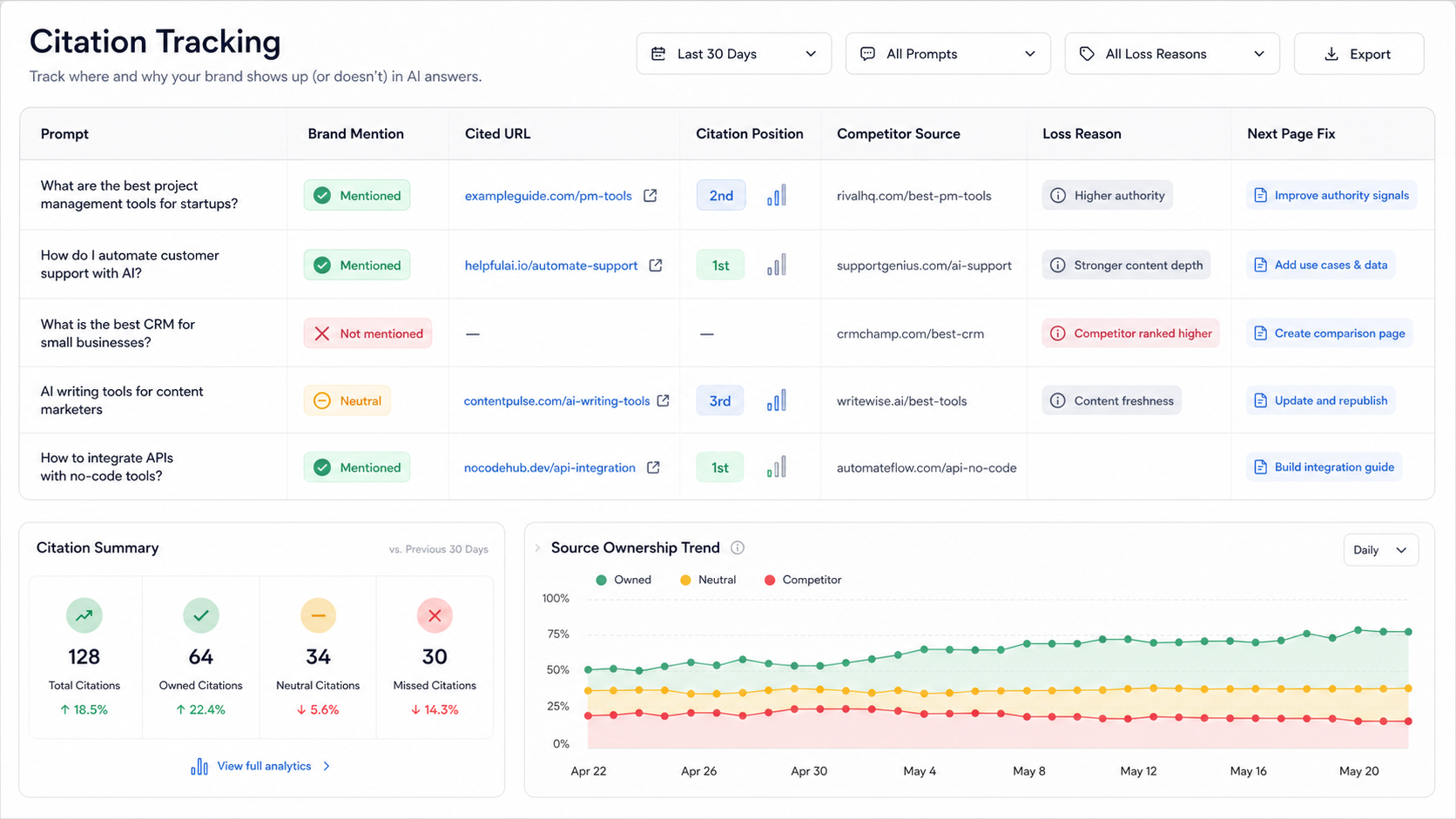
Use this guide when you already understand the broad Perplexity SEO checklist and need the operating system for cited URLs. If you need a metric benchmark, pair it with the Perplexity citation rate benchmark. If the immediate problem is a lost source slot, read why Perplexity does not cite your site after you capture the tracking fields below.
What is Perplexity citation tracking?
Perplexity citation tracking is the process of recording which URLs Perplexity cites for a fixed set of prompts, which brands it names, which competitors own source slots, and whether the intended page is being cited. It turns Perplexity answers into a repeatable dataset for source ownership, page fixes, and weekly AI visibility reporting.
Perplexity citations are the visible source links attached to a Perplexity answer. For SEO and GEO teams, each citation should be captured as a cited domain, cited URL, citation position, prompt intent, answer claim, competitor presence, and target URL match.
Perplexity describes the product as an answer engine that searches the web and includes links to original sources. That makes it one of the cleanest AI search surfaces to track because the source layer is visible. You are not guessing whether the answer used your site; you can inspect the URL Perplexity showed.
Why should you track citations separately from mentions?
Track citations separately from mentions because Perplexity can name your brand without citing your website, cite your website without recommending your product, or cite the wrong URL from your domain. Those outcomes look similar in a vanity score, but they require different fixes.
Use this decision table:
| Perplexity outcome | What it means | First fix |
|---|---|---|
| Brand named, target URL cited | Best outcome: brand and source both won | Strengthen the page and track position |
| Brand named, competitor cited | Entity known, but competitor owns proof | Improve the intended source page |
| Brand absent, competitor cited | Category or source ownership gap | Create or rewrite the matching page |
| Domain cited, wrong URL | Internal topology is unclear | Link the narrow page from related posts |
| Publisher or Reddit cited | Third-party proof is shaping the answer | Add better evidence and earn outside mentions |
| No visible citation | Prompt may not trigger source-backed mode | Track separately and test a more specific prompt |
The painful miss is "brand named, competitor cited." Leadership may read that as progress. A buyer reads it as "this other source is the proof." Treat it as a fixable source gap, not a win.
What fields should a Perplexity citation tracker include?
A useful Perplexity citation tracker should capture the prompt, prompt bucket, answer date, brands named, cited domains, cited URLs, citation order, target URL expected, target URL cited, loss reason, and next page fix. Anything less turns the report into screenshots instead of work.
Start with these fields:
| Field | Example | Why it matters |
|---|---|---|
| Prompt | "how do I track Perplexity citations for my brand" | Makes the test repeatable |
| Prompt bucket | Workflow | Keeps metrics tied to buyer intent |
| Surface | Perplexity | Avoids blending AI products |
| Brands named | Tracemetry, Profound, Otterly | Shows shortlist presence |
| Cited domains | tracemetry.com, profound.com | Shows source ownership |
| Cited URLs | Exact article or landing page | Shows which page won |
| Citation position | First, second, third | Early citations often frame the answer |
| Target URL | URL you expected to win | Enables target URL citation rate |
| Loss reason | Wrong URL, competitor source, missing page | Turns tracking into action |
| Next fix | Add direct answer and table | Gives the team one job |
Do not stop at domain-level reporting. Domain citation rate tells you whether your site appeared. Target URL citation rate tells you whether the correct page owned the specific question. The second metric is what tells the content team what to fix.
How do you build a prompt set for Perplexity citation tracking?
Build a Perplexity citation tracking prompt set around buyer jobs, not only keywords. Include exact search terms where they sound natural, but most prompts should be phrased as questions a buyer would ask when comparing tools, diagnosing a failure, or deciding what to fix next.
Use 40-80 prompts for a stable early program:
| Prompt bucket | Count | Example prompt |
|---|---|---|
| Category discovery | 8-12 | "what are the best AI visibility tools for B2B SaaS" |
| Surface-specific | 6-10 | "how do I track Perplexity citations for my brand" |
| Workflow | 6-10 | "what is the best way to monitor cited URLs in Perplexity" |
| Comparison | 8-12 | "Tracemetry vs Profound for AI search monitoring" |
| Alternatives | 6-10 | "best Profound alternatives for startups" |
| Failure mode | 8-12 | "why does Perplexity cite competitors instead of my website" |
| Reporting | 4-8 | "how do I report Perplexity citation rate to executives" |
Add entity terms naturally when they clarify the query: Perplexity, cited URLs, source links, citation tracking, AI visibility tracking, generative engine optimization, answer engine optimization, brand mentions, competitor citations, source ownership, B2B SaaS, comparison pages, alternatives pages, Article schema, FAQ schema, and buyer shortlists.
Then lock the prompt wording. If you keep changing prompts, you are not tracking citation movement. You are changing the test.
How do you calculate Perplexity citation metrics?
Calculate Perplexity citation metrics from prompt runs, not from impressions or keyword volume. Each prompt run can produce several brands and several citations, so you need separate metrics for brand presence, domain citation, target URL citation, and competitor source share.
Use these formulas:
| Metric | Formula | Use |
|---|---|---|
| Brand mention rate | Runs naming your brand / total relevant runs | Shortlist presence |
| Domain citation rate | Runs citing your domain / total relevant runs | Source ownership |
| Target URL citation rate | Runs citing the intended URL / total relevant runs | Correct page ownership |
| Owned citation share | Your cited URLs / all cited URLs in tracked runs | Competitive source share |
| First-cited rate | Runs where your domain is first cited / citation-producing runs | Source prominence |
| Wrong URL rate | Runs citing your domain but not the target URL / domain-cited runs | Internal topology problem |
If you sample each prompt multiple times, count runs rather than unique prompts. Perplexity answers can vary because retrieval, freshness, and answer composition vary. A single run is evidence. A weekly sample is a metric.
How do you classify competitor citation losses?
Classify competitor citation losses by the smallest page or proof change that could win the next run. The goal is not to shame the content calendar. The goal is to identify whether you need a new source page, a sharper answer block, clearer entity language, fresher proof, or better internal links.
Use this loss reason map:
| Loss reason | What you saw | Fix |
|---|---|---|
| Missing page | No page directly answers the prompt | Create a focused source page |
| Weak answer block | Page exists, but answer is buried | Add a 40-80 word direct answer near the top |
| Wrong intent | Your URL answers a broader topic | Rewrite the page for the buyer's job |
| Weak entity clarity | Product, category, and use case are unclear | Name entities in title, intro, H2s, and FAQ |
| Stale proof | Competitor has fresher facts or examples | Update examples, dates, and source references |
| Weak proof | Publisher or competitor has better evidence | Add credible sources and specific claims |
| Weak topology | Wrong internal URL gets cited | Link the target page from pillar and support posts |
| Schema mismatch | Markup does not match visible content | Align Article and FAQ schema with page copy |
Google's structured data documentation frames markup as explicit clues about page meaning and says structured data should describe visible content. Use the same standard here. Schema can clarify a strong source page; it cannot rescue a page that never answers the prompt.
What does a weekly Perplexity citation tracking workflow look like?
A weekly workflow should take a prompt set from measurement to one shipped fix. Run the same prompts, capture cited URLs, classify the highest-value losses, update one source page, add internal links, and schedule the re-check. The loop matters more than the dashboard.
Use this cadence:
- Run the locked prompt set. Keep wording, locale, and surface stable.
- Capture cited URLs. Record domain, exact URL, position, and answer claim.
- Separate mention and citation wins. Do not blend brand presence with source ownership.
- Sort by buyer intent. Comparison, alternatives, pricing-adjacent, and failure-mode prompts go first.
- Inspect competitor sources. Compare title, intro, tables, sources, FAQ, schema, and freshness.
- Pick one fix. Choose the target URL that should have won.
- Publish a page-level improvement. Add a direct answer, table, sources, FAQ, and internal links.
- Re-measure in 7-14 days. Use the same prompt and record whether the loss reason changed.
For Tracemetry, the clean workflow is: run the free AI visibility audit, identify Perplexity prompts where competitors own citations, use features to generate source-grounded briefs, publish the fix, and review source ownership again before the next report.
Which pages usually improve Perplexity citations fastest?
The pages that improve Perplexity citations fastest are pages that match decision-stage prompts: comparisons, alternatives, troubleshooting guides, buyer checklists, benchmark explainers, and specific workflow pages. Generic top-of-funnel posts are useful for authority, but they are not always the first source gaps to fix.
Prioritize this order:
| Page type | Example prompt | Why it moves faster |
|---|---|---|
| Troubleshooting guide | "why does Perplexity cite competitors instead of my site" | Matches painful failure intent |
| Workflow guide | "how do I track cited URLs in Perplexity" | Gives Perplexity a clear how-to source |
| Comparison page | "Tracemetry vs Profound for AI visibility tracking" | Supports buyer shortlist answers |
| Alternatives page | "best Profound alternatives for startups" | Captures challenger-intent prompts |
| Benchmark guide | "what is a good Perplexity citation rate" | Gives the answer a metric framework |
| Product feature page | "AI visibility tool with Perplexity citation tracking" | Connects source proof to conversion |
If the right page already exists, improve it before creating another URL. Too many overlapping pages can make source selection worse because Perplexity may cite the broad page when the narrow page should win.
What should the report show executives?
An executive Perplexity citation report should show whether the brand is being recommended, whether the site owns source links, which competitors are being cited instead, and which page fix is next. Keep the report short enough to drive action.
Use this format:
| Report section | Include |
|---|---|
| Executive score | Mention rate, domain citation rate, target URL citation rate |
| High-intent movement | Comparison, alternatives, workflow, and failure-mode changes |
| Competitor source wins | Competitor URLs cited instead of your target pages |
| Recovered prompts | Prompts that moved from absent to mentioned or cited |
| Wrong URL issues | Cases where your domain was cited but the wrong page won |
| Fixes shipped | Pages updated, internal links added, schema aligned |
| Next action | One source page or proof gap to fix this week |
Do not lead with traffic alone. Perplexity referral traffic matters, but source ownership often moves before analytics shows a meaningful click pattern. Track AI referral traffic alongside citation ownership, not instead of it.
FAQ
What is Perplexity citation tracking? Perplexity citation tracking is the process of recording which URLs Perplexity cites for a fixed set of prompts, which brands it names, and whether your intended page owns the citation. It separates brand mentions from cited source links so teams can identify the next page fix.
How is Perplexity citation tracking different from Perplexity citation monitoring? Citation monitoring is the ongoing program. Citation tracking is the specific data capture layer: prompt, answer, brand mentions, cited URLs, citation position, target URL match, loss reason, and next fix. In practice, tracking feeds the monitoring report.
What is the most important Perplexity citation metric? Target URL citation rate is usually the most actionable metric. Domain citation rate shows whether your site appeared, but target URL citation rate shows whether the correct page owned the exact prompt.
How many Perplexity prompts should I track? Track 40-80 prompts for a stable early program. Include category discovery, surface-specific, workflow, comparison, alternatives, failure-mode, and reporting prompts. Use fewer only for a quick diagnostic.
Can Perplexity cite my brand but use a competitor as the source? Yes. That is one of the most common high-value losses. It means your brand may be considered, but Perplexity found a competitor, publisher, review site, or community page to be a clearer source for the answer.
How often should I re-check Perplexity citations after a page fix? Re-check after 7-14 days for most page-level fixes. Keep the same prompt wording and capture the same fields so the result shows whether citation ownership changed, not whether the test changed.
Start with the cited URL, not the chart
Run the free Tracemetry audit and look for prompts where Perplexity cites a competitor, publisher, Reddit thread, or the wrong page on your own site. If those prompts matter, use Tracemetry Pro to track cited URLs weekly, generate source-grounded briefs, and re-measure every fix.
For the surrounding workflow, read Perplexity citation monitoring, how Perplexity chooses sources, and content that AI cites. Then fix the one cited URL gap that would change the next buyer answer.
Sources: Perplexity Help Center: What is Perplexity?, Perplexity Help Center: Practical Tips for Using Perplexity, Google Search Central: Introduction to structured data, Evaluating Verifiability in Generative Search Engines.
Frequently asked questions
What is Perplexity citation tracking?
Perplexity citation tracking is the process of recording which URLs Perplexity cites for a fixed set of prompts, which brands it names, and whether your intended page owns the citation. It separates brand mentions from cited source links so teams can identify the next page fix.
How is Perplexity citation tracking different from Perplexity citation monitoring?
Citation monitoring is the ongoing program. Citation tracking is the specific data capture layer: prompt, answer, brand mentions, cited URLs, citation position, target URL match, loss reason, and next fix. In practice, tracking feeds the monitoring report.
What is the most important Perplexity citation metric?
Target URL citation rate is usually the most actionable metric. Domain citation rate shows whether your site appeared, but target URL citation rate shows whether the correct page owned the exact prompt.
How many Perplexity prompts should I track?
Track 40-80 prompts for a stable early program. Include category discovery, surface-specific, workflow, comparison, alternatives, failure-mode, and reporting prompts. Use fewer only for a quick diagnostic.
Can Perplexity cite my brand but use a competitor as the source?
Yes. That is one of the most common high-value losses. It means your brand may be considered, but Perplexity found a competitor, publisher, review site, or community page to be a clearer source for the answer.
How often should I re-check Perplexity citations after a page fix?
Re-check after 7-14 days for most page-level fixes. Keep the same prompt wording and capture the same fields so the result shows whether citation ownership changed, not whether the test changed.
See your own AI visibility today.
Free public report. 60 seconds. No signup. Or get started on Pro to track 250 prompts continuously.