AI optimization for websites: the 100-point source-readiness score
How to score whether a website is ready for AI answers: crawl access, entity clarity, prompt-to-page ownership, direct answers, proof, schema, links, and measurement.
AI optimization for websites is no longer a vague "use AI in marketing" project. For SEO and content teams, the painful problem is that a website can rank, load quickly, and convert humans while still being a poor source for ChatGPT, Perplexity, Gemini, Claude, Google AI Overviews, and other AI answer systems.
Use the fast rule: score the site like an answer source, not just a search result. A strong AI-optimized website has clear entity pages, direct answers, visible proof, crawlable content, matching schema, internal links, and a weekly prompt measurement loop. If the page cannot explain the answer in one clean block, an assistant has a rational reason to cite someone else.
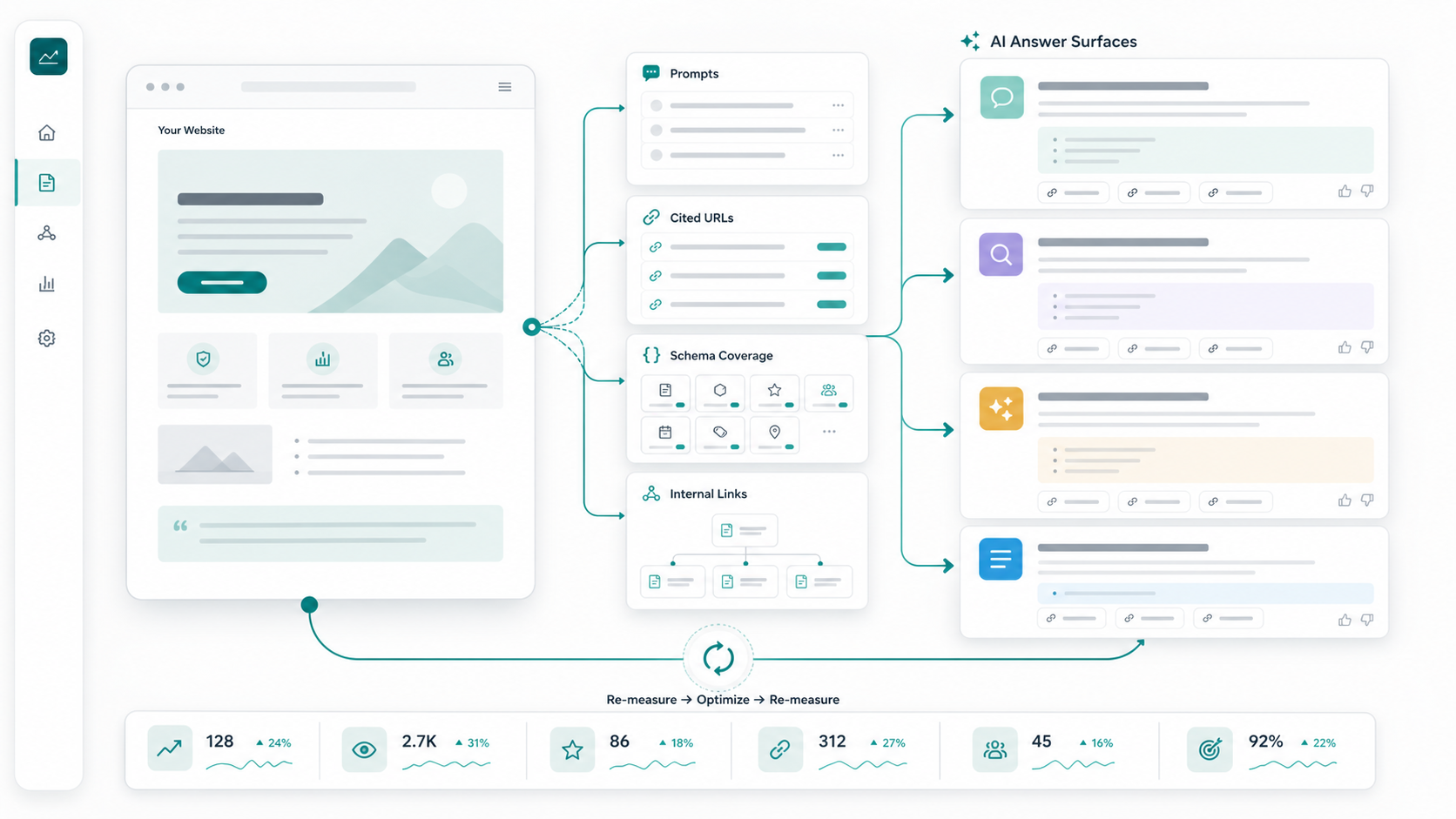
This guide is the scoring layer between AI search optimization, the answer engine optimization checklist, and the broader generative engine optimization audit. Use it when leadership asks, "Is our website ready for AI answers?" and the team needs a practical score instead of another opinion. When the score exposes prompts where competitors own the source slot, run an answer engine optimization content gap analysis before assigning new drafts. When the audit produces a page to write, turn it into an answer engine optimization content brief before assigning the draft.
What is AI optimization for websites?
AI optimization for websites is the process of making a site easier for AI answer systems to retrieve, understand, cite, and recommend. It includes crawlability, entity clarity, answer-first copy, source-worthy proof, structured data, internal links, and prompt-level monitoring across surfaces such as ChatGPT, Perplexity, Gemini, Claude, and Google AI experiences.
AI optimization is source-readiness work for generated answers. The website is not being optimized for a model in the abstract. It is being optimized so an AI system can answer a buyer's question with the right facts, the right source URL, and the right next step.
Searchers use broad phrases such as "ai optimization" and "ai engine optimization" for several different jobs. That language is messy, so the page needs to disambiguate the work: this is not model compression, prompt engineering, or AI automation. This is website optimization for AI-mediated discovery.
Google's guidance for AI features in Search and its generative AI optimization guide both point back to the normal Search foundation: useful, accessible, crawlable web content. OpenAI's ChatGPT Search documentation also describes answers that can include links to web sources. The practical takeaway is simple: a website still has to earn source selection.
When should a website get an AI optimization score?
A website should get an AI optimization score when AI answers influence buyer research and the team cannot explain why competitors are being named, cited, or recommended. The score is useful before a content sprint, after a site migration, during a rebrand, before an agency pilot, or when classic SEO reports look healthy but sales hears "ChatGPT recommended someone else."
Use this decision table:
| Situation | What to score first | Why it matters |
|---|---|---|
| Competitors appear in AI shortlists | Category and comparison pages | The assistant found clearer shortlist evidence elsewhere |
| Your brand is mentioned but not cited | Source pages and internal links | Brand awareness exists, but source ownership is weak |
| AI answers describe old features | Product, pricing, docs, and FAQ pages | Stale public facts are easier to repeat than private truth |
| Google rankings are stable but AI referrals are flat | Prompt coverage and target URL citation rate | Rank does not prove answer selection |
| A new site or rebrand launched | Entity pages, redirects, schema, and branded prompts | AI systems need a clean source-of-truth map |
| Leadership wants "AI SEO" work | Measurement and fix queue | A score turns the vague request into specific work |
The score should not become theater. If it does not tell you which URL to update this week, it is just another dashboard.
What should the AI optimization score measure?
The best AI optimization score measures whether a website can become the source an AI answer needs. Score seven areas: crawl access, entity clarity, prompt-to-page ownership, answer extraction, proof, structured data, and measurement. Each category should lead to a page fix, not a vanity grade.
Use this 100-point scorecard:
| Category | Points | Pass condition |
|---|---|---|
| Crawl and index access | 15 | Important pages are indexable, render server-side or cleanly, load quickly, and are not blocked by robots, noindex, login walls, or broken canonicals |
| Entity clarity | 15 | The site clearly names the brand, product, audience, category, competitors, use cases, integrations, authors, and locations where relevant |
| Prompt-to-page ownership | 15 | High-intent prompts map to one intended URL each, with no overlapping pages fighting for the same answer |
| Answer extraction | 15 | Important pages include 40-80 word direct answers, definition blocks, tables, checklists, and visible FAQ content |
| Source-worthy proof | 15 | Claims are supported by examples, product facts, current screenshots, public documentation, customer proof, or reliable external sources |
| Schema and metadata | 10 | Article, FAQPage, Product, Organization, SoftwareApplication, Breadcrumb, or HowTo schema matches visible content where appropriate |
| Measurement loop | 15 | The team tracks prompts, surfaces, mentions, citations, competitors, answer accuracy, target URLs, and re-measure dates |
Grade the website like this:
| Score | Meaning | Best next action |
|---|---|---|
| 80-100 | Source-ready | Expand prompt coverage and improve weak pages by revenue priority |
| 60-79 | Partially ready | Fix answer blocks, schema, proof, and internal links on priority URLs |
| 40-59 | Visible but hard to cite | Build the prompt-to-page map and rewrite source pages before publishing more content |
| Below 40 | AI-invisible foundation | Fix crawlability, entity pages, canonical structure, and measurement before content expansion |
The uncomfortable truth: most websites do not lose AI citations because they lack 50 more blog posts. They lose because the answer engine cannot find one page that cleanly owns the question.
How do you run an AI optimization audit for one website?
Run the audit in six steps: pick buyer prompts, map target URLs, test AI answers, score source readiness, ship page fixes, then re-measure the same prompts. The audit is only useful if the prompt wording and target URL stay stable long enough to compare before and after.
1. Build the prompt set
Start with 40-80 prompts if this is a real business program. Include category discovery, shortlist, comparison, alternatives, workflow, integration, pricing-adjacent, branded, and failure-mode questions.
Good AI query phrasing sounds like this:
- "What is the best way to optimize a website for AI answers?"
- "Why does ChatGPT cite competitors instead of my website?"
- "How do I know if my site is ready for answer engine optimization?"
- "When should I update an old SEO page for AI search instead of writing a new one?"
- "Best AI visibility workflow for a B2B SaaS content team"
- "Which pages should an AI optimization audit check first?"
For a deeper prompt workflow, use AI search prompt monitoring. For benchmark reporting, use the LLM visibility benchmark.
2. Map one target URL to each important prompt
Every important prompt should have one intended source page. If the page does not exist, mark it as a gap. If three pages could answer the prompt, choose the owner and make the others support it with internal links.
Use this routing rule:
| Prompt intent | Best URL type |
|---|---|
| "What is..." | Definition, glossary, or pillar page |
| "How do I..." | Checklist, workflow, or guide |
| "Best tool for..." | Comparison or buyer guide |
| "X vs Y" | Honest comparison page |
| "Why does..." | Diagnosis or troubleshooting page |
| "Pricing / plan / feature" | Product, pricing, or feature page |
This is where website AI optimization becomes different from old keyword clustering. A keyword can map to several URLs. A generated answer needs one source that can defend the answer.
3. Test the current answers
Run the prompt set across the surfaces your buyers use. Keep ChatGPT, Perplexity, Gemini, Claude, Google AI Overviews, and Google AI Mode separate because each surface exposes sources differently.
Record these fields:
| Field | Why it matters |
|---|---|
| Prompt | The buyer question |
| Surface | The answer engine being tested |
| Brands mentioned | Whether you entered the answer |
| URLs cited | Which sources supported the answer |
| Target URL cited | Whether the intended page won |
| Competitors mentioned | Who owns the shortlist |
| Answer accuracy | Whether your product or category is described correctly |
| Fix type | Update page, add proof, fix schema, earn source, improve crawlability |
Screenshots are evidence. Rows are operations. If the audit ends in screenshots but no fix queue, the website is not being optimized.
4. Score the source page
For every lost prompt, open the URL that should have won and score it against the 100-point rubric. Most failures fall into four buckets:
| Failure | What it looks like | Fix |
|---|---|---|
| No direct answer | The page takes 600 words to say the useful thing | Add a 40-80 word answer under the first matching H2 |
| Weak entity clarity | The page avoids specific product, category, competitor, or use-case terms | Name the real nouns buyers and answer engines need |
| Thin proof | The claim is true but unsupported | Add examples, screenshots, docs, sources, or customer evidence |
| Ambiguous internal map | Related pages link with vague anchors or not at all | Link older posts to the intended page with descriptive anchors |
If the page is a product detail page, use the product-specific workflow in product page answer engine optimization. If the issue is source decay after the page used to win, use AI citation decay.
5. Ship page fixes before new content
The fastest website AI optimization work is usually an update to an existing page. Add the direct answer, proof block, visible FAQ, internal links, and schema to the page that already matches the prompt.
Create a new page only when no current URL can honestly answer the question. Publishing overlapping pages for every variation of "AI optimization," "AI search optimization," "AI engine optimization," and "answer engine optimization" makes the source map worse.
6. Re-measure the same prompts
Re-run the same prompt wording after the page is crawled or refreshed. For fast-crawled sites, check again after 7-14 days and then after 30 days. Watch target URL citation rate, domain citation rate, brand mention rate, answer accuracy, competitor source share, and AI referral traffic where available.
Google's AI feature reporting in Search Console can help with Google Search generative experiences, but it cannot replace prompt-level tracking across ChatGPT, Perplexity, Gemini, Claude, and other assistants. Keep Search Console beside the prompt table, not instead of it.
What pages matter most for website AI optimization?
The pages that matter most are the pages an AI answer would need as evidence: home, product, pricing, feature, comparison, alternatives, category, documentation, customer proof, FAQ, glossary, and high-intent blog pages. Low-value content can wait. Source-of-truth pages come first.
Prioritize in this order:
| Priority | Page type | Why it matters |
|---|---|---|
| 1 | Homepage and about/entity pages | Establish brand, category, audience, and credibility |
| 2 | Product, feature, pricing, and demo pages | Answer commercial and capability questions |
| 3 | Comparison and alternatives pages | Influence shortlist and vendor-selection prompts |
| 4 | Category and glossary pages | Own definitions and category framing |
| 5 | Workflow and checklist posts | Win "how do I..." prompts |
| 6 | FAQ, docs, support, and integration pages | Fix stale or wrong product answers |
| 7 | Customer proof and case studies | Support recommendation and trust claims |
For Tracemetry, a practical source graph links this page to AI search optimization, AI search monitoring, schema markup for AI search, content that AI assistants cite, and AI visibility tracking. The graph matters because answer systems should see how the topic, measurement workflow, page structure, and product path connect.
How is AI optimization different from SEO, GEO, and AEO?
AI optimization is the broad operator phrase. SEO optimizes for search result visibility. AEO optimizes for direct answer selection. GEO optimizes for being named and recommended in generated answers. Website AI optimization is the site-level source-readiness work that supports all three.
| Term | Practical question | What to measure |
|---|---|---|
| SEO | "Does the page rank and earn clicks?" | Rankings, impressions, clicks, conversions |
| AEO | "Can this page answer the question directly?" | Answer selection, FAQ/snippet eligibility, target URL citation rate |
| GEO | "Does the assistant mention or recommend the brand?" | Brand mention rate, recommendation rate, share of voice |
| AI optimization for websites | "Is the site source-ready for AI answers?" | Source-readiness score, target URL citation rate, answer accuracy, fix velocity |
The categories overlap because the web is still the substrate. The mistake is treating the labels as separate departments. The work should become one loop: measure the answer, fix the source page, link it properly, and re-measure.
What is the fastest AI optimization fix for a website?
The fastest AI optimization fix is to choose one high-intent prompt where a competitor is currently cited, then improve the page that should have won. Add a direct answer, a decision table, source-backed proof, visible FAQ, matching schema, and internal links from two or three older related pages.
Use this 60-minute fix:
- Pick one lost prompt.
- Assign the target URL.
- Add a 40-80 word answer under the first relevant H2.
- Add one table that answers the decision, comparison, or failure mode.
- Add 4-6 FAQ answers that match conversational AI queries.
- Cite primary sources for platform, schema, or standards claims.
- Link to the page from related posts with descriptive anchors.
- Re-measure the same prompt after crawl/update time.
Do not start with a 90-day content calendar. Start with one source gap that hurts.
FAQ
What is AI optimization for websites? AI optimization for websites is the process of making a site easier for AI answer systems to retrieve, understand, cite, and recommend. It includes crawl access, entity clarity, prompt-to-page ownership, direct answers, proof, schema, internal links, and prompt-level monitoring.
Is AI optimization the same as AI search optimization? They overlap, but AI optimization is broader. AI search optimization usually describes the page-level work of being cited in generated search answers. Website AI optimization scores the whole site: source pages, entity clarity, schema, internal links, proof, and measurement.
How do I know if my website is ready for AI answers? Score it against seven areas: crawl access, entity clarity, prompt-to-page ownership, answer extraction, source-worthy proof, schema and metadata, and a measurement loop. A score below 60 usually means the site is visible to crawlers but hard for AI systems to cite confidently.
What is the fastest way to optimize a website for AI search? Pick one high-intent prompt where a competitor is cited, assign the URL that should win, add a direct answer, table, proof, visible FAQ, matching schema, and internal backlinks, then re-measure the same prompt after 7-14 days.
Do I need new pages for AI optimization? Only when no existing URL honestly matches the prompt. Most websites should update priority source pages first. Too many overlapping pages can confuse answer systems and make them cite the wrong URL.
What metrics matter for website AI optimization? Track source-readiness score, brand mention rate, domain citation rate, target URL citation rate, answer accuracy, competitor source share, re-measure movement, and AI referral traffic where surfaces send clicks.
Start with the score
Run a free Tracemetry audit to see the first prompts, competitors, and source gaps for your domain. Use Tracemetry Pro when you want weekly prompt monitoring, citation evidence, source-grounded briefs, publishing workflow, and re-measurement in one operating loop.
Sources: Google AI features and your website, Google generative AI optimization guide, Google structured data introduction, Google structured data policies, OpenAI ChatGPT Search Help Center, OpenAI ChatGPT Search announcement, and Perplexity citations documentation.
Frequently asked questions
What is AI optimization for websites?
AI optimization for websites is the process of making a site easier for AI answer systems to retrieve, understand, cite, and recommend. It includes crawl access, entity clarity, prompt-to-page ownership, direct answers, proof, schema, internal links, and prompt-level monitoring.
Is AI optimization the same as AI search optimization?
They overlap, but AI optimization is broader. AI search optimization usually describes the page-level work of being cited in generated search answers. Website AI optimization scores the whole site: source pages, entity clarity, schema, internal links, proof, and measurement.
How do I know if my website is ready for AI answers?
Score it against seven areas: crawl access, entity clarity, prompt-to-page ownership, answer extraction, source-worthy proof, schema and metadata, and a measurement loop. A score below 60 usually means the site is visible to crawlers but hard for AI systems to cite confidently.
What is the fastest way to optimize a website for AI search?
Pick one high-intent prompt where a competitor is cited, assign the URL that should win, add a direct answer, table, proof, visible FAQ, matching schema, and internal backlinks, then re-measure the same prompt after 7-14 days.
Do I need new pages for AI optimization?
Only when no existing URL honestly matches the prompt. Most websites should update priority source pages first. Too many overlapping pages can confuse answer systems and make them cite the wrong URL.
What metrics matter for website AI optimization?
Track source-readiness score, brand mention rate, domain citation rate, target URL citation rate, answer accuracy, competitor source share, re-measure movement, and AI referral traffic where surfaces send clicks.
Make your next SEO decision with better evidence.
Explore practical guides to AI visibility, source citations, and choosing the right tools for your team.