Answer engine optimization examples: 5 page patterns that win AI answers
Five practical answer engine optimization examples for definitions, comparisons, troubleshooting, workflows, and FAQs — plus the checklist and metrics to prove they worked.
Answer engine optimization examples are concrete page patterns that make a source easy for ChatGPT, Perplexity, Google AI Overviews, Bing Copilot, and other answer engines to select as the direct answer. The fastest way to improve AEO is not to write a bigger guide; it is to add one clear answer block, one comparison table, one troubleshooting section, and matching FAQ schema to the page that should win the prompt. If you want the full page-level sequence before editing, use the answer engine optimization checklist.
If you already have the basics from our answer engine optimization guide, use this page as the practical swipe file. Pick the example that matches the query you want to win, copy the structure, and measure whether the same prompt starts citing or naming your page.
If your team already optimizes paragraph, list, and table answers for Google, the AEO vs featured snippets comparison shows which habits carry over and which measurement gaps still need work.
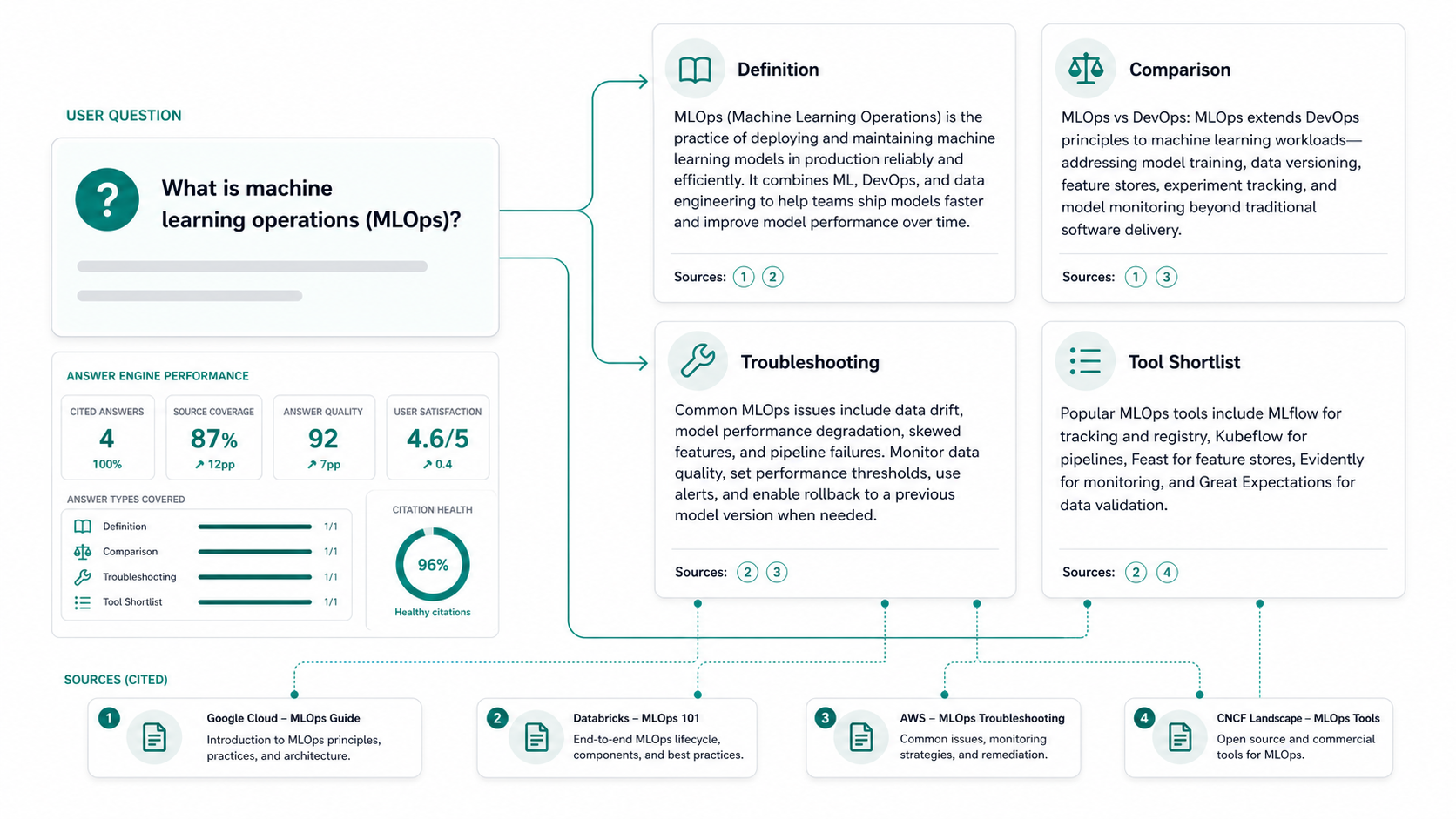
What is a good answer engine optimization example?
A good AEO example is a page section that directly answers a visible question in a format an answer engine can extract: a definition, ordered steps, a comparison table, a failure-mode diagnosis, or a concise FAQ answer. The section must be useful to a reader first, but it also needs a clean heading, specific entities, and a self-contained answer immediately below the heading.
The painful version is familiar: you rank for a topic, but ChatGPT names a competitor; Perplexity cites a review site; Google AI Overview summarizes the category without your URL. That usually means the page exists but the answer is buried, vague, stale, or missing the exact format the engine needs.
Here is the decision rule: if a human cannot copy one paragraph or table from your page and use it to answer the prompt, an answer engine probably cannot either.
Example 1: a definition block for "what is" prompts
Definition prompts need one answer before they need context. AEO loses when the page opens with market history, brand positioning, or a soft intro instead of the definition the user asked for.
Use this pattern:
[Term] is [plain-English definition] for [audience/use case]. It matters because [specific consequence]. The practical test is [one observable signal].
For example:
AI citation tracking is the process of recording when an AI answer cites your page, competitor pages, review sites, or third-party sources for a fixed prompt set. It matters because brand mentions without source ownership can still send the buyer to someone else's URL. The practical test is whether the same target page earns citations week over week.
Why it works: the first two words name the entity, the sentence can stand alone, and the paragraph gives the engine a complete answer without forcing it to infer the job-to-be-done.
Use this for prompts like:
- "what is answer engine optimization"
- "what is AI citation tracking"
- "what is AI share of voice"
- "what is target URL citation rate"
For a deeper content-shape checklist, see how to write content that AI assistants actually cite. If you already know the exact prompt and URL, use the AI engine optimization checklist to turn that page into a stronger cited source.
Example 2: a comparison table for "best" and "vs" prompts
Comparison prompts need structured tradeoffs. A paragraph that says "both tools are powerful" is not enough; the answer engine needs criteria it can lift into a recommendation.
| Prompt type | Weak page shape | AEO-friendly page shape |
|---|---|---|
| "Best X for Y" | Generic list of tools | Ranked picks by use case, with decision criteria |
| "X vs Y" | Feature dump | Pick X if / pick Y if table |
| "Alternatives to X" | Ten logos and summaries | Alternatives grouped by buyer constraint |
| "X for B2B SaaS" | Broad category page | Use-case page with workflow, limits, and next step |
The table should answer the buyer's real decision. If the prompt is "best AI visibility tool for a B2B SaaS team," the columns should be buyer-fit, AI surfaces tracked, prompt volume, reporting cadence, and where the tool is weak. Do not use a generic feature matrix if the buyer is asking for a recommendation.
This is why our B2B SaaS AI search playbook maps prompt shapes to content types before it tells teams what to write.
Example 3: a troubleshooting section for failure-mode prompts
Failure-mode prompts are underrated because they match how buyers ask AI when something is broken. "Why does ChatGPT cite competitors?" and "Why is my brand missing from AI answers?" are more actionable than broad category keywords.
Use this structure:
- Name the symptom.
- Give the likely cause.
- Give the fastest page-level fix.
- Link to the relevant measurement or conversion path.
Example:
| Symptom | Likely cause | Fastest fix |
|---|---|---|
| ChatGPT mentions you but cites a competitor | Your brand is known, but the competitor page is a clearer source | Add a direct answer, table, proof, FAQ, and internal links to the intended URL |
| Perplexity cites your domain but the wrong page | Internal links or headings make the wrong URL look more relevant | Strengthen the target page and link to it from related posts |
| Google AI Overview summarizes the category without you | Your page lacks a concise answer or trusted support | Add a 40-80 word answer, current sources, visible author/date, and matching schema |
| AI answers omit your product entirely | The prompt has no matching page or entity signal | Create a focused use-case, comparison, or alternatives page |
The reader gets a fix immediately. The answer engine gets an extractable diagnosis. Both matter.
If competitor citations are the specific problem, use the full source-gap workflow in why ChatGPT cites competitors instead of your website.
Example 4: a step-by-step answer for workflow prompts
Workflow prompts ask "how do I..." or "what is the best way to..." The answer should be ordered, not essay-shaped.
For AEO, the ideal step list has five to seven steps. Each step needs a short name and a sentence that says what to do. This mirrors how HowTo-style content is parsed, and it is also easier for humans to follow. Google says structured data should match visible page content, so the visible steps must be the source of any schema you ship, not a hidden parallel version in JSON-LD.
Use this template:
- Lock the prompt set. Choose 40-80 prompts across definition, comparison, shortlist, failure-mode, and workflow intent.
- Assign one target URL per prompt. Decide which page should own the answer before changing copy.
- Inspect current answers. Record brand mentions, cited URLs, answer accuracy, and competitor source wins.
- Classify the gap. Label the loss as missing page, weak answer, stale proof, unclear entity, schema mismatch, or wrong URL.
- Fix the page shape. Add the answer block, table, checklist, FAQ, and internal links needed for that prompt.
- Re-measure on the same wording. Do not change the prompt when judging whether the fix worked.
This also gives your team a faster content decision: improve an existing URL when the intent already matches; create a new page only when no current page can honestly own the answer.
Example 5: an FAQ block that matches real AI questions
FAQ content works when it answers the questions a buyer would actually ask. It fails when it repeats the same keyword in six slightly different ways.
Good AEO FAQ questions include:
- "Why does ChatGPT cite competitors instead of my site?"
- "How do I know which page should own an AI citation?"
- "What is the fastest AEO fix for an existing article?"
- "When should I create a new AEO page instead of updating an old one?"
- "How long should I wait before rechecking an AI answer?"
Bad FAQ questions include:
- "What are answer engine optimization examples?"
- "Are answer engine optimization examples important?"
- "Why use answer engine optimization examples?"
The first set maps to buyer problems. The second set exists for keywords, and the copy reads like it.
The AEO example checklist
Use this before publishing a page meant to win answer selection:
- The page has one primary query and one intended target URL.
- The first important H2 has a 40-80 word direct answer under it.
- At least one paragraph starts with "[Term] is..."
- The page includes one table, checklist, or step list where the answer has a structured shape.
- The FAQ questions match visible buyer prompts, not synthetic keyword variants.
- Internal links point to the pillar, the relevant measurement guide, and the conversion page.
- External citations support claims about search features, structured data, or standards.
- Article and FAQ schema match visible content.
- The page receives backlinks from at least one older related post.
- The same prompt will be rechecked after publishing.
For standards and eligibility, keep the page aligned with Google's guidance on AI features, structured data policies, and helpful content guidance. Schema helps engines understand the page, but it is not a substitute for visible, useful copy.
How to measure whether these examples worked
Measure the prompt, not the article. Pick 20-50 prompts the page should influence, run them before publishing, then run the same prompts again after the page is crawled and answers refresh.
Track four fields:
| Metric | What it tells you |
|---|---|
| Brand mention rate | Whether the answer names you |
| Domain citation rate | Whether any page on your domain is cited |
| Target URL citation rate | Whether the intended page is cited |
| Competitor source share | Whether competitors still own the answer |
Target URL citation rate is the most useful page-level metric. Domain citation rate can look good while the wrong URL wins, and brand mention rate can look good while a third-party source controls the narrative.
Run the free Tracemetry audit if you need a quick baseline. For continuous tracking, Tracemetry Pro monitors custom prompt sets weekly across AI surfaces and turns citation gaps into source-grounded content briefs.
FAQ
What is the best answer engine optimization example? The best answer engine optimization example is a direct-answer block under a question-style H2, followed by a table, checklist, or FAQ that makes the answer easy to extract. For most existing pages, this is faster than writing a new article.
How do I optimize an existing page for answer engines? Choose the prompt the page should win, add a direct 40-80 word answer near the top, include a structured table or checklist, add FAQ content that matches real buyer questions, strengthen internal links, and re-measure the exact same prompt after publishing.
What should an AEO comparison table include? An AEO comparison table should include the criteria a buyer uses to make a decision: best fit, tradeoffs, limits, pricing context when appropriate, setup effort, and the situation where each option is the wrong choice. Generic feature tables are weaker.
When should I create a new AEO page instead of updating an old page? Create a new page only when no current URL matches the prompt intent. If a relevant URL already exists, update that page first with clearer answers, proof, schema, and internal links. Overlapping pages can make answer engines pick the wrong URL.
How long does it take to see AEO changes? For page-shape changes, recheck after 7-14 days on fast-crawled sites and again after 30 days. Some Google AI Overview and assistant answers move quickly; competitive prompts may need more authority and repeated measurement.
Start with one page
Do not turn AEO into a 30-page content calendar before proving the loop. Pick one high-intent prompt, one target URL, and one of the examples above. Ship the fix, then re-measure.
If you want the fastest baseline, run the free AI visibility audit. If you already know the prompts you care about, Tracemetry Pro tracks them weekly and shows exactly which page fixes should come next.
Frequently asked questions
What is the best answer engine optimization example?
The best answer engine optimization example is a direct-answer block under a question-style H2, followed by a table, checklist, or FAQ that makes the answer easy to extract. For most existing pages, this is faster than writing a new article.
How do I optimize an existing page for answer engines?
Choose the prompt the page should win, add a direct 40-80 word answer near the top, include a structured table or checklist, add FAQ content that matches real buyer questions, strengthen internal links, and re-measure the exact same prompt after publishing.
What should an AEO comparison table include?
An AEO comparison table should include the criteria a buyer uses to make a decision: best fit, tradeoffs, limits, pricing context when appropriate, setup effort, and the situation where each option is the wrong choice. Generic feature tables are weaker.
When should I create a new AEO page instead of updating an old page?
Create a new page only when no current URL matches the prompt intent. If a relevant URL already exists, update that page first with clearer answers, proof, schema, and internal links. Overlapping pages can make answer engines pick the wrong URL.
How long does it take to see AEO changes?
For page-shape changes, recheck after 7-14 days on fast-crawled sites and again after 30 days. Some Google AI Overview and assistant answers move quickly; competitive prompts may need more authority and repeated measurement.
See your own AI visibility today.
Free public report. 60 seconds. No signup. Or get started on Pro to track 250 prompts continuously.