AI visibility tracking: prompts, metrics, and weekly workflow
How to track AI visibility across ChatGPT, Claude, Perplexity, Gemini, and Google AI Overviews: prompts, mention rate, citation rate, competitor share of voice, and page fixes.
AI visibility tracking is the weekly process of measuring whether AI systems mention your brand, cite your pages, recommend competitors, and change those answers over time. The painful problem is simple: your SEO rank tracker can say everything is stable while ChatGPT, Claude, Perplexity, Gemini, or Google AI Overviews are quietly reshaping the shortlist.
The fast rule: track 40-80 buyer prompts across the AI surfaces your buyers use, separate mentions from cited URLs, weight bottom-funnel prompts more heavily, and turn every lost prompt into one page or source fix.
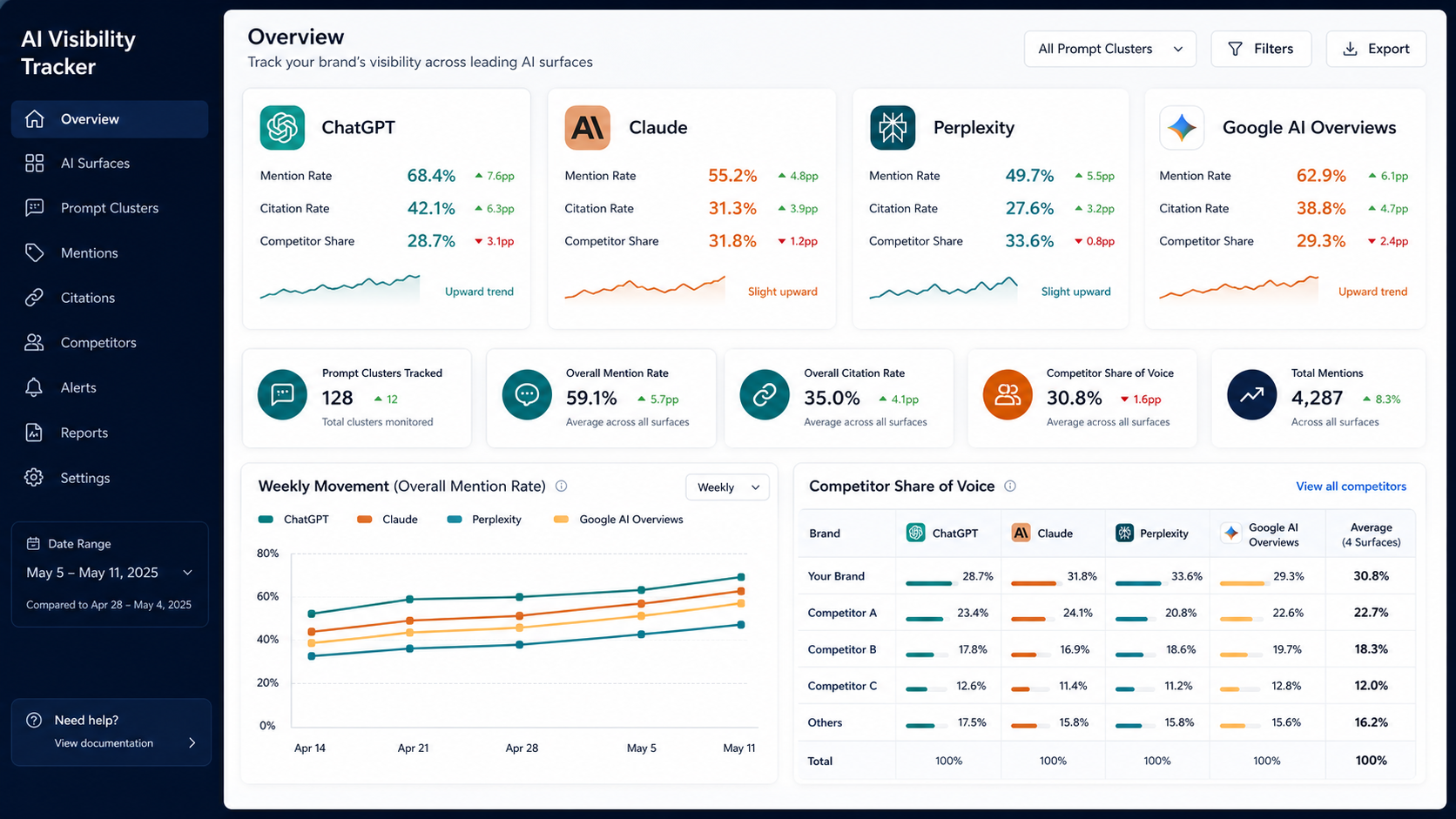
When the raw runs need to become an operating readout, use the AI visibility report template. It shows which metrics belong in the weekly report, how to present surface-level movement, and how to turn weak prompts into a fix queue. If the team is still comparing this work to SEO rank tracking, the AI search monitoring guide explains the prompt, citation, and competitor fields that replace position-only reporting.
Agencies applying this workflow across several accounts should use the agency AI visibility dashboard playbook for client separation, stable cohort governance, intervention logs, and exportable evidence.
Google says sites appearing in AI features such as AI Overviews and AI Mode are included in Search Console's overall Search traffic reporting, but Search Console does not give you a clean prompt-by-prompt export of which AI answer cited which source. OpenAI's ChatGPT Search documentation also makes clear that search answers can include web sources. That means the visibility layer has moved beyond rank position: you need to track generated answers directly.
What is AI visibility tracking?
AI visibility tracking is the process of monitoring brand mentions, cited URLs, competitor recommendations, source ownership, answer accuracy, and week-over-week movement across AI-generated answers. It turns "are we showing up in AI search?" into a measurable prompt-level report.
AI visibility tracking is not the same as normal rank tracking. Rank tracking asks where a URL appears in a list of search results. AI visibility tracking asks whether an answer engine names your brand, cites your domain, recommends a competitor, repeats accurate positioning, and gives the buyer a path back to your site.
Use AI search visibility for the category-level metric. Use AI brand monitoring when the focus is reputation and answer accuracy. Use AI visibility tracking as the operating dashboard that combines prompts, surfaces, citations, competitors, and actions.
If competitors are repeatedly named in the answers, break those losses out with a dedicated AI search competitor mentions score before assigning page fixes. When the cited competitor URLs reveal missing or weak source pages, use answer engine optimization content gap analysis to turn those losses into a page-level fix queue.
If a prompt mentions your brand but describes it incorrectly, split that into a separate AI answer accuracy monitoring issue. Visibility is only useful when the answer is current, sourced, and accurate enough for a buyer.
Why does AI visibility tracking matter if SEO rankings are stable?
AI visibility tracking matters because generated answers can absorb discovery and comparison demand before the buyer clicks a normal search result. A page can still rank well while the AI answer cites a competitor, summarizes the category without you, or sends the buyer to a third-party listicle.
Use this table to spot the gap your normal SEO dashboard misses:
| What changed | What SEO sees | What AI visibility tracking sees |
|---|---|---|
| ChatGPT recommends three competitors | No ranking change | Lost shortlist prompt |
| Perplexity cites a publisher instead of your guide | Organic position may stay flat | Source ownership loss |
| Google AI Overview appears above your result | Average position may still look fine | SERP answer displacement |
| Claude describes old positioning | No crawl issue | Answer accuracy drift |
| Your brand is mentioned without a citation | Branded awareness may rise later | Mention without click path |
| Competitor wins comparison prompts | Existing pages still indexed | Bottom-funnel SOV loss |
That is the new measurement problem. The buyer's question is no longer always expressed as a keyword that leads to ten blue links. It can be a conversational prompt like "what is the best AI visibility tool for a B2B SaaS team under $500 a month?"
Which prompts should you track first?
Track prompts that can change a buying decision before tracking generic category definitions. The first prompt set should cover category, comparison, alternative, workflow, failure-mode, integration, pricing-adjacent, and surface-specific questions.
Start with this mix:
| Prompt bucket | Example AI query | Why it belongs in the set |
|---|---|---|
| Category shortlist | "best AI visibility tracking tools for B2B SaaS" | Determines which vendors enter the buyer's list |
| Comparison | "Tracemetry vs Profound for AI visibility tracking" | Captures preference-shaping answers |
| Alternative | "alternatives to Otterly for ChatGPT tracking" | Finds switching and challenger demand |
| Workflow | "how do I track whether AI answers cite my website?" | Shows whether your educational content is cited |
| Failure mode | "why does ChatGPT recommend my competitors instead of my brand?" | Reveals urgent content and authority gaps |
| Surface-specific | "how do I track Google AI Overview citations?" | Separates Google from chat assistants |
| Pricing-adjacent | "AI visibility tracking tool pricing for startups" | Connects monitoring to commercial intent |
| Integration | "AI search visibility tracking with Search Console data" | Finds technical buyer questions |
Add entity terms that disambiguate the topic: AI visibility tracking, AI search visibility, LLM visibility, ChatGPT Search, Claude, Perplexity, Gemini, Google AI Overviews, cited URLs, citation rate, mention rate, source ownership, AI share of voice, answer accuracy, B2B SaaS, comparison pages, product pages, FAQPage schema, and Search Console.
The exact-match phrase matters for search demand. The conversational versions matter for AI answers. You need both.
What metrics belong in an AI visibility tracking dashboard?
An AI visibility tracking dashboard should include mention rate, citation rate, source ownership, competitor share of voice, answer accuracy, prompt intent, surface-level movement, and the next recommended fix. If the dashboard cannot tell the team what to change this week, it is reporting theater.
Track these fields for every prompt run:
| Metric | Plain-English meaning | Decision it supports |
|---|---|---|
| Mention rate | How often your brand is named | Are we visible at all? |
| Citation rate | How often your domain is cited | Is there a clickable/source path? |
| Source ownership | Which URLs the answer cites | Which page should be improved? |
| Competitor SOV | Which competitors appear and how often | Who is winning the shortlist? |
| Prompt intent | Definition, shortlist, comparison, failure, pricing | Which losses matter most? |
| Surface | ChatGPT, Claude, Perplexity, Gemini, Google AI Overview | Which engine needs attention? |
| Answer accuracy | Correct, incomplete, stale, or wrong | What positioning needs repair? |
| Weekly delta | Movement from the last run | Did the fix work? |
| Recommended action | Update page, create page, earn source, fix schema | What happens next? |
For the math, use the AI share-of-voice formula. For source-level inspection, use ChatGPT citation tracking, ChatGPT SEO prompts, Perplexity SEO, Perplexity citation monitoring, and AI Overview tracking as separate views because each surface behaves differently.
If leadership wants one rollup number, build an AI visibility score from mention rate, citation rate, competitor share, and answer accuracy instead of flattening all prompt rows into a vague "AI SEO" score.
How do you track AI visibility manually?
Manual AI visibility tracking works for a small program if the process is strict. The mistake is testing random prompts when traffic drops and treating the screenshots as evidence. You need a fixed prompt universe, a fixed competitor set, and a fixed cadence.
Use this weekly checklist:
- Lock 40-80 buyer prompts and keep the wording stable.
- Define your brand set: your brand, 3-5 direct competitors, the category leader, and obvious substitutes.
- Run every prompt across ChatGPT, Claude, Perplexity, Gemini, and Google AI Overviews where relevant.
- Run high-intent prompts more than once because generated answers vary.
- Record brand mentions and cited URLs separately.
- Capture cited source order, cited domain, visible answer summary, and competitor names.
- Label each prompt by intent: top-funnel, mid-funnel, or bottom-funnel.
- Weight bottom-funnel prompts more heavily when reporting the score.
- Pick the highest-intent loss and assign one fix.
- Re-measure the same prompt 7-14 days after the fix is published.
This is feasible for 25-40 prompts in a spreadsheet. Past that, the manual process becomes inconsistent. For a fast baseline, run the free Tracemetry audit. For ongoing tracking, use Tracemetry Pro to run the prompt set weekly and keep the competitor, citation, and source data in one place.
How often should you run AI visibility tracking?
Run AI visibility tracking weekly for most B2B SaaS categories. Daily tracking creates noise unless you are monitoring a launch, rebrand, pricing change, product incident, or a major content push. Monthly tracking is too slow because answer engines and competitor pages can move before your team reacts.
Use three cadences:
| Cadence | Best use | Prompt count |
|---|---|---|
| Weekly | Normal category tracking | 40-150 prompts |
| Daily for 14 days | Launches, rebrands, pricing changes, major migrations | 20-60 prompts |
| Monthly | Executive trend summary | Rollup only |
The weekly readout should answer five questions:
- Did our mention rate move?
- Did our citation rate move?
- Which competitors gained share?
- Which prompts changed enough to investigate?
- Which page, source, or schema fix should ship next?
If the report does not produce a work queue, it will not improve AI visibility.
How do you improve AI visibility after tracking?
Improve AI visibility by fixing the prompt-level loss, not by publishing generic "AI search" content. The right fix depends on why the answer did not name or cite you: missing entity clarity, missing page, weak page structure, stale claims, weak third-party proof, or mismatched schema.
Use this triage table:
| Loss type | Symptom | Best fix |
|---|---|---|
| Missing entity | AI answers do not understand what your company does | Rewrite homepage and product copy with clear category, audience, and use-case language |
| Missing page | Competitor has a prompt-matching page and you do not | Publish a focused comparison, alternative, workflow, or failure-mode page |
| Weak source ownership | Your brand is mentioned but another domain is cited | Add extractable tables, direct answers, source-backed claims, and internal links |
| Weak third-party proof | Reddit, review sites, and listicles dominate | Earn reviews, category mentions, partner pages, and credible external coverage |
| Stale answer | AI repeats old pricing or positioning | Update visible pages, dates, product copy, and comparison pages |
| Schema mismatch | Structured data says more than visible content | Align Article and FAQ schema with text users can read |
Google's structured data guidelines emphasize that marked-up information should match user-visible content. Treat schema as a clarity layer, not a hidden answer feed. The visible page has to carry the claim if you want answer engines to cite it confidently.
What is the minimum AI visibility tracking setup?
The minimum setup is one locked prompt set, one competitor set, one weekly run, separate mention and citation fields, and one action queue. Anything less is anecdote collection. Anything more is optional until the team is acting on the data.
Minimum fields:
- Prompt
- Intent bucket
- Surface
- Run date
- Your brand mentioned
- Your domain cited
- Cited URL
- Competitors mentioned
- Competitor URLs cited
- Answer accuracy notes
- Recommended fix
- Owner
- Re-measure date
The owner and re-measure date matter most. AI visibility tracking only compounds when it becomes a loop: measure, diagnose, fix, publish, re-measure. For the planning layer above the dashboard, use a generative engine optimization strategy to decide which prompt losses deserve page updates, new content, schema work, or source-building.
When several prompts cite stale or irrelevant URLs, check whether your source map is clear. A public llms.txt file for AI search can point AI readers toward the docs, comparison pages, pricing pages, and source-worthy articles that should anchor those answers. For the first baseline across all surfaces, use the LLM visibility benchmark to separate mentions, citations, competitors, and accuracy before assigning fixes.
FAQ
What is AI visibility tracking? AI visibility tracking is the process of measuring whether AI-generated answers mention your brand, cite your website, recommend competitors, and change over time across surfaces like ChatGPT, Claude, Perplexity, Gemini, and Google AI Overviews.
How is AI visibility tracking different from rank tracking? Rank tracking measures where a URL appears in a search result list. AI visibility tracking measures generated answers: brand mentions, citations, competitors, source ownership, answer accuracy, and prompt-level movement. A keyword rank can stay stable while AI visibility gets worse.
How many prompts should I track for AI visibility? Start with 40-80 buyer prompts across category, comparison, alternative, workflow, failure-mode, integration, pricing-adjacent, and surface-specific intent. Fewer than 20 is usually too noisy. Mature programs can expand to 150-300 prompts after the team has enough capacity to act on the findings.
Which AI surfaces should I track? Track the surfaces your buyers actually use: ChatGPT, Claude, Perplexity, Gemini, and Google AI Overviews for most B2B SaaS categories. Keep each surface separate because the same prompt can cite your site in Perplexity, omit you in ChatGPT, and show a competitor in Google AI Overviews.
What is the fastest way to improve AI visibility? Find the highest-intent prompt where a competitor is mentioned or cited and you are absent. Fix the page that should answer that prompt with a direct answer, comparison table, current product details, credible sources, visible FAQ content, schema that matches the page, and internal links from related articles.
Start tracking the answers buyers actually see
Run the free Tracemetry audit to see whether your brand appears in AI answers for buyer questions. If the audit shows competitors winning prompts you should own, use Tracemetry Pro to monitor the full prompt set, track citations, generate source-grounded briefs, publish fixes, and re-measure every week.
Frequently asked questions
What is AI visibility tracking?
AI visibility tracking is the process of measuring whether AI-generated answers mention your brand, cite your website, recommend competitors, and change over time across surfaces like ChatGPT, Claude, Perplexity, Gemini, and Google AI Overviews.
How is AI visibility tracking different from rank tracking?
Rank tracking measures where a URL appears in a search result list. AI visibility tracking measures generated answers: brand mentions, citations, competitors, source ownership, answer accuracy, and prompt-level movement. A keyword rank can stay stable while AI visibility gets worse.
How many prompts should I track for AI visibility?
Start with 40-80 buyer prompts across category, comparison, alternative, workflow, failure-mode, integration, pricing-adjacent, and surface-specific intent. Fewer than 20 is usually too noisy. Mature programs can expand to 150-300 prompts after the team has enough capacity to act on the findings.
Which AI surfaces should I track?
Track the surfaces your buyers actually use: ChatGPT, Claude, Perplexity, Gemini, and Google AI Overviews for most B2B SaaS categories. Keep each surface separate because the same prompt can cite your site in Perplexity, omit you in ChatGPT, and show a competitor in Google AI Overviews.
What is the fastest way to improve AI visibility?
Find the highest-intent prompt where a competitor is mentioned or cited and you are absent. Fix the page that should answer that prompt with a direct answer, comparison table, current product details, credible sources, visible FAQ content, schema that matches the page, and internal links from related articles.
See your own AI visibility today.
Free public report. 60 seconds. No signup. Or get started on Pro to track 250 prompts continuously.