AI search optimization: how to make your website citable
How to optimize a website for AI search: prompt-to-page mapping, answer-first sections, proof blocks, schema, internal links, and measurement across ChatGPT, Perplexity, Gemini, Claude, and Google AI Overviews.
AI search optimization is the work of making your website easy for AI-powered search systems to find, understand, quote, and cite when a buyer asks a question. The fastest path is not "write more AI content." It is to pick one revenue-relevant prompt, assign one target URL, make that page answer-first, then measure whether ChatGPT, Perplexity, Gemini, Claude, and Google AI features use it.
If your team already has SEO pages but AI answers still recommend competitors, the problem is usually page ownership. The assistant found a clearer source somewhere else. This guide shows how to fix that without creating a messy pile of overlapping pages.
What is AI search optimization?
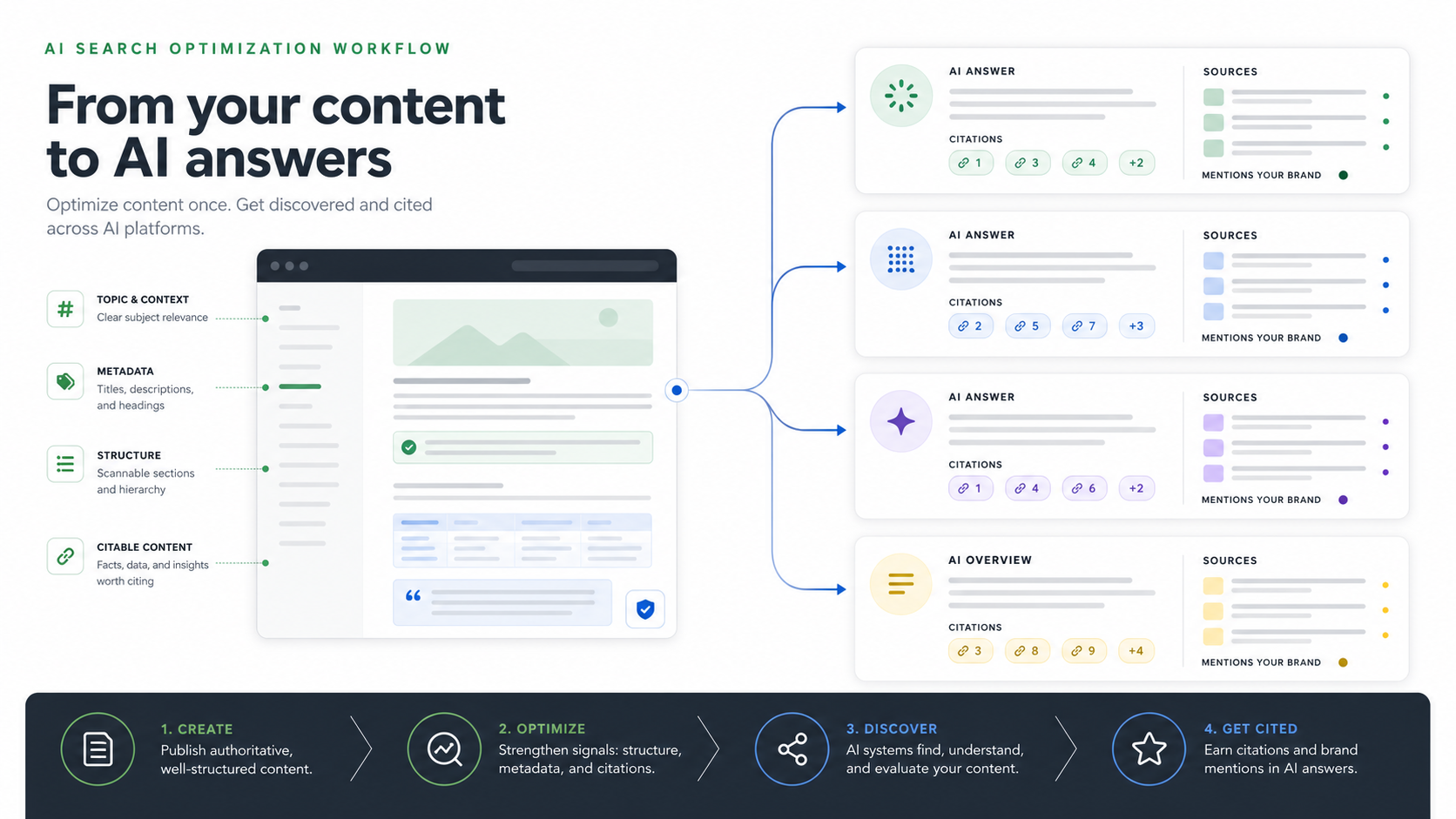
AI search optimization is the process of improving website pages so AI search systems can retrieve them, understand their entity context, extract a useful answer, and cite the correct URL in generated results. It overlaps with SEO, answer engine optimization, and generative engine optimization, but the practical unit is a prompt-to-page match.
AI search optimization is page-level source ownership for AI-generated answers. Instead of asking "does this page rank?", ask "when a buyer asks this exact question, does the assistant name us, cite us, and describe us correctly?"
Google says its AI experiences can show links to supporting web pages, and OpenAI describes ChatGPT Search as answers with relevant web sources. That means your website still matters. The page just has to be easier to use as a source than the pages already winning the answer.
When should you optimize a website for AI search?
Optimize a website for AI search when buyers are asking questions that generate AI answers and your brand is absent, uncited, misdescribed, or replaced by a competitor. The highest-value prompts are category, comparison, alternatives, workflow, pricing-adjacent, and failure-mode questions.
Use this decision rule before editing anything:
| AI answer pattern | What it usually means | Best next move |
|---|---|---|
| Competitor named, you absent | The assistant sees another source as more relevant | Improve or create the target page |
| You are named but not linked | Your brand is known, but the source page is weak | Add a direct answer, proof, FAQ, and schema |
| Your domain is cited, but the wrong URL wins | Your internal topology is unclear | Link older related pages to the intended URL |
| A review site defines your positioning | Third-party proof outranks owned source-of-truth copy | Publish a clearer source page and earn external mentions |
| The answer is outdated or wrong | Freshness and entity facts are weak | Update facts, author/date metadata, and product descriptions |
For broad diagnosis, start with a generative engine optimization audit. For a page-level fix, keep reading.
How do you optimize a website for AI search?
Optimize a website for AI search by building a repeatable loop: choose the prompt, choose the target URL, inspect current AI answers, improve the page, add source signals, link it into the site, and re-measure. The loop matters because AI answers move. A one-time rewrite is not a measurement system.
1. Pick one prompt and one page
Do not begin with a keyword list. Begin with a buyer question that an AI assistant would actually receive:
- "what is the best AI search optimization tool for a B2B SaaS team"
- "how do I optimize my website for AI search"
- "why does ChatGPT cite my competitors instead of my website"
- "best way to track AI search visibility across ChatGPT and Perplexity"
- "Tracemetry vs Profound for AI search monitoring"
Then assign one URL that should win that question. If two pages can answer the same prompt, decide which one owns the intent and make the other page support it with an internal link. Ambiguity makes answer engines pick the wrong source.
2. Add a direct answer under the first important heading
The first H2 should answer the prompt in 40-80 words. It should stand alone if copied into an AI answer. Avoid category history and vague setup. The answer block should name the category, audience, use case, surfaces, and next action.
Use this pattern:
AI search optimization is [definition] for [audience]. It matters because [business consequence]. The fastest way to improve it is [page-level action], then [measurement step].
That shape is boring on purpose. It gives a retriever a complete chunk.
3. Make the page extractable, not just longer
AI search systems cite pages that can support an answer. A 3,000-word essay with no table, checklist, definition, or source links is harder to use than a 1,200-word page with clean answer blocks.
Add at least one extractable block:
| Block type | Use it when the prompt asks... | Example |
|---|---|---|
| Definition | "what is..." | "AI search optimization is..." |
| Decision table | "which should I..." | Tool, service, or workflow comparison |
| Checklist | "how do I..." | Page update sequence |
| Failure-mode table | "why does..." | Diagnosis of missing citations |
| Measurement table | "how do I track..." | Mention rate, citation rate, target URL rate |
If you need examples of the page patterns, use the answer engine optimization examples guide.
4. Add source-worthy proof
Generic claims get paraphrased away. Specific claims, product facts, primary documentation, and current examples are easier to cite.
For AI search optimization pages, proof can include:
- official documentation from Google, OpenAI, Bing, Anthropic, or Perplexity
- a named prompt set and measurement cadence
- a before/after page example
- a table comparing ChatGPT, Perplexity, Gemini, Claude, and Google AI Overviews
- a current author, date, and update trail
- product screenshots or workflow descriptions
Google's structured data guidance says markup should describe content visible to users. Treat that as the standard for AI search too. If the useful answer only exists in metadata, it is weak.
What should an AI-search-ready page include?
An AI-search-ready page should include a direct answer, a clear definition, entity-rich headings, a table or checklist, visible FAQ content, matching schema, source links, and internal links from related pages. These are not decorations. They make the page easier to retrieve, parse, and cite.
Use this pre-publish checklist. For the narrower page-by-page workflow, use the answer engine optimization checklist before you publish or refresh the URL. If leadership wants a site-level grade before deciding what to fix, use the AI optimization for websites source-readiness score.
| Item | Pass condition |
|---|---|
| Prompt owner | One target prompt has one intended URL |
| Direct answer | The first important H2 answers in 40-80 words |
| Entity clarity | The page names the product, category, audience, surface, and use case |
| Extractable block | The page has a table, checklist, or step sequence |
| Source proof | Claims about AI search, schema, or platforms link to reliable sources |
| FAQ | Questions match real AI query phrasing |
| Schema | Article and FAQ schema match visible page content |
| Internal links | The page links to 2-5 related resources and receives backlinks |
| Conversion path | The reader gets a specific next step, not a generic CTA |
For Tracemetry, the conversion path is simple: run a free AI visibility audit for a snapshot, or use Tracemetry Pro for continuous prompt tracking and source-grounded content fixes.
If you are choosing the platform that will produce those measurements, use the AI search optimization tool data accuracy checklist before trusting any blended visibility score.
How is AI search optimization different from SEO?
SEO optimizes for ranking in a list of results. AI search optimization optimizes for being selected as a source inside a generated answer. The work overlaps, but AI search requires stronger prompt mapping, answer-first sections, entity clarity, citation tracking, and page-level measurement.
| Discipline | Main question | Success metric | Common mistake |
|---|---|---|---|
| SEO | "Do we rank for this keyword?" | Rank, impressions, clicks | Treating ranking as the whole job |
| AEO | "Does our page answer the question directly?" | Answer selection, snippet capture, citation ownership | Writing vague intros before the answer |
| GEO | "Does the assistant name our brand?" | Brand mention rate, recommendation rate | Measuring mentions without source URLs |
| AI search optimization | "Does the assistant cite the correct page?" | Target URL citation rate, answer accuracy, referral traffic | Creating duplicate pages for the same prompt |
The sharpest AI search metric is target URL citation rate. Domain citation rate can hide the real problem: the assistant may cite your site, but use a weak or outdated URL.
How do you measure AI search optimization?
Measure AI search optimization by running a fixed prompt set across the surfaces your buyers use, then tracking brand mentions, cited URLs, answer accuracy, competitor source share, and referral traffic. Keep prompt wording stable so you are measuring page movement, not test noise.
Start with 40-80 prompts if this is a real business program. Include:
- category prompts: "best AI visibility tools"
- workflow prompts: "how do I track AI search visibility"
- comparison prompts: "Tracemetry vs Profound"
- alternatives prompts: "Profound alternatives for B2B SaaS"
- failure-mode prompts: "why does ChatGPT cite competitors"
- reporting prompts: "how do I measure AI share of voice"
Then record results by surface. ChatGPT, Perplexity, Gemini, Claude, and Google AI Overviews do not behave the same way. A page can win Perplexity citations and still be absent from ChatGPT.
For surface-specific workflows, use ChatGPT citation tracking, Perplexity citation tracking, Gemini citation tracking, and AI Overview tracking.
What is the fastest AI search optimization fix?
The fastest AI search optimization fix is to update the page that should already own the prompt. Add a direct answer near the top, a decision table or checklist, visible FAQ content, credible source links, matching schema, and internal links from older related posts.
Do this in one sitting:
- Pick the prompt where a competitor is currently cited.
- Decide which URL should win.
- Add a 40-80 word direct answer under the first relevant H2.
- Add one table that answers the decision or failure mode.
- Add 4-6 FAQ answers that match real AI queries.
- Link from 2-3 older pages to the improved URL.
- Re-run the same prompt after 7-14 days.
If the page still does not move, the missing ingredient is usually authority or proof, not word count. Earn external mentions, add stronger examples, or create a more defensible comparison.
FAQ
What is AI search optimization? AI search optimization is the process of making website pages easier for AI search systems to retrieve, understand, cite, and recommend in generated answers. It focuses on prompt-to-page ownership, not just keyword rankings.
How do I optimize my website for AI search? Pick one buyer prompt, assign one target URL, add a direct answer near the top, include a table or checklist, cite reliable sources, add FAQ and Article schema that matches visible content, link related pages to the URL, and re-measure the same prompt.
Is AI search optimization the same as answer engine optimization? They overlap. Answer engine optimization is the broader practice of being selected as an answer. AI search optimization is the website and page-level work that helps AI search systems cite the correct source URL.
What metrics matter for AI search optimization? Track brand mention rate, domain citation rate, target URL citation rate, answer accuracy, competitor source share, and AI referral traffic. Target URL citation rate is the most actionable page-level metric.
How long does AI search optimization take? For fast-crawled sites, recheck 7-14 days after a page update and again after 30 days. Some answers move quickly, but competitive prompts often need stronger proof, internal links, and external authority before they shift.
Do I need new pages for every AI search prompt? No. Create a new page only when no existing URL honestly matches the prompt. If a relevant page already exists, improve that page first. Too many overlapping pages can make AI systems cite the wrong URL.
Start with one source gap
Pick the AI answer where losing hurts the most: a comparison, shortlist, workflow, or failure-mode prompt where a competitor owns the source. Fix the intended page, link it properly, and measure the same prompt again.
Run the free Tracemetry audit to see the first gaps across AI surfaces. Use Tracemetry Pro when you want weekly prompt tracking, competitor source monitoring, and source-grounded briefs for the pages that should win.
Sources: Google AI optimization guide, Google AI features and your website, Google structured data introduction, Google structured data policies, OpenAI ChatGPT Search announcement, and OpenAI ChatGPT Search Help Center.
Frequently asked questions
What is AI search optimization?
AI search optimization is the process of making website pages easier for AI search systems to retrieve, understand, cite, and recommend in generated answers. It focuses on prompt-to-page ownership, not just keyword rankings.
How do I optimize my website for AI search?
Pick one buyer prompt, assign one target URL, add a direct answer near the top, include a table or checklist, cite reliable sources, add FAQ and Article schema that matches visible content, link related pages to the URL, and re-measure the same prompt.
Is AI search optimization the same as answer engine optimization?
They overlap. Answer engine optimization is the broader practice of being selected as an answer. AI search optimization is the website and page-level work that helps AI search systems cite the correct source URL.
What metrics matter for AI search optimization?
Track brand mention rate, domain citation rate, target URL citation rate, answer accuracy, competitor source share, and AI referral traffic. Target URL citation rate is the most actionable page-level metric.
How long does AI search optimization take?
For fast-crawled sites, recheck 7-14 days after a page update and again after 30 days. Some answers move quickly, but competitive prompts often need stronger proof, internal links, and external authority before they shift.
Do I need new pages for every AI search prompt?
No. Create a new page only when no existing URL honestly matches the prompt. If a relevant page already exists, improve that page first. Too many overlapping pages can make AI systems cite the wrong URL.
See your own AI visibility today.
Free public report. 60 seconds. No signup. Or get started on Pro to track 250 prompts continuously.