Answer engine optimization content gap analysis: find prompts competitors own
How to run an answer engine optimization content gap analysis: map buyer prompts to cited competitor URLs, target pages, loss reasons, page fixes, and re-measurement.
Answer engine optimization content gap analysis solves the problem that old SEO gap reports miss: your team can have rankings, articles, and decent topical coverage while AI answers still cite competitors for the questions that shape a buyer's shortlist.
Use the fast rule: an AEO content gap is not "we do not have a post for this keyword." It is "we do not have one clear, citable source URL for this buyer prompt." Find the prompts where competitors win, map the cited URLs, decide whether to update or create a page, then re-measure the same prompt after the fix ships.
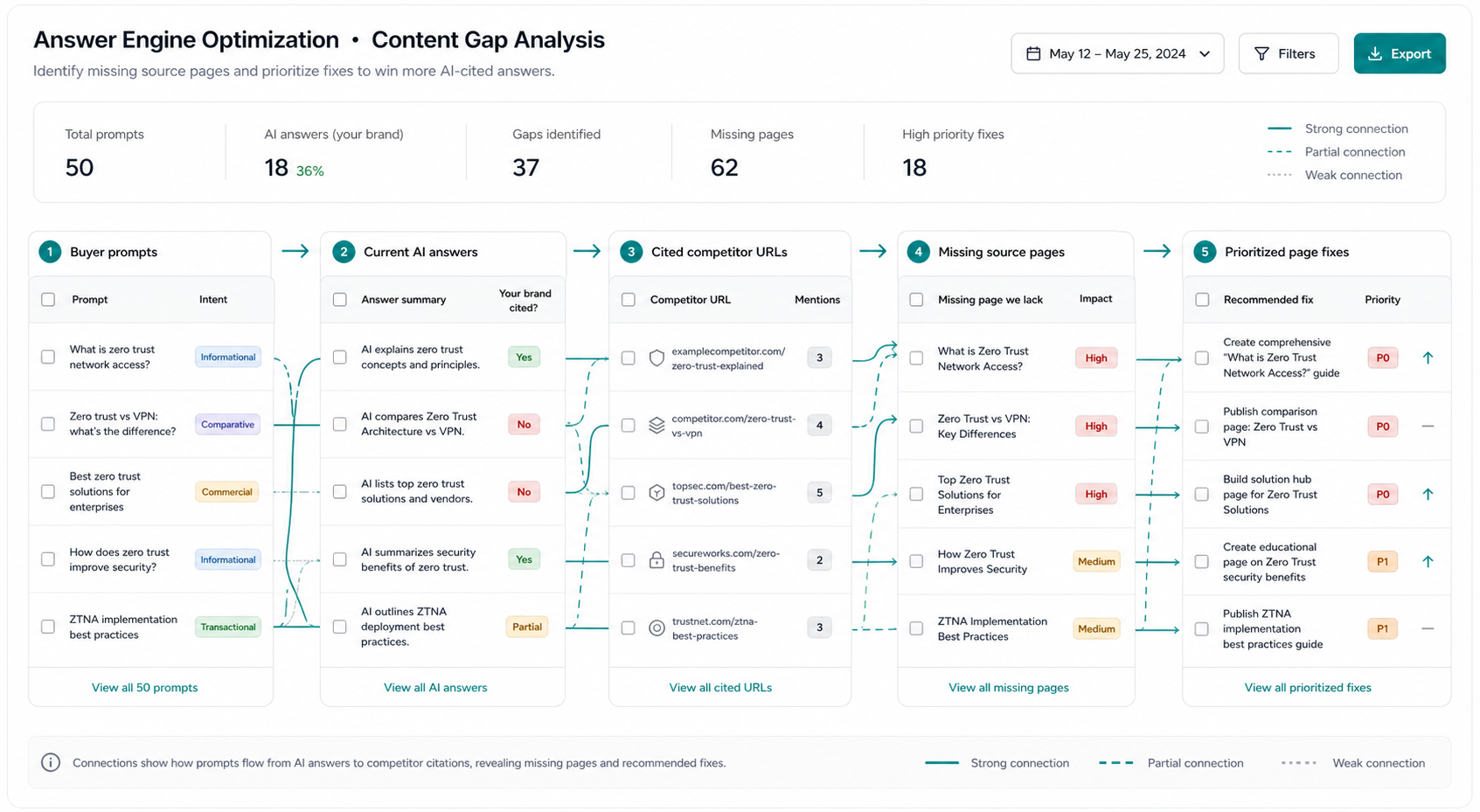
This guide fits between the AI optimization for websites score, the answer engine optimization content brief, and AI visibility tracking. Use it when the audit says "competitors keep getting cited" and the team needs to know exactly which pages are missing, weak, stale, or overlapping. If you first need to compare who wins each buyer question and which sources support them, run an AEO competitor analysis.
What is answer engine optimization content gap analysis?
Answer engine optimization content gap analysis is the process of finding buyer prompts where AI answer systems cite, mention, or recommend competitors because your site lacks the right source page. It maps each prompt to the intended URL, current cited sources, loss reason, fix type, internal links, and re-measurement date.
An AEO content gap is a missing or weak source for an AI-generated answer. It can be a page that does not exist, a page that exists but buries the answer, a page with no proof, or a cluster where several URLs compete for the same prompt.
Google's guidance for AI features says normal Search foundations still matter: useful, crawlable content and eligible links remain part of the system. OpenAI's ChatGPT Search help center also describes answers with links to web sources. The practical conclusion is blunt: if your best page cannot be retrieved, extracted, and trusted as a source, an answer engine has every reason to cite someone else.
How is an AEO content gap different from an SEO content gap?
An SEO content gap compares keywords and ranking URLs. An AEO content gap compares generated answers, cited URLs, brand mentions, competitor recommendations, answer accuracy, and the page that should own each prompt. The unit of analysis changes from keyword rank to prompt-source ownership.
Use this table to keep the two workflows separate:
| Gap type | SEO content gap | AEO content gap |
|---|---|---|
| Input | Keywords, SERPs, ranking pages | Buyer prompts, AI answers, cited URLs |
| Loss signal | Competitor ranks and you do not | Competitor is cited, named, or recommended |
| Page decision | Publish a missing keyword page | Update or create the source URL that should own the prompt |
| Proof needed | Search intent coverage | Direct answer, table, visible FAQ, sources, entity clarity |
| Success metric | Rank, impressions, clicks | Target URL citation rate, mention rate, recommendation movement |
| Common mistake | Thin page for every keyword | Overlapping pages for the same generated answer |
SEO gap analysis still helps with vocabulary. It tells you how people phrase the topic. AEO gap analysis tells you what the AI answer currently trusts and which source page has to change.
Which prompts should you analyze first?
Start with prompts that can change buying behavior: shortlist, comparison, alternatives, workflow, failure-mode, pricing-adjacent, integration, and surface-specific questions. Definition prompts can wait unless they control category positioning or feed a commercial page.
Build a starting set like this:
| Prompt bucket | Example query | Why it finds gaps |
|---|---|---|
| Shortlist | "best AI visibility tool for a B2B SaaS marketing team" | Shows which vendors enter the generated buyer list |
| Comparison | "Tracemetry vs Profound for AI search reporting" | Finds pages that shape preference |
| Alternative | "best Otterly alternative for ChatGPT citation tracking" | Reveals challenger and switching demand |
| Workflow | "how do I find content gaps for answer engine optimization" | Shows whether your educational source pages are citable |
| Failure mode | "why does ChatGPT cite competitors instead of my site" | Exposes urgent source and proof gaps |
| Pricing-adjacent | "affordable answer engine optimization tools for startups" | Connects source ownership to commercial fit |
| Surface-specific | "how do I improve Perplexity citations for my website" | Separates ChatGPT, Perplexity, Gemini, Claude, and AI Overviews |
Add entity terms that disambiguate the market: answer engine optimization, AEO, generative engine optimization, AI search visibility, ChatGPT Search, Perplexity citations, Google AI Overviews, Gemini, Claude, cited URLs, source ownership, competitor mentions, B2B SaaS, product pages, comparison pages, FAQPage schema, and pricing pages.
How do you run an AEO content gap analysis?
Run the analysis in five steps: lock the prompt set, collect current AI answers, map cited URLs, classify the loss, and assign one page fix. The workflow should end with a work queue, not a folder of screenshots.
1. Lock the prompt set
Choose 40-80 prompts for a durable program or 15-25 prompts for a quick diagnostic. Keep the wording stable. If you change the prompt every time you test, you cannot tell whether a page fix moved the answer or whether you simply asked a different question.
2. Collect the current answers
Run the prompts across the surfaces your buyers actually use. Keep ChatGPT, Perplexity, Gemini, Claude, and Google AI experiences separate because their cited sources and brand recommendations can diverge.
Record these fields for every run:
| Field | Why it matters |
|---|---|
| Prompt | The exact buyer question |
| Surface | The answer engine tested |
| Your brand mentioned | Whether the answer names you |
| Your domain cited | Whether there is a source path to your site |
| Target URL cited | Whether the intended page owns the answer |
| Competitors mentioned | Who is shaping the shortlist |
| Competitor URLs cited | Which source pages are winning |
| Answer accuracy | Whether facts about your product or category are correct |
| Loss reason | The fix you should assign |
Screenshots are useful evidence, but rows are what make the process operational.
3. Map each prompt to one intended URL
Every important prompt needs one page owner. If your site has no honest page for the prompt, mark it as a missing page. If three pages could answer it, pick the strongest owner and make the other pages support it with internal links.
Use this routing rule:
| Prompt intent | Best URL owner |
|---|---|
| "What is..." | Pillar, glossary, or category page |
| "How do I..." | Workflow, checklist, or tutorial page |
| "Best tool for..." | Buyer guide, comparison, or product-fit page |
| "X vs Y" | Honest comparison page |
| "Why does..." | Failure-mode or troubleshooting page |
| Pricing or plan fit | Pricing, feature, or product page |
This is the step most teams skip. Without page ownership, content gap analysis becomes a list of articles to write. With page ownership, it becomes a source map.
4. Classify the loss reason
Do not label every miss as "need new content." Most AEO gaps are page-shape problems, not topic absence.
Use this loss matrix:
| Loss reason | What it looks like | Best fix |
|---|---|---|
| Missing page | Competitor has a prompt-matching page and you do not | Publish one focused page that owns the prompt |
| Weak direct answer | Your page exists but never states the answer cleanly | Add a 40-80 word answer under the first relevant H2 |
| Weak proof | The claim is true but unsupported | Add table, example, methodology, source links, or product evidence |
| Ambiguous entity language | The page avoids category, audience, competitor, or use-case terms | Name the nouns answer systems need to disambiguate the page |
| Overlapping pages | Several URLs answer the same prompt | Pick one owner, update titles/H2s, and link support pages to it |
| Stale facts | AI repeats old pricing, features, or positioning | Update visible product, pricing, docs, and comparison content |
| Third-party proof gap | Review sites or publishers dominate vendor prompts | Earn credible reviews, partner pages, directory mentions, or source citations |
The fastest win is usually not a new article. It is the highest-intent prompt where a competitor is cited and your target URL is absent, but your site already has a page that could honestly answer the question after a focused update.
What should the fix queue include?
The fix queue should include prompt, intent, surface, cited competitor URL, intended URL, loss reason, fix type, internal links to add, owner, and re-measure date. If the queue does not include a target URL, the team cannot ship the fix cleanly.
Use this copyable format:
Prompt:
[exact AI query]

Intent:
[shortlist / comparison / workflow / failure-mode / pricing-adjacent]

Current winner:
[competitor or publisher URL cited today]

Intended source URL:
[existing URL to update or new URL to publish]

Loss reason:
[missing page / weak answer / weak proof / stale facts / overlap / authority gap]

Fix:
[direct answer, table, FAQ, schema, examples, product facts, internal links]

Internal links to add:
[2-5 source pages that should point to the intended URL]

Conversion path:
[/features, /pricing, /demo, or the relevant product page]

Re-measure:
[same prompt, same surfaces, 7-14 days after publish or crawl]
This reduces effort because writers, editors, and product marketers do not have to infer strategy from a keyword export. It reduces time because every fix is already tied to a page and a measurement step.
Should you update an old page or create a new one?
Update an old page when it already matches the prompt intent. Create a new page only when no current URL can honestly answer the question. Overlapping pages can make answer engines cite the wrong URL or skip your site because the source map is unclear.
Use this decision table:
| Situation | Update existing page | Create new page |
|---|---|---|
| Page already matches the prompt | Yes | No |
| Page ranks but AI cites competitors | Yes, improve answer/proof/source clarity | Usually no |
| No URL answers the buyer job | No | Yes |
| Existing page is too broad | Maybe, if it can own the prompt | Yes, if the intent deserves a focused source |
| Several posts overlap | Consolidate or clarify ownership | No, until overlap is fixed |
| Product/pricing facts are stale | Yes | No |
For Tracemetry's own topic graph, this article should not replace the answer engine optimization checklist or the AEO content brief template. It owns the gap-analysis step: finding which prompt needs which source page before the brief or checklist work begins.
What proof makes the new or updated page citable?
The page needs at least one extractable proof block: a decision table, checklist, side-by-side example, methodology, metric definition, source-backed claim, or before/after page fix. AEO pages fail when they make true claims in a format an answer system cannot confidently lift.
Use this proof checklist before publishing:
- The page has a direct answer under the first important H2.
- The article includes one table or checklist that answers the prompt without surrounding context.
- Claims about Google AI features, structured data, or ChatGPT search cite official sources.
- Product claims name current features, use cases, limitations, and conversion paths.
- FAQ answers match visible page text and any schema output.
- Related pages link to the intended URL with descriptive anchors.
Google's structured data policies are a useful forcing function: structured data should match visible page content. Treat the whole page the same way. Do not hide the answer in metadata. Put the useful answer where readers can see it.
How do you measure whether the gap closed?
Measure the same prompt after the page is crawled or refreshed. Track target URL citation rate, domain citation rate, brand mention rate, recommendation rate, answer accuracy, competitor source share, and AI referral traffic where available.
Use this minimum recheck:
| Metric | Question it answers |
|---|---|
| Target URL citation rate | Did the intended page become the source? |
| Domain citation rate | Did any page from your site get cited? |
| Brand mention rate | Did the answer name your brand? |
| Recommendation rate | Did the answer put your brand forward as an option? |
| Competitor source share | Are competitor pages still supporting the answer? |
| Answer accuracy | Did the answer describe your product or category correctly? |
Recheck after 7-14 days on fast-crawled sites, then again after 30 days. Do not declare victory from one answer. Generated answers vary, so look for movement across the locked prompt set.
How can Tracemetry help find AEO content gaps?
Tracemetry helps find AEO content gaps by connecting prompt monitoring, cited URLs, competitor mentions, answer accuracy, source-grounded briefs, and re-measurement. The useful output is a fix queue: which prompt is lost, which URL should own it, why the current page fails, and what to publish or update next.
A practical workflow looks like this:
- Run the prompt set across ChatGPT, Claude, Perplexity, Gemini, and Google AI experiences.
- Identify prompts where competitors are cited, your brand is missing, or the wrong URL is sourced.
- Classify the loss as missing page, weak answer, weak proof, stale facts, overlap, or authority gap.
- Generate the brief for the intended source page.
- Publish the fix, add internal links, and re-measure the same prompt.
Run the free Tracemetry audit to see the first source gaps for your domain. Use Tracemetry Pro when you want weekly prompt tracking, competitor citation monitoring, source-grounded briefs, and measured page fixes in one workflow.
FAQ
What is answer engine optimization content gap analysis? Answer engine optimization content gap analysis finds buyer prompts where AI answers cite, mention, or recommend competitors because your site lacks the right source page. It maps each prompt to a target URL, current cited sources, loss reason, page fix, internal links, and re-measurement step.
How is AEO content gap analysis different from SEO gap analysis? SEO gap analysis compares keywords and ranking pages. AEO content gap analysis compares prompts, generated answers, cited URLs, brand mentions, competitor recommendations, answer accuracy, and whether the intended source URL is being cited.
What is the fastest way to find AEO content gaps? Run 15-25 high-intent prompts across the AI surfaces your buyers use, record which competitor URLs are cited, map each prompt to the page that should own it, and classify the loss reason. Start with prompts where a competitor is cited and your target URL is absent.
Should I create new content for every AEO gap? No. Update an existing page when it already matches the prompt intent. Create a new page only when no current URL can honestly answer the question. Publishing overlapping pages can weaken source clarity.
Which metrics show that an AEO content gap closed? Target URL citation rate is the most useful page-level metric. Also track domain citation rate, brand mention rate, recommendation rate, answer accuracy, competitor source share, and AI referral traffic where available.
How often should I recheck a fixed prompt? Recheck the same prompt after 7-14 days for fast-crawled sites, then again after 30 days. Keep the wording, surface, target URL, and competitor set stable so the comparison is meaningful.
Start with the lost source, not the missing keyword
The old content-gap instinct is to publish more pages. The better AEO move is to find the answer source you are losing, decide whether an existing URL can own it, and make that page easier to cite.
Start with one painful prompt, one intended source URL, and one fix. Then re-measure. That loop beats a 50-topic content calendar that never checks whether AI answers changed.
Sources: Google AI features and your website, Google generative AI optimization guidance, Google structured data policies, OpenAI ChatGPT Search Help Center, and OpenAI ChatGPT Search announcement.
Frequently asked questions
What is answer engine optimization content gap analysis?
Answer engine optimization content gap analysis finds buyer prompts where AI answers cite, mention, or recommend competitors because your site lacks the right source page. It maps each prompt to a target URL, current cited sources, loss reason, page fix, internal links, and re-measurement step.
How is AEO content gap analysis different from SEO gap analysis?
SEO gap analysis compares keywords and ranking pages. AEO content gap analysis compares prompts, generated answers, cited URLs, brand mentions, competitor recommendations, answer accuracy, and whether the intended source URL is being cited.
What is the fastest way to find AEO content gaps?
Run 15-25 high-intent prompts across the AI surfaces your buyers use, record which competitor URLs are cited, map each prompt to the page that should own it, and classify the loss reason. Start with prompts where a competitor is cited and your target URL is absent.
Should I create new content for every AEO gap?
No. Update an existing page when it already matches the prompt intent. Create a new page only when no current URL can honestly answer the question. Publishing overlapping pages can weaken source clarity.
Which metrics show that an AEO content gap closed?
Target URL citation rate is the most useful page-level metric. Also track domain citation rate, brand mention rate, recommendation rate, answer accuracy, competitor source share, and AI referral traffic where available.
How often should I recheck a fixed prompt?
Recheck the same prompt after 7-14 days for fast-crawled sites, then again after 30 days. Keep the wording, surface, target URL, and competitor set stable so the comparison is meaningful.
Make your next SEO decision with better evidence.
Explore practical guides to AI visibility, source citations, and choosing the right tools for your team.