AI brand monitoring alerts: what deserves an immediate fix?
How to set AI brand monitoring alerts for buyer-risk changes: lost mentions, competitor gains, citation drops, wrong claims, negative sentiment, and source drift.
AI brand monitoring alerts are the trigger rules that tell your team when an AI answer changed enough to investigate. The painful problem is not lack of data. It is waking up to a dashboard full of prompt drift, competitor mentions, missing citations, and sentiment labels with no idea which change actually deserves a page fix today.
The fast rule: alert on buyer-risk changes, not every answer variation. Page someone when a high-intent prompt loses your brand, cites a competitor, repeats a wrong claim, drops the target URL, or changes sentiment from positive/neutral to mixed/negative. Everything else belongs in the weekly report.
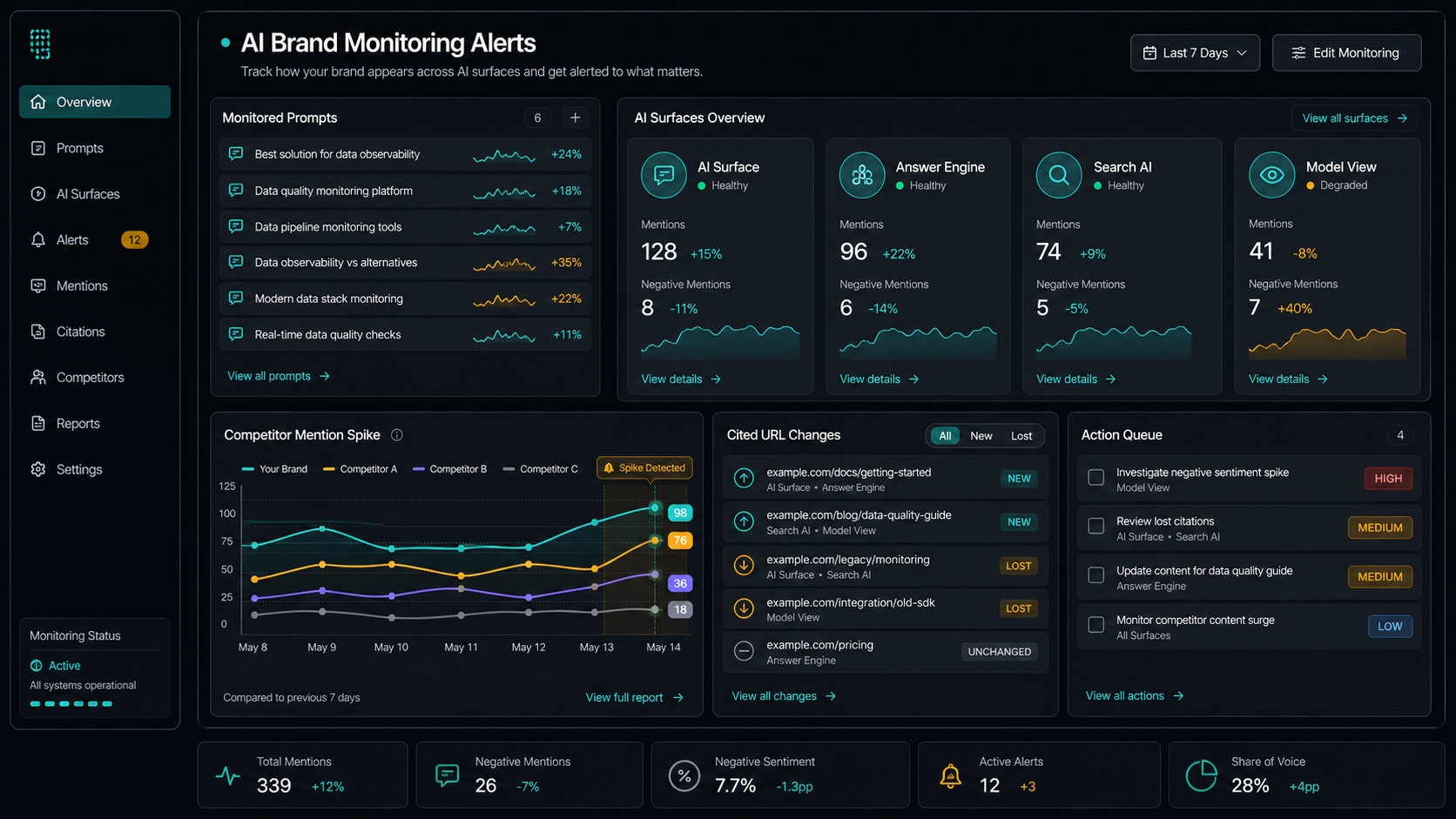
Google explains that AI features can show a generated snapshot with links to supporting web results. OpenAI describes ChatGPT search as answers with links to relevant web sources. For operators, that means the alert needs to watch the generated answer, the cited URL, and the buyer prompt together.
Use AI brand monitoring for the full operating model, AI search sentiment monitoring for tone labels, and AI answer accuracy monitoring when the alert is tied to a wrong product, pricing, or positioning claim.
What is an AI brand monitoring alert?
An AI brand monitoring alert is a rule that fires when a tracked prompt, AI surface, brand mention, cited URL, competitor mention, answer sentiment, or accuracy label crosses a threshold. The alert should include the exact prompt, answer excerpt, cited sources, prior result, severity, and recommended next action.
AI brand monitoring alerts are not the same as social mention alerts. A social alert tells you someone posted about the brand. An AI alert tells you an answer engine changed the way it describes, cites, ranks, or compares your brand for a buyer question.
Good alerts answer one operator question: "Do we need to fix something now, or can this wait for the weekly AI visibility review?"
Which AI answer changes deserve an alert?
Alert on changes that can affect buying confidence, shortlist inclusion, or source ownership. Do not alert on harmless wording differences, broad top-of-funnel prompts, or one-off variation where the brand, citation, and competitor outcome stayed the same.
Use this severity table:
| Alert type | Trigger | Severity | First owner |
|---|---|---|---|
| Brand disappeared | High-intent prompt mentioned you last run, now it does not | Critical | SEO/content |
| Competitor replaced you | Competitor is recommended and you are absent | Critical | Product marketing |
| Target URL lost citation | Your domain is cited, but the wrong page owns the answer | High | SEO/content |
| Wrong claim appeared | Answer repeats stale pricing, missing feature, or false comparison | High | Product marketing |
| Sentiment worsened | Positive or neutral answer became mixed or negative | High | Brand/content |
| New source dominates | Review, Reddit, publisher, or competitor page became the cited source | Medium | SEO/PR |
| AI surface drift | One surface changed while others stayed stable | Medium | SEO/analytics |
| Low-intent wording drift | Answer changed wording without buyer-risk movement | Low | Weekly report |
If the alert involves a named competitor, use the AI search competitor mentions workflow before assigning a fix. If the alert involves the correct brand but the wrong source URL, check AI citation decay.
What should the alert payload include?
An AI brand monitoring alert should include enough evidence for a human to decide in under five minutes. The alert should not just say "visibility dropped." It should show the prompt, surface, old outcome, new outcome, cited URLs, likely reason, and the page or source to inspect first.
Minimum alert payload:
| Field | Example | Why it matters |
|---|---|---|
| Prompt | "best AI visibility tools for B2B SaaS" | Shows buyer intent |
| Surface | ChatGPT, Perplexity, Gemini, Claude, Google AI Overview | Keeps engines separate |
| Previous outcome | Brand cited, target URL cited, positive framing | Baseline |
| Current outcome | Competitor cited, brand absent | Change |
| Cited URLs | Competitor comparison page, publisher listicle | Source path |
| Severity | Critical, high, medium, low | Routing |
| Business risk | Lost shortlist, wrong claim, citation loss | Why it matters |
| Recommended action | Update comparison page, earn source, fix pricing claim | Next step |
| Re-measure date | 7-14 days after fix | Closes the loop |
For source-level alerts, include the exact cited URL. For answer-quality alerts, include the sentence that changed. For competitor alerts, include all named competitors so AI share of voice stays consistent.
How do you set alert thresholds without creating noise?
Set thresholds by prompt intent and severity, not by a generic percentage drop. One high-intent prompt losing a competitor comparison can matter more than ten broad educational prompts changing wording. Start strict, review every alert for two weeks, then relax only where the team can act.
Use this rule set:
- Critical alerts: Fire immediately when a bottom-funnel prompt loses the brand, a competitor replaces you, or a wrong claim appears in a buying answer.
- High alerts: Fire within the workday when the target URL loses citation, answer sentiment worsens, or a key source changes.
- Medium alerts: Batch daily when a surface drifts, a new third-party source appears, or a prompt needs review but no buyer-risk change happened.
- Low alerts: Never page. Put them in the weekly AI visibility report.
The easiest anti-noise rule: require two samples for critical alerts when the surface is highly variable, unless the answer contains a harmful wrong claim. For launch, pricing, or incident periods, run daily alerts for 14 days and then return to weekly monitoring.
What prompt set should alerts watch first?
Alerts should watch the prompts where a changed AI answer can change a deal. Start with comparison, category shortlist, alternatives, pricing-adjacent, implementation-risk, integration, and failure-mode prompts. Add broad awareness prompts later.
Build the first alert set from these prompt buckets:
| Prompt bucket | Example AI query | Alert to watch |
|---|---|---|
| Category shortlist | "best AI visibility tools for startups" | Brand absent or competitor first-named |
| Comparison | "Tracemetry vs Profound for AI search monitoring" | Competitor-favorable framing |
| Alternative | "best alternative to Otterly for ChatGPT tracking" | Missing challenger mention |
| Pricing-adjacent | "affordable AI brand monitoring tool" | Wrong pricing or fit claim |
| Source ownership | "how do I track AI brand mentions?" | Target URL citation loss |
| Failure mode | "why does ChatGPT recommend my competitors?" | Wrong diagnostic advice |
| Surface-specific | "how do I monitor Google AI Overview citations?" | Google-only citation drift |
Natural entity terms help disambiguate the task: AI brand monitoring alerts, AI brand monitoring, AI search visibility, ChatGPT Search, Perplexity, Gemini, Claude, Google AI Overviews, cited URLs, competitor recommendations, answer sentiment, answer accuracy, target URL citation rate, source ownership, and B2B SaaS.
How should teams route AI brand monitoring alerts?
Route each alert to the team that can change the source of truth. Content should own page-shape and internal-link fixes. Product marketing should own positioning, competitor, and pricing claims. PR should own third-party source gaps. Analytics should own tracking and attribution issues.
Use this routing table:
| Alert reason | Send to | First action |
|---|---|---|
| Brand absent from buyer prompt | SEO/content | Map prompt to target page and improve direct answer |
| Competitor cited instead | Product marketing + SEO | Inspect competitor source and publish a sharper comparison |
| Wrong product or pricing claim | Product marketing | Fix source-of-truth pages and visible FAQ content |
| Negative or stale framing | Brand/content | Find cited source and update proof or positioning |
| Third-party source dominates | PR/partnerships | Earn or correct external proof |
| Wrong page cited | SEO | Strengthen target page and internal links |
| AI referral drop | Analytics + SEO | Compare citations, landing pages, and referral logs |
Do not send every alert to the same Slack channel. That is how teams learn to ignore the system. Route by fix owner and include the smallest useful action.
What is the best way to investigate an AI alert?
Investigate by preserving evidence first, then tracing the source path. Generated answers can change, so the prompt, surface, timestamp, raw answer, citations, and screenshots matter before anyone rewrites a page.
Use this 20-minute checklist:
- Save the raw answer, cited URLs, surface, date, location if relevant, and sample number.
- Compare against the last stable result for the same prompt.
- Label the alert type: brand absent, competitor gain, citation loss, sentiment drop, wrong claim, or source drift.
- Read every cited URL before editing your own page.
- Decide which page should own the prompt.
- Update the direct answer, evidence, table, FAQ, schema, and internal links on that page.
- Add the fix owner and re-measure date.
- Re-run the same prompt after 7-14 days.
For manual teams, a spreadsheet is enough for 20-40 prompts. For weekly monitoring across surfaces, use the free Tracemetry audit for a snapshot and Tracemetry Pro when you need ongoing alerts, raw answer evidence, cited URLs, competitor extraction, and source-grounded briefs.
How often should AI brand monitoring alerts run?
Run AI brand monitoring alerts weekly for normal operations, daily during launch or pricing windows, and immediately for a small set of crisis prompts. The cadence should match the cost of missing a change, not the team's appetite for dashboards.
| Cadence | Use it for | Prompt set |
|---|---|---|
| Weekly | Normal B2B SaaS monitoring | 40-150 prompts |
| Daily for 14 days | Launches, pricing changes, rebrands, major page fixes | 20-60 prompts |
| Immediate | Reputation, safety, legal, or critical sales claims | 5-20 prompts |
| Monthly | Executive trend review | Rollup only |
Monthly alerting is too slow for high-intent prompts. Daily alerting on every prompt is noisy. Weekly with severity-based routing is the sane default.
Start with five alerts that actually move revenue
If you only set five alerts, use these:
- High-intent prompt loses your brand.
- Competitor becomes first-named.
- Your target URL stops being cited.
- AI answer repeats a wrong pricing or product claim.
- Sentiment changes from positive/neutral to mixed/negative on a comparison prompt.
That small set catches the moments where an AI answer can change a buyer's shortlist. Once the team can handle those reliably, add lower-severity source drift, citation-position movement, and AI referral changes.
Start monitoring the changes buyers actually see
Run the free Tracemetry audit to see where your brand appears, which competitors show up, and which sources AI systems cite. If the snapshot shows buyer-risk movement, use Tracemetry Pro to monitor the full prompt set, route alerts by severity, generate source-grounded fixes, and re-measure the exact prompts after publishing.
Sources: Google AI features and your website, Google robots.txt guide, OpenAI ChatGPT search announcement, OpenAI web search docs.
Frequently asked questions
What is an AI brand monitoring alert?
An AI brand monitoring alert is a rule that fires when a tracked AI answer changes in a way that can affect a buyer. Common triggers include losing a brand mention, a competitor becoming first-named, target URL citation loss, negative sentiment, or a wrong pricing or product claim.
Which AI answer changes deserve immediate alerts?
Immediate alerts should be limited to buyer-risk changes: high-intent prompts where your brand disappears, competitors replace you, your target page stops being cited, a wrong claim appears, or sentiment worsens on a comparison or shortlist prompt.
How do I avoid noisy AI monitoring alerts?
Route alerts by severity and prompt intent. Critical alerts fire immediately, high alerts fire within the workday, medium alerts batch daily, and low-risk wording changes stay in the weekly report. Require repeat samples for variable surfaces unless the answer contains a harmful wrong claim.
How often should AI brand monitoring alerts run?
Run weekly alerts for normal monitoring, daily alerts for 14 days around launches, pricing changes, rebrands, or major page fixes, and immediate alerts only for a small set of reputation, safety, legal, or critical sales prompts.
What should an AI alert include?
The alert should include the prompt, AI surface, previous result, current result, cited URLs, competitors named, severity, business risk, recommended action, owner, and re-measure date. Without raw evidence, the team cannot diagnose the source of the change.
Who should own AI brand monitoring alerts?
Route by fix owner. SEO and content should own page-shape and internal-link alerts. Product marketing should own positioning, competitor, and pricing alerts. PR should own third-party proof gaps. Analytics should own referral and measurement alerts.
See your own AI visibility today.
Free public report. 60 seconds. No signup. Or get started on Pro to track 250 prompts continuously.