AI search competitor mentions: track and fix shortlist losses
How to track AI search competitor mentions across ChatGPT, Perplexity, Gemini, Claude, and Google AI Overviews: prompts, cited URLs, loss reasons, scoring, and fixes.
AI search competitor mentions are the moment ChatGPT, Perplexity, Gemini, Claude, or Google AI Overviews names another vendor in an answer where your brand should have had a shot. The painful part is not the mention itself. The painful part is not knowing whether the competitor won because of a stronger page, a clearer category signal, a fresher source, or simple answer drift.
The fast rule: treat every competitor mention as a prompt-level loss until you classify it. If the prompt has buying intent, record the surface, answer, cited URLs, competitor names, answer accuracy, and the page that should have owned the answer. Then fix the source, not the spreadsheet.
This guide sits between AI visibility tracking, ChatGPT share of voice, and AI answer accuracy monitoring. Use it when the question is "why did the AI recommend them instead of us?" When the mention data is ready, use the AEO competitor analysis workflow to diagnose the winning sources and prioritize page fixes.
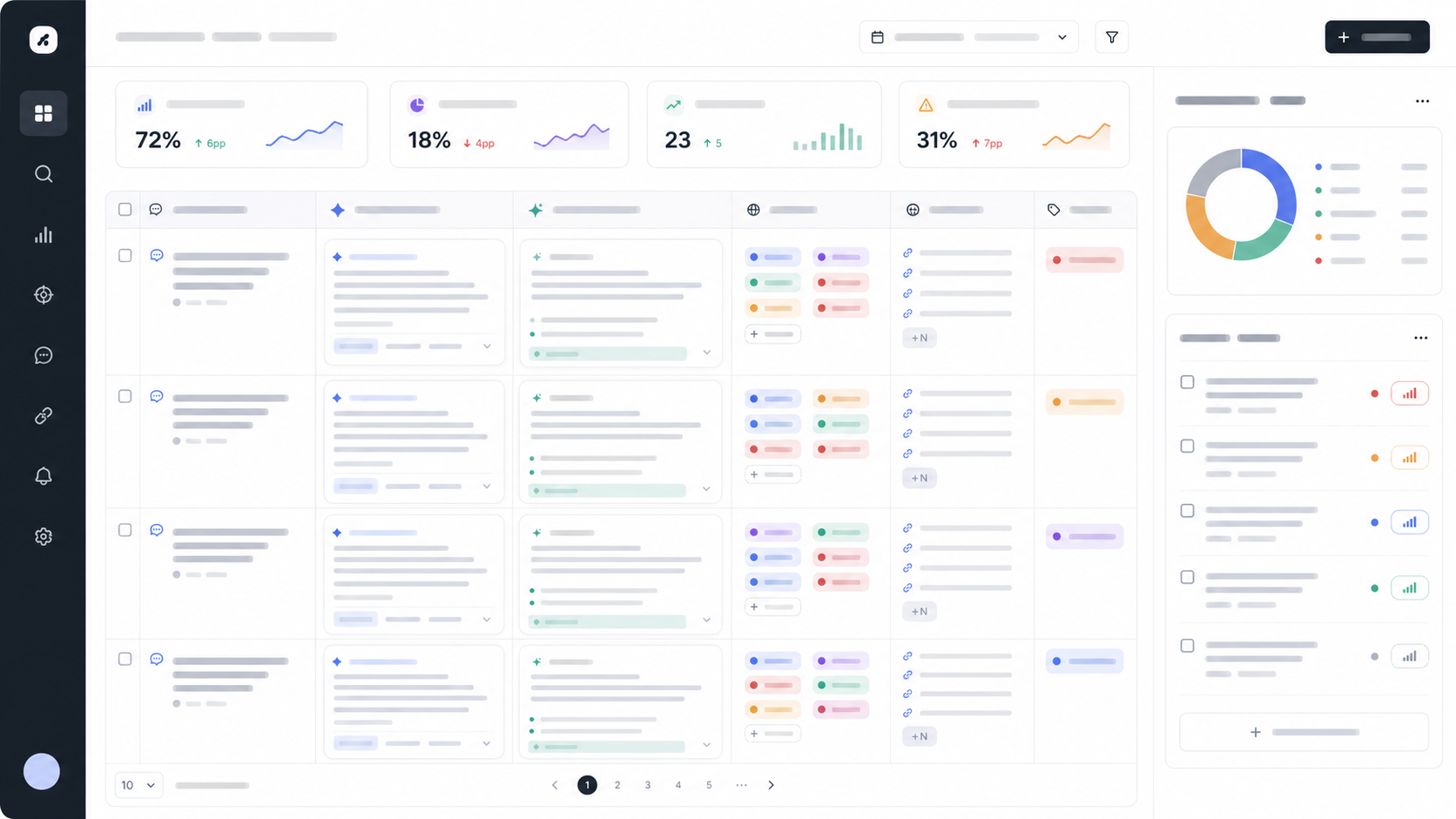
What are AI search competitor mentions?
AI search competitor mentions are competitor brand names that appear inside generated answers for your tracked buyer prompts. They can appear as recommendations, examples, alternatives, sources, citations, comparison rows, or named tools in an AI-generated shortlist.
An AI search competitor mention is a measurable signal that an answer engine found a competitor more relevant, more retrievable, more source-worthy, or more familiar for that prompt. It is not automatically a crisis, but it is always evidence. The job is to separate harmless category noise from prompts that can change a buyer's shortlist.
OpenAI describes ChatGPT Search as answers with links to web sources. Google says its AI features are rooted in Search systems and can include links from the web. Perplexity is source-forward. The practical takeaway is simple: generated answers are not magic. They are shaped by public pages, source clarity, entity language, freshness, citations, and the user's exact phrasing.
Which competitor mentions should you care about first?
Care about competitor mentions on prompts with decision intent first: shortlist, comparison, alternatives, pricing-adjacent, integration, implementation, and failure-mode prompts. A competitor named in a generic definition answer matters less than a competitor recommended in a buyer's "best tool for..." question.
Use this priority table:
| Prompt type | Example AI query | Priority | Why it matters |
|---|---|---|---|
| Shortlist | "best AI visibility tools for B2B SaaS teams" | High | The buyer is building the vendor list |
| Comparison | "Tracemetry vs Profound for AI visibility tracking" | High | The answer can frame the deal |
| Alternative | "best Otterly alternative for AI search reporting" | High | The buyer is switch-ready |
| Failure mode | "why does ChatGPT recommend competitors instead of my brand" | High | The prompt reveals the fix |
| Workflow | "how to track competitor mentions in ChatGPT answers" | Medium | The answer can cite your method |
| Definition | "what is AI search visibility" | Lower | Useful, but less directly tied to pipeline |
Do not chase every competitor mention equally. If a competitor is mentioned in a broad educational answer but your product is not relevant to that exact question, ignore it. If they appear in a high-intent shortlist where your product belongs, move it to the top of the fix queue.
For ChatGPT-specific shortlist prompts, add first-named rate to the report. A competitor named fourth is annoying; a competitor named first is the loss that can shape the buyer's default shortlist.
Why does ChatGPT or Perplexity mention competitors instead of you?
AI answers mention competitors when their public source map is stronger for the prompt. That can mean they have a better page, clearer category language, fresher proof, stronger third-party mentions, better schema, or simply a page that matches the user's question more directly.
Classify the loss before writing anything:
| Loss reason | What it looks like | First fix |
|---|---|---|
| Missing page | Competitor owns a specific workflow or comparison question | Create the page only if no current URL can answer it |
| Weak answer block | Your page has the topic but no direct 40-80 word answer | Rewrite the first screen and H2 answer |
| Vague entity language | AI cannot tell who you serve or what category you belong to | Add plain category, ICP, use case, and competitor context |
| Weak source ownership | Competitor is cited; you are mentioned without a URL | Add extractable tables, FAQs, sources, and internal links |
| Stale proof | Competitor page looks newer or more current | Update dates, examples, screenshots, product details, and citations |
| Third-party authority gap | Review/list pages mention them but omit you | Build or correct public profiles, partner pages, directories, and reviews |
The dumb move is publishing another generic "best tools" blog post. The useful move is finding the one source gap that made the competitor's answer plausible.
How do you track competitor mentions in AI answers?
Track competitor mentions with a fixed prompt set, approved competitor list, separate AI surfaces, and one row per prompt run. Keep mentions, citations, answer accuracy, and share of voice separate so the team knows what actually changed.
Minimum tracking fields:
- Prompt
- Prompt bucket
- Surface: ChatGPT, Perplexity, Gemini, Claude, or Google AI Overviews
- Date
- Your brand mentioned: yes/no
- Competitors mentioned
- Competitor mention type: recommendation, example, alternative, comparison, citation, or source
- Your domain cited: yes/no
- Competitor domains cited
- Cited URLs
- Citation order
- Answer accuracy label
- Loss reason
- Target page to fix
- Owner
- Re-measure date
For an early program, use 40-80 prompts. Include conversational phrases such as "what is the best way to monitor competitor mentions in AI search?", "why does ChatGPT recommend competitors?", "how do I track competitor share of voice in AI answers?", and "when should I create a comparison page instead of updating an existing page?"
What is the best scoring model for competitor mentions?
The best scoring model weights competitor mentions by buyer intent and source ownership. A competitor mention in a high-intent prompt with a competitor citation is a bigger loss than a competitor name in a top-of-funnel explanation with no citation.
Use this simple model:
| Signal | Score |
|---|---|
| Competitor mentioned in a low-intent prompt | 1 |
| Competitor mentioned in a workflow prompt | 2 |
| Competitor mentioned in a shortlist, comparison, or alternative prompt | 4 |
| Competitor cited with a URL | +2 |
| Your brand absent | +2 |
| Your brand mentioned but not cited | +1 |
| Answer includes an inaccurate claim about you | +3 |
Sort the weekly report by total loss score. That pushes the team toward prompts where a fix can affect pipeline, not prompts that merely look annoying.
Should you create a new page or update an existing one?
Update an existing page when it almost satisfies the prompt. Create a new page only when no current URL directly answers the buyer's question. Too many overlapping pages can make source selection more confusing.
Use this decision table:
| Situation | Better move | Example |
|---|---|---|
| Your page covers the topic but buries the answer | Update the page | Add a direct answer and decision table to an AI visibility guide |
| Competitor wins a comparison prompt | Create or update a comparison page | "Tracemetry vs Profound" needs tradeoffs, not a generic guide |
| Competitor wins a workflow prompt | Update the workflow guide | Add the missing steps, fields, examples, and FAQ |
| Competitor wins because of third-party proof | Build external source proof | Correct directories, partner pages, review pages, and public profiles |
| Wrong product detail appears | Update source-of-truth pages | Pricing, features, integrations, docs, and FAQ must agree |
This is where generative engine optimization strategy matters. A strategy is not "publish more." It is choosing the smallest source fix that can change the next generated answer.
What fixes competitor mentions fastest?
The fastest fix is usually a focused update to the page that should own the prompt. Add a direct answer, a comparison or decision table, current product details, visible FAQ content, source-backed claims, schema that matches the page, and internal links from related pages.
Use this 45-minute triage:
- Save the exact answer. Capture prompt, date, surface, answer text, brands mentioned, cited URLs, and citation order.
- Classify the mention. Mark it as recommendation, example, alternative, comparison, citation, or source.
- Find the winning source. Inspect the competitor page or cited URL that made the answer easy to generate.
- Compare the target page. Check whether your page answers the same question in the first screen.
- Fix the answer block. Add a 40-80 word answer under the relevant H2.
- Add proof. Include current examples, screenshots, source links, or a table that explains the decision.
- Align schema. FAQ and Article schema should match visible copy. Google's structured data guidelines warn against hidden or misleading structured data.
- Add internal links. Link from related pages such as AI brand monitoring, ChatGPT citation tracking, and content that AI cites.
- Re-measure. Run the same prompt again after 7-14 days.
If the competitor wins because every trusted third-party source mentions them and nobody mentions you, an owned-page update will not be enough. You need public proof outside your domain.
How often should you report competitor mentions?
Report competitor mentions weekly for normal operations and daily for short windows around launches, pricing changes, rebrands, category repositioning, and major comparison-page updates. Monthly reporting is too slow for high-intent prompt losses.
Your weekly report should show:
- Top prompts where competitors were mentioned and you were absent
- Top prompts where competitors were cited and you were not
- Competitor share of voice by surface
- Citation gap by domain
- New wrong or stale claims
- Pages updated this week
- Prompts to re-measure next week
- Third-party proof gaps
Roll this into the AI visibility report, but keep a separate competitor section. A blended visibility score can hide the exact answer where a competitor is taking the shortlist.
When competitor tracking reveals repeated product-versus-product questions, build the intended source with the AEO comparison-page framework instead of publishing an unsupported feature grid.
FAQ
What are AI search competitor mentions? AI search competitor mentions are competitor brand names that appear inside generated answers from ChatGPT, Perplexity, Gemini, Claude, or Google AI Overviews for your tracked buyer prompts. They can appear as recommendations, examples, alternatives, comparison options, or cited sources.
Why does ChatGPT recommend competitors instead of my brand? ChatGPT may recommend competitors when their public pages, third-party mentions, category language, examples, or source citations are clearer for the prompt. First classify the loss, then update the page that should own the answer or build the missing third-party proof.
How do I track competitor mentions in AI search? Use a fixed prompt set, approved competitor list, and one row per prompt run. Record the surface, answer, competitor names, cited URLs, citation order, answer accuracy, loss reason, and target page to fix. Keep mentions separate from citations.
How many prompts do I need for competitor mention tracking? Start with 40-80 buyer prompts across shortlist, comparison, alternatives, workflow, failure-mode, integration, and pricing-adjacent questions. Fewer than 20 prompts is easy to cherry-pick; larger programs can expand once the team is acting on the findings.
Should I create competitor comparison pages for AI search? Create comparison pages when buyers already ask direct comparison or alternative prompts. Do not create thin comparison pages just to name competitors. The page needs real tradeoffs, proof, current product details, FAQ content, and a clear answer for the exact prompt.
What is the fastest way to reduce competitor mentions in AI answers? Fix the highest-intent prompt where a competitor is cited and your domain is absent. Improve the target page with a direct answer, decision table, current examples, visible FAQ content, matching schema, internal links, and then re-measure the same prompt.
Start with the competitor answer that can cost you a deal
Run the free Tracemetry audit to see which AI answers mention competitors, cite competitor pages, omit your brand, or describe your product incorrectly. If the snapshot shows a real shortlist loss, use Tracemetry Pro to track the full prompt set, prioritize fixes, and re-measure the answers that matter.
Sources: OpenAI ChatGPT Search, Google AI features and your website, Google Search generative AI optimization guidance, Google structured data guidelines, Perplexity publishers program.
Frequently asked questions
What are AI search competitor mentions?
AI search competitor mentions are competitor brand names that appear inside generated answers from ChatGPT, Perplexity, Gemini, Claude, or Google AI Overviews for your tracked buyer prompts. They can appear as recommendations, examples, alternatives, comparison options, or cited sources.
Why does ChatGPT recommend competitors instead of my brand?
ChatGPT may recommend competitors when their public pages, third-party mentions, category language, examples, or source citations are clearer for the prompt. First classify the loss, then update the page that should own the answer or build the missing third-party proof.
How do I track competitor mentions in AI search?
Use a fixed prompt set, approved competitor list, and one row per prompt run. Record the surface, answer, competitor names, cited URLs, citation order, answer accuracy, loss reason, and target page to fix. Keep mentions separate from citations.
How many prompts do I need for competitor mention tracking?
Start with 40-80 buyer prompts across shortlist, comparison, alternatives, workflow, failure-mode, integration, and pricing-adjacent questions. Fewer than 20 prompts is easy to cherry-pick; larger programs can expand once the team is acting on the findings.
Should I create competitor comparison pages for AI search?
Create comparison pages when buyers already ask direct comparison or alternative prompts. Do not create thin comparison pages just to name competitors. The page needs real tradeoffs, proof, current product details, FAQ content, and a clear answer for the exact prompt.
What is the fastest way to reduce competitor mentions in AI answers?
Fix the highest-intent prompt where a competitor is cited and your domain is absent. Improve the target page with a direct answer, decision table, current examples, visible FAQ content, matching schema, internal links, and then re-measure the same prompt.
See your own AI visibility today.
Free public report. 60 seconds. No signup. Or get started on Pro to track 250 prompts continuously.