AI search monitoring: what to track beyond rank
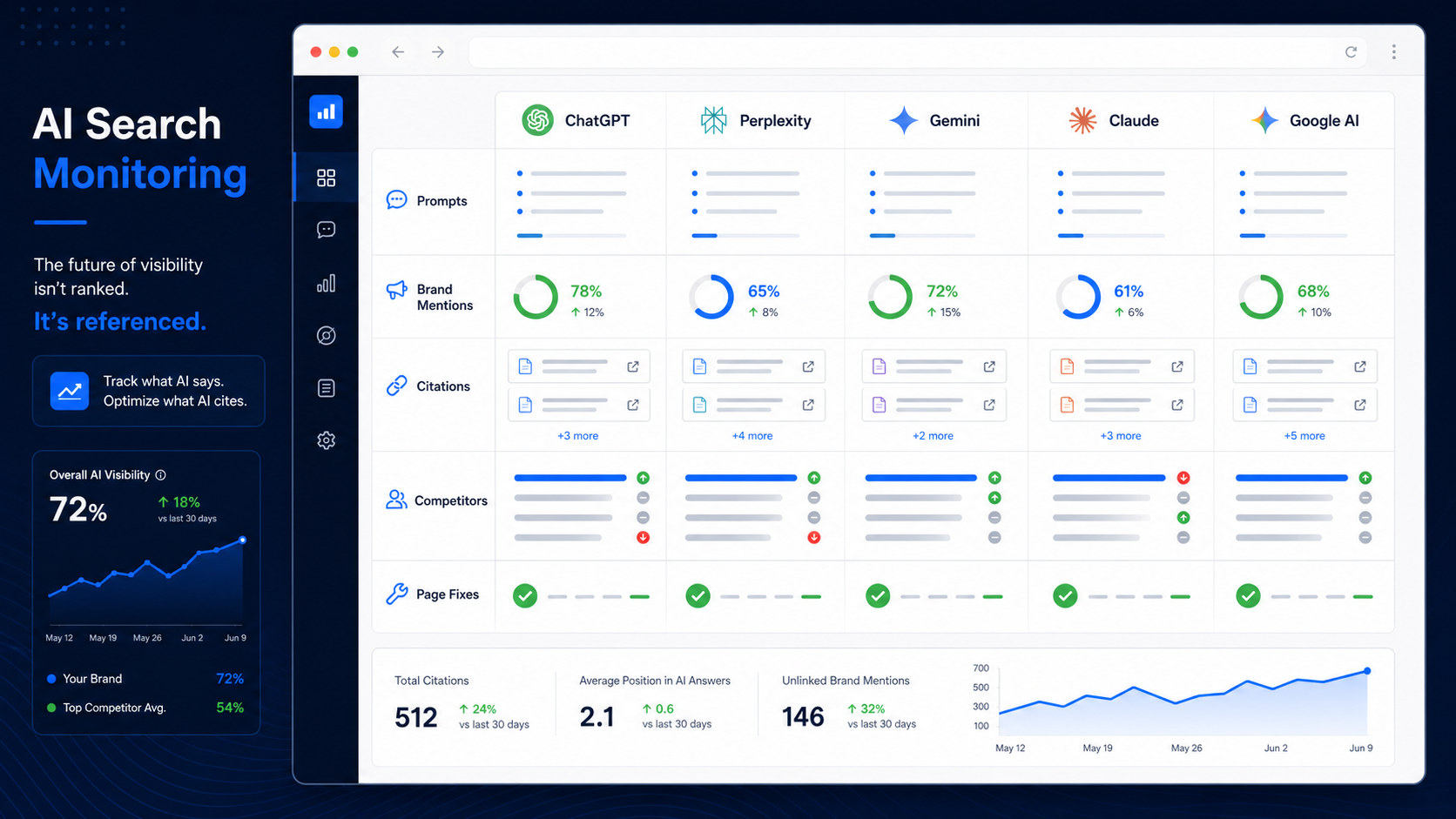
AI search monitoring replaces rank-only reporting with prompt-level tracking across ChatGPT, Perplexity, Gemini, Claude, and Google AI: mentions, citations, competitors, accuracy, and page fixes.
AI search monitoring is what rank tracking becomes when buyers stop scanning ten blue links and start asking ChatGPT, Perplexity, Gemini, Claude, and Google AI answers for recommendations. The painful part is that a normal SEO dashboard can still look fine while AI answers are naming competitors, citing publisher listicles, and sending buyers into a shortlist you never entered.
The fast rule: monitor prompts, mentions, citations, competitors, and fixable source gaps separately. A single "AI visibility" score is useful for reporting, but the operating system is the prompt-level table that tells you which page to update before next week's run.
Use this guide when you already understand AI search visibility and need the weekly monitoring workflow. If your problem is only prompt-set design, start with AI search prompt monitoring. If the issue is executive reporting, use the AI search visibility report.
What is AI search monitoring?
AI search monitoring is the recurring process of checking how a brand appears in AI-generated answers across ChatGPT, Perplexity, Gemini, Claude, Google AI Overviews, and Google AI Mode. It tracks prompts, brand mentions, citations, competitor recommendations, answer accuracy, and the pages that should be fixed.
AI search monitoring is not the same as rank tracking. Rank tracking asks, "Where did our URL appear in search results?" AI search monitoring asks, "Did the answer name us, cite us, describe us correctly, and recommend us against the competitors buyers are considering?"
That distinction matters because answer surfaces expose sources differently. OpenAI says ChatGPT Search can produce timely answers with links to web sources. Google's site-owner guidance covers AI features such as AI Overviews and AI Mode, where content can be included in AI experiences. Perplexity's developer documentation treats citations as first-class response objects. The common thread is not ranking position. It is answer presence and source ownership.
Why is AI search monitoring different from rank tracking?
AI search monitoring is different because the unit of measurement is the answer, not the search result page. One answer can mention multiple vendors, cite zero or several URLs, summarize old claims, and change the buyer's shortlist without producing a measurable click.
Here is the practical difference:
| Traditional rank tracking | AI search monitoring |
|---|---|
| Tracks URL position for a keyword | Tracks answer presence for a prompt |
| Measures one ranked list | Measures generated recommendations and citations |
| Optimizes title, page relevance, links, and SERP features | Optimizes entity clarity, source ownership, citations, proof, and answer accuracy |
| Reports average position and organic clicks | Reports mention rate, citation rate, competitor share, and prompt losses |
| Usually works keyword by keyword | Works by buyer question, surface, and intent bucket |
If your board asks "are we showing up in AI search?", average position will not answer it. You need to know whether the answer named your brand, which URL it cited, what competitor it preferred, and whether the cited source matches the page you want buyers to see.
Which AI search surfaces should you monitor first?
Monitor the surfaces that influence your category before trying to cover everything. For most B2B SaaS teams, the first monitoring set should include ChatGPT, Perplexity, Gemini, Claude, and Google AI Overviews or AI Mode where available. Keep each surface separate because answer behavior differs.
Start with this surface map:
| Surface | What to watch | Best first metric |
|---|---|---|
| ChatGPT Search | Brand recommendations, cited web sources, stale product claims | Mention rate and domain citation rate |
| Perplexity | Source URLs, citation order, publisher dominance | Citation rate and target URL citation rate |
| Gemini | Category framing, feature summaries, competitor lists | Answer accuracy and competitor share |
| Claude | Narrative recommendations and comparison framing | Brand presence and claim accuracy |
| Google AI Overviews / AI Mode | Search displacement, linked sources, query coverage | AI answer presence and cited domains |
Do not blend these into one number too early. A brand can be strong on Perplexity because it has source-worthy content and weak on ChatGPT because the entity profile is muddy. A blended score hides the fix.
What should an AI search monitoring system track?
An AI search monitoring system should track enough fields to turn an answer loss into a page fix. The minimum dataset is prompt, surface, intent bucket, answer date, brands mentioned, URLs cited, competitor URLs cited, answer accuracy, target page, loss reason, owner, and re-measure date.
Use this row shape:
| Field | Example | Why it matters |
|---|---|---|
| Prompt | "best AI visibility tools for B2B SaaS" | The buyer question being tested |
| Surface | ChatGPT, Perplexity, Gemini, Claude, Google AI | Keeps answer engines separate |
| Intent bucket | Shortlist, comparison, alternative, workflow, failure mode | Lets you weight commercial prompts |
| Your brand mentioned | Yes / no | Shows whether you enter the answer |
| Your domain cited | Yes / no | Shows whether you own the source path |
| Target URL cited | Yes / no | Shows whether the right page won |
| Competitors mentioned | Profound, Peec, Otterly | Feeds share-of-voice reporting |
| Cited competitor URL | A listicle, product page, docs page, review page | Reveals what source format is winning |
| Answer accuracy | Correct, incomplete, stale, wrong | Protects sales and positioning |
| Recommended fix | Update page, add comparison, earn review, fix schema | Turns monitoring into work |
The row matters more than the screenshot. Screenshots are evidence; rows are operations. If a prompt loss cannot be assigned to a URL and a fix type, the monitoring process is not actionable yet.
Which prompts should you include in AI search monitoring?
Include prompts that map to buyer decisions, not just keywords. A balanced AI search monitoring set covers category discovery, shortlist, comparisons, alternatives, workflow questions, failure modes, integrations, pricing-adjacent questions, and brand-specific prompts.
Build the first set from these buckets:
| Prompt bucket | Example conversational query | What it reveals |
|---|---|---|
| Category discovery | "what is the best way to monitor AI search visibility?" | Whether your category language is retrievable |
| Shortlist | "best AI search monitoring tools for SaaS teams" | Which vendors enter the buying set |
| Comparison | "Tracemetry vs Profound for AI visibility tracking" | How the answer frames direct competitors |
| Alternatives | "best Otterly alternative for citation tracking" | Whether challenger demand finds you |
| Workflow | "how do I track ChatGPT and Perplexity citations every week?" | Whether educational pages are source-worthy |
| Failure mode | "why does ChatGPT recommend competitors instead of my company?" | Which urgent gaps need source fixes |
| Integration | "AI visibility monitoring tool with publishing workflow" | Whether product capabilities are understood |
| Pricing-adjacent | "affordable AI search monitoring software for startups" | Whether bottom-funnel demand includes you |
Use exact-match terms where natural: AI search monitoring, AI visibility tracking, AI brand monitoring, AI search prompt monitoring, ChatGPT citation tracking, Perplexity citation monitoring, AI share of voice, answer accuracy, cited URLs, competitor mentions, and generative engine optimization.
Then add conversational variants because buyers do not talk like keyword exports:
- "How do I know if my company shows up in AI answers?"
- "Why does Perplexity cite a competitor but not my site?"
- "What is the best way to track AI search visibility every week?"
- "When should we update a page after losing an AI citation?"
- "Which AI search monitoring metrics should a SaaS team report?"
The best prompt set feels like a sales call, support ticket, analyst question, and search query had a useful collision. If the list sounds like an SEO spreadsheet, it will miss the messy questions that change real buying decisions.
How often should you monitor AI search results?
Run AI search monitoring weekly for normal operations. Weekly is frequent enough to catch answer drift and confirm whether shipped page fixes changed the next run, but slow enough to avoid panic over normal model variation. Use daily checks only for launches, rebrands, pricing changes, incidents, or high-risk reputation moments.
Use this cadence:
| Cadence | Best use | What to report |
|---|---|---|
| Weekly | Normal GEO operations | Prompt wins/losses, citations, competitors, next fixes |
| Monthly | Leadership reporting | Weighted AI share of voice, risks, shipped improvements |
| Daily for 7-14 days | Launch, rebrand, pricing change, incident | Accuracy drift, stale claims, urgent source gaps |
Keep the prompt wording, competitor set, locale, and surface list stable. If you add prompts, mark them as a new cohort. Otherwise a visibility gain may only mean you added easier prompts.
How do you turn AI search monitoring into page fixes?
Turn every important loss into one diagnosis. The wrong response to AI invisibility is publishing random "GEO content." The right response is finding the prompt, source, and URL mismatch that caused the answer to prefer someone else.
Use this triage map:
| What the answer shows | Likely cause | Best next fix |
|---|---|---|
| Competitors named, you absent | Missing entity clarity or missing page | Rewrite category language or publish the focused page |
| You named, competitor cited | Weak source ownership | Add direct answer, table, proof, sources, and internal links |
| Your domain cited, wrong URL | Ambiguous internal map | Clarify titles, H2s, anchors, and backlinks |
| Old feature or pricing claim repeated | Stale public copy | Update product, pricing, docs, comparison pages, and FAQ |
| Publisher dominates vendor prompt | Third-party proof gap | Earn reviews, directory coverage, partner pages, and customer proof |
| No source shown | Surface behavior or weak retrievability | Improve crawlability, indexability, schema, and answer structure |
The fastest win is usually a page update, not a new article. Add a 40-80 word answer under the H2 that matches the prompt, include a decision table, cite credible sources when making factual claims, align FAQ schema with visible FAQ text, and link to the page from adjacent posts.
For surface-specific repair loops, pair this process with ChatGPT citation tracking, Perplexity citation tracking, Gemini citation tracking, and AI Overview tracking.
What does a good AI search monitoring report include?
A good AI search monitoring report is short enough to read and specific enough to create work. It shows movement across the locked prompt set, the prompts that changed, the sources competitors won with, and the exact page updates that should ship before the next run.
Use this report structure:
- Scoreboard: Mention rate, domain citation rate, target URL citation rate, answer accuracy, and competitor share by surface.
- Movement: The prompts gained, lost, or materially changed since the last run.
- Source ownership: Your cited URLs, competitor cited URLs, and publisher URLs controlling shortlist answers.
- Accuracy risks: Wrong or stale product, pricing, integration, category, or comparison claims.
- Fix queue: One existing page to update, one missing page to consider, one third-party source gap, and the re-measure date.
If the report ends with "AI visibility is down" and nobody knows which URL to edit, the report failed. Monitoring is useful only when it compresses uncertainty into the next fix.
What tools do you need for AI search monitoring?
You can monitor a small AI search prompt set manually for a few weeks, but the process gets brittle once multiple people, surfaces, and competitors are involved. A serious tool should preserve prompt history, separate surfaces, store citations, classify competitors, and connect losses to content briefs or page updates.
Use this decision table:
| Team stage | Use this setup | Upgrade trigger |
|---|---|---|
| First baseline | Spreadsheet, 30-50 prompts, weekly manual run | The team cannot repeat the same run consistently |
| Early GEO program | AI visibility tool with prompt tracking and citation capture | Leadership asks for trend and competitor movement |
| Content operations | Monitoring plus source-grounded briefs and publishing workflow | Losses need to become page updates every week |
| Mature category | Multi-surface monitoring, weighted share of voice, audit history | AI visibility becomes a pipeline or brand-risk metric |
Tracemetry is built for the operating stage: monitor buyer prompts, capture citations and competitors, generate source-grounded briefs, publish fixes, and re-measure whether the answer changed. Run the free AI visibility audit for a baseline, then use Tracemetry Pro when the prompt set needs to become a recurring workflow.
How do you avoid bad AI search monitoring?
Bad AI search monitoring tracks only prompts you already win, changes the prompt list every week, blends all surfaces into one score, ignores citations, and reports screenshots instead of fixable source gaps. It creates motion without changing the answers buyers see.
Avoid these mistakes:
- Tracking only branded prompts.
- Treating a brand mention as a full win when a competitor owns the citation.
- Mixing ChatGPT, Perplexity, Gemini, Claude, and Google AI answers into one unexplained score.
- Adding new prompts without marking a new cohort.
- Ignoring answer accuracy because the brand was mentioned.
- Publishing new content before checking whether an existing page can win.
- Marking up FAQ answers that are not visible on the page.
- Calling AI referral traffic the whole story when many AI answers influence buyers without a click.
The clean version is boring in the best way: same prompts, same surfaces, same competitor set, same weekly cadence, one fix queue, and a re-measure date.
FAQ
What is AI search monitoring? AI search monitoring is the recurring process of checking how a brand appears in AI-generated answers across ChatGPT, Perplexity, Gemini, Claude, Google AI Overviews, and Google AI Mode. It tracks prompts, brand mentions, citations, competitors, answer accuracy, and source ownership.
How is AI search monitoring different from AI visibility tracking? AI visibility tracking is the broader measurement category. AI search monitoring is the recurring operating workflow: run prompts, record answers and citations, identify losses, update pages, and re-measure the same prompt set.
How many prompts should I monitor for AI search? Start with 40-80 prompts across category discovery, shortlist, comparison, alternatives, workflow, failure-mode, integration, pricing-adjacent, and branded buckets. Mature programs can expand once the team has enough capacity to act on the findings.
How often should AI search monitoring run? Weekly is the best cadence for normal operations. Use daily checks for launches, rebrands, pricing changes, reputation incidents, or major page releases. Monthly is fine for leadership rollups but too slow for page-level fixes.
Should I monitor AI mentions or citations? Monitor both. Mentions show whether your brand enters the answer. Citations show whether your domain owns the source path. For commercial prompts, target URL citation rate is usually the most actionable metric.
Can Google Search Console replace AI search monitoring? No. Search Console is still essential for Google Search performance, but it does not give a complete prompt-level view across ChatGPT, Perplexity, Gemini, Claude, competitors, answer accuracy, and cited source ownership.
What is the fastest way to improve AI search monitoring results? Pick the highest-intent prompt where a competitor is mentioned or cited and you are absent. Update the page that should have won with a direct answer, table, examples, visible FAQ content, credible sources, and internal links, then re-measure the same prompt.
Sources: OpenAI ChatGPT Search, Google AI features and your website, Google AI optimization guide, Google structured data policies, Perplexity citation parsing documentation.
Frequently asked questions
What is AI search monitoring?
AI search monitoring is the recurring process of checking how a brand appears in AI-generated answers across ChatGPT, Perplexity, Gemini, Claude, Google AI Overviews, and Google AI Mode. It tracks prompts, brand mentions, citations, competitors, answer accuracy, and source ownership.
How is AI search monitoring different from AI visibility tracking?
AI visibility tracking is the broader measurement category. AI search monitoring is the recurring operating workflow: run prompts, record answers and citations, identify losses, update pages, and re-measure the same prompt set.
How many prompts should I monitor for AI search?
Start with 40-80 prompts across category discovery, shortlist, comparison, alternatives, workflow, failure-mode, integration, pricing-adjacent, and branded buckets. Mature programs can expand once the team has enough capacity to act on the findings.
How often should AI search monitoring run?
Weekly is the best cadence for normal operations. Use daily checks for launches, rebrands, pricing changes, reputation incidents, or major page releases. Monthly is fine for leadership rollups but too slow for page-level fixes.
Should I monitor AI mentions or citations?
Monitor both. Mentions show whether your brand enters the answer. Citations show whether your domain owns the source path. For commercial prompts, target URL citation rate is usually the most actionable metric.
Can Google Search Console replace AI search monitoring?
No. Search Console is still essential for Google Search performance, but it does not give a complete prompt-level view across ChatGPT, Perplexity, Gemini, Claude, competitors, answer accuracy, and cited source ownership.
What is the fastest way to improve AI search monitoring results?
Pick the highest-intent prompt where a competitor is mentioned or cited and you are absent. Update the page that should have won with a direct answer, table, examples, visible FAQ content, credible sources, and internal links, then re-measure the same prompt.
Make your next SEO decision with better evidence.
Explore practical guides to AI visibility, source citations, and choosing the right tools for your team.