AI visibility score: how to calculate and improve it
How to calculate an AI visibility score across ChatGPT, Perplexity, Gemini, Claude, AI Overviews, and AI Mode using mention rate, citation rate, competitor share, and answer accuracy.
An AI visibility score is a weighted metric that shows how often AI answers mention your brand, cite your domain, rank you against competitors, and describe you accurately across a fixed prompt set. The painful problem is that "we showed up once in ChatGPT" is not a measurement system.
Use the fast rule: score visibility from four separate signals, not one blended vanity number. Track mention rate, citation rate, competitor share, and answer accuracy by surface, then weight the prompts by buying intent so a lost comparison answer hurts more than a generic definition answer.
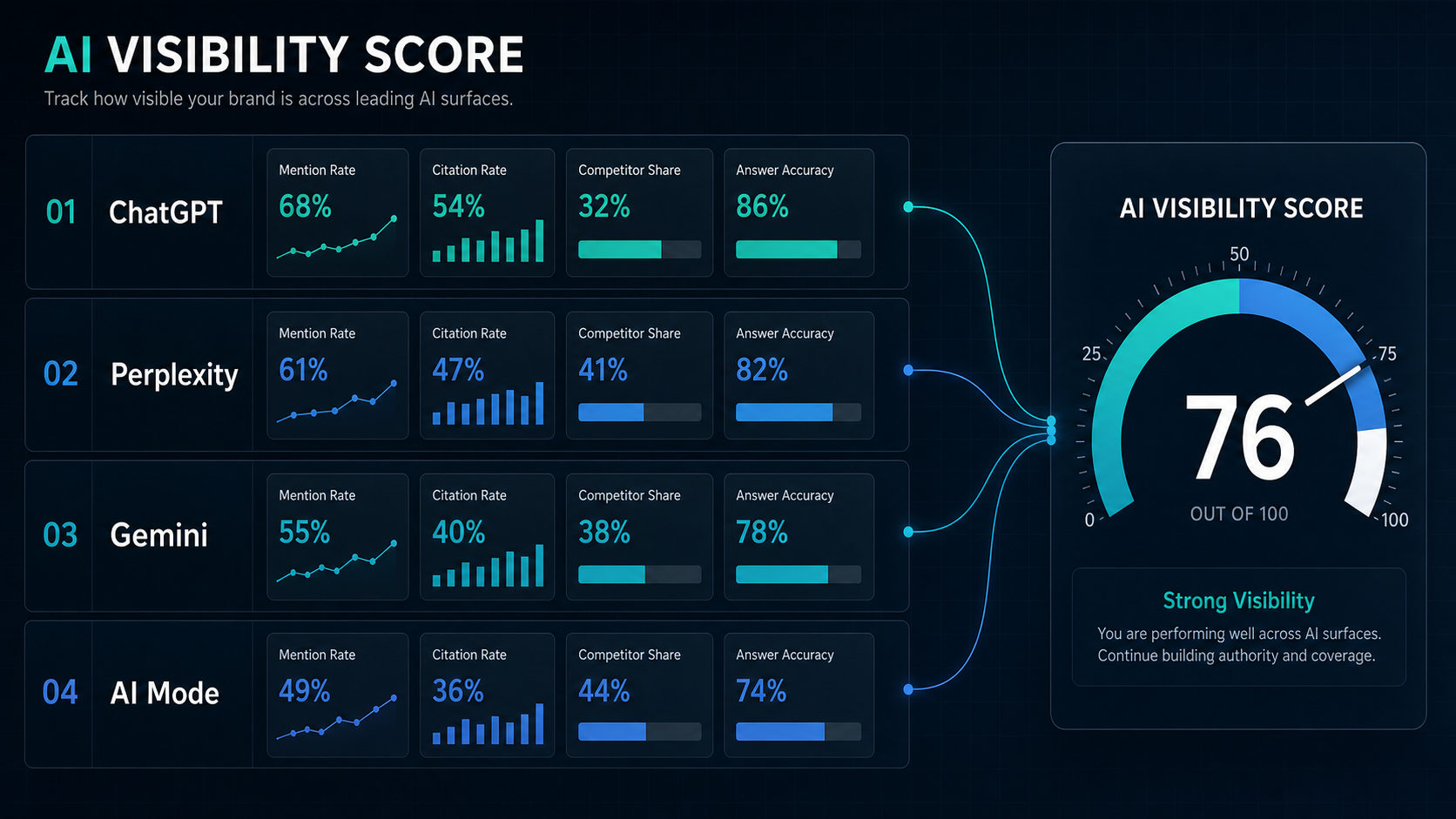
This guide sits between AI visibility tracking, AI share of voice, answer engine optimization metrics, and the weekly AI visibility report. Use it when leadership asks for one number, but the content team still needs to know what to fix.
When the score has to connect to business value, use the answer engine optimization ROI framework to report prompt wins beside citations, AI referral traffic, conversions, and assisted pipeline. If you need the raw baseline before choosing score weights, start with the LLM visibility benchmark workflow.
What is an AI visibility score?
An AI visibility score is a weighted score that summarizes whether your brand appears in AI-generated answers for the prompts buyers ask. A useful score includes brand mentions, domain citations, competitor share of voice, answer accuracy, and surface-level coverage across ChatGPT, Perplexity, Gemini, Claude, and Google AI experiences.
AI visibility score is not a replacement for prompt-level analysis. It is the scoreboard above the work queue. The score tells you whether visibility is improving. The prompt rows tell you why.
Google says AI features in Search can show links to supporting websites, and OpenAI describes ChatGPT Search as a search experience that can include source links. That means a serious score has to separate two questions:
- Did the AI answer name the brand?
- Did the AI answer cite a page the buyer can click, verify, or use as a source?
Those are different outcomes. A mention without a citation can shape preference, but it may not send source authority back to your site. A citation without a brand mention can make your content useful while your competitor still wins the shortlist.
How should you calculate an AI visibility score?
Calculate an AI visibility score by scoring each prompt run on four dimensions: brand mention, domain citation, competitor share, and answer accuracy. Then apply an intent weight so bottom-funnel prompts count more than generic informational prompts.
Use this simple model:
| Component | What it measures | Suggested weight |
|---|---|---|
| Mention score | Your brand is named in the answer | 30% |
| Citation score | Your domain or target URL is cited | 30% |
| Competitive score | You appear ahead of, or instead of, approved competitors | 25% |
| Accuracy score | The answer describes your product, category, pricing, and fit correctly | 15% |
Then multiply the prompt result by intent:
| Prompt intent | Example prompt | Intent weight |
|---|---|---|
| Definition | "what is AI visibility tracking" | 1x |
| Workflow | "how do I measure AI visibility weekly" | 2x |
| Tool shortlist | "best AI visibility tools for B2B SaaS" | 4x |
| Comparison | "Tracemetry vs Profound for AI search monitoring" | 4x |
| Failure mode | "why does ChatGPT recommend competitors instead of my brand" | 3x |
The exact weights can change by business model. The important part is consistency. If the prompt set or the weights change every week, the score becomes a storytelling device instead of an operating metric.
What is a good AI visibility score?
A good AI visibility score depends on the category, prompt set, surfaces, and competitor denominator. For most B2B SaaS teams, the first useful benchmark is not an industry average. It is whether the same locked prompt set improves week over week while high-intent losses turn into shipped page fixes.
Use these ranges as operating labels, not universal truth:
| Score range | What it usually means | What to do next |
|---|---|---|
| 0-20 | AI answers rarely mention or cite you | Fix entity clarity and publish pages for missing buyer questions |
| 21-45 | You appear in some answers but competitors own key prompts | Improve comparison, alternatives, workflow, and proof pages |
| 46-70 | You are visible but citations or accuracy are inconsistent | Strengthen source ownership, schema, internal links, and product facts |
| 71-85 | You are one of the category sources | Defend high-intent prompts and monitor answer drift |
| 86+ | You dominate the measured prompt set | Audit for prompt bias, expand the set, and watch new competitors |
The trap is chasing a high number across easy prompts. A 75 score on definition prompts can be worth less than a 30 score on tool-shortlist prompts. Weight the questions that can change a buying decision.
Which prompts belong in the score?
The score should use a fixed set of buyer prompts, not a random list of keywords. Include category, shortlist, comparison, alternative, workflow, failure-mode, pricing-adjacent, integration, and surface-specific questions.
Start with 40-80 prompts across these buckets:
| Bucket | Example AI query | Why it belongs |
|---|---|---|
| Category | "what is AI visibility score for SaaS" | Tests whether the category is understood |
| Shortlist | "best AI visibility tools for a B2B SaaS startup" | Tests vendor recommendation visibility |
| Comparison | "Tracemetry vs Profound for AI visibility tracking" | Tests preference-shaping answers |
| Alternative | "best Otterly alternative for AI search monitoring" | Tests challenger and switching demand |
| Workflow | "how do I calculate an AI visibility score" | Tests whether educational content is cited |
| Failure mode | "why does Perplexity cite competitors instead of my website" | Tests urgent diagnostic content |
| Pricing-adjacent | "affordable AI visibility monitoring for startups" | Tests commercial evaluation prompts |
| Surface-specific | "how do I score Google AI Overview visibility" | Separates Google from chat assistants |
Add entity terms naturally: AI visibility score, AI search visibility, LLM visibility, generative engine optimization, answer engine optimization, ChatGPT Search, Perplexity citations, Gemini, Claude, Google AI Overviews, AI Mode, mention rate, citation rate, source ownership, answer accuracy, and competitor share of voice.
How do you score each AI surface separately?
Score each AI surface separately before rolling up the final number. ChatGPT, Perplexity, Gemini, Claude, Google AI Overviews, and AI Mode do not behave like one search engine. The same prompt can cite your guide in Perplexity, mention a competitor in ChatGPT, and trigger a Google answer that cites a publisher.
Use this surface scorecard:
| Surface | Primary score | What to inspect |
|---|---|---|
| ChatGPT | Mention rate and first-named rate | Whether your brand enters the recommendation set |
| Perplexity | Citation rate and cited URL ownership | Whether your pages are used as sources |
| Gemini | Citation rate and answer accuracy | Whether Google-adjacent answers repeat current facts |
| Claude | Answer accuracy and source quality | Whether cited sources support the conclusion |
| Google AI Overviews | Presence rate and cited domains | Whether the SERP answer displaces normal clicks |
| Google AI Mode | Source ownership and follow-up stability | Whether the conversational answer keeps your source through exploration |
For deeper surface workflows, use ChatGPT citation tracking, Perplexity citation monitoring, Gemini citation tracking, and AI Mode tracking. The rollup score is useful, but surface-level losses are where the fix lives.
Why can an AI visibility score go up while revenue stays flat?
An AI visibility score can rise without revenue impact when the gains come from low-intent prompts, weak mentions, non-clickable citations, or answers that frame the brand incorrectly. The score is only useful when it is weighted toward prompts that influence discovery, comparison, and buying decisions.
Check these failure modes before celebrating:
- The score improved on definition prompts, but comparison prompts still name competitors.
- The brand is mentioned, but the cited source is a publisher or competitor page.
- The AI answer describes old pricing, missing features, or the wrong use case.
- The prompt set excludes alternatives, integrations, pricing, and failure-mode questions.
- The report blends all AI surfaces, hiding a loss on the surface buyers actually use.
- The team measures the score but does not ship page, schema, or proof fixes.
This is why the score should always sit next to a fix queue. A good AI search visibility report shows the number, the biggest prompt wins, the biggest prompt losses, cited URLs, competitor movement, answer accuracy issues, and the next page to update.
How do you improve your AI visibility score?
Improve your AI visibility score by fixing the highest-intent prompt losses first. Do not publish generic AI SEO content just to add pages. Choose the prompt where a competitor is cited, identify the page that should win, improve that page, link it into the cluster, and re-measure the same prompt.
Use this fix sequence:
- Pick one losing prompt with buying intent.
- Save the exact answer, cited URLs, competitor names, and surface.
- Choose the target URL that should own the answer.
- Add a 40-80 word direct answer under a relevant H2.
- Add a decision table, comparison block, checklist, or example.
- Cite credible sources for platform behavior, standards, or factual claims.
- Align FAQ schema with visible FAQ copy.
- Add internal links from related AI visibility, citation, and reporting pages.
- Re-run the exact prompt after publishing and record movement.
Google's structured data policies emphasize that marked-up content should match what users can see on the page. Treat that as the rule for AI visibility fixes too. If the answer only exists in schema, metadata, or hidden content, it is not a durable source.
For the strategic layer, use a generative engine optimization strategy. For the operational layer, use AI search prompt monitoring so the prompt set, cited URLs, competitors, and re-measure dates do not live in scattered screenshots.
What should the weekly score report show?
The weekly score report should show the score, the movement, and the work queue. Leadership gets the rollup. Operators get the prompt-level losses. If either side is missing, the score will not improve.
Minimum report:
- Overall AI visibility score.
- Score by surface.
- Mention rate, citation rate, competitor share, and answer accuracy.
- Top gained prompts and top lost prompts.
- High-intent prompts where competitors were cited.
- Target pages that should be updated.
- Fixes shipped since last report.
- Re-measure dates for shipped fixes.
The weekly question is not "did the chart move?" It is "which answer did buyers see, which source shaped it, and what are we changing before the next run?"
FAQ
What is an AI visibility score? An AI visibility score is a weighted metric that measures how often AI-generated answers mention your brand, cite your domain, rank you against competitors, and describe you accurately across a fixed prompt set.
How do you calculate AI visibility score? Calculate it from mention rate, citation rate, competitor share of voice, and answer accuracy, then weight each prompt by intent. Bottom-funnel shortlist and comparison prompts should count more than generic definition prompts.
Is AI visibility score the same as AI share of voice? No. AI share of voice measures your share of brand mentions against a defined competitor set. AI visibility score is broader because it can include citations, source ownership, answer accuracy, and surface coverage.
How many prompts do I need for an AI visibility score? Start with 40-80 buyer prompts across category, shortlist, comparison, alternatives, workflow, failure-mode, pricing-adjacent, integration, and surface-specific intent. Keep the prompt set stable so weekly movement is comparable.
Which AI tools should I include in the score? Include the AI surfaces your buyers use: ChatGPT, Perplexity, Gemini, Claude, Google AI Overviews, and Google AI Mode for most B2B SaaS categories. Report each surface separately before creating a rollup score.
What is the fastest way to improve a low AI visibility score? Find the highest-intent prompt where a competitor is cited and your domain is absent. Improve the target page with a direct answer, comparison table, current product details, credible sources, visible FAQ content, matching schema, and internal links from related pages.
Turn the score into a work queue
Run the free Tracemetry audit to get a first read on whether AI answers mention your brand, cite your site, and recommend competitors. Use Tracemetry Pro when you need a weekly AI visibility score, prompt-level diagnostics, source-grounded briefs, publishing workflow, and re-measurement in one loop.
Sources: Google AI features and your website, Google structured data policies, OpenAI ChatGPT Search.
Frequently asked questions
What is an AI visibility score?
An AI visibility score is a weighted metric that measures how often AI-generated answers mention your brand, cite your domain, rank you against competitors, and describe you accurately across a fixed prompt set.
How do you calculate AI visibility score?
Calculate it from mention rate, citation rate, competitor share of voice, and answer accuracy, then weight each prompt by intent. Bottom-funnel shortlist and comparison prompts should count more than generic definition prompts.
Is AI visibility score the same as AI share of voice?
No. AI share of voice measures your share of brand mentions against a defined competitor set. AI visibility score is broader because it can include citations, source ownership, answer accuracy, and surface coverage.
How many prompts do I need for an AI visibility score?
Start with 40-80 buyer prompts across category, shortlist, comparison, alternatives, workflow, failure-mode, pricing-adjacent, integration, and surface-specific intent. Keep the prompt set stable so weekly movement is comparable.
Which AI tools should I include in the score?
Include the AI surfaces your buyers use: ChatGPT, Perplexity, Gemini, Claude, Google AI Overviews, and Google AI Mode for most B2B SaaS categories. Report each surface separately before creating a rollup score.
What is the fastest way to improve a low AI visibility score?
Find the highest-intent prompt where a competitor is cited and your domain is absent. Improve the target page with a direct answer, comparison table, current product details, credible sources, visible FAQ content, matching schema, and internal links from related pages.
See your own AI visibility today.
Free public report. 60 seconds. No signup. Or get started on Pro to track 250 prompts continuously.