LLM visibility benchmark: how to measure AI search presence
How to run an LLM visibility benchmark across ChatGPT, Perplexity, Gemini, Claude, and Google AI experiences: prompts, citations, competitor SOV, accuracy, and weekly page fixes.
An LLM visibility benchmark shows whether AI assistants mention, recommend, or cite your brand more often than competitors for the prompts buyers actually ask. The fast rule is simple: track one fixed prompt set across ChatGPT, Perplexity, Gemini, Claude, and Google AI experiences, then compare brand presence, source ownership, answer accuracy, and movement week over week.
The painful problem is that most teams only notice AI visibility when a prospect says "ChatGPT recommended a competitor." By then, the answer has already shaped the shortlist. A benchmark gives your team the baseline before the revenue pain shows up in demos, branded search, or direct traffic.
Use this guide after the AI visibility score explainer and before you choose a generative engine optimization tool. If you already know one page is losing citations, use the answer engine optimization checklist instead.
If you need external evidence before building your own baseline, review the generative engine optimization statistics guide. It separates controlled visibility experiments, citation-overlap studies, attributable referral traffic, and the limits of each dataset.
What is an LLM visibility benchmark?
An LLM visibility benchmark is a repeatable measurement of how a brand appears in AI-generated answers across a fixed set of buyer prompts. It records the AI surface, prompt, answer, mentioned brands, cited URLs, competitor presence, target URL citation, and answer accuracy so the team can compare performance over time.
LLM visibility benchmark is the baseline for AI search visibility. It does not ask "did we rank number three?" It asks "when buyers ask an answer engine for help, are we named, recommended, cited, described accurately, and supported by the right source page?"
That difference matters because AI search is not one channel. ChatGPT Search may show inline citations or a sources panel, Google explains that AI features can use web content and links, and Perplexity exposes search and answer products around cited, web-grounded results. The benchmark has to separate surfaces before it rolls anything into one score.
Useful references: OpenAI's ChatGPT Search help, Google's AI features guidance, Google's generative AI optimization guidance, and Perplexity's API overview.
Which metrics should an LLM visibility benchmark include?
A useful benchmark includes metrics that connect answer visibility to page fixes: brand mention rate, recommendation rate, citation rate, target URL citation rate, competitor share of voice, answer accuracy, and AI referral traffic where it exists. Do not start with one blended score unless the raw evidence is preserved underneath it.
| Metric | What it answers | Why it matters |
|---|---|---|
| Brand mention rate | Did the answer name us? | Shows whether the brand is in the AI shortlist |
| Recommendation rate | Did the answer recommend us as a fit? | Separates passing mentions from buyer influence |
| Domain citation rate | Did any page on our domain get cited? | Shows source ownership at the site level |
| Target URL citation rate | Did the intended page get cited? | Shows whether the correct page owns the answer |
| Competitor share of voice | Who else appeared? | Reveals shortlist losses and category leaders |
| Answer accuracy | Was the description correct? | Prevents visibility wins from becoming trust losses |
| AI referral traffic | Did the answer send measurable visits? | Captures the click-through layer when available |
Target URL citation rate is the most actionable metric. Domain citation rate can look healthy while an outdated article, pricing page, or unrelated post wins the citation instead of the page that should own the prompt.
How do you build the prompt set?
Build the prompt set from buyer jobs, not from a normal keyword export. Start with 40-80 prompts for an early benchmark, grouped by intent: definition, shortlist, comparison, alternatives, workflow, failure mode, integration, pricing, and product-category questions. Keep the wording stable so the benchmark can be repeated.
For a B2B SaaS benchmark, include prompts like:
- "what is the best way to track AI search visibility for a SaaS company?"
- "best LLM visibility tool for B2B SaaS"
- "ChatGPT vs Perplexity citations for brand visibility"
- "why does ChatGPT recommend competitors instead of my company?"
- "how do I measure whether AI assistants cite the right page?"
- "what should be in an answer engine optimization dashboard?"
- "AI visibility benchmark for SaaS marketing teams"
- "when should I update a page instead of writing a new AEO article?"
Entity terms should appear naturally inside the prompts and page copy: LLM visibility, AI search visibility, ChatGPT Search, Perplexity, Gemini, Claude, Google AI Overviews, AI Mode, cited URLs, brand mentions, source ownership, target URL citation rate, answer accuracy, B2B SaaS, comparison pages, pricing pages, and FAQ schema.
If you need a starter structure, use the AI search prompt monitoring guide first. A weak prompt set makes every benchmark look scientific while quietly measuring the wrong demand.
What is the fastest LLM visibility benchmark workflow?
The fastest workflow is a five-step loop: choose prompts, run them across surfaces, classify answers, assign page fixes, and repeat the same benchmark weekly. This is enough to create a credible baseline without turning the first pass into a research project.
- Choose 40-80 prompts. Use buyer questions across category, comparison, alternatives, failure modes, and workflows.
- Run each prompt by surface. Keep ChatGPT, Perplexity, Gemini, Claude, and Google AI experiences separate.
- Record raw evidence. Save the exact answer, brands mentioned, cited URLs, citation order, timestamp, and surface.
- Score the outcome. Mark mention, recommendation, domain citation, target URL citation, competitor presence, and answer accuracy.
- Assign fixes. Update an existing page when intent matches; create a new page only when no current URL can honestly answer the prompt.
- Re-measure weekly. Use the same prompt wording and compare movement, not vibes.
The easiest decision rule: if a prompt names a competitor and cites their page, inspect the source they won with. If your existing page already targets that intent, improve the page. If no page fits, write the missing use-case, comparison, or troubleshooting page.
How should you score benchmark results?
Score results with clear labels your content, SEO, and revenue teams can understand. A benchmark is useful only when the score maps back to a visible answer and a page-level action.
| Result | Score label | Action |
|---|---|---|
| Brand is absent and competitor is recommended | Lost shortlist | Build or improve the page that should answer the prompt |
| Brand is mentioned but competitor is cited | Mention without source | Add proof, direct answers, and internal links to the target page |
| Domain is cited but wrong URL wins | Wrong source | Strengthen the target URL and link from the cited page |
| Target URL is cited but answer is stale | Accuracy risk | Update the source of truth and recheck citations |
| Brand is recommended and target URL is cited | Owned answer | Defend freshness and monitor for decay |
Do not punish every absent answer equally. A missing mention on a broad definition prompt is less urgent than losing "best [category] tool for [buyer]" or "alternative to [competitor]" prompts. Weight high-intent prompts more heavily in the weekly report.
How does this benchmark differ from SEO rank tracking?
SEO rank tracking measures where a URL appears in a list of results. LLM visibility benchmarking measures how a generated answer uses brands and sources. The unit of demand is the prompt, the output is an answer, and the evidence is the mentioned brand plus the cited URL.
Google says its generative AI search features are rooted in its Search systems, so foundational SEO still matters. But a normal rank tracker will not tell you whether ChatGPT recommended a competitor, whether Perplexity cited your old article, or whether an AI answer described your product incorrectly.
Use both. SEO tools are still strong for crawling, indexing, technical fixes, keyword demand, backlinks, and search traffic. LLM visibility benchmarking adds the answer layer: prompts, citations, competitors, recommendations, and source ownership.
When should you use a tool instead of a spreadsheet?
Use a spreadsheet for a short pilot with 20-40 prompts and one surface. Use a tool when you need more surfaces, weekly history, competitor normalization, cited URL extraction, client reporting, raw answer storage, or page-fix workflows. Manual tracking breaks once multiple people need to trust the same number.
| Situation | Spreadsheet is enough | Use a tool |
|---|---|---|
| Prompt count | 20-40 prompts | 50+ prompts |
| Surfaces | One or two | ChatGPT, Perplexity, Gemini, Claude, Google |
| Cadence | One-time audit | Weekly benchmark |
| Team | One operator | SEO, content, founder, agency, or revenue team |
| Evidence | Manual screenshots | Stored raw answers and cited URLs |
| Output | Baseline report | Fix queue, briefs, and re-measurement |
Tracemetry is built for the second column: benchmark the prompts, preserve the raw answer evidence, identify citation gaps, generate source-grounded briefs, and re-measure after publishing.
What should the benchmark report look like?
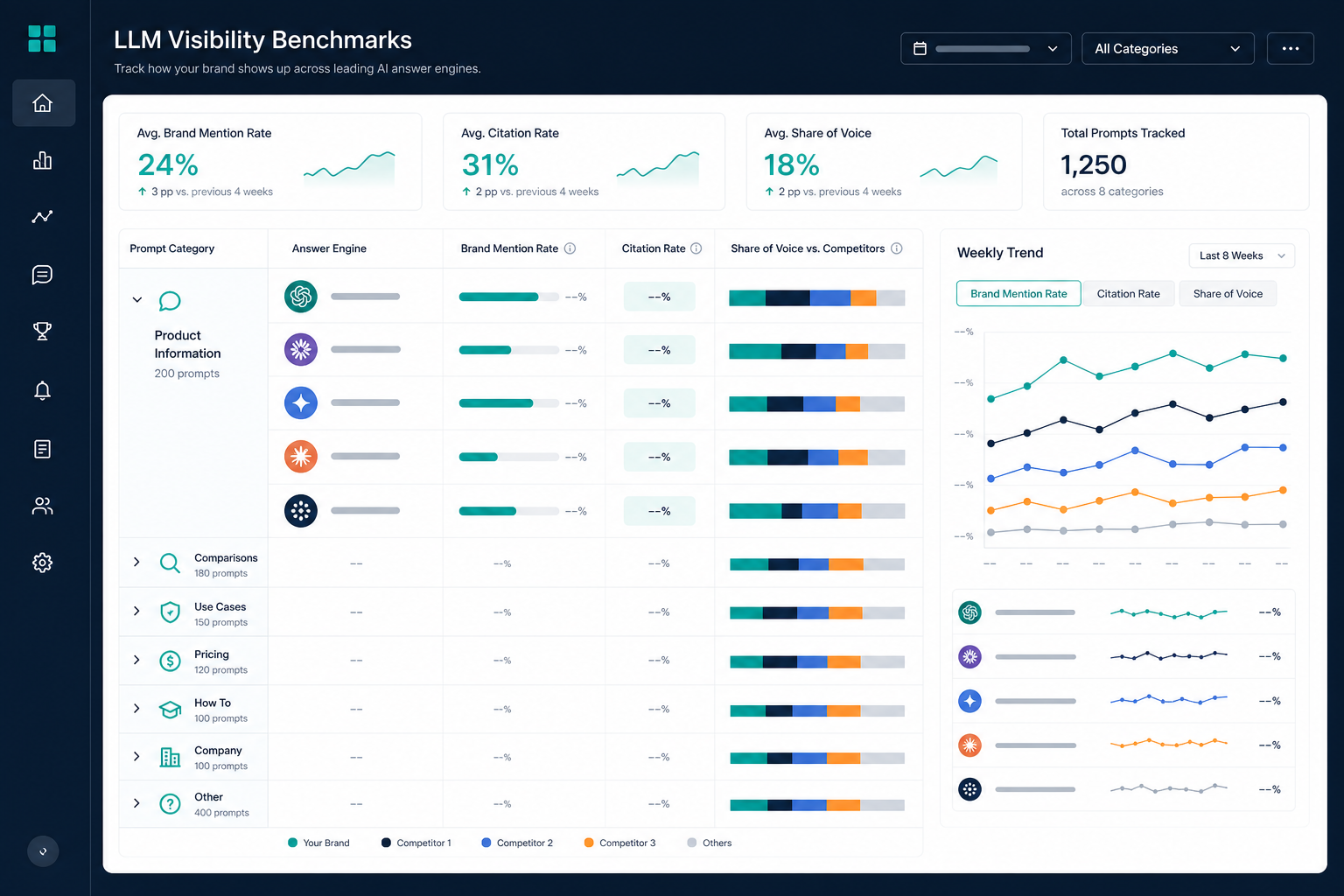
The report should fit on one screen first, then let the team drill into raw answers. Start with top-line movement, surface-by-surface scores, biggest competitor gains, lost prompts, target URL citation misses, and the next three page fixes.
Include these sections:
- Executive summary: what changed since last week and which prompts matter commercially.
- Surface table: ChatGPT, Perplexity, Gemini, Claude, and Google results shown separately.
- Lost shortlist prompts: high-intent prompts where competitors appear and your brand does not.
- Citation gaps: prompts where your domain or target URL failed to win the source.
- Accuracy risks: answers that describe your product, pricing, or category incorrectly.
- Fix queue: update this page, create this page, add this proof, re-measure on this date.
This is where the benchmark becomes revenue work instead of dashboard theater. The goal is not to admire the score. The goal is to close the prompt gaps that shape buyer shortlists.
Checklist: run your first LLM visibility benchmark
- Pick 40-80 buyer prompts and keep the wording fixed.
- Group prompts by definition, shortlist, comparison, alternatives, workflow, failure mode, pricing, and integration intent.
- Run each prompt across the AI surfaces your buyers use.
- Save the raw answer, cited URLs, brands, competitors, timestamp, and surface.
- Score brand mention, recommendation, domain citation, target URL citation, competitor SOV, and answer accuracy.
- Weight commercial prompts more than broad informational prompts.
- Assign every important loss to an existing-page update or a new page.
- Link related posts to the target page so the source path is obvious.
- Re-measure weekly and compare movement on the same wording.
For the page-level fix sequence, use answer engine optimization examples. For broader measurement, use AI visibility tracking. For a quick baseline, run the free Tracemetry audit.
FAQ
What is an LLM visibility benchmark? An LLM visibility benchmark is a repeatable measurement of whether AI assistants mention, recommend, cite, and accurately describe your brand for a fixed set of buyer prompts. It compares your performance against competitors across surfaces like ChatGPT, Perplexity, Gemini, Claude, and Google AI experiences.
How many prompts do I need for an LLM visibility benchmark? Start with 40-80 prompts for a useful weekly benchmark. Fewer than 20 prompts is too noisy and too easy to cherry-pick. Larger programs can expand after they have the publishing and optimization capacity to act on the findings.
Which LLM visibility metric matters most? Target URL citation rate is the best page-level metric because it shows whether the specific page you intended to own the prompt was cited. Brand mention rate is useful, but it can hide cases where a competitor or third-party page controls the source.
How often should I update an LLM visibility benchmark? Run it weekly for normal monitoring. Use daily checks only around launches, pricing changes, rebrands, major content updates, or sudden competitor movement. Monthly reporting is usually too slow for high-intent prompts.
Can I benchmark LLM visibility manually? Yes, for a small pilot. Put 20-40 prompts in a spreadsheet, run them on the same surfaces, and record mentions, recommendations, cited URLs, competitors, and answer accuracy. Move to a tool when you need more prompts, history, exports, and page-fix workflows.
Is LLM visibility benchmarking the same as AI SEO? No. AI SEO or answer engine optimization is the work of improving visibility. The benchmark is the measurement layer that shows where you stand, which prompts are lost, which pages are cited, and what to fix next.
Start with the benchmark, not a content calendar
Do not guess your way into 30 AI search articles. Run the benchmark first. Find the prompts where buyers see competitors, identify the pages that should own those answers, and fix the highest-intent gaps.
Run the free AI visibility audit for a quick baseline, or use Tracemetry Pro to monitor your custom prompt set weekly and turn lost answers into source-grounded page fixes.
Frequently asked questions
What is an LLM visibility benchmark?
An LLM visibility benchmark is a repeatable measurement of whether AI assistants mention, recommend, cite, and accurately describe your brand for a fixed set of buyer prompts. It compares your performance against competitors across surfaces like ChatGPT, Perplexity, Gemini, Claude, and Google AI experiences.
How many prompts do I need for an LLM visibility benchmark?
Start with 40-80 prompts for a useful weekly benchmark. Fewer than 20 prompts is too noisy and too easy to cherry-pick. Larger programs can expand after they have the publishing and optimization capacity to act on the findings.
Which LLM visibility metric matters most?
Target URL citation rate is the best page-level metric because it shows whether the specific page you intended to own the prompt was cited. Brand mention rate is useful, but it can hide cases where a competitor or third-party page controls the source.
How often should I update an LLM visibility benchmark?
Run it weekly for normal monitoring. Use daily checks only around launches, pricing changes, rebrands, major content updates, or sudden competitor movement. Monthly reporting is usually too slow for high-intent prompts.
Can I benchmark LLM visibility manually?
Yes, for a small pilot. Put 20-40 prompts in a spreadsheet, run them on the same surfaces, and record mentions, recommendations, cited URLs, competitors, and answer accuracy. Move to a tool when you need more prompts, history, exports, and page-fix workflows.
Is LLM visibility benchmarking the same as AI SEO?
No. AI SEO or answer engine optimization is the work of improving visibility. The benchmark is the measurement layer that shows where you stand, which prompts are lost, which pages are cited, and what to fix next.
See your own AI visibility today.
Free public report. 60 seconds. No signup. Or get started on Pro to track 250 prompts continuously.