Perplexity SEO checklist: how to earn more citations
A practical Perplexity SEO checklist for improving citation rate: prompts, retrieval, page fixes, schema, internal links, and weekly re-measurement.
Perplexity SEO is the work of making your pages easy for Perplexity to retrieve, parse, cite, and re-cite for buyer questions. The fast win is not "write more content." It is to inspect the prompts where competitors get cited, fix the page that should have won, and re-measure the same prompt set every week.
Use this checklist when your Google rankings look fine but Perplexity keeps citing competitors, publishers, Reddit, or old listicles instead of your own source pages. If you already have a specific lost prompt, start with the narrower guide on why Perplexity does not cite your site, then come back to this checklist for the full page audit.
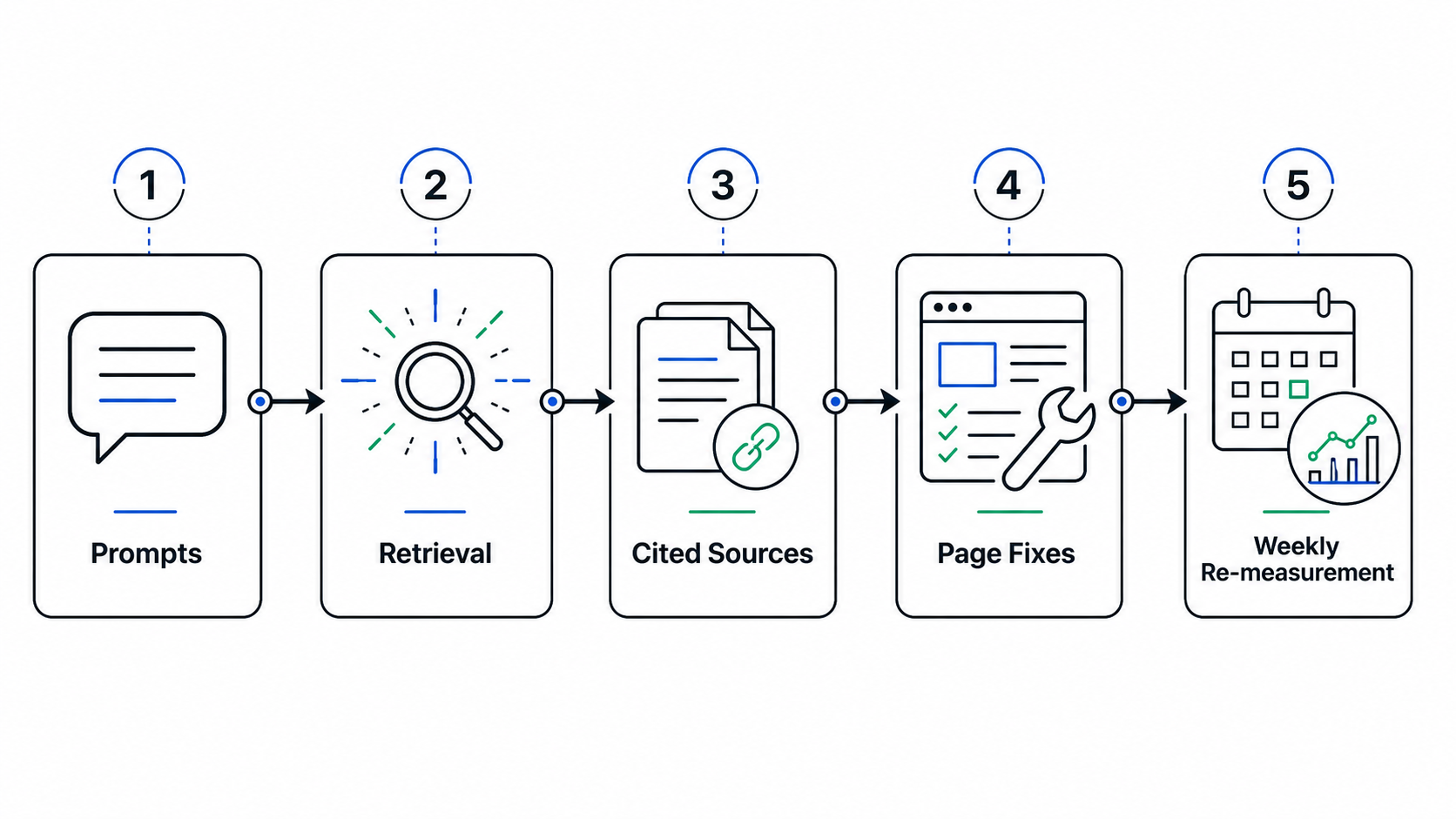
The real question is not whether "Perplexity SEO" is a perfect category name yet. The real question is whether buyers are already asking Perplexity the questions your pages should answer, and whether your domain appears as a cited source when those answers are generated.
What is Perplexity SEO?
Perplexity SEO is the process of improving whether Perplexity names, cites, and links to your pages in source-grounded answers. It combines classic SEO retrieval work with AI-citation work: prompt selection, page structure, direct answers, schema, source-worthy claims, and weekly citation tracking.
Perplexity SEO is narrower than generative engine optimization. GEO covers ChatGPT, Claude, Gemini, Google AI Overviews, and Perplexity. Perplexity SEO focuses on the surface where citations are most visible and where a page-level fix can move faster than brand-memory work.
Perplexity's own site describes the product as giving accurate answers backed by citations and built around the open web. Google's generative AI guidance explains the same underlying pattern for AI search more broadly: retrieval-augmented generation uses indexed pages to ground answers, and query fan-out can expand one user question into several related searches. That is why this checklist starts with retrieval and source ownership, not copywriting tricks.
If you need the broad playbook first, read how to optimize content for Perplexity. This page is the execution checklist.
When should you use a Perplexity SEO checklist?
Use a Perplexity SEO checklist when the answer already exists somewhere, but your page is not the source Perplexity chooses. The highest-value moments are bottom-funnel prompts: "best X for Y," "X alternatives," "how to solve Y," "X vs Y," and "which tool should I use for..."
Use this decision table before creating a new page:
| Perplexity result | What it means | Fix |
|---|---|---|
| Competitor cited, you absent | The prompt has commercial value and your entity/page is weak | Improve or create the matching page |
| You are named but not cited | Brand is known, but source page is not extractable | Add direct answer, table, FAQ, schema, sources |
| Your page is cited but the summary is wrong | Perplexity found you but misread the page | Rewrite the first 150 words and update claims |
| Publisher/listicle cited instead | Third-party authority is shaping the answer | Build comparison content and earn external mentions |
| Old page cited | Freshness and update clarity are weak | Add honest updatedAt, current examples, recent sources |
The dumb move is publishing ten generic "what is" articles because keyword tools show volume. The useful move is fixing the one URL that should win the prompt where a buyer is actively shortlisting.
How do you build the Perplexity prompt set?
Build a 40-80 prompt set that mixes exact keywords, conversational questions, comparisons, and failure modes. Do not track only "Perplexity SEO" as a keyword. A buyer asks Perplexity for decisions, not keyword reports.
Start with these buckets:
| Bucket | Count | Example prompts |
|---|---|---|
| Surface-specific | 8 | "how to rank in Perplexity", "how does Perplexity choose citations" |
| Category discovery | 8 | "what is the best way to monitor AI search visibility" |
| Tool shortlisting | 10 | "best AI visibility tools for B2B SaaS" |
| Comparison | 8 | "Tracemetry vs Profound for Perplexity tracking" |
| Failure mode | 8 | "why does Perplexity cite competitors instead of my site" |
| Workflow | 6 | "how do I improve Perplexity citation rate every week" |
Add entity terms that disambiguate the surface and use case: Perplexity, citations, cited sources, answer engine optimization, AI search visibility, retrieval, source links, brand mentions, citation rate, share of voice, B2B SaaS, comparison pages, FAQPage schema, Article schema, product pages, and buyer shortlisting.
Then lock the set. Changing prompts every week makes the score feel better and the data worse.
What should you check on every page?
Check whether the page can be retrieved, understood, quoted, trusted, and connected to the rest of the site. A page that ranks in Google but loses in Perplexity usually fails one of those five tests.
Use this page-level checklist:
- Title matches intent. The title says exactly what the prompt asks, without being spammy.
- Direct answer appears early. The first paragraph or first H2 gives a 40-80 word answer.
- The page names entities clearly. Product, category, audience, competitors, surface, and use case are explicit.
- The page has extractable blocks. Tables, numbered steps, definitions, and concise FAQs beat long prose.
- Claims are source-worthy. Statistics, standards, and factual claims link to credible sources.
- Schema matches visible content. Add
Articleand FAQ where the renderer supports it. - Internal links explain topology. Link from pillar, measurement, schema, and citation posts.
- Freshness is honest. Use visible publish/update dates and current examples.
- Conversion path is specific. Link to the audit, features, pricing, or demo that matches the job.
Google's structured data documentation says structured data provides explicit clues about a page and classifies page content; it also warns not to add structured data for information that is not visible to users. Treat that as the baseline rule for AI extraction too: schema should clarify the page, not describe a better page you forgot to write.
How do you fix a Perplexity citation loss?
Fix a Perplexity citation loss by matching the prompt to the page that should have won, comparing that page against the cited competitor URL, and shipping the smallest visible change that makes your page more useful as a source. Create a new URL only when no existing page satisfies the prompt intent.
Use this five-step workflow:
- Capture the exact answer. Record prompt, cited URLs, cited order, brands named, and answer summary.
- Classify the loss. Missing page, weak page shape, weak authority, stale content, wrong intent, or unclear entity.
- Pick the target URL. Usually this is an existing guide, comparison page, product page, or FAQ page.
- Rewrite the source block. Add a direct answer, decision table, examples, and FAQ that match the prompt.
- Re-measure in 7-14 days. Perplexity moves faster than model-memory surfaces, but not instantly.
For Tracemetry, the loop is: run a free AI visibility audit, find prompts where competitors are cited, generate briefs for missing source pages, publish the fix, and re-measure source ownership inside the same prompt set.
What should you connect before publishing?
Connect the page to the sources a reader naturally needs next: the broad playbook, the measurement workflow, the schema guide, and the audit or demo path. Perplexity can only cite what it can retrieve and contextualize, but the links still need to help a human move through the problem.
Before publishing, check these connections:
- If you need the strategy layer first, read the Perplexity optimization playbook.
- If your page is not getting cited, compare it against content that AI cites and the schema markup for AI search guide.
- If leadership needs a metric, use AI share-of-voice measurement to report citation rate and competitive visibility.
- If you want a snapshot before changing pages, run the audit. If you already have a program running, review features or book a demo.
Do the same in reverse for your strongest related pages. A checklist page should not sit alone; it should be reachable from the broader GEO audit, the ChatGPT citation workflow, and the main Perplexity playbook.
What does a weekly Perplexity SEO operating rhythm look like?
A practical weekly rhythm takes 90 minutes for a small prompt set: run prompts, classify losses, pick one page fix, publish the update, and record whether citation ownership improved the next week. The goal is fewer heroic audits and more boring compounding.
Use this schedule:
| Day | Work | Output |
|---|---|---|
| Monday | Run locked prompt set | Mention rate, citation rate, cited URLs |
| Tuesday | Classify top 10 losses | Fix queue by buyer intent |
| Wednesday | Update or draft one page | Direct answer, table, FAQ, schema |
| Thursday | Add internal links and sources | Reader path and source context |
| Friday | Publish and record baseline | Re-measure date set 7-14 days out |
The metric to watch is not raw traffic at first. Watch citation rate for decision-stage prompts, then referral traffic from perplexity.ai, then demo or signup conversion. If citation rate improves but traffic does not, your cited page may answer the question without creating a strong next step.
If you need the measurement layer in more detail, use the Perplexity citation monitoring workflow. It breaks citation rate into prompt buckets, cited URLs, competitor source ownership, loss reasons, and the weekly report fields that turn this checklist into an operating system.
If the loss is already visible and you need to know why that URL won, read how Perplexity chooses sources. It gives the source-selection scorecard for intent match, extractability, entity clarity, freshness, proof, topology, and schema.
If your team is testing paid placements too, use Perplexity ads and brand visibility before launch so the report separates sponsored appearance from organic citation ownership.
FAQ
What is Perplexity SEO? Perplexity SEO is the process of improving whether Perplexity names, cites, and links to your pages in source-grounded answers. It focuses on prompt tracking, retrievability, direct-answer page structure, schema, credible sources, and weekly citation-rate measurement. For the measurement layer, use the Perplexity citation rate benchmark to split mention rate, citation rate, target URL citation rate, and competitor source share.
How is Perplexity SEO different from ChatGPT SEO? Perplexity is more citation-forward, so page-level source ownership matters more. ChatGPT SEO also tracks citations, but ChatGPT often behaves more like a recommendation engine. Perplexity behaves more like an answer engine with visible sources, so fixes can be narrower and faster to measure.
How many prompts should I track for Perplexity? Track 40-80 prompts for a stable early program. Include discovery, shortlisting, comparison, failure-mode, and workflow prompts. For a quick diagnostic, 20 prompts is acceptable, but do not use it as a durable metric.
What pages improve Perplexity citation rate fastest? Comparison pages, alternatives pages, troubleshooting guides, buyer guides, and specific workflow checklists usually improve citation rate fastest because they match prompts where buyers need a source before making a decision.
Does schema help Perplexity SEO? Schema helps by making the page easier to parse and classify, especially when FAQ and Article data match visible content. It is not a magic ranking factor. Use schema as a clarity layer on top of useful, source-worthy content.
Start with the source gaps
Run the free Tracemetry audit and look for prompts where Perplexity cites competitors instead of you. If the gaps matter, use Tracemetry Pro to track 250 prompts weekly across ChatGPT, Claude, Perplexity, and Gemini, generate source-grounded briefs, and re-measure after each page ships.
Frequently asked questions
What is Perplexity SEO?
Perplexity SEO is the process of improving whether Perplexity names, cites, and links to your pages in source-grounded answers. It focuses on prompt tracking, retrievability, direct-answer page structure, schema, credible sources, and weekly citation-rate measurement.
How is Perplexity SEO different from ChatGPT SEO?
Perplexity is more citation-forward, so page-level source ownership matters more. ChatGPT SEO also tracks citations, but ChatGPT often behaves more like a recommendation engine. Perplexity behaves more like an answer engine with visible sources, so fixes can be narrower and faster to measure.
How many prompts should I track for Perplexity?
Track 40-80 prompts for a stable early program. Include discovery, shortlisting, comparison, failure-mode, and workflow prompts. For a quick diagnostic, 20 prompts is acceptable, but do not use it as a durable metric.
What pages improve Perplexity citation rate fastest?
Comparison pages, alternatives pages, troubleshooting guides, buyer guides, and specific workflow checklists usually improve citation rate fastest because they match prompts where buyers need a source before making a decision.
Does schema help Perplexity SEO?
Schema helps by making the page easier to parse and classify, especially when FAQ and Article data match visible content. It is not a magic ranking factor. Use schema as a clarity layer on top of useful, source-worthy content.
See your own AI visibility today.
Free public report. 60 seconds. No signup. Or get started on Pro to track 250 prompts continuously.