AI brand monitoring: the weekly workflow for generated answers
How to monitor brand mentions, citations, competitors, and answer accuracy across ChatGPT, Claude, Perplexity, Gemini, and Google AI Overviews.
AI brand monitoring is the weekly process of checking how often AI systems mention your brand, which sources they cite, which competitors they recommend, and whether the answer is accurate enough to trust. The painful part is that the old brand-monitoring stack watches social posts, news, and review sites while buyers are now asking ChatGPT, Perplexity, Gemini, and Google AI answers for shortlists.
The fast rule: do not start with a giant dashboard. Start with 40-80 buyer prompts, four AI surfaces, three samples per prompt, and one weekly decision: which page, source, or third-party proof needs to change next?
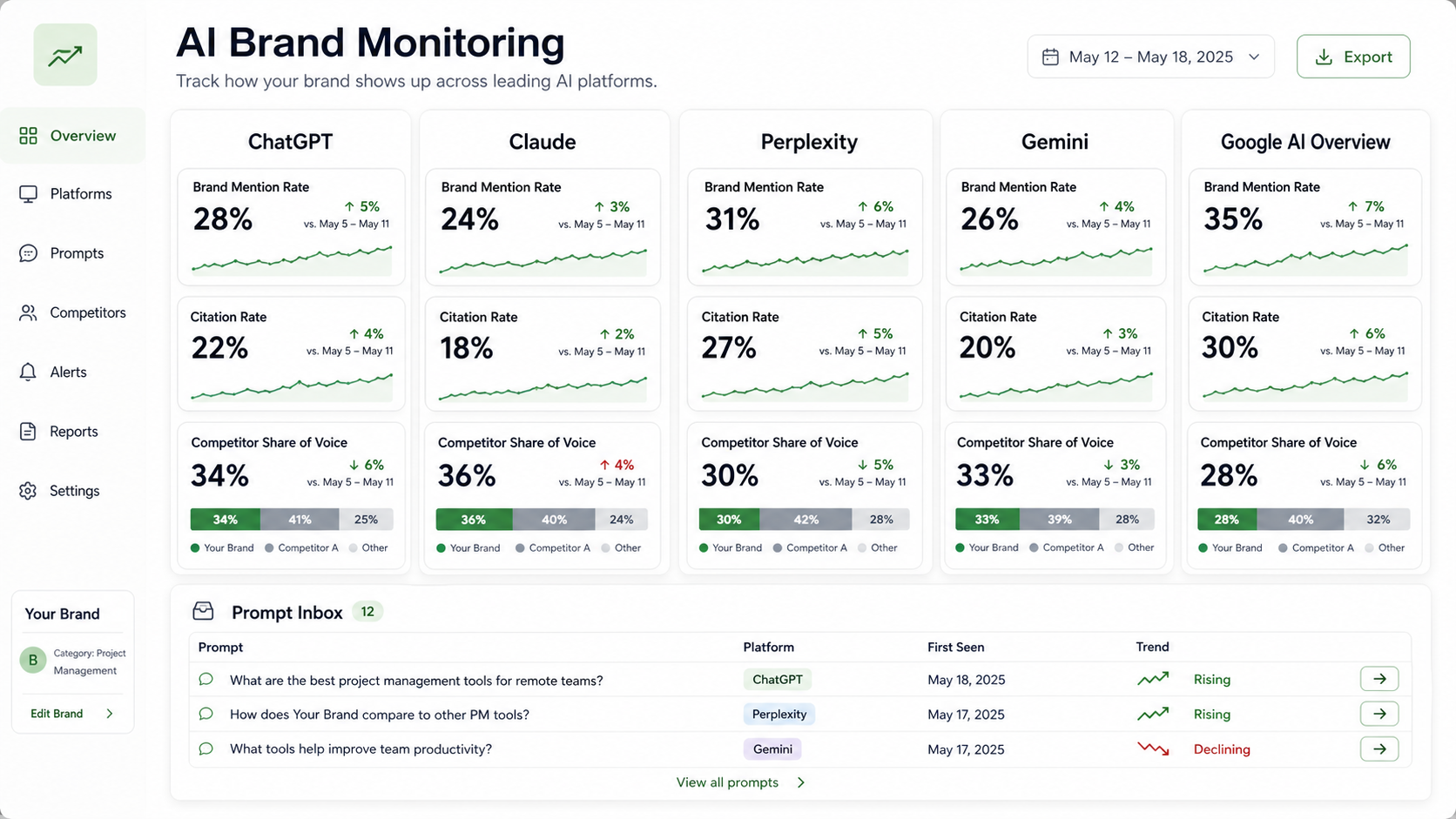
Google says AI Overviews provide a snapshot with links to explore more on the web, while OpenAI's help center says ChatGPT can use web search for recent or source-backed responses. That means brand monitoring now has to capture generated answers, not only pages where your brand name appears.
If you only check whether your brand appears, you will miss the money signal. The useful version separates mentions, citations, competitors, source URLs, answer sentiment, and the prompt that triggered the answer.
What is AI brand monitoring?
AI brand monitoring is the practice of tracking brand mentions, citations, competitor recommendations, answer sentiment, and source ownership across AI-generated answers. It covers ChatGPT, Claude, Perplexity, Gemini, Google AI Overviews, and other answer surfaces where buyers ask category, comparison, and troubleshooting questions.
AI brand monitoring is different from traditional social listening because the monitored object is not a public post. It is a generated answer. The answer may name your brand, cite your site, cite a competitor, summarize a review, or recommend a vendor without creating a normal backlink, mention, or referral session.
Use AI search visibility for the high-level metric. Use AI visibility tracking when you need the prompt-level dashboard across ChatGPT, Claude, Perplexity, Gemini, and Google AI Overviews. Use AI search monitoring when the goal is to replace rank-only reporting with prompts, citations, competitors, and page fixes. Use the monitoring workflow as the operating loop that tells the team what changed this week and what to fix next.
When the answer names another vendor, classify it with the AI search competitor mentions workflow instead of treating every competitor mention as the same kind of loss.
When the issue is not presence but truthfulness, add AI answer accuracy monitoring to the workflow. It separates stale pricing, wrong feature claims, misleading comparisons, and unverifiable source paths from normal mention and citation metrics.
When the issue is not truthfulness but framing, add AI search sentiment monitoring. It separates positive, neutral, mixed, negative, wrong, and unverifiable answer tone so the team can see whether AI answers are helping or hurting buyer confidence.
When the issue is urgency, use AI brand monitoring alerts. Alerts should fire for buyer-risk changes such as lost mentions, competitor gains, citation drops, wrong claims, and sentiment changes, while normal wording drift stays in the weekly report.
Why does AI brand monitoring matter now?
AI brand monitoring matters because buyers are moving discovery, comparison, and troubleshooting questions into answer engines. If an AI answer names three competitors and omits you, the buyer may never search your brand, click your ad, or reach your comparison page.
The risk is not only invisibility. It is silent displacement:
| AI answer pattern | Business risk | What to monitor |
|---|---|---|
| Competitor recommended, you absent | Lost shortlist demand | Mention rate, competitor share of voice |
| You mentioned without citation | Awareness without a click path | Citation rate, source URL ownership |
| Your brand described incorrectly | Sales friction and trust loss | Answer accuracy, claim drift |
| Old pricing or positioning repeated | Bad-fit pipeline | Freshness, cited source date |
| Publisher or Reddit source dominates | Third-party proof gap | External citations, review/source mix |
| Google AI Overview cites competitors | Search result displacement | AI Overview presence and cited domains |
Traditional brand monitoring still matters for reputation. AI brand monitoring matters for pipeline because the answer can compress the buyer's shortlist before your site gets a visit.
Which prompts should you monitor first?
Monitor prompts where the answer can change a buying decision. Start with category, comparison, alternative, use-case, integration, problem, and pricing-adjacent questions. Skip generic awareness prompts until you have the bottom-funnel set under control.
Build the first prompt set from these buckets:
| Prompt bucket | Example AI query | Why it matters |
|---|---|---|
| Category shortlist | "best AI visibility tools for B2B SaaS" | Names the vendors buyers evaluate |
| Comparison | "Tracemetry vs Profound for AI visibility tracking" | Shapes direct competitive preference |
| Alternative | "alternatives to Otterly for ChatGPT tracking" | Captures switching and challenger demand |
| Workflow | "how do I monitor brand mentions in AI answers?" | Reveals whether your content is the source |
| Failure mode | "why does ChatGPT recommend my competitors?" | Finds urgent content and authority gaps |
| Surface-specific | "how do I track Google AI Overview citations?" | Separates Google, ChatGPT, and Perplexity behavior |
| Revenue-adjacent | "AI visibility tool pricing for startups" | Connects monitoring to buying intent |
Add entity terms that disambiguate the task: AI brand monitoring, AI brand visibility, ChatGPT Search, Claude, Perplexity, Gemini, Google AI Overviews, brand mentions, cited URLs, citation rate, source ownership, share of voice, competitor recommendations, B2B SaaS, product pages, comparison pages, reviews, and FAQPage schema.
The conversational phrasing matters. AI systems are more likely to answer "why does ChatGPT cite my competitor instead of my website?" than a keyword-stuffed phrase like "AI brand monitoring solution platform".
What should an AI brand monitoring dashboard include?
An AI brand monitoring dashboard should show mention rate, citation rate, competitor share of voice, answer accuracy, source ownership, prompt-level losses, and week-over-week movement. The dashboard should point to the next fix, not just display a score.
Track these fields for every prompt run:
| Field | Example | Decision it supports |
|---|---|---|
| Surface | ChatGPT, Claude, Perplexity, Gemini, Google AI Overview | Which engine is drifting |
| Prompt | "best AI visibility tools for startups" | Which buyer question changed |
| Brand mentioned | Yes / no | Basic presence |
| Brand cited | Yes / no | Whether there is a click path |
| Cited URL | /blog/ai-brand-visibility-tools | Which page owns the answer |
| Competitors named | Profound, Peec, Otterly | Share-of-voice denominator |
| Citation position | First, second, third | Source prominence |
| Answer sentiment | positive, neutral, negative, wrong | Quality control |
| Recommended action | update page, earn source, create comparison | Work queue |
For the math layer, use the AI share-of-voice formula. For source-level analysis, use ChatGPT citation tracking, Perplexity citation monitoring, and AI Overview tracking as separate views, because cited-source behavior differs by surface.
How do you monitor AI brand mentions manually?
Manual AI brand monitoring works if the prompt set is small and the process is strict. The mistake is asking a few prompts whenever someone is nervous and treating the result as a trend.
Use this weekly workflow:
- Lock the prompt set. Use 40-80 buyer prompts. Do not rewrite them every week.
- Define the competitor set. Include direct competitors, category leaders, and common substitutes.
- Run each prompt on each surface. Keep ChatGPT, Claude, Perplexity, Gemini, and Google AI Overviews separate.
- Sample repeated answers. Run important prompts three times because generated answers vary.
- Record mentions and citations separately. A brand mention is not the same as a cited URL.
- Capture source URLs. Save the page, domain, citation order, and answer context.
- Flag wrong claims. Mark incorrect pricing, outdated features, wrong integrations, and bad comparisons.
- Prioritize by buyer intent. Fix bottom-funnel competitor and shortlisting prompts before generic definitions.
- Re-measure after fixes. Use the same prompt wording 7-14 days after publishing or page updates.
For a first baseline, run the free AI visibility audit. For weekly monitoring, connect the prompt set to Tracemetry Pro so the team gets prompt-level movement, competitor changes, and source-grounded briefs without rebuilding the spreadsheet.
How is AI brand monitoring different from social listening?
Social listening monitors public conversation. AI brand monitoring monitors generated answers. The inputs, surfaces, metrics, and fixes are different enough that one tool cannot be judged by the other's reporting model.
| Traditional brand monitoring | AI brand monitoring |
|---|---|
| Tracks social posts, news, reviews, forums | Tracks generated answers and citations |
| Measures mention volume and sentiment | Measures mention rate, citation rate, and share of voice |
| Responds with comms, support, PR, or escalation | Responds with page fixes, schema, source proof, and content briefs |
| Works from public URLs where the mention already exists | Samples prompts because answers are generated on demand |
| Optimizes reputation and brand health | Optimizes discoverability, shortlist inclusion, and answer accuracy |
Tools like Brandwatch, Sprout, and Meltwater are built for social and media monitoring. They help you understand what people say in public. AI brand monitoring tools are built for answer surfaces where the buyer may never publish the question or the answer anywhere.
What do you do when AI answers mention competitors instead?
When AI answers mention competitors instead of you, classify the loss before writing anything. The right fix may be a better page, a comparison page, third-party proof, structured data, fresh documentation, or earned mentions on sources AI systems already cite.
Use this triage:
| Loss type | Symptom | Fix |
|---|---|---|
| Missing entity | AI does not understand what you do | Rewrite homepage/product copy with clear category language |
| Missing page | Competitor has a page matching the prompt and you do not | Publish a focused comparison, alternative, or workflow page |
| Weak source ownership | You are mentioned but a publisher is cited | Add source-worthy data, tables, examples, and citations |
| Weak third-party proof | Reddit, reviews, or listicles dominate | Earn reviews, community mentions, and credible category coverage |
| Stale information | AI repeats old positioning or pricing | Update visible pages and make dates truthful |
| Wrong schema/content match | Schema says more than the visible page | Align structured data with readable content |
Google's structured data guidelines emphasize marking up information that is visible to users. Do not hide FAQ answers in schema while the page says something else. If the answer engine cites or summarizes your page, the visible copy has to carry the claim.
How often should you run AI brand monitoring?
Run AI brand monitoring weekly for most B2B SaaS categories. Daily monitoring creates noise unless you are managing a launch, crisis, pricing change, or high-volume consumer brand. Monthly monitoring is too slow because competitors can win prompts and shape the shortlist before your team sees the change.
Use three cadences:
| Cadence | Use it for | Prompt count |
|---|---|---|
| Weekly | Normal category monitoring | 40-150 prompts |
| Daily for 14 days | Launches, rebrands, pricing changes, major pages | 20-60 prompts |
| Monthly | Board-level trend summary | Rollup only |
The weekly report should answer five questions:
- Did our mention rate move?
- Did our citation rate move?
- Which competitors gained share?
- Which prompts changed enough to investigate?
- Which page or source should we fix this week?
Anything beyond that is decoration unless the team can act on it.
What is the minimum AI brand monitoring setup?
The minimum setup is one locked prompt set, one competitor list, one weekly run, separate mention and citation fields, and one action queue. You can do it in a spreadsheet for a month. If the category matters, automate it before manual sampling becomes inconsistent.
Minimum fields:
- Prompt
- Intent bucket
- Surface
- Run date
- Your brand mentioned
- Your domain cited
- Cited URL
- Competitors mentioned
- Competitor URLs cited
- Answer accuracy notes
- Recommended fix
- Owner
- Re-measure date
That last field matters. AI brand monitoring is not a reporting exercise. It is a loop: measure, diagnose, fix, publish, re-measure.
FAQ
What is AI brand monitoring? AI brand monitoring is the process of tracking how often and how accurately your brand appears in AI-generated answers. It measures brand mentions, cited URLs, competitor recommendations, source ownership, share of voice, and answer accuracy across ChatGPT, Claude, Perplexity, Gemini, and Google AI Overviews.
How is AI brand monitoring different from AI brand visibility? AI brand visibility is the outcome: how often your brand appears in relevant AI answers. AI brand monitoring is the process that measures that outcome every week, identifies competitor gains, and turns prompt-level losses into page, schema, content, or authority fixes.
Can traditional brand monitoring tools track AI answers? Most traditional brand monitoring tools are built for public mentions on social media, news, reviews, and forums. They may use AI to classify sentiment, but they usually do not run buyer prompts across ChatGPT, Claude, Perplexity, Gemini, and Google AI Overviews or separate mentions from cited URLs.
How many prompts should I monitor for AI brand tracking? Start with 40-80 prompts across category, comparison, alternative, workflow, failure-mode, surface-specific, and revenue-adjacent intent. Mature programs can expand to 150-300 prompts once they have enough publishing and optimization capacity to act on the findings.
What is the fastest way to improve AI brand monitoring results? Fix the highest-intent prompt where a competitor is mentioned or cited and you are absent. Update the target page with a direct answer, comparison table, current product details, credible sources, visible FAQ content, and internal links from related pages. Then re-measure the same prompt set.
Start monitoring the answers buyers actually see
Run the free Tracemetry audit to see whether your brand appears for buyer questions across major AI surfaces. If the report shows competitors winning prompts you should own, use Tracemetry Pro to monitor the full prompt set, track citations, generate source-grounded briefs, publish fixes, and measure whether the answers change.
Frequently asked questions
What is AI brand monitoring?
AI brand monitoring is the process of tracking how often and how accurately your brand appears in AI-generated answers. It measures brand mentions, cited URLs, competitor recommendations, source ownership, share of voice, and answer accuracy across ChatGPT, Claude, Perplexity, Gemini, and Google AI Overviews.
How is AI brand monitoring different from AI brand visibility?
AI brand visibility is the outcome: how often your brand appears in relevant AI answers. AI brand monitoring is the process that measures that outcome every week, identifies competitor gains, and turns prompt-level losses into page, schema, content, or authority fixes.
Can traditional brand monitoring tools track AI answers?
Most traditional brand monitoring tools are built for public mentions on social media, news, reviews, and forums. They may use AI to classify sentiment, but they usually do not run buyer prompts across ChatGPT, Claude, Perplexity, Gemini, and Google AI Overviews or separate mentions from cited URLs.
How many prompts should I monitor for AI brand tracking?
Start with 40-80 prompts across category, comparison, alternative, workflow, failure-mode, surface-specific, and revenue-adjacent intent. Mature programs can expand to 150-300 prompts once they have enough publishing and optimization capacity to act on the findings.
What is the fastest way to improve AI brand monitoring results?
Fix the highest-intent prompt where a competitor is mentioned or cited and you are absent. Update the target page with a direct answer, comparison table, current product details, credible sources, visible FAQ content, and internal links from related pages. Then re-measure the same prompt set.
See your own AI visibility today.
Free public report. 60 seconds. No signup. Or get started on Pro to track 250 prompts continuously.