Generative engine optimization audit: the 2026 checklist
How to run a generative engine optimization audit: prompts, AI surfaces, mention rate, citation rate, share of voice, competitor gaps, and the fixes that move AI visibility.
A generative engine optimization audit tells you whether AI assistants can find, understand, mention, and cite your brand for the prompts your buyers actually ask. The fast version is simple: test 40-80 category prompts across ChatGPT, Claude, Perplexity, and Gemini, score brand presence, inspect citations, then fix the pages that should have been cited but were not.
This is still an early category, so the wording varies: AI visibility audit, GEO audit, answer engine audit, AI search audit. The job is the same either way: find the prompts where buyers ask for help, see which brands and URLs the assistants trust, and turn that evidence into a prioritized fix list. For the full prompt-to-page worksheet, technical checks, scoring model, and re-test package, use the answer engine optimization audit checklist.
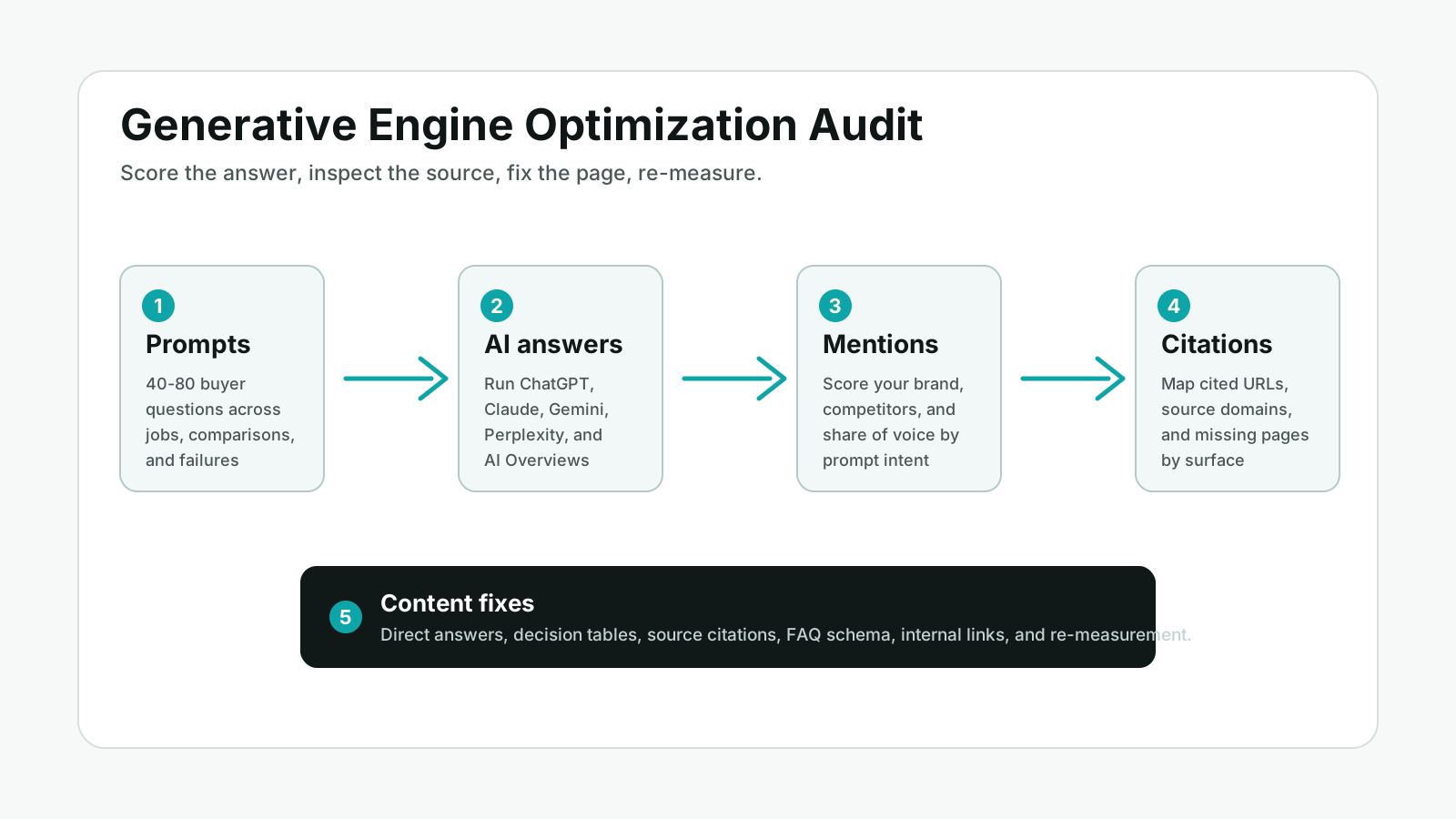
The mistake most teams make is treating GEO like a content-quality vibe check. It is not. You need a repeatable audit that connects prompts, answers, competitors, citations, page gaps, and the next content fixes.
What is a generative engine optimization audit?
A generative engine optimization audit is a structured review of how often your brand appears in AI-generated answers, which competitors appear instead, which sources get cited, and what content or authority gaps explain the result. It turns vague "are we showing up in AI?" anxiety into a ranked action list.
Generative engine optimization audit is the diagnostic layer of GEO. GEO improves your odds of being mentioned, recommended, or cited by AI assistants. The audit measures the current baseline, identifies missing prompts, and shows which pages need clearer answers, better schema, stronger citations, or new decision-stage content.
If you are new to the category, start with the broader GEO definition, then use this audit as the operating checklist.
When should you run a GEO audit?
Run a GEO audit when AI answers can influence your shortlist, not only when AI traffic is already visible in analytics. For B2B SaaS, devtools, agencies, healthcare software, ecommerce, and local-service categories, buyers increasingly ask AI assistants for vendor shortlists before they ever visit Google.
The clean trigger: run the audit before you refresh positioning, launch a content program, buy an AI visibility tool, or brief an agency. A one-time audit gives you the baseline. A weekly version becomes your AI search visibility scoreboard.
| Signal | What it means | Audit priority |
|---|---|---|
| Your competitors are named in ChatGPT but you are not | Entity and content gaps are already costing shortlist presence | High |
| Your pages rank on Google but are not cited by Perplexity | The pages are retrievable but not extractable | High |
| Your category has "best", "alternative", or "for [use case]" searches | Buyers ask comparison prompts that AI assistants answer directly | High |
| You have no FAQ, Article, Product, or HowTo schema | AI systems have fewer structured anchors to extract | Medium |
| You only track Google rankings | You are measuring the old surface and missing the AI surface | Medium |
How do you run the audit in one afternoon?
The one-afternoon GEO audit has five steps: build the prompt set, run each prompt across AI surfaces, score mentions and citations, map winners to source pages, then prioritize fixes by buyer intent. Do not start by writing content. Start by finding the prompts where content would change the answer.
Use this workflow:
- Define 40-80 prompts. Include discovery, comparison, alternative, troubleshooting, pricing, and "best tool for [specific job]" phrasing.
- Run each prompt on multiple surfaces. At minimum: ChatGPT, Claude, Perplexity, and Gemini. Treat Google AI Overviews as a related but separate answer-engine surface because Google documents its own AI feature behavior separately; use a dedicated AI Overview tracking pass when Google SERP citations and CTR changes matter.
- Record every brand mention. Count your brand, direct competitors, adjacent substitutes, and publishers.
- Record cited URLs. For Perplexity and web-enabled answers, log the exact pages cited. For uncited answers, log the brands named anyway.
- Classify the gap. Missing entity, missing page, weak page shape, weak schema, stale page, or competitor authority.
- Ship the smallest fix. Update an existing page when one should win. Create a new page only when the prompt needs a page you do not have.
For a quick benchmark, use the free Tracemetry audit. It runs a smaller version of the same loop and gives you the top competitors and first gaps in about 60 seconds.
Which prompts belong in the audit?
The prompt set should mirror buyer questions, not SEO keyword lists. Search keywords help you find language, but AI prompts are usually more conversational: "what is the best way to...", "why does...", "which tool should I use for...", and "what are the alternatives to...".
Build the prompt set from five buckets:
- Category definition: "what is generative engine optimization", "what is AI visibility"
- Tool shortlisting: "best AI visibility tools for B2B SaaS", "tools to track ChatGPT mentions"
- Comparison: "Tracemetry vs Profound", "Otterly vs Peec for AI search tracking"
- Failure mode: "why does my brand not show up in ChatGPT", "why is Perplexity citing competitors"
- Workflow: "how do I audit AI search visibility", "how to measure share of voice in AI answers"
Entity terms matter here. Include your product name, category names, fileable use cases, audience terms, competitors, and surfaces: ChatGPT, Claude, Perplexity, Gemini, Google AI Overviews, answer engine optimization, AI search visibility, LLM visibility, and generative engine optimization.
What metrics should a GEO audit report?
A useful GEO audit reports mention rate, citation rate, share of voice, competitor displacement, surface-level differences, and prompt-level opportunity. The metric that matters most is not the prettiest dashboard number. It is the list of buyer prompts where a competitor appears and your brand does not.
Track these six numbers:
| Metric | Formula | Why it matters |
|---|---|---|
| Mention rate | Prompts where your brand is named / total prompts | Measures basic AI visibility |
| Citation rate | Prompts citing your domain / total prompts | Measures source authority and page extractability |
| AI share of voice | Your mentions / all tracked brand mentions | Shows competitive position |
| Weighted SOV | SOV weighted by buyer intent | Prevents top-funnel prompts from hiding revenue gaps |
| Citation ownership | Your cited URLs / all cited URLs mentioning your category | Shows whether your site is the source or only the brand |
| Fixable gap count | High-intent prompts with a clear page/schema/content fix | Turns the audit into a work queue |
For the full math, use the AI share-of-voice formula. For page-level fixes, compare every weak page against the content shape that AI assistants cite.
How do you decide what to fix first?
Fix the prompt gaps closest to revenue first. A bottom-funnel comparison prompt where a competitor is recommended is more valuable than a top-funnel definition prompt where nobody is named. The audit should produce a priority queue, not a giant content calendar.
Use this decision rule:
| If the gap is... | Fix this first | Example |
|---|---|---|
| Competitor named, you absent | Create or improve comparison/alternative content | "best [category] tools for agencies" |
| You are named but not cited | Improve source-worthy page structure and citations | Add direct answers, examples, sources, FAQ |
| Your page is cited but answer is wrong | Update claims and add clearer entity/schema signals | Product capability, pricing, use case |
| Perplexity cites competitors, ChatGPT names nobody | Add cited, fresh, web-indexed pages | Recent benchmark, buyer's guide |
| Claude names old positioning | Strengthen entity pages and About/product copy | Clear category and audience language |
Do not publish ten generic "what is X" posts. That is the slow path. Publish the one page that answers the exact buyer prompt the model is already trying to answer.
What page fixes usually move GEO audit scores?
The fixes that move audit scores are boring and specific: answer the prompt in the first 100 words, add comparison logic, cite sources, add FAQ schema, strengthen internal links, and make the brand/entity relationship explicit. Generic content volume rarely moves AI visibility by itself.
Start with existing pages:
- Add a 40-80 word direct answer under the H1 or first H2.
- Add a decision table for comparison or shortlisting prompts.
- Add visible FAQ content and FAQ schema where supported.
- Add
Article,FAQPage,Product, orHowToschema when appropriate. - Link from the page to the product, pricing, audit, and related educational pages.
- Update stale dates and stale claims honestly.
- Cite primary or credible sources for claims about Google AI features, structured data, and content quality.
For schema, use the schema markup for AI search guide. If Perplexity is the surface losing most often, run the narrower Perplexity SEO checklist against the pages that should have been cited. If the audit needs a site-level source-readiness grade before page fixes, use the AI optimization for websites scorecard. Google's own docs on AI features in Search, structured data, and helpful content are the baseline references. The original GEO research paper is also useful context for why content structure and source credibility affect generative answers: GEO: Generative Engine Optimization.
If the audit identifies one page that should already own a prompt, use the AI engine optimization checklist to make that page easier for AI systems to retrieve, extract, cite, and re-measure.
What should the final audit deliverable look like?
The final deliverable should be a ranked table of prompt gaps, not a 40-slide strategy deck. Each row should include the prompt, surface, current winner, cited source, your status, likely cause, recommended fix, target URL, owner, and expected re-measure date.
Minimum deliverable:
- Baseline mention rate and citation rate
- Per-surface breakdown for ChatGPT, Claude, Perplexity, Gemini, and Google AI Overviews when available
- Top 10 missing high-intent prompts
- Top 10 competitor-cited pages
- Existing pages to update
- New pages to create
- Schema and internal-link fixes
- Re-measure date, usually 7-14 days after publishing
Tracemetry turns this into an operating loop: visibility tracking, opportunity discovery, brief generation, draft generation, review, publishing, and re-measurement. The audit is the first measurement pass, not the entire program. Use the generative engine optimization strategy guide when you need to turn the audit into a 90-day execution plan.
FAQ
What is a generative engine optimization audit? A generative engine optimization audit measures whether your brand is mentioned, recommended, or cited in AI-generated answers for buyer-relevant prompts. It compares your presence against competitors, identifies the source pages AI assistants cite, and produces a prioritized list of content, schema, and authority fixes.
How is a GEO audit different from an SEO audit? An SEO audit checks rankings, crawlability, technical health, backlinks, and organic traffic. A GEO audit checks generated answers: which brands AI assistants name, which sources they cite, and which prompts produce competitor recommendations. The work overlaps, but the scoring surface is different.
How many prompts do I need for a reliable AI visibility audit? For a meaningful category baseline, use 40-80 prompts across discovery, comparison, alternative, troubleshooting, and decision-stage intent. Fewer than 20 prompts is usually too noisy. More than 100 prompts is useful for mature programs but unnecessary for a first audit.
Which AI surfaces should a GEO audit include? Start with ChatGPT, Claude, Perplexity, and Gemini. Add Google AI Overviews for search-result visibility and Bing Copilot if your audience uses Microsoft surfaces heavily. Report each surface separately because the same brand can win on Perplexity and lose on ChatGPT.
What is the fastest fix after a bad GEO audit? Update the page that should have been cited. Put a direct answer near the top, add a comparison table or checklist, cite credible sources, add FAQ schema, and link it from related pages. Create a new page only when no existing page matches the prompt intent.
Start with the audit
Run the free AI visibility audit for your domain. If the gaps are obvious, move into continuous tracking on Tracemetry Pro: 250 prompts, weekly runs, competitor share of voice, source-grounded briefs, draft generation, editorial review, and re-measurement.
Frequently asked questions
What is a generative engine optimization audit?
A generative engine optimization audit measures whether your brand is mentioned, recommended, or cited in AI-generated answers for buyer-relevant prompts. It compares your presence against competitors, identifies the source pages AI assistants cite, and produces a prioritized list of content, schema, and authority fixes.
How is a GEO audit different from an SEO audit?
An SEO audit checks rankings, crawlability, technical health, backlinks, and organic traffic. A GEO audit checks generated answers: which brands AI assistants name, which sources they cite, and which prompts produce competitor recommendations. The work overlaps, but the scoring surface is different.
How many prompts do I need for a reliable AI visibility audit?
For a meaningful category baseline, use 40-80 prompts across discovery, comparison, alternative, troubleshooting, and decision-stage intent. Fewer than 20 prompts is usually too noisy. More than 100 prompts is useful for mature programs but unnecessary for a first audit.
Which AI surfaces should a GEO audit include?
Start with ChatGPT, Claude, Perplexity, and Gemini. Add Google AI Overviews for search-result visibility and Bing Copilot if your audience uses Microsoft surfaces heavily. Report each surface separately because the same brand can win on Perplexity and lose on ChatGPT.
What is the fastest fix after a bad GEO audit?
Update the page that should have been cited. Put a direct answer near the top, add a comparison table or checklist, cite credible sources, add FAQ schema, and link it from related pages. Create a new page only when no existing page matches the prompt intent.
See your own AI visibility today.
Free public report. 60 seconds. No signup. Or get started on Pro to track 250 prompts continuously.