Gemini citation tracking: prompts, cited URLs, and fixes
How to track Gemini citations weekly: prompt sets, cited URLs, brand mentions, Google AI surface splits, competitor sources, answer accuracy, and page fixes.
Gemini citation tracking gets messy when teams treat every Google surface as one number. Gemini Apps, Google AI Overviews, and AI Mode can all influence a buyer, but they expose sources differently and should be measured separately.
The fast rule: track Gemini as its own surface, record mentioned brands and cited sources separately, and fix the highest-intent prompt where Gemini names a competitor or shows a source path that should have belonged to you.
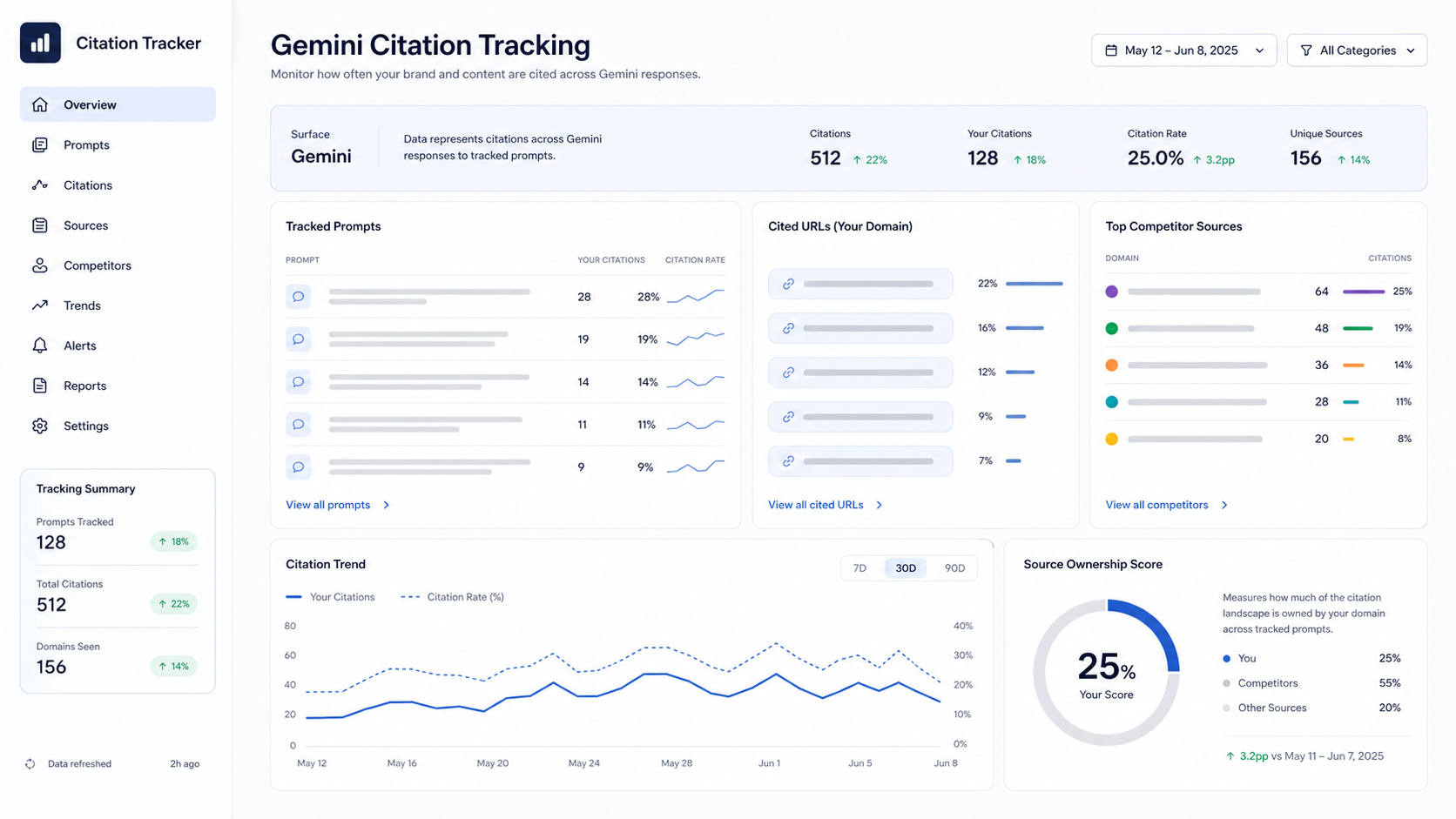
Use this guide after your broad AI visibility tracking workflow is in place. If your team already tracks ChatGPT citation tracking, Claude citation tracking, and Perplexity citation monitoring, Gemini is the next surface to separate instead of blending it into a generic AI score.
What is Gemini citation tracking?
Gemini citation tracking is the process of measuring when Gemini or Google AI surfaces cite your domain, which URLs they use as sources, which competitors they name instead, and whether the answer is accurate enough for a buyer to trust. It turns "Gemini mentioned us" into a repeatable source-ownership report.
Gemini citation tracking is the Google-specific layer of AI visibility measurement. Brand mention tracking answers whether Gemini names your company. Citation tracking answers whether the answer gives the user a source path to your website, a competitor page, a publisher page, a Google result, or no visible source at all.
Google's Gemini Help documentation says Gemini Apps may show sources and related links, but not every response includes them. Google's Search Central documentation also treats AI Overviews and AI Mode as Search experiences with links, snippets, and crawl/indexing rules. That means the measurement has to separate Gemini Apps from Google Search generative features; use AI Mode tracking when the surface is Google's conversational Search experience rather than Gemini Apps.
When should you track Gemini citations instead of only mentions?
Track Gemini citations when the prompt can influence a shortlist, comparison, internal memo, or page visit. A brand mention is useful, but a cited source tells you which page Gemini or Google used to support the answer and what page deserves the next fix.
| Prompt type | Primary metric | Why it matters |
|---|---|---|
| "Best AI visibility tools for SaaS" | Brand mention rate + first-named rate | Recommendation order affects shortlists |
| "How do I track Gemini citations?" | Target URL citation rate | The workflow guide should own the source slot |
| "Tracemetry vs Profound for Gemini SEO" | Competitor citation share | Comparison prompts expose proof gaps |
| "Why does Gemini cite my competitor?" | Loss reason | The answer tells you which page shape to fix |
Do not merge Gemini with ChatGPT, Claude, or Perplexity. Gemini may lean on Google Search systems, user context, Workspace-connected sources, or no visible source depending on the experience. A blended AI visibility score hides whether the Google surface is the real loss.
How do you build a Gemini prompt set?
A Gemini prompt set should include category, tool, comparison, alternatives, workflow, failure-mode, and Google-specific prompts. Keep the wording stable for weekly measurement, then add natural conversational variants that buyers actually ask.
Start with 40-80 prompts:
| Bucket | Count | Example prompts |
|---|---|---|
| Category discovery | 8-12 | "best AI visibility tools", "tools for generative engine optimization" |
| Gemini-specific | 6-10 | "how do I track Gemini citations", "Gemini SEO tools for B2B SaaS" |
| Google AI surfaces | 6-10 | "how do I know if AI Overviews cite my site", "track Google AI Mode sources" |
| Comparison | 8-12 | "Tracemetry vs Profound for Gemini citation tracking" |
| Alternatives | 6-10 | "best Otterly alternative for Gemini and Perplexity monitoring" |
| Failure mode | 6-10 | "why does Gemini cite competitors instead of my site" |
| Pricing-adjacent | 4-8 | "affordable AI visibility monitoring for startup SaaS" |
Add entity terms naturally: Gemini, Google AI Overviews, AI Mode, Google Search, source links, cited URLs, brand mentions, source ownership, AI visibility tracking, answer engine optimization, generative engine optimization, B2B SaaS, comparison pages, alternatives pages, Article schema, FAQPage schema, and snippets.
The exact-match term keeps your dataset repeatable. The conversational term catches how buyers ask inside an assistant: "what is the best way to track Gemini citations?", "why does Gemini cite old sources?", and "how do I fix low visibility in Google AI answers?"
What should you record for each Gemini answer?
Record the exact prompt, surface, answer summary, brands named, cited URLs, source type, answer accuracy, and loss reason. Gemini citation tracking only becomes useful when every row points to a page, prompt, or competitor source you can act on.
| Field | Example | Why it matters |
|---|---|---|
| Surface | Gemini Apps, AI Overview, AI Mode | Prevents Google surfaces from getting blended |
| Prompt | "tools to track Gemini citations" | Keeps re-runs comparable |
| Brands named | Tracemetry, Profound, Otterly | Measures recommendation presence |
| Cited URL | /blog/gemini-citation-tracking | Shows source ownership |
| Source type | Owned, competitor, publisher, Google result, none | Explains the win or loss |
| Citation position | First, later, inline, side panel, absent | Separates strong source wins from weak ones |
| Answer accuracy | Correct, partial, wrong, stale | Reveals reputation risk |
| Loss reason | Missing page, weak proof, stale page, unclear entity | Turns tracking into a content queue |
Gemini can name your brand without citing your site. It can cite a publisher that describes you. It can also surface related links without making the link central to the answer. Treat those as different outcomes, not one generic visibility score.
How do you calculate Gemini citation rate?
Calculate Gemini citation rate by dividing Gemini answers that cite your domain by total relevant Gemini prompt runs. Report target URL citation rate, owned source share, competitor citation share, and correct-answer rate separately so the metric leads to the next page fix.
Use this scorecard:
| Metric | Formula | Use |
|---|---|---|
| Gemini mention rate | Answers naming your brand / total prompt runs | Brand presence |
| Gemini domain citation rate | Answers citing your domain / total prompt runs | Source ownership |
| Target URL citation rate | Answers citing the intended URL / total prompt runs | Page-level clarity |
| Owned source share | Your cited URLs / all category cited URLs | Competitive source control |
| Competitor citation share | Competitor cited URLs / all category cited URLs | Proof gap |
| Correct-answer rate | Accurate answers / total prompt runs | Reputation risk |
The target URL metric is the one most teams miss. If Gemini cites your homepage for a "how to track citations" prompt, that is a partial win. The better win is Gemini citing the specific workflow page that answers the question cleanly.
Why does Gemini cite a competitor instead of your site?
Gemini usually cites a competitor when their page is easier to retrieve, easier to parse, more current, or more directly useful for the prompt. The fix is not "write more AI content." The fix is to identify the prompt, the competitor source, and the owned URL that should have answered it.
Common loss patterns:
| Loss pattern | What it means | Fix |
|---|---|---|
| No mention, no citation | Google does not connect you to the category | Create or rewrite the missing category/workflow page |
| Mention, competitor citation | Gemini knows your brand but trusts another source | Add proof, examples, direct answers, and source-backed claims |
| Wrong owned URL cited | Internal topology is unclear | Add links from related posts to the intended page |
| Publisher source wins | Third-party page looks more neutral | Publish comparison evidence and strengthen external references |
| Stale answer | Gemini found old facts or weak freshness signals | Update the page date, examples, screenshots, and FAQ |
| No visible source | The surface did not expose sources for that answer | Track the answer, but do not count it as a citation win |
For Google Search generative features, the basics still matter. Google's generative AI search guidance says foundational SEO remains relevant because these experiences are rooted in Search ranking and quality systems. Google's structured-data guidance says structured data helps Search understand page content. Use that as the model: make the visible page easier to understand, not just the markup cleaner.
What pages improve Gemini citation tracking fastest?
The fastest Gemini citation gains usually come from pages that match decision-stage prompts: comparison pages, alternatives pages, category explainers, workflow guides, pricing-adjacent pages, and troubleshooting guides. These pages give Gemini a cleaner source when the user asks for help choosing or fixing something.
Prioritize pages with this checklist:
- Put a 40-80 word direct answer under the primary H2.
- Name the surface explicitly: Gemini Apps, AI Overviews, AI Mode, or Google Search.
- Add a table that compares metrics, page fixes, or loss reasons.
- Cite primary sources for claims about Google behavior, structured data, snippets, and AI features.
- Add visible FAQ content that matches FAQ schema.
- Link from related AI visibility, GEO, citation, and Google AI posts.
- Link to the conversion page where the reader can run or book the workflow.
If your existing page almost answers the prompt, update it first. Create a new page only when no current URL directly satisfies the question. Too many overlapping pages can make source selection less clear.
How should a weekly Gemini citation report look?
A weekly Gemini citation report should show prompt-level wins and losses, not just one executive percentage. The report should tell the team which Google surface moved, which source won, which competitor page took the citation, and what page fix shipped.
Use five sections:
| Report section | What to include |
|---|---|
| Executive score | Gemini mention rate, domain citation rate, target URL citation rate, correct-answer rate |
| Surface split | Gemini Apps, AI Overviews, AI Mode, and Google Search results tracked separately |
| Prompt losses | High-intent prompts where competitors or publishers were cited |
| Page queue | Intended URL, missing element, owner, due date, expected re-measure date |
| Shipped fixes | Pages updated, internal links added, sources added, schema aligned |
Roll Gemini into your broader AI search visibility report, but keep the Google tab separate. Gemini can improve while ChatGPT is flat, and Google AI Overviews can cite a different page than Gemini Apps. Your action queue needs that surface-level detail.
FAQ
What is Gemini citation tracking?
Gemini citation tracking is the process of recording whether Gemini or Google AI surfaces cite your domain for buyer-relevant prompts, which URLs they cite, which competitors appear instead, and whether the answer is accurate. It is the source-level measurement layer for Google AI visibility.
How is Gemini citation tracking different from AI Overview tracking?
Gemini citation tracking focuses on Gemini Apps and Google AI answers where Gemini is the assistant experience. AI Overview tracking focuses on Google Search results pages. Track both, but keep the surfaces separate because source display, user behavior, and Search Console reporting differ.
How many prompts should I track for Gemini?
Start with 40-80 prompts across category discovery, Gemini-specific, Google AI surface, comparison, alternatives, workflow, failure-mode, and pricing-adjacent intent. Use more samples for prompts that affect pipeline, category perception, or answer accuracy.
What should I do if Gemini mentions my brand but does not cite my site?
Treat it as a source-ownership gap. Improve the intended page with a direct answer, useful table, clear entity language, visible FAQ, credible sources, and internal links from related pages. Then re-measure the same prompt after 7-14 days.
Can Google Search Console show Gemini citations?
Search Console can help you understand Google Search performance, and Google has started adding generative AI feature views for Search experiences. It still does not replace prompt-level citation tracking because you need to know the exact answer, cited URL, competitor source, and loss reason.
What pages help Gemini cite my website?
Comparison pages, alternatives pages, workflow guides, buyer guides, category explainers, and troubleshooting posts usually help fastest because they match decision-stage prompts. The page should answer early, provide extractable evidence, cite reliable sources, and link naturally into the rest of the cluster.
Start with the Gemini prompts that affect shortlists
Do not wait for a perfect Google AI dashboard before measuring Gemini. Start with 40 buyer prompts, separate mentions from cited URLs, and fix the prompt where a competitor owns the source you should own.
Run the free Tracemetry audit for a quick cross-surface snapshot. If Gemini matters in your buyer journey, use Tracemetry Pro to track Gemini, ChatGPT, Claude, Perplexity, and Google AI surfaces weekly, generate source-grounded briefs, and re-measure after each page ships.
Sources: Gemini Apps sources and related links, Google AI features and your website, Google generative AI search optimization guide, Google structured data introduction, Google Search Generative AI performance reports, Google robots meta and snippet controls.
Frequently asked questions
What is Gemini citation tracking?
Gemini citation tracking is the process of recording whether Gemini or Google AI surfaces cite your domain for buyer-relevant prompts, which URLs they cite, which competitors appear instead, and whether the answer is accurate. It is the source-level measurement layer for Google AI visibility.
How is Gemini citation tracking different from AI Overview tracking?
Gemini citation tracking focuses on Gemini Apps and Google AI answers where Gemini is the assistant experience. AI Overview tracking focuses on Google Search results pages. Track both, but keep the surfaces separate because source display, user behavior, and Search Console reporting differ.
How many prompts should I track for Gemini?
Start with 40-80 prompts across category discovery, Gemini-specific, Google AI surface, comparison, alternatives, workflow, failure-mode, and pricing-adjacent intent. Use more samples for prompts that affect pipeline, category perception, or answer accuracy.
What should I do if Gemini mentions my brand but does not cite my site?
Treat it as a source-ownership gap. Improve the intended page with a direct answer, useful table, clear entity language, visible FAQ, credible sources, and internal links from related pages. Then re-measure the same prompt after 7-14 days.
Can Google Search Console show Gemini citations?
Search Console can help you understand Google Search performance, and Google has started adding generative AI feature views for Search experiences. It still does not replace prompt-level citation tracking because you need to know the exact answer, cited URL, competitor source, and loss reason.
What pages help Gemini cite my website?
Comparison pages, alternatives pages, workflow guides, buyer guides, category explainers, and troubleshooting posts usually help fastest because they match decision-stage prompts. The page should answer early, provide extractable evidence, cite reliable sources, and link naturally into the rest of the cluster.
See your own AI visibility today.
Free public report. 60 seconds. No signup. Or get started on Pro to track 250 prompts continuously.