Most reliable AI search optimization tool for data accuracy
How to choose the most reliable AI search optimization tool: raw prompt evidence, cited URLs, competitor extraction, surface separation, and accuracy checks before you buy.
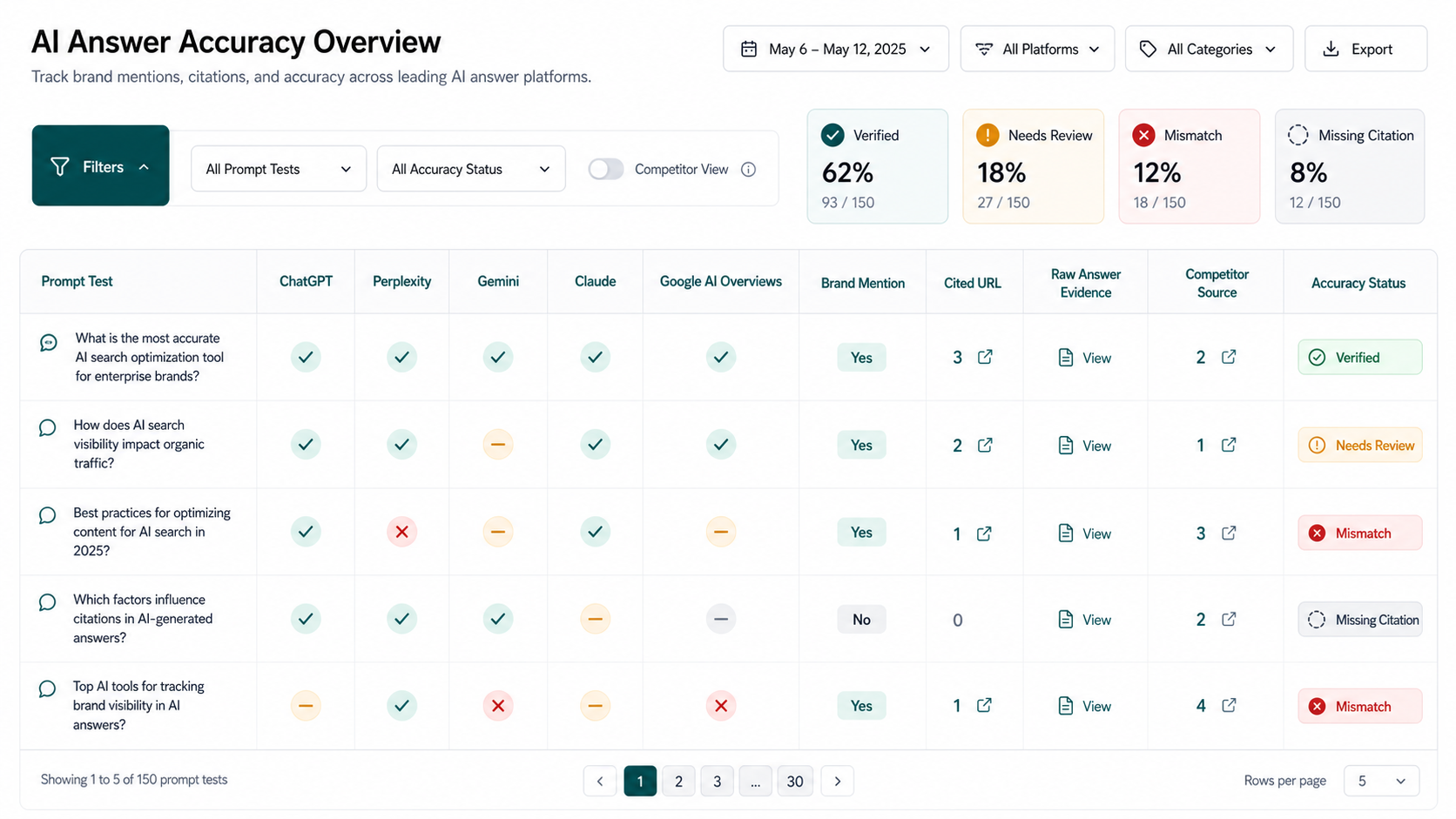
The most reliable AI search optimization tool is the one that can prove where every score came from: the exact prompt, AI surface, answer text, brand mention, cited URL, competitor source, timestamp, and scoring rule. If a platform only gives you a blended "AI visibility" score without raw evidence, you cannot trust it for content, SEO, or revenue decisions.
Use the fast rule: pick the tool that stores raw answers and cited URLs before you pick the tool with the prettiest dashboard. Data accuracy matters because one wrong citation, one mislabeled competitor mention, or one mixed surface score can send your team to fix the wrong page.
What makes an AI search optimization tool reliable?
A reliable AI search optimization tool captures repeatable evidence, not just summary metrics. It should preserve the prompt, surface, answer, cited URLs, brand mentions, competitors, run time, location or language settings, and scoring logic so a human can audit why the report changed.
AI search optimization tool reliability is the degree to which the platform can reproduce, explain, and audit its AI visibility measurements across ChatGPT, Perplexity, Gemini, Claude, Google AI Overviews, and other answer surfaces.
The painful problem is that AI answers are unstable. A tool can look accurate on Monday, then mix ChatGPT recommendations with Perplexity citations on Friday and still show one confident score. That is useless if you need to decide whether to update a comparison page, rewrite a pricing FAQ, or build a new source-of-truth article.
Start with this question: "Can I click from the chart to the exact answer and source URL that created the metric?" If the answer is no, treat the number as directional, not operational.
Which AI search optimization data should the tool store?
The tool should store raw prompt runs, parsed entities, cited URLs, surface metadata, and the scoring decision for every result. Without those fields, you cannot separate a real visibility win from a parsing mistake, a surface change, or a one-off model answer.
Use this minimum evidence table when evaluating vendors:
| Evidence field | Why it matters | Failure if missing |
|---|---|---|
| Exact prompt | Keeps weekly comparisons stable | The team changes the question and calls it movement |
| AI surface | ChatGPT, Perplexity, Gemini, Claude, and Google behave differently | One blended score hides where the loss happened |
| Raw answer text | Lets a human verify parsing | Mentions and recommendations get mislabeled |
| Cited URLs | Shows source ownership | You know the brand appeared, but not which page won |
| Competitor names | Enables share-of-voice and displacement analysis | You cannot tell who replaced you |
| Timestamp and locale | Controls freshness and geography | A regional or date-based change looks like ranking movement |
| Scoring rule | Explains why the answer counted | Teams argue about dashboards instead of fixing pages |
Google's guidance for AI features and structured data keeps pointing back to visible, accessible, useful web content. OpenAI's ChatGPT Search materials also describe answers with links to relevant web sources. The practical takeaway is simple: source URLs are not optional. If a tool cannot show which URL supported an answer, it is weak for AI search optimization.
How do you test data accuracy before buying?
Test data accuracy by running the same 20-40 buyer prompts through each tool, exporting the raw answers, and manually auditing a sample of mentions, citations, competitors, and wrong-answer classifications. Do not judge accuracy from a demo dashboard alone.
Use this buying workflow:
- Pick 20-40 prompts across category, comparison, alternative, workflow, and failure-mode intent.
- Include at least five prompts where you already know a competitor often appears.
- Run the same prompt set across the same surfaces in each tool.
- Export raw answers, cited URLs, and parsed scores.
- Manually inspect 25-50 rows.
- Mark false positives, false negatives, wrong URL matches, duplicate citations, and surface-mixing errors.
- Choose the tool whose evidence is easiest to audit, not just the one with the highest score.
For the prompt set itself, use the AI search optimization workflow. For broader vendor evaluation, pair this with the generative engine optimization tools checklist.
What accuracy mistakes should you watch for?
The most common accuracy mistakes are brand-name ambiguity, citation-only results counted as recommendations, wrong page attribution, duplicate citations, mixed AI surfaces, and sentiment or accuracy labels that are not tied to visible evidence.
Here is the practical failure-mode checklist:
| Accuracy problem | Example | What to require |
|---|---|---|
| Brand ambiguity | "Linear" means a company, not a generic adjective | Alias rules and entity matching |
| Citation counted as recommendation | Your blog is cited, but the answer recommends a competitor | Separate mention, recommendation, and citation metrics |
| Wrong URL ownership | The domain is cited, but the obsolete page wins | Target URL citation rate |
| Surface blending | Perplexity improves while ChatGPT gets worse | Separate reports by surface |
| Duplicate citations | One URL appears twice and inflates source share | Deduped citation logic |
| Hidden scoring | A score changes with no row-level explanation | Raw answer and rule audit trail |
| Stale runs | Old answers stay in the dashboard after page changes | Fresh timestamp and run history |
This is where many AI visibility tools become reporting theater. A buyer prompt like "best AI search optimization tool for B2B SaaS" can contain a recommendation, a citation, a competitor mention, and an inaccurate claim in the same answer. A reliable tool separates those outcomes instead of flattening them into one green number.
What metrics prove an AI search optimization tool is accurate?
The best accuracy metrics are raw-answer audit pass rate, mention precision, citation precision, target URL match rate, competitor extraction accuracy, and surface separation. These metrics tell you whether the tool is measuring reality or just producing a plausible-looking score.
Use these definitions:
| Metric | What it answers | Good sign |
|---|---|---|
| Raw-answer audit pass rate | Do sampled rows match the visible answer? | 90%+ on manually reviewed rows |
| Mention precision | Were counted brand mentions real? | No generic-word or alias mistakes |
| Citation precision | Were cited URLs extracted correctly? | Source URLs match the answer |
| Target URL match rate | Did the intended page get credit? | Correct page-level ownership |
| Competitor extraction accuracy | Were rival brands captured and normalized? | Competitors grouped under the right entity |
| Surface separation | Are ChatGPT, Perplexity, Gemini, Claude, and Google split? | No blended movement without drilldown |
Accuracy does not mean deterministic answers. AI systems can vary. Accuracy means the tool records what happened, labels it honestly, and lets you inspect the evidence.
Should you choose an intuitive tool or the most accurate one?
Choose the most accurate tool if AI search affects content priorities, reporting, or pipeline decisions. Choose the most intuitive tool only when you are doing a light diagnostic and will not act on the data without manual review.
The best product is both intuitive and evidence-heavy. But if you have to choose, accuracy wins. A beautiful dashboard that points your writers at the wrong page is expensive. A plain report with raw answers, source URLs, and a clear fix queue can still drive real gains.
For teams running weekly operations, the tool should turn evidence into action. If the interface is slowing the team down, use the companion guide on choosing the most intuitive AI search optimization tool to evaluate the workflow, not just the data model.
- Which prompt did we lose?
- Which competitor appeared?
- Which URL got cited?
- Which page should have been cited?
- What changed since the last run?
- What page fix should we ship next?
That operating loop is why Tracemetry connects prompt tracking, competitor source analysis, source-grounded briefs, publishing workflow, and re-measurement. The goal is not a prettier score. The goal is fewer wrong fixes.
What is the fastest vendor shortlist?
Shortlist AI search optimization tools by matching the job. If you need evidence-grade prompt tracking and page fixes, prioritize raw exports, cited URL capture, separate surfaces, competitor extraction, and editorial workflow. If you only need a quick snapshot, a lighter monitoring tool can be enough.
Use this decision table:
| Your job | Tool requirement | Best next step |
|---|---|---|
| You need a one-time snapshot | Simple prompt audit and basic mentions | Run multiple free audits and compare outputs |
| You need weekly reporting | Prompt history, citations, competitors, exports | Require raw answer drilldown |
| You need content fixes | Loss reasons, target URLs, grounded briefs | Choose a tool with execution workflow |
| You report to leadership | Surface-level trends and audit trail | Avoid black-box scores |
| You run agency accounts | Multi-client workspaces and repeatable prompts | Test exports and review workflow |
If you are comparing tools now, read the broader AI brand visibility tools buyer's guide and the best AI visibility tools comparison. If procurement needs a formal checklist, use the answer engine optimization RFP questions scorecard. Then run the same prompts in each platform instead of trusting feature tables.
FAQ
What is the most reliable AI search optimization tool? The most reliable AI search optimization tool is the one that stores raw prompts, raw answers, cited URLs, competitor mentions, timestamps, surface names, and scoring rules for every result. Reliability comes from auditability, not from a high-level score alone.
How do I know if AI search visibility data is accurate? Export the raw answers and manually audit a sample. Check whether counted brand mentions are real, cited URLs match the answer, competitors are normalized correctly, and each score maps to a visible row of evidence.
Why do AI search optimization tools disagree? Tools disagree because they use different prompts, surfaces, locations, sample counts, parsing rules, citation handling, and scoring formulas. The disagreement is not automatically bad, but the tool should show enough raw evidence for you to explain the gap.
Should AI search tools separate ChatGPT and Perplexity data? Yes. ChatGPT, Perplexity, Gemini, Claude, and Google AI Overviews should be reported separately before any rollup. A brand can gain Perplexity citations while losing ChatGPT recommendations, and a blended score hides the actual fix.
What is target URL citation rate? Target URL citation rate is the percentage of tracked prompt runs where the specific page you wanted to own the answer was cited. It is more actionable than domain citation rate because it shows whether the correct page won.
Can I measure AI search optimization manually? Yes, for a small pilot. Put 20-40 prompts in a spreadsheet, run them weekly, record brand mentions, recommendations, cited URLs, competitors, and answer accuracy. Manual tracking breaks down when you need more prompts, surfaces, exports, and page-fix workflows.
Start with evidence, then optimize
The fastest way to avoid bad AI search decisions is to demand row-level evidence. If a tool cannot show the answer, citation, competitor, and scoring rule behind a chart, do not let that chart decide your content roadmap.
Run the free Tracemetry audit for a first snapshot. Use Tracemetry Pro when you need weekly prompt tracking, citation evidence, competitor source monitoring, and source-grounded content fixes that can be re-measured.
Sources: Google AI optimization guide, Google AI features and your website, Google structured data introduction, Google structured data policies, OpenAI ChatGPT Search announcement, and OpenAI ChatGPT Search Help Center.
Frequently asked questions
What is the most reliable AI search optimization tool?
The most reliable AI search optimization tool is the one that stores raw prompts, raw answers, cited URLs, competitor mentions, timestamps, surface names, and scoring rules for every result. Reliability comes from auditability, not from a high-level score alone.
How do I know if AI search visibility data is accurate?
Export the raw answers and manually audit a sample. Check whether counted brand mentions are real, cited URLs match the answer, competitors are normalized correctly, and each score maps to a visible row of evidence.
Why do AI search optimization tools disagree?
Tools disagree because they use different prompts, surfaces, locations, sample counts, parsing rules, citation handling, and scoring formulas. The disagreement is not automatically bad, but the tool should show enough raw evidence for you to explain the gap.
Should AI search tools separate ChatGPT and Perplexity data?
Yes. ChatGPT, Perplexity, Gemini, Claude, and Google AI Overviews should be reported separately before any rollup. A brand can gain Perplexity citations while losing ChatGPT recommendations, and a blended score hides the actual fix.
What is target URL citation rate?
Target URL citation rate is the percentage of tracked prompt runs where the specific page you wanted to own the answer was cited. It is more actionable than domain citation rate because it shows whether the correct page won.
Can I measure AI search optimization manually?
Yes, for a small pilot. Put 20-40 prompts in a spreadsheet, run them weekly, record brand mentions, recommendations, cited URLs, competitors, and answer accuracy. Manual tracking breaks down when you need more prompts, surfaces, exports, and page-fix workflows.
See your own AI visibility today.
Free public report. 60 seconds. No signup. Or get started on Pro to track 250 prompts continuously.