AI engine optimization checklist: how to get cited in AI answers
A practical AI engine optimization checklist for improving whether ChatGPT, Perplexity, Gemini, Claude, and Google AI experiences retrieve, cite, and accurately describe the right page.
AI engine optimization is the page-level work that helps AI search systems find your content, extract the right answer, and cite the right URL when a buyer asks a question. The fast rule: pick one prompt, assign one target page, add a direct answer, add evidence, add schema, link it from related pages, then re-measure the same prompt.
If your SEO traffic looks fine but AI answers still name competitors, you do not need another generic guide. You need a checklist that turns a weak page into a source an answer engine can actually use.
If you need the broader website workflow before the page-level checklist, start with AI search optimization. It explains how to choose the prompt, assign the target URL, add source signals, and measure whether AI search systems cite the right page.
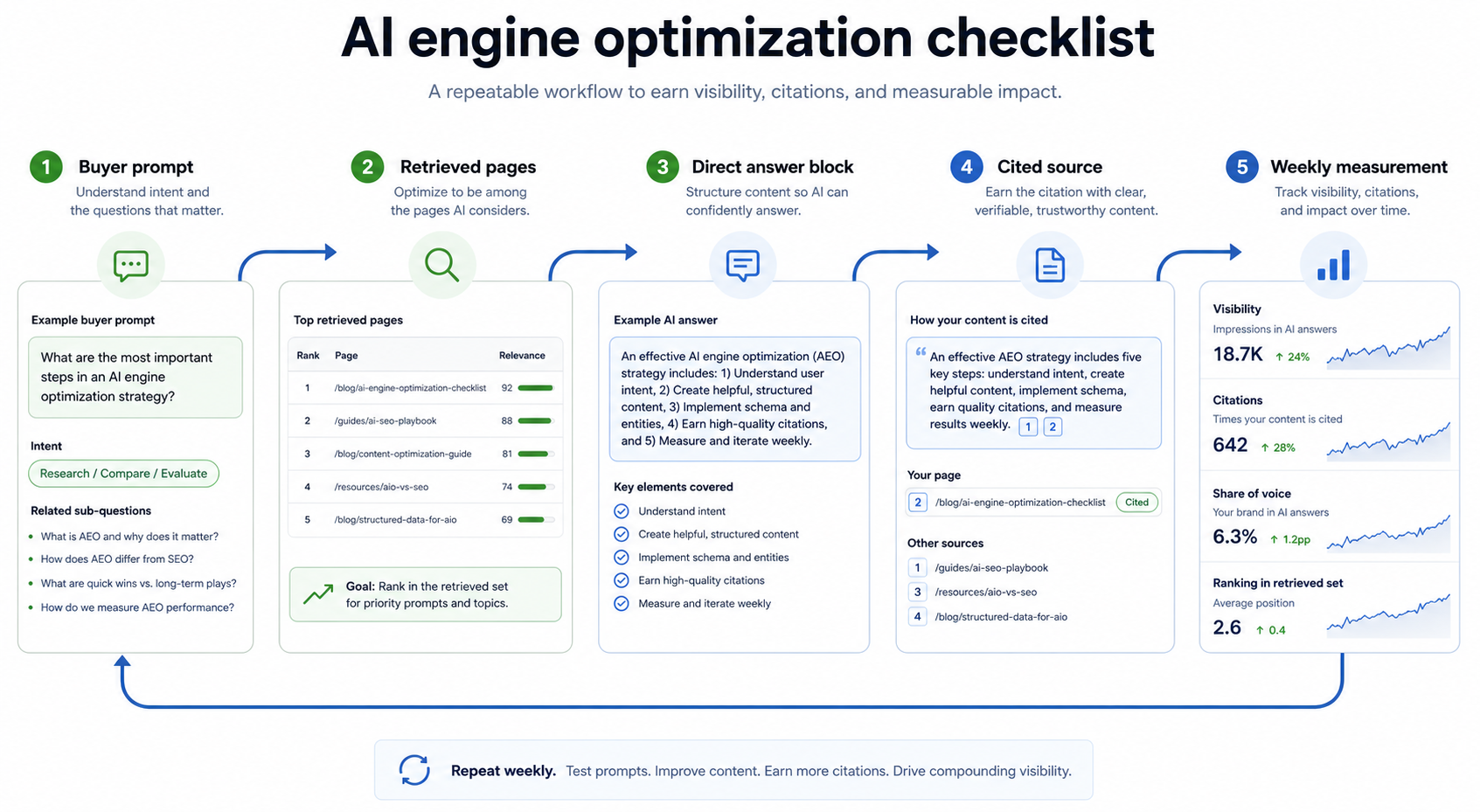
The strategy is narrower than "write more AI content": win the prompts where buyers need a source, comparison, checklist, or decision rule.
What is AI engine optimization?
AI engine optimization is the process of improving pages so AI systems can retrieve them, understand the entity they describe, extract a concise answer, and cite the correct URL in generated answers. It overlaps with SEO, AEO, and GEO, but the operating unit is a prompt-to-page match, not a keyword-to-rank match.
AI engine optimization is the practical layer of answer engine optimization: make one page clearly answer one buyer question, then measure whether ChatGPT, Perplexity, Gemini, Claude, or Google AI experiences mention, cite, or recommend that page.
Google's Search documentation says AI features can show links to supporting web pages, and OpenAI's ChatGPT Search docs describe answers with relevant web sources. That means page ownership still matters. The source has to be findable, useful, and explicit enough to support the generated answer.
When should you use this checklist?
Use this checklist when an AI answer already exists for the topic, but your page is missing, uncited, or replaced by a competitor source. The highest-value cases are commercial prompts: "best X for Y," "X alternatives," "X vs Y," "how do I solve Y," and "why does X fail?"
Do not use this checklist to spray new pages across every keyword variation. Use it to fix the page that should already own the answer.
| Current AI answer | Likely problem | Best first move |
|---|---|---|
| Competitor named, you absent | No matching page or weak entity clarity | Create or improve the target page |
| You are named but not cited | Brand known, source page weak | Add answer block, proof, FAQ, schema |
| Your domain cited, wrong page | Internal topology is unclear | Strengthen links to the intended page |
| Old third-party page cited | Freshness and proof gap | Add current evidence and update date |
| Answer is wrong about you | Source-of-truth page is stale | Correct product facts and schema |
If the gap is broad visibility, start with the generative engine optimization audit. If the gap is a specific cited-source loss, this checklist is the faster path.
How do you run an AI engine optimization checklist?
Run the checklist in seven steps: lock the prompt, assign the target URL, inspect current AI answers, add an answer-first section, add source-worthy proof, align schema with visible content, then re-measure after the page is crawled. The point is not to make the article longer. The point is to make the answer easier to select.
1. Lock one prompt before editing
Pick one buyer prompt and keep the wording stable. Good prompts sound like real AI queries:
- "what is the best way to track AI search visibility for a B2B SaaS brand"
- "why does ChatGPT cite competitors instead of my website"
- "how do I improve Perplexity citation rate"
- "best AI visibility tool for agencies"
- "Tracemetry vs Profound for AI search monitoring"
Keywords help you find the vocabulary, but conversational prompts reveal the job. Include surface terms, entity terms, product names, competitors, use cases, and failure modes naturally: ChatGPT, Perplexity, Google AI Overviews, answer engine optimization, AI visibility tracking, source citations, competitor mentions, B2B SaaS, agencies, schema, and pricing.
2. Assign one target URL
Before changing copy, decide which URL should win. If two pages could answer the same prompt, merge the intent or make the distinction obvious. AI systems can choose the wrong page when your own site sends mixed signals.
Use this rule:
| Prompt type | Target page |
|---|---|
| Definition | Glossary or pillar guide |
| Checklist | Execution guide |
| Tool shortlist | Comparison or buyer guide |
| Competitor question | Comparison or alternatives page |
| Product workflow | Feature or use-case page |
| Failure mode | Troubleshooting guide |
This page is the checklist URL. The broader category should still point to what answer engine optimization means, GEO vs SEO, and content that AI assistants cite.
3. Inspect the current answer
Run the prompt across the AI surfaces your buyers use. Record brands mentioned, cited URLs, citation order, answer accuracy, and whether the answer suggests a next step that helps or hurts you.
Do not collapse everything into one score. A brand can be mentioned in ChatGPT, absent in Claude, cited by Perplexity, and misrepresented in Google AI Overviews. The fix depends on the surface and the cited source.
If you need a measurement template, use AI search visibility tracking or AI share of voice measurement before editing pages.
4. Add a direct answer under the first important heading
The first H2 should answer the prompt in 40-80 words. No throat-clearing, no category history, no "in today's digital landscape." A human should be able to copy that block into a Slack message and answer the question.
Use this structure:
[Term] is [definition] for [audience/use case]. It matters because [specific consequence]. The fastest way to improve it is [one action], then [measurement step].
That shape works because it gives the retriever a complete chunk. For more examples, use the answer engine optimization examples swipe file.
5. Add one extractable proof block
AI answers cite pages that can support a claim. Give them a source-worthy block: a table, checklist, benchmark, definition, short methodology, or before/after example.
Use this mini-checklist:
- The answer contains specific nouns, not generic claims.
- The page names the relevant product, category, surface, and audience.
- The table or checklist solves the prompt without needing the whole article.
- Claims about Google, OpenAI, schema, or standards link to primary documentation.
- The CTA matches the job, not a generic "learn more."
Google's structured data docs explain that structured data helps Search understand page content and qualify pages for richer results. Google's structured data policies also require markup to describe user-visible content. Treat that as the bar for AI engine optimization too: if the useful answer only exists in metadata or schema, it is not a durable source.
6. Add schema that matches visible copy
For most AI engine optimization pages, use Article and visible FAQ content. Add FAQPage only when the questions and answers are on the page. Use HowTo only when the visible article has actual ordered steps.
Schema is not a magic AI ranking switch. It is a clarity layer. It helps parsers understand what the page is, who wrote it, when it changed, and which Q&A blocks are visible to the reader.
7. Link the page into the topic graph
Internal links tell readers and crawlers what role the page plays. A checklist page should link to the pillar, measurement guide, schema guide, and conversion path. It should also receive links from older related posts so it is not orphaned.
For this topic, the natural path is:
- Learn the category: answer engine optimization
- Optimize the website workflow: AI search optimization
- See practical patterns: answer engine optimization examples
- Measure the baseline: generative engine optimization audit
- Fix citations by surface: ChatGPT citation tracking and Perplexity SEO checklist
- Start the workflow: run the free Tracemetry audit or review Tracemetry pricing
What should the finished page include?
A finished AI engine optimization page should include a direct answer, definition block, decision table, proof or source section, visible FAQ, matching schema, internal links, and one conversion path. If any of those are missing, the page may still rank, but it is less useful as an AI source.
Use this final pre-publish checklist:
| Item | Pass condition |
|---|---|
| Prompt | One primary prompt and one target URL are documented |
| Direct answer | First important H2 has a 40-80 word answer |
| Definition | One paragraph starts with "[Term] is..." |
| Structure | Page includes a table, checklist, or ordered workflow |
| Proof | Platform or schema claims cite reliable primary sources |
| Schema | FAQ/Article/HowTo schema matches visible content |
| Links out | Reader gets the next measurement or conversion step |
| Links in | At least one older related page links back |
| Measurement | Same prompt will be checked again in 7-14 days |
How do you measure whether AI engine optimization worked?
Measure whether the same prompt starts producing a better answer. The practical metrics are brand mention rate, domain citation rate, target URL citation rate, answer accuracy, competitor source share, and referral traffic where the surface sends clicks. Compare the same prompt wording before and after the page change.
Do not judge success from one run. AI answers vary. Use a weekly cadence and look for movement on the prompts closest to revenue.
| Metric | What changed if it improves |
|---|---|
| Brand mention rate | The assistant now recognizes you as relevant |
| Domain citation rate | Your site is becoming a source |
| Target URL citation rate | The correct page owns the prompt |
| Answer accuracy | The assistant describes your product correctly |
| Competitor source share | Fewer answers depend on competitor pages |
| Referral traffic | Cited answers are turning into visits |
For surface-specific measurement, use ChatGPT citation tracking, Perplexity citation tracking, Gemini citation tracking, and AI Overview tracking.
FAQ
Is AI engine optimization the same as answer engine optimization? AI engine optimization is a practical way to describe the same page-level work as answer engine optimization: improving content so AI-powered answer systems can retrieve, extract, and cite it. AEO is the cleaner category term; AI engine optimization is useful when searchers use that phrasing.
What is the fastest AI engine optimization fix? The fastest fix is updating the page that should already win the prompt. Add a direct answer near the top, a decision table or checklist, visible FAQ content, credible source links, matching schema, and internal links from related pages.
Should I create a new page or update an old one? Update an old page when it already matches the prompt intent. Create a new page only when no current URL can honestly answer the prompt. Too many overlapping pages can make AI systems cite the wrong source.
Does schema help with AI engine optimization? Schema helps when it matches visible content and clarifies the page type, author, date, and Q&A structure. It does not replace useful copy. Treat schema as a parser aid, not as a shortcut around weak content.
How long should I wait before rechecking AI answers? Recheck 7-14 days after publishing for fast-moving sites, then again after 30 days. Keep the prompt wording stable and compare mention rate, citation rate, target URL citation rate, and answer accuracy.
Start with one prompt
Do not turn this into a 100-page AI content calendar. Pick the one buyer prompt where a competitor is being named or cited today. Fix the intended page, link it properly, and re-measure.
Run the free Tracemetry audit to find the first prompt gap. Use Tracemetry Pro when you want weekly tracking, source-grounded briefs, draft generation, and re-measurement in one workflow.
Sources: Google AI features in Search, Google structured data introduction, Google structured data policies, OpenAI ChatGPT Search announcement, and OpenAI ChatGPT Search Help Center.
Frequently asked questions
Is AI engine optimization the same as answer engine optimization?
AI engine optimization is a practical way to describe the same page-level work as answer engine optimization: improving content so AI-powered answer systems can retrieve, extract, and cite it. AEO is the cleaner category term; AI engine optimization is useful when searchers use that phrasing.
What is the fastest AI engine optimization fix?
The fastest fix is updating the page that should already win the prompt. Add a direct answer near the top, a decision table or checklist, visible FAQ content, credible source links, matching schema, and internal links from related pages.
Should I create a new page or update an old one?
Update an old page when it already matches the prompt intent. Create a new page only when no current URL can honestly answer the prompt. Too many overlapping pages can make AI systems cite the wrong source.
Does schema help with AI engine optimization?
Schema helps when it matches visible content and clarifies the page type, author, date, and Q&A structure. It does not replace useful copy. Treat schema as a parser aid, not as a shortcut around weak content.
How long should I wait before rechecking AI answers?
Recheck 7-14 days after publishing for fast-moving sites, then again after 30 days. Keep the prompt wording stable and compare mention rate, citation rate, target URL citation rate, and answer accuracy.
Make your next SEO decision with better evidence.
Explore practical guides to AI visibility, source citations, and choosing the right tools for your team.