Answer engine optimization for SaaS: the source-page playbook
Build a SaaS AEO strategy that maps buyer prompts to product, integration, comparison, pricing, and documentation pages, then measures citations and pipeline.
Most SaaS teams have plenty of indexed content and still disappear when a buyer asks ChatGPT, Perplexity, Gemini, or Claude which product fits a specific workflow. The problem is rarely a missing glossary article. It is that product, integration, comparison, pricing, and help pages do not answer the questions that shape a shortlist.
Use this fast rule: map each high-intent buyer question to one page that can prove the answer. Fix that source page, measure whether it earns citations and recommendations, and only create a new URL when no existing page can honestly own the question.
What is answer engine optimization for SaaS?
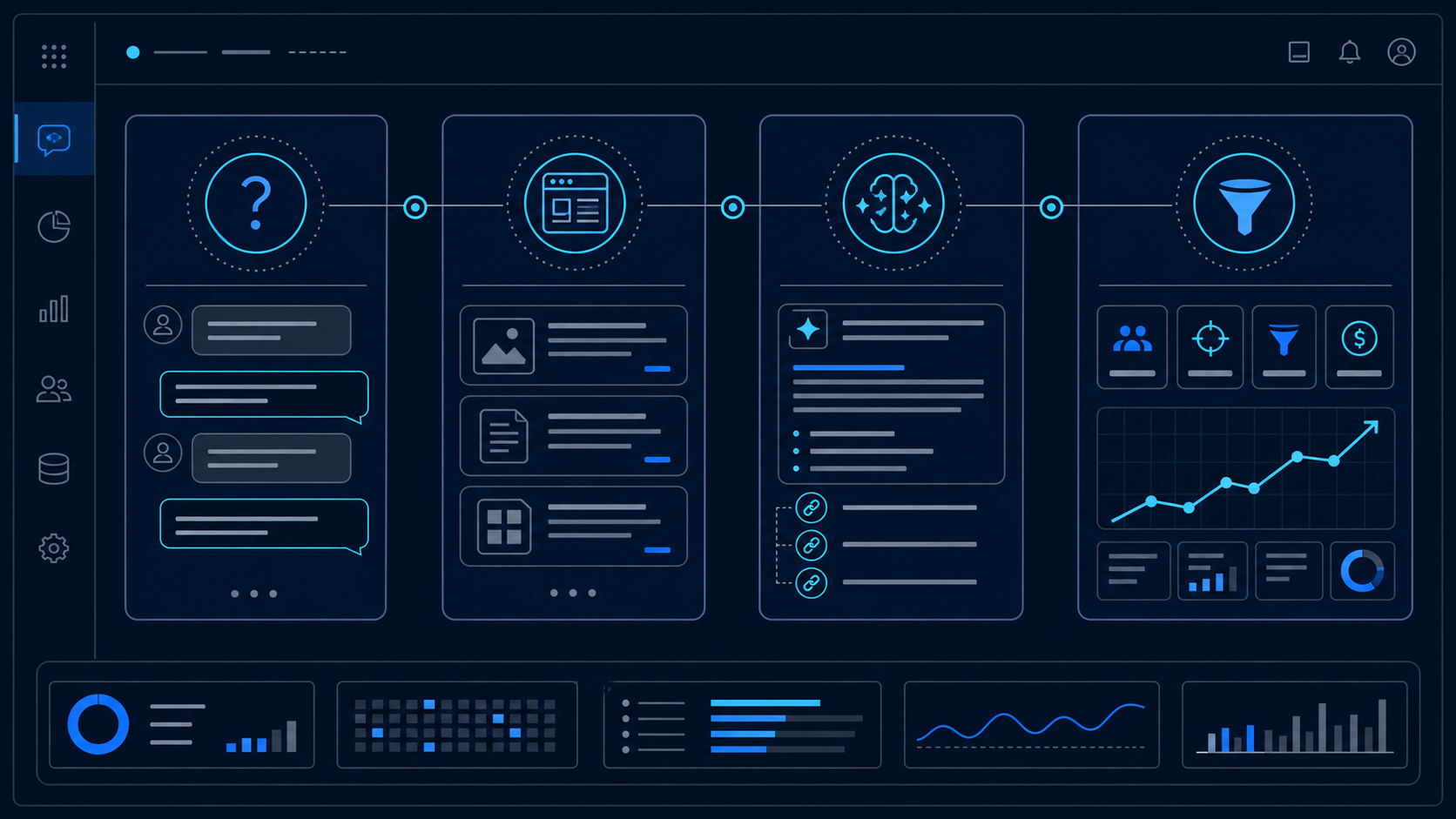
Answer engine optimization for SaaS is the process of making a software company's pages easier for AI answer engines to retrieve, understand, cite, and recommend. It connects buyer prompts to authoritative product, use-case, integration, comparison, and documentation pages, then measures mentions, citations, answer accuracy, referrals, and pipeline outcomes.
SaaS answer engine optimization is a source-of-truth program for the questions buyers ask before they sign up or book a demo. It complements a SaaS SEO strategy: search rankings and organic traffic still matter, but AEO also measures whether generated answers name the product, cite the correct URL, describe it accurately, and place it on the right shortlist.
The shortest useful workflow is:
- Capture real discovery, comparison, workflow, integration, pricing, and failure-mode prompts.
- Assign one intended source page to each important prompt.
- Measure which brands and URLs AI answers mention and cite now.
- Fix the highest-value source-page gaps.
- Re-run the same prompts after discovery or recrawl.
If the team has not established a baseline, use the 90-day AEO roadmap before scaling production.
For multi-product or multi-region organizations, the enterprise answer engine optimization framework adds central governance, local source ownership, risk controls, and rollout rules to this page-level SaaS workflow.
For long buying cycles with sales, security, and procurement stakeholders, use the B2B answer engine optimization playbook to connect source-page work to shortlist and pipeline evidence.
Which SaaS pages should own AI answers?
The best page owner matches the buyer's job. Product pages should own capability questions, integration pages should own compatibility questions, comparison pages should own tradeoffs, documentation should own implementation details, and pricing or policy pages should own current commercial facts. A blog should not impersonate the product source of truth.
| Buyer question | Best source page | Evidence the page needs |
|---|---|---|
| “Can this tool automate weekly client reports?” | Feature or use-case page | Workflow, limits, output, screenshots, proof |
| “Does it integrate with HubSpot?” | Integration page | Supported actions, setup, permissions, limitations |
| “What is the best alternative to Product X for agencies?” | Comparison or alternatives page | Audience fit, tradeoffs, pricing basis, migration facts |
| “How do I fix an API authentication error?” | Documentation or help page | Exact symptoms, causes, steps, version context |
| “How much does it cost for 20 seats?” | Pricing page | Current tiers, billing unit, add-ons, date updated |
| “Is it suitable for healthcare teams?” | Industry or security page | Controls, scope, certifications, explicit limitations |
This mapping prevents two expensive mistakes: publishing a new article that competes with a revenue page, and letting a third-party review site become the clearest source for facts your own site should state.
How do you build a SaaS buyer-prompt set?
Build the prompt set from jobs, constraints, competitors, integrations, and failure modes—not by converting a keyword list into questions. Start with sales calls, support tickets, win-loss notes, site search, community discussions, and customer interviews. Then preserve a locked measurement cohort so results remain comparable over time.
Cover these six prompt groups:
- Discovery: “What tools can automate SEO reporting for a small agency?”
- Workflow: “How do I monitor whether ChatGPT recommends my brand?”
- Comparison: “Product A vs Product B for a multi-client team.”
- Alternatives: “What is the best alternative to Product A with citation tracking?”
- Integration and constraint: “Which platform works with HubSpot and supports EU data requirements?”
- Failure mode: “Why is my brand missing from AI answers even though it ranks in Google?”
Start with 40–80 prompts for one product line or audience. Include the entity names that remove ambiguity: product category, user role, company size, platform, region, integration, and use case. The AI search prompt taxonomy provides a repeatable structure for building the set.
What should you change on a SaaS page for AEO?
Change the smallest set of blocks that makes the page a complete, defensible answer. Put a direct answer near the relevant heading, state who the product is and is not for, expose current facts, show evidence, explain tradeoffs, link to deeper documentation, and keep schema consistent with visible copy.
Use this source-page checklist:
- Add a 40–80 word answer to the exact buyer question.
- Name the product category, audience, workflow, and important constraint.
- Show steps, inputs, outputs, limits, and prerequisites for workflow claims.
- Add a comparison or decision table when the buyer must choose.
- Support performance, security, compliance, or benchmark claims with verifiable evidence.
- State pricing, availability, integration, and policy facts on their canonical source pages.
- Link from related product, documentation, and educational pages.
- Validate rendered HTML, indexability, canonical signals, and appropriate structured data.
- Record the change and schedule the same prompt cohort for re-testing.
Do not add a fake “AI optimization” paragraph to every page. Clear product facts and useful decision support beat repetitive keyword copy. The AEO content brief turns a lost prompt into a writer-ready page plan.
How should SaaS comparison and alternatives pages work?
SaaS comparison pages should help a qualified buyer choose, even when your product is not the best fit. State the audience, evaluation date, plan assumptions, feature differences, limitations, migration effort, and decision rule. A page that hides tradeoffs is less useful to readers and easier for independent review sites to replace.
A strong comparison block answers four questions:
- Who should choose each product?
- Which workflows and integrations differ?
- What does the price comparison assume?
- What limitations could change the decision?
Keep competitor facts dated and sourced. Avoid unsupported superlatives such as “best,” “fastest,” or “most accurate.” If a competitor changes a plan or feature, update the visible copy and any structured data together. Accuracy matters because an AI answer can repeat stale comparison claims at scale.
How do you measure SaaS AEO performance?
Measure prompt-level visibility and business outcomes separately. Use recommendation rate, target-page citation rate, first-named rate, answer accuracy, and competitor citation share to diagnose the answer layer. Use qualified AI referrals, signups, demos, assisted opportunities, and deduplicated pipeline to evaluate commercial impact.
| Metric | What it answers |
|---|---|
| Recommendation rate | Does the product enter relevant shortlists? |
| Target-page citation rate | Does the intended SaaS URL own the answer? |
| Answer accuracy | Are product, pricing, integration, and policy claims correct? |
| Competitor citation share | Which domains supply the category's answers? |
| Qualified AI referrals | Do cited visits reach meaningful product actions? |
| Fix-to-win rate | Which shipped page changes produce repeated movement? |
Run important prompts more than once because generated answers vary. Keep wording, market, language, surface, and account conditions as stable as practical. Compare distributions, not a favorable screenshot. Use the AI search attribution model to separate sourced revenue from assisted influence.
What are the most common SaaS AEO mistakes?
The most common SaaS AEO mistakes are optimizing only blog posts, measuring random prompts, leaving product facts scattered across pages, creating biased comparison copy, and reporting mentions as revenue. These choices produce activity without establishing which source should win or whether a shipped change caused repeatable improvement.
Avoid these failure modes:
- Publishing dozens of definition articles while product and integration pages stay vague.
- Sending every prompt to the homepage instead of matching intent to a specific URL.
- Changing prompt wording between baseline and re-test.
- Letting pricing, security, or integration claims contradict each other across the site.
- Treating schema as a substitute for useful visible content.
- Counting any brand mention as a recommendation or citation.
- Claiming pipeline from prompt visibility without journey evidence.
- Scaling a template before the first source-page fixes show repeated movement.
FAQ
Is AEO different from SaaS SEO? Yes. SaaS SEO improves organic discovery and rankings across the buyer journey. AEO focuses on whether AI-generated answers retrieve, cite, describe, and recommend the correct SaaS sources. They share technical and content foundations, but AEO adds prompt cohorts, cited-URL tracking, recommendation measurement, and answer-accuracy checks.
Should a SaaS company optimize blog posts or product pages first? Fix the page that should own the buyer question. Capability questions usually belong on feature or use-case pages; compatibility questions on integration pages; implementation questions in documentation; and comparison questions on transparent comparison pages. Use blog posts when the intent is genuinely educational.
How many prompts should a SaaS AEO program track? Start with 40–80 prompts for one audience, product line, or buyer journey. Include discovery, workflow, comparison, alternatives, integration, constraint, pricing-adjacent, and failure-mode questions. Keep a locked core set for trend measurement and a smaller discovery set for new language.
How long does SaaS answer engine optimization take? Use a 90-day first cycle: establish the baseline, fix priority source pages, allow discovery or recrawl, and re-test exact prompt cohorts. Some citations may change sooner, while other surfaces lag. The first cycle should prove which changes work, not promise universal visibility.
Does schema markup improve SaaS visibility in AI answers? Schema can clarify visible entities and facts, but it does not rescue weak, contradictory, or inaccessible pages. Use appropriate SoftwareApplication, Organization, Article, FAQ, Breadcrumb, or Product markup only when it accurately represents content users can see.
What is the best SaaS AEO metric? Target-page citation rate is the clearest source-ownership metric. Pair it with recommendation rate and answer accuracy, then connect qualified AI referrals, signups, demos, and assisted pipeline using explicit evidence tiers. No single metric proves the whole buyer journey.
Start with one buyer journey, not the whole website
Choose one valuable SaaS audience, lock its high-intent questions, and map every question to the page that should answer it. Measure the current winners before editing anything. Then run a Tracemetry audit to identify missing citations, wrong source URLs, competitor wins, and inaccurate answers—and use Tracemetry Pro to monitor whether each source-page fix actually moves the same prompts.
Frequently asked questions
Is AEO different from SaaS SEO?
Yes. SaaS SEO improves organic discovery and rankings across the buyer journey. AEO focuses on whether AI-generated answers retrieve, cite, describe, and recommend the correct SaaS sources. AEO adds prompt cohorts, cited-URL tracking, recommendation measurement, and answer-accuracy checks.
Should a SaaS company optimize blog posts or product pages first?
Fix the page that should own the buyer question. Capability questions usually belong on feature or use-case pages, compatibility questions on integration pages, implementation questions in documentation, and comparison questions on transparent comparison pages.
How many prompts should a SaaS AEO program track?
Start with 40–80 prompts for one audience, product line, or buyer journey. Include discovery, workflow, comparison, alternatives, integration, constraint, pricing-adjacent, and failure-mode questions.
How long does SaaS answer engine optimization take?
Use a 90-day first cycle to establish the baseline, fix priority source pages, allow discovery or recrawl, and re-test exact prompt cohorts. The first cycle should prove which changes work, not promise universal visibility.
Does schema markup improve SaaS visibility in AI answers?
Schema can clarify visible entities and facts, but it does not rescue weak, contradictory, or inaccessible pages. Use appropriate structured data only when it accurately represents content users can see.
What is the best SaaS AEO metric?
Target-page citation rate is the clearest source-ownership metric. Pair it with recommendation rate and answer accuracy, then connect qualified AI referrals, signups, demos, and assisted pipeline using explicit evidence tiers.
See your own AI visibility today.
Free public report. 60 seconds. No signup. Or get started on Pro to track 250 prompts continuously.