Answer Engine Optimization for Marketplaces: the Practical Playbook
A practical marketplace AEO playbook for governing catalog entities, mapping buyer questions to source pages, correcting AI answers, and measuring citations.
Marketplace buyers increasingly ask ChatGPT, Perplexity, Gemini, and Google to compare products, recommend sellers, explain fees, and check fit before opening a marketplace. If the answer cites a review site, a merchant, or a competitor instead of your category and listing pages, you lose both the visit and control of the facts.
Use this fast rule: choose one category, lock 30 buyer questions, map each question to one authoritative marketplace page, and fix the ten answers with the highest commercial value or accuracy risk. Recheck the same questions weekly. That creates a measurable operating loop without trying to optimize an entire catalog at once.
What is answer engine optimization for marketplaces?
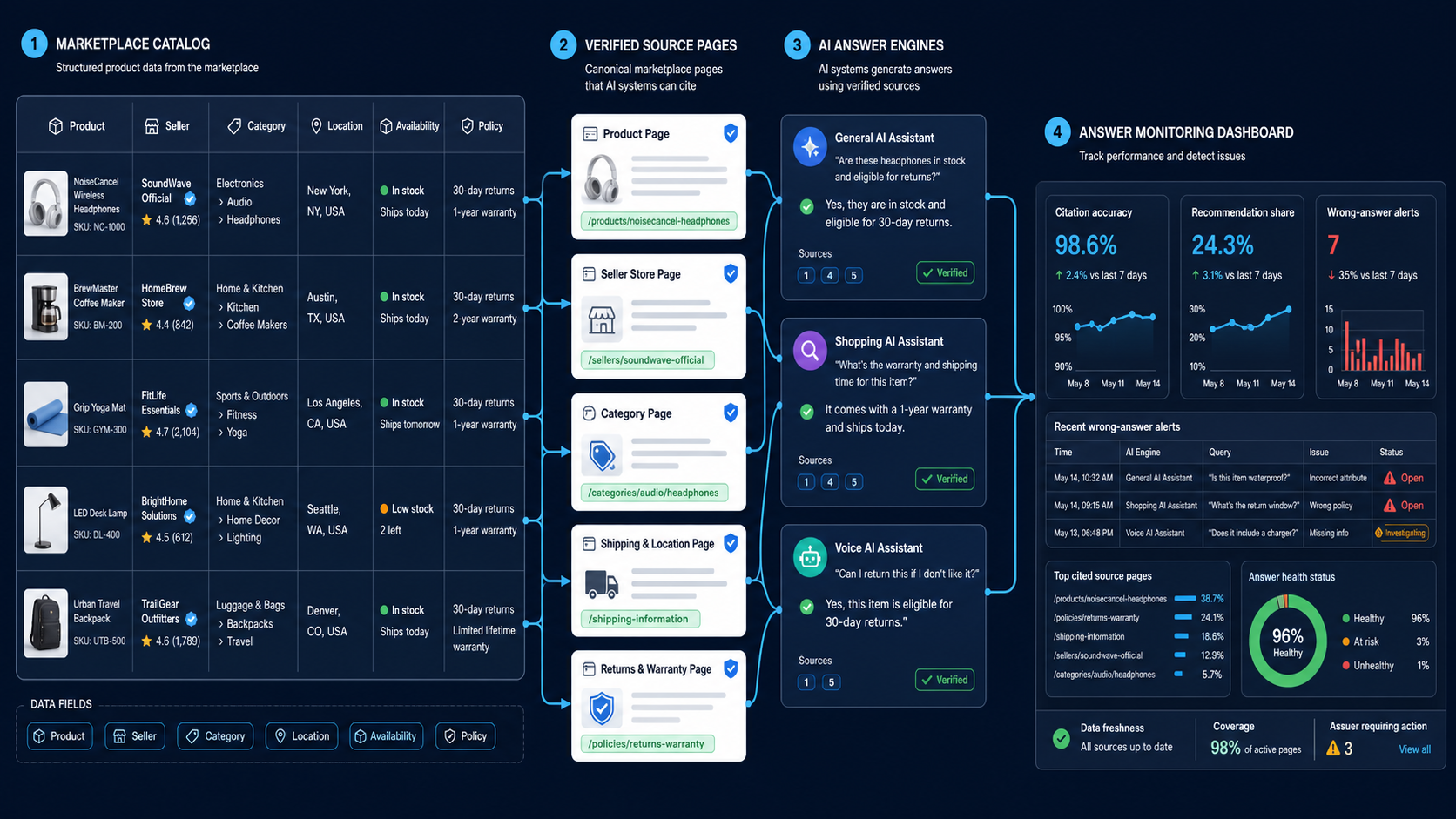
Answer engine optimization for marketplaces is the process of making category, listing, seller, policy, and location pages easier for AI systems to retrieve, understand, cite, and recommend accurately. It combines catalog data quality, page-level evidence, entity clarity, technical accessibility, and repeated monitoring of generated answers across important buyer questions.
Marketplace AEO is source-of-truth management for AI-assisted product and provider discovery. Unlike a single-brand site, a marketplace must represent the platform, sellers, offers, inventory, locations, reviews, policies, and changing availability without letting those entities blur together.
Marketplace AEO does not replace ecommerce answer engine optimization or technical SEO. It adds an observation layer: exact questions, complete answers, cited URLs, recommended sellers or products, wrong claims, competitors, and changes over time.
Which marketplace questions should you track first?
Track questions that can change discovery, comparison, trust, or purchase. Begin with one category and one market, then cover product fit, seller selection, location, price, availability, policies, and failure modes. A stable set of 30–50 questions is more useful than hundreds of prompts nobody reviews.
Start with these six buckets:
| Buyer job | Example conversational query | Intended source |
|---|---|---|
| Discover | “What is the best marketplace for refurbished laptops?” | Category or marketplace page |
| Compare | “Which refurbished laptop is best for design work?” | Comparison or category guide |
| Verify seller | “How do I choose a reliable seller for a used laptop?” | Seller standards or profile page |
| Check fit | “Will this model run two external displays?” | Product or listing page |
| Check terms | “What happens if a refurbished device arrives damaged?” | Returns or buyer-protection page |
| Find locally | “Where can I buy a refurbished laptop near Austin?” | Location-category page |
Include the questions sales, support, seller-success, and onsite-search data reveal. Useful failure-mode phrases include “why does the price change at checkout?”, “how do I verify a seller?”, “when should I avoid a refurbished device?”, and “what is the best way to compare marketplace listings?”
Which marketplace page should own each AI answer?
Assign every important question to the page that can prove the answer most directly. Category pages should own selection guidance, listing pages should own item-specific facts, seller profiles should own seller evidence, and policy pages should own marketplace guarantees. Editorial pages should explain decisions without contradicting transactional sources.
Use this ownership model:
- Marketplace page: platform purpose, geographic coverage, participation rules, and buyer protections.
- Category page: assortment, filters, selection criteria, common tradeoffs, and category-level comparisons.
- Listing or product page: exact item, seller, offer, condition, compatibility, price, availability, and delivery facts.
- Seller profile: identity, service area, verification, ratings methodology, policies, and current offerings.
- Location page: locally available categories, providers, constraints, and market-specific facts.
- Policy or help page: fees, returns, disputes, cancellations, safety, and support procedures.
If several pages compete to answer the same question, name one intended source and link the supporting pages to it descriptively. If no page can substantiate the answer, create the missing source instead of stretching an unrelated article.
How do you prevent wrong AI answers about listings and sellers?
Prevent wrong answers by keeping material facts consistent across catalog feeds, rendered HTML, structured data, seller profiles, policies, and third-party sources. Preserve every harmful answer with its prompt, citations, timestamp, market, and test conditions, then route the issue to the owner of the authoritative fact.
Marketplace errors deserve separate severity levels:
- Critical: safety, legality, identity, eligibility, or buyer-protection claims that could cause harm.
- High: wrong price basis, availability, fees, condition, compatibility, location, or cancellation terms.
- Medium: stale feature, seller, category, or delivery information that changes consideration.
- Low: wording differences that remain materially accurate.
Do not try to “correct the model” with more generic copy. First correct the canonical source, remove contradictions, clarify effective dates and scope, and then recheck the unchanged question. The wrong AI answers workflow explains how to preserve evidence and manage the correction queue.
What makes a marketplace page easier for AI systems to cite?
A citable marketplace page identifies the entity early, answers the buyer's question directly, exposes current evidence in rendered HTML, and states important limits. It separates platform claims from seller claims and avoids making critical facts depend entirely on filters, client-side widgets, images, or rapidly expiring URLs.
Use this page checklist:
- Put a 40–80 word direct answer under the relevant heading.
- Name the product, category, seller, location, audience, and use case precisely.
- Show price basis, fees, availability, condition, service area, or eligibility with update dates.
- Explain rating, verification, ranking, and review methods instead of relying on badges alone.
- Keep stable canonical URLs for important categories, products, sellers, and policies.
- Render decision-critical facts in accessible HTML.
- Add descriptive internal links between listings, categories, seller profiles, and policies.
- Keep structured data aligned with visible page content.
Google's structured data policies require markup to represent visible content accurately. Google's documentation for product structured data also distinguishes product information from offer details. Schema can clarify a page; it cannot guarantee an AI citation or compensate for contradictory catalog data.
How should a marketplace prioritize AEO fixes?
Prioritize by buyer value, factual risk, visibility gap, confidence in the diagnosis, and effort. Fix a wrong buyer-protection answer or a high-intent category omission before polishing an informational definition you already own. The first sprint should be small enough to publish and remeasure in two weeks.
Score each loss from 1–5:
| Factor | A high score means |
|---|---|
| Buyer value | The answer affects a shortlist, listing view, lead, booking, or transaction |
| Accuracy risk | The wrong answer can mislead a buyer or seller materially |
| Visibility gap | Competitors or third parties win while the intended page is absent |
| Confidence | Repeated evidence points to a specific source problem |
| Ease | The accountable team can publish and validate the fix quickly |
Start with five to ten fixes. Record the hypothesis, changed URL, publication date, expected answer, and retest date. The AEO content gap workflow helps distinguish a missing source from a page that merely needs stronger evidence.
How do you measure marketplace AEO?
Measure recommendations, citations, target-page ownership, answer accuracy, competitor presence, and qualified marketplace actions separately. A brand mention is not a win when the AI system cites the wrong URL, names an unavailable seller, or misstates a policy. Keep raw answers behind every score.
Use four reporting layers:
- Answer: mention rate, recommendation rate, material-claim accuracy, competitor share.
- Source: domain citation rate, target-page citation rate, and cited third-party sources.
- Marketplace: qualified listing views, searches, seller contacts, bookings, carts, and registrations.
- Operations: errors resolved, source pages improved, time to correction, and fix-to-win rate.
Segment results by category, market, AI surface, buyer job, and intended page type. Preserve the prompt cohort so week-to-week comparisons remain honest. Use the AEO metrics guide to keep visibility indicators separate from commercial outcomes.
Who should own marketplace AEO?
One growth, SEO, or product-marketing owner should manage the prompt cohort and fix queue. Catalog teams own item data, marketplace operations own policies, seller teams own provider facts, engineering owns rendering and feeds, and legal or trust teams review consequential claims. Shared input is necessary; accountability still needs a name.
A lean weekly rhythm is:
- Review new omissions, competitor wins, wrong citations, and material errors.
- Select no more than five fixes with named page owners.
- Correct the authoritative source and its internal discovery path.
- Recheck completed work after discovery or recrawl.
- Record what moved, what did not, and the next hypothesis.
What marketplace AEO mistakes waste the most time?
The biggest wastes are tracking generic vanity prompts, treating every seller as the same entity, generating thin location pages, hiding key facts in widgets, and changing the test set while claiming improvement. Marketplaces also fail when catalog, policy, and schema values disagree.
Avoid these failure modes:
- counting any platform mention as a recommendation win;
- letting seller copy override platform policies or verified catalog facts;
- publishing duplicate filter pages without unique buyer value;
- confusing a product, listing, offer, seller, and marketplace in page copy or markup;
- optimizing stale or unavailable inventory as if it were permanent;
- treating star ratings as evidence without explaining their scope;
- changing prompts, markets, or scoring rules between reports;
- commissioning more articles before fixing category, listing, and policy sources.
FAQ
Does marketplace AEO replace marketplace SEO?
No. Crawlability, indexation, useful category and listing pages, internal links, authority, structured data, and conversion design remain foundational. Marketplace AEO adds prompt-level observation of AI recommendations, citations, source ownership, seller and product accuracy, competitor presence, and repeated testing.
How many AI prompts should a marketplace track first?
Start with 30–50 high-value questions for one category and market. Keep a locked core cohort for comparison and a separate discovery list for emerging buyer questions. Expand only when the team can inspect the evidence and ship the resulting fixes.
Should every seller and listing have its own indexable page?
No. Index pages only when they provide stable, useful, non-duplicative information for buyers. Thin, expired, duplicate, or inaccessible listings can create crawl waste and source confusion. Apply clear lifecycle, canonical, and availability rules.
Can product schema guarantee marketplace citations?
No. Structured data can clarify products, offers, ratings, sellers, and availability when it matches visible content. It cannot guarantee retrieval, citation, ranking, or recommendation, and it cannot repair weak evidence or conflicting data.
What is the best marketplace AEO metric?
Target-page citation rate is the clearest source-ownership metric. Pair it with qualified recommendation rate and material-claim accuracy so a result counts only when the marketplace is recommended appropriately, the right page is cited, and the answer is correct.
What is the first marketplace AEO action to take?
Choose one valuable category, lock 30 buyer questions, and capture current answers, citations, recommendations, competitors, and material errors. Map the ten highest-value losses to the category, listing, seller, location, or policy page that should own each answer.
Turn marketplace questions into owned sources
The marketplace that wins AI-assisted discovery will not be the one with the most generated category copy. It will be the one that keeps entities and material facts clear, assigns every valuable question to a defensible source, and learns which fixes produce accurate recommendations. Run a Tracemetry AI visibility audit to find the first source gaps, or book a demo to monitor marketplace questions, citations, competitors, and corrections on a recurring schedule.
Frequently asked questions
Does marketplace AEO replace marketplace SEO?
No. Crawlability, indexation, useful category and listing pages, internal links, authority, structured data, and conversion design remain foundational. Marketplace AEO adds prompt-level observation of AI recommendations, citations, source ownership, seller and product accuracy, competitor presence, and repeated testing.
How many AI prompts should a marketplace track first?
Start with 30–50 high-value questions for one category and market. Keep a locked core cohort for comparison and a separate discovery list for emerging buyer questions. Expand only when the team can inspect the evidence and ship the resulting fixes.
Should every seller and listing have its own indexable page?
No. Index pages only when they provide stable, useful, non-duplicative information for buyers. Thin, expired, duplicate, or inaccessible listings can create crawl waste and source confusion. Apply clear lifecycle, canonical, and availability rules.
Can product schema guarantee marketplace citations?
No. Structured data can clarify products, offers, ratings, sellers, and availability when it matches visible content. It cannot guarantee retrieval, citation, ranking, or recommendation, and it cannot repair weak evidence or conflicting data.
What is the best marketplace AEO metric?
Target-page citation rate is the clearest source-ownership metric. Pair it with qualified recommendation rate and material-claim accuracy so a result counts only when the marketplace is recommended appropriately, the right page is cited, and the answer is correct.
What is the first marketplace AEO action to take?
Choose one valuable category, lock 30 buyer questions, and capture current answers, citations, recommendations, competitors, and material errors. Map the ten highest-value losses to the category, listing, seller, location, or policy page that should own each answer.
Make your next SEO decision with better evidence.
Explore practical guides to AI visibility, source citations, and choosing the right tools for your team.