Answer engine optimization report: template and metrics
Build an AEO report that connects buyer prompts, recommendations, citations, answer accuracy, competitors, conversions, and prioritized page fixes.
An answer engine optimization report shows whether AI answer systems mention your brand, recommend it, cite the right pages, describe it accurately, and influence qualified demand. It replaces a folder of screenshots with a repeatable view of what changed, why it changed, and what your team should fix next.
Use this fast rule: put five numbers on page one—recommendation rate, target-page citation rate, answer accuracy, competitive share of voice, and AI-assisted conversions. Every number must link back to the prompt, answer, cited source, and owner. If it cannot trigger a decision, it belongs in an appendix.
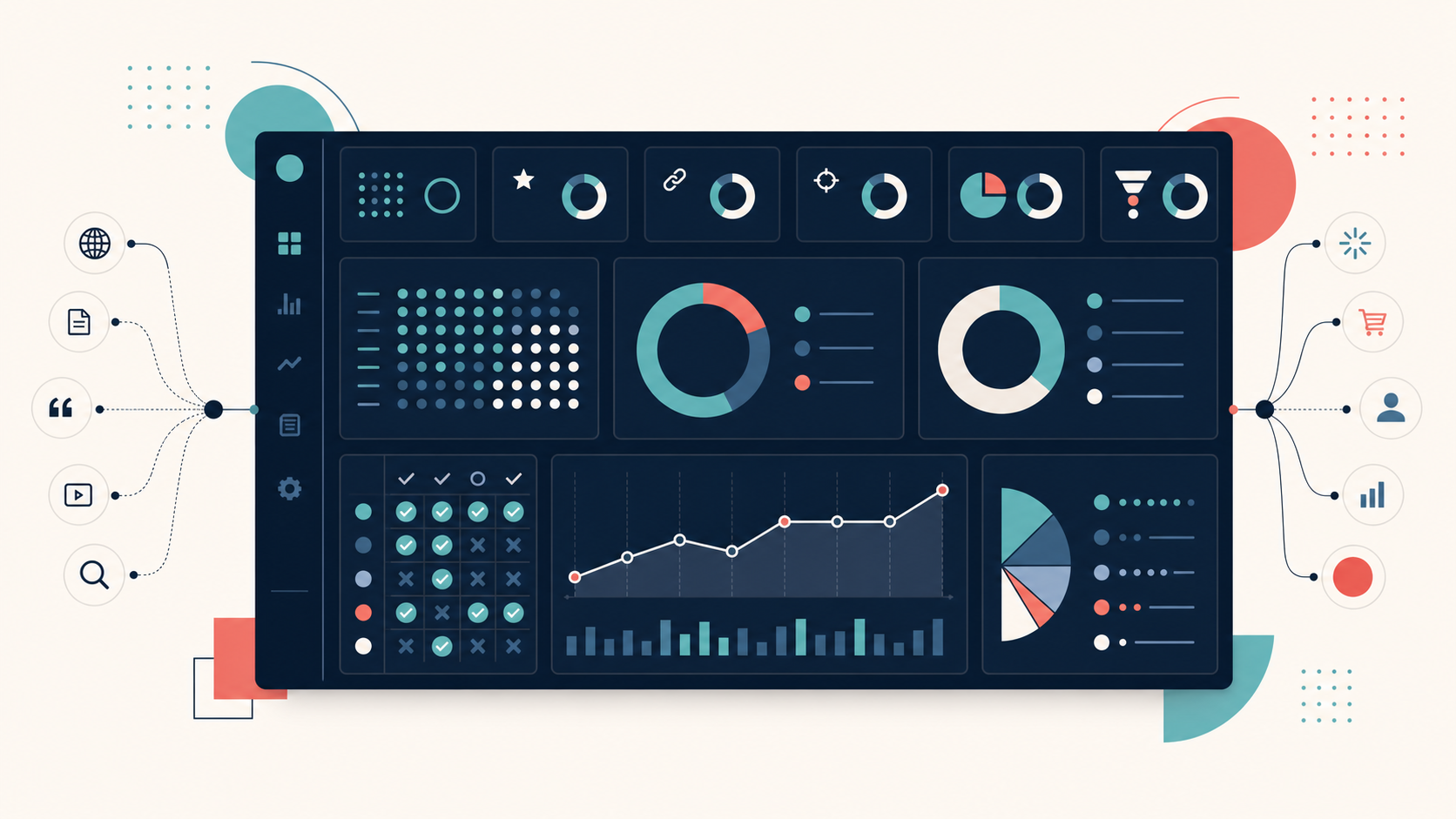
This guide gives you the template, formulas, cadence, and decision rules. If you are still deciding what to measure, start with answer engine optimization metrics. If you need a broader measurement baseline, use the LLM visibility benchmark.
What is an answer engine optimization report?
An answer engine optimization report is a recurring scorecard that connects buyer prompts to AI-generated answers, brand recommendations, cited URLs, factual accuracy, competitor visibility, traffic, and conversions. Its job is to show whether your brand is becoming a more visible and reliable answer—and which content or entity fix should happen next.
An AEO report is the operating record for answer engine optimization. It should preserve the exact prompt, AI surface, run date, answer evidence, brands named, citations found, target URL, intent, and business outcome. That evidence makes weekly comparisons credible instead of anecdotal.
A useful report answers four questions:
- Are answer engines choosing us for questions buyers ask?
- Are they citing the page we want to own that question?
- Is the answer accurate enough to help a buyer?
- Which fix has the best chance of improving the next run?
What should an AEO report include?
An AEO report should include an executive scorecard, prompt-level evidence, competitor movement, citation ownership, answer-accuracy issues, traffic and conversion signals, and a prioritized action queue. Separate leading indicators from commercial outcomes so an early citation win is not presented as revenue.
Use this one-page structure:
| Section | Include | Decision it supports |
|---|---|---|
| Coverage | Prompts tested by intent, market, persona, and surface | Is the sample representative? |
| Visibility | Recommendation rate, first-named rate, mention rate | Are we entering buyer shortlists? |
| Source ownership | Domain and target-page citation rate | Are the right pages supplying answers? |
| Accuracy | Accurate, incomplete, stale, wrong, unsupported | Is AI creating sales or reputation risk? |
| Competition | Share of voice and competitors gaining prompts | Who is displacing us, and where? |
| Demand | AI referrals, conversions, assisted pipeline | Is visibility producing commercial evidence? |
| Actions | Owner, page, fix, expected signal, due date | What ships before the next report? |
Do not lead with a blended visibility score alone. A score can rise because low-value definition prompts improved while purchase-intent prompts still recommend competitors. Show the components and segment them by intent.
Which prompts belong in the report?
Include stable prompts that represent the buyer journey: category discovery, problem diagnosis, workflow, shortlist, comparison, alternatives, pricing-adjacent questions, and failure modes. Start with 40–80 prompts, keep a locked core set for trend measurement, and maintain a smaller discovery set for emerging language.
Use a prompt inventory like this:
| Intent | Example prompt | Primary outcome |
|---|---|---|
| Category | “What is the best way to monitor AI search visibility?” | Mention and citation |
| Workflow | “How do I build a weekly AEO report?” | Target-page citation |
| Shortlist | “Best answer engine optimization tools for B2B SaaS” | Recommendation and order |
| Comparison | “Which AI visibility platform has source-level evidence?” | Recommendation and accuracy |
| Alternative | “What are alternatives to manual ChatGPT tracking?” | Competitive share of voice |
| Failure mode | “Why does ChatGPT cite competitors instead of our site?” | Citation diagnosis |
| Pricing-adjacent | “Is AEO software worth paying for?” | Recommendation and conversion path |
Keep prompt wording, location, language, surface, and run conditions consistent. Changing the questions every week destroys comparability. Add or retire prompts through a dated changelog, not silently.
For a systematic grouping method, use the AI search prompt taxonomy.
How do you calculate the headline AEO metrics?
Calculate headline AEO metrics from eligible prompts, not from every answer in the database. Recommendation rate uses buyer prompts where a recommendation is natural; target-page citation rate uses prompts mapped to a specific page; answer accuracy uses brand-present answers; share of voice uses a defined competitor set.
Recommendation rate = prompts recommending your brand / eligible recommendation prompts

Target-page citation rate = prompts citing the intended URL / prompts mapped to that URL

Answer accuracy = accurate brand-present answers / all brand-present answers

Competitive share of voice = your approved mentions / all approved competitor-set mentions

Fix-to-win rate = improved fixed prompts / fixed prompts re-measured
Always show numerator, denominator, and change beside a percentage. “Citation rate rose to 31%” is weak reporting. “The intended page was cited on 25 of 80 mapped prompts, up from 17 of 80” is auditable.
Do not mix surfaces before reviewing them separately. ChatGPT, Perplexity, Gemini, Claude, and Google AI experiences can select different sources and brands. A blended total is useful for leadership only after the surface-level table is available.
How should the executive summary be written?
Write the executive summary as three changes, two risks, and three actions. Name the prompt group or page behind every claim. A leader should understand the commercial direction in two minutes, while an operator should be able to click from the summary to the underlying evidence.
Use this fill-in template:
This period: Recommendation rate changed from [A] to [B] across [N] eligible prompts. Target-page citation rate changed from [C] to [D]. The largest gain came from [intent/page/surface], while [competitor] gained visibility on [prompt group].
Risk: [N] brand-present answers were stale or wrong, mainly about [fact]. [N] high-intent prompts cited a competitor when our mapped page was available.
Next actions: Update [page] with [specific proof], strengthen links from [supporting pages], and re-run [prompt group] on [date]. Owner: [name].
Avoid claims such as “AEO performance was strong” unless the report defines strong. State the evidence and the consequence.
How do you report citation ownership?
Report citation ownership at both domain and target-page level. Domain citation rate shows whether your site is used at all; target-page citation rate shows whether the intended source wins its mapped question. The second metric is more actionable because it exposes weak pages and internal routing problems.
Use these diagnosis rules:
| Result | Meaning | First action |
|---|---|---|
| Brand recommended, target page cited | Strong answer ownership | Defend freshness and monitor |
| Brand recommended, competitor cited | Visibility without source control | Add proof and earn corroborating mentions |
| Brand absent, your page cited | Useful source, weak positioning | Clarify product fit and entity language |
| Wrong page cited | Internal ownership is unclear | Strengthen title, answer block, anchors, and backlinks |
| No citation shown | No source evidence available | Track the answer separately; do not invent attribution |
Record the cited URL exactly. Grouping all citations at domain level hides whether a product page, blog post, homepage, or unrelated URL supplied the answer.
How should answer accuracy appear in the report?
Classify every brand-present answer as accurate, incomplete, stale, wrong, or unsupported. Quote only the short fragment needed to document the issue, link to the public source of truth, assign an owner, and record whether the correction is visible on the page before re-measuring.
Prioritize accuracy issues in this order:
- Wrong pricing, security, compliance, availability, or product claims.
- Wrong category or use-case positioning.
- Stale feature descriptions.
- Missing differentiators that affect a shortlist.
- Cosmetic wording differences.
An AI mention is not a win when it sends a buyer into a confused sales call. Use the workflow in AI answer accuracy monitoring for evidence capture and correction tracking.
How do you connect the report to revenue?
Connect the report to revenue with evidence tiers. Direct evidence includes AI-referred visits that convert. Assisted evidence includes later conversions after an AI visit, branded search, or a documented sales discovery source. Leading evidence includes high-intent recommendations and citations with no measurable click yet.
For a complete measurement design—including sourcing rules, attribution windows, self-reported discovery, confidence tiers, and deduplication—use the AI search attribution model.
| Evidence tier | Examples | Reporting language |
|---|---|---|
| Direct | AI referral → signup, audit, demo, form, purchase | “Generated” |
| Assisted | AI touchpoint before a later qualified conversion | “Influenced” |
| Leading | High-intent recommendation or citation | “Improved visibility” |
Never multiply mentions by an assumed click value and call it revenue. Keep AEO ROI conservative: show measured conversions, assisted evidence, and leading indicators separately.
Google Analytics can identify known referral traffic and conversion behavior, but it cannot reveal every no-click answer that shaped a decision. Prompt tracking and analytics solve different parts of the measurement problem.
What should the weekly AEO action queue contain?
The action queue should rank fixes by buyer intent, size of the prompt loss, business risk, confidence in the diagnosis, and effort. Each row needs one owner, one target page, one concrete change, one success metric, and one re-measurement date.
Use this priority formula:
Priority = intent value × affected prompts × business risk × confidence ÷ effort
The exact weights matter less than using the same rule every week. A wrong pricing answer on five comparison prompts should usually outrank ten missing citations on educational prompts.
Before closing the meeting, confirm:
- The target URL and prompt group are named.
- The proposed edit is specific.
- Supporting internal links are assigned.
- Proof or source requirements are clear.
- The owner and due date are recorded.
- The same prompts will be re-run after crawling.
- The result will be marked won, unchanged, or regressed.
How often should you send an AEO report?
Send an operator report weekly and a leadership report monthly. Re-measure page fixes 7–14 days after publication or recrawl. Use daily monitoring only during launches, pricing changes, rebrands, major incidents, or periods when answer accuracy can create immediate business risk.
Weekly reports should emphasize prompt movement, citation changes, accuracy incidents, competitor gains, and the fix queue. Monthly reports should show stable trend lines, high-intent outcomes, AI referrals, conversions, assisted pipeline, and lessons from completed experiments. Use the 90-day answer engine optimization roadmap to turn those findings into sequenced ownership and page work.
What makes an AEO report misleading?
An AEO report becomes misleading when it cherry-picks prompts, changes the sample without disclosure, counts branded questions as neutral wins, blends surfaces too early, treats every mention as a recommendation, hides cited URLs, or presents visibility as revenue.
Watch for these failure modes:
- Screenshots without a reproducible prompt record.
- Percentages without denominators.
- Averages that mix educational and purchase-intent prompts.
- Competitor share of voice without a fixed competitor set.
- FAQ or schema claims that are not visible on the page.
- “Wins” measured with different prompts after the page changed.
- Action lists with no owner or re-test date.
- AI traffic reported without conversion quality.
The report should make uncertainty visible. If an answer has no citation, say so. If attribution is assisted rather than direct, label it. Credibility compounds.
How can Tracemetry automate AEO reporting?
Before automating the report, define the answer engine optimization workflow that produces it: a locked prompt cohort, raw answer evidence, intended source pages, owned fixes, publish dates, and comparable rechecks.
Tracemetry can turn fixed prompt sets into a repeatable AEO report by tracking brand mentions, recommendation order, cited URLs, competitors, answer accuracy, changes over time, and the pages attached to each prompt. That gives operators evidence for the next fix and leaders a cleaner view of commercial progress.
A practical workflow:
- Run an AI visibility audit to identify the first prompt and citation gaps.
- Lock a buyer-intent prompt set and map every prompt to a target page.
- Track each AI surface separately.
- Review recommendations, citations, competitors, and accuracy weekly.
- Send the highest-value losses into a page-level action queue.
- Re-run the exact prompts after changes are indexed.
- Connect known AI referrals to conversion and pipeline evidence.
When manual screenshots stop scaling, review Tracemetry pricing or book a demo to build continuous prompt tracking and reporting around the questions your buyers actually ask.
FAQ
What is an answer engine optimization report? An answer engine optimization report is a recurring scorecard that connects buyer prompts to AI answers, brand recommendations, cited URLs, answer accuracy, competitor visibility, traffic, conversions, and prioritized page fixes.
What metrics should an AEO report include? Include recommendation rate, first-named rate, target-page citation rate, answer accuracy, competitive share of voice, AI referral conversions, and fix-to-win rate. Segment the metrics by prompt intent and AI surface.
How many prompts are needed for an AEO report? Start with 40–80 buyer prompts across category, workflow, shortlist, comparison, alternative, pricing-adjacent, and failure-mode intent. Keep a locked core set so changes remain comparable.
How often should AEO reporting happen? Operators should review AEO performance weekly, while leadership usually needs a monthly report. Re-measure exact page-level prompts 7–14 days after a fix is published or recrawled.
Can GA4 create an AEO report by itself? No. Analytics can measure known AI referral visits and conversions, but it cannot show no-click recommendations, prompt-level competitor visibility, cited URLs, or answer accuracy. Pair analytics with prompt and citation monitoring.
How do you prove AEO reporting is working? Track whether shipped fixes improve the same prompts. Report the fix-to-win rate beside target-page citations, recommendations, answer accuracy, qualified AI referrals, and assisted pipeline.
Frequently asked questions
What is an answer engine optimization report?
An answer engine optimization report is a recurring scorecard that connects buyer prompts to AI answers, brand recommendations, cited URLs, answer accuracy, competitor visibility, traffic, conversions, and prioritized page fixes.
What metrics should an AEO report include?
Include recommendation rate, first-named rate, target-page citation rate, answer accuracy, competitive share of voice, AI referral conversions, and fix-to-win rate. Segment the metrics by prompt intent and AI surface.
How many prompts are needed for an AEO report?
Start with 40–80 buyer prompts across category, workflow, shortlist, comparison, alternative, pricing-adjacent, and failure-mode intent. Keep a locked core set so changes remain comparable.
How often should AEO reporting happen?
Operators should review AEO performance weekly, while leadership usually needs a monthly report. Re-measure exact page-level prompts 7–14 days after a fix is published or recrawled.
Can GA4 create an AEO report by itself?
No. Analytics can measure known AI referral visits and conversions, but it cannot show no-click recommendations, prompt-level competitor visibility, cited URLs, or answer accuracy. Pair analytics with prompt and citation monitoring.
How do you prove AEO reporting is working?
Track whether shipped fixes improve the same prompts. Report the fix-to-win rate beside target-page citations, recommendations, answer accuracy, qualified AI referrals, and assisted pipeline.
See your own AI visibility today.
Free public report. 60 seconds. No signup. Or get started on Pro to track 250 prompts continuously.