Answer engine optimization content refresh: the practical workflow
Refresh existing content for AI answers with a measured workflow for citation decay, factual accuracy, source ownership, internal links, and re-testing.
Your page still ranks, but AI answers have stopped citing it. Or the citation remains while the answer repeats an old price, feature, or definition. Publishing another article will not fix that. You need a focused answer engine optimization content refresh that restores the page as the clearest, freshest source for a specific buyer question.
Use this fast rule: refresh an existing URL when it already matches the question and has links, history, or citations. Create a new page only when the old URL serves a different intent. Then preserve the prompt set, fix the evidence gap, and measure the same questions again.
What is an answer engine optimization content refresh?
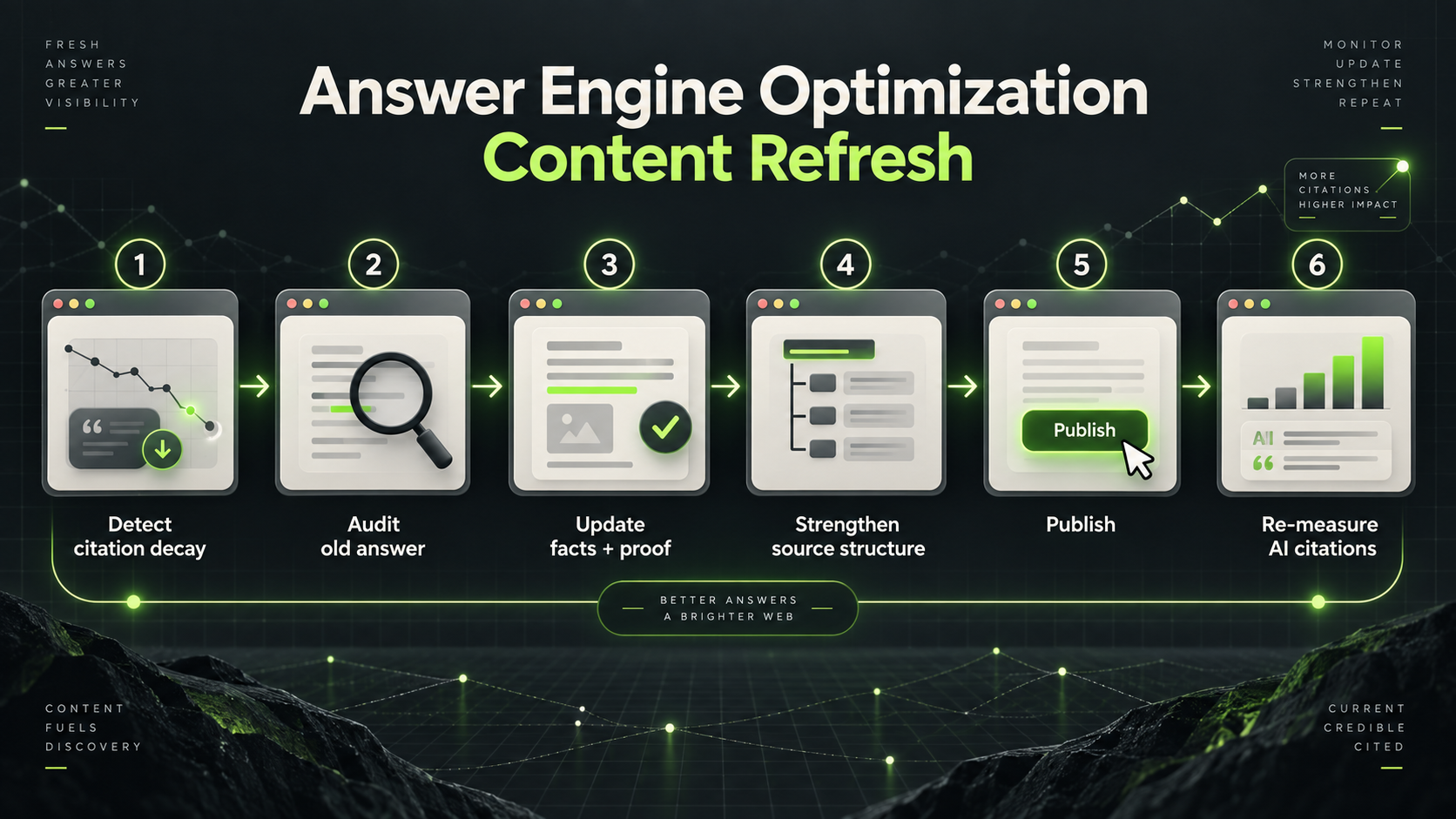
An answer engine optimization content refresh is a targeted update to an existing page so AI systems can retrieve, understand, cite, and recommend it accurately. It starts with lost or incorrect answers, updates the source facts and proof, improves extractable structure, strengthens internal discovery, and re-tests the same prompts after publication.
An AEO content refresh is a source-repair project, not a new publication date pasted onto old copy. Its job is to close a measured answer gap: the wrong page is cited, a competitor owns the source, your brand is absent, or the generated answer is materially outdated.
If you do not yet know which URL should own the answer, run an AEO content gap analysis. If the URL is known but the page needs execution guidance, use the answer engine optimization checklist alongside this refresh workflow.
When should you refresh an existing page instead of creating a new one?
Refresh the existing page when its audience, question, and intended answer still match the prompt. Create a new page when the user job, audience, product category, comparison, or required depth is meaningfully different. This avoids splitting authority and forcing answer engines to choose between near-duplicate sources.
| Situation | Refresh the existing URL | Create a new URL |
|---|---|---|
| Facts changed | Yes: update claims, evidence, dates, and schema | No |
| Citation rate fell | Yes: inspect competing sources and strengthen proof | Only if intent changed |
| Wrong internal page is cited | Consolidate ownership and improve links | Only for a distinct question |
| Page answers part of the prompt | Expand it if the same reader needs the answer | Create if the missing answer serves another job |
| Old page has links and history | Usually preserve and improve it | Redirect only after a deliberate consolidation |
| Two pages target the same answer | Merge into the stronger source | Do not add a third page |
The decision should be based on answer ownership, not word count. A short page with the right purpose can be improved. A long page written for the wrong intent should not be stretched until it becomes incoherent.
What signals show that an AEO page needs refreshing?
A page needs an AEO refresh when repeated prompt tests show citation decay, source substitution, recommendation loss, or factual drift. Traffic decline can support the diagnosis, but AI-answer evidence is more direct: save the complete answer, cited URLs, brands, engine, timestamp, and test conditions.
Look for these six signals:
- Target-page citation rate falls. Your domain may still appear, but a less useful URL replaces the intended source.
- Competitors gain source share. Their pages now provide fresher evidence, clearer comparisons, or a better direct answer.
- The answer is outdated. Pricing, features, availability, policies, statistics, or definitions no longer match reality.
- Your brand is cited but not recommended. The page supplies a fact without explaining fit, limits, or the next decision.
- The page is retrieved for the wrong prompts. Entity ambiguity makes the content appear relevant to a different product, audience, or use case.
- AI referrals land but do not convert. The answer earns the click, while the page fails to continue the user's job.
Do not overreact to one result. AI outputs vary. Confirm a meaningful loss across repeated runs or multiple high-value prompts, then inspect the AI citation decay workflow before editing.
How do you audit a page before refreshing it?
Audit the answer before the article. Lock a small prompt cohort, capture current outputs and cited sources, identify the precise failure, and compare the target page with the sources now winning. This turns a vague rewrite into a bounded repair with a measurable before state.
Use this pre-refresh worksheet:
| Audit field | Question to answer | Evidence to save |
|---|---|---|
| Prompt | Which exact buyer question should this page support? | Fixed prompt text |
| Intended source | Which URL should own the answer? | Canonical URL |
| Current outcome | Is the brand mentioned, recommended, or cited? | Complete answer and links |
| Accuracy | Which material claims are correct, missing, or stale? | Claim-level notes |
| Competitor advantage | Why is another source easier to use? | Better proof, format, freshness, or authority |
| Page obstacle | What blocks retrieval or extraction? | Rendering, canonical, structure, ambiguity, or thin evidence |
| Success metric | What should move after the refresh? | Citation, recommendation, or accuracy target |
The audit should end with one sentence: “For this prompt set, update this URL because this evidence or answer block is missing.” If the team cannot write that sentence, it is not ready to refresh the page.
What should you update in an AEO content refresh?
Update the smallest set of elements that resolves the measured gap: direct answer, factual claims, supporting evidence, comparison criteria, entity language, internal links, metadata, visible FAQ, and matching structured data. Preserve useful sections and URLs instead of rewriting everything for novelty.
Work in this order:
- Rewrite the direct answer. Put a self-contained 40–80 word answer below the relevant question-style heading.
- Correct material facts. Verify prices, dates, product capabilities, names, availability, and limitations against authoritative sources.
- Add extractable proof. Use a decision table, calculation, example, checklist, methodology, or source-backed comparison.
- Clarify entities. Name the product, category, platform, audience, location, and use case where ambiguity is possible.
- Remove stale sections. Delete unsupported predictions, expired offers, obsolete screenshots, and redundant filler.
- Strengthen source discovery. Add contextual links from relevant pages and link the refreshed page to its supporting sources.
- Align visible content and schema. FAQ and Article markup should describe what readers can actually see.
- Improve the next action. Route the reader to a useful feature, workflow, demo, or decision rather than a generic CTA.
Google's guidance says the same core SEO practices apply to its AI features, including crawlability, internal links, page experience, and accurate structured data. Google also requires structured data to represent visible page content. Treat these as foundations, not magic markup.
How much of the page should you rewrite?
Rewrite only what the evidence says is broken. A surgical refresh is better when the page already owns the right intent and contains useful material. A substantial rewrite is justified when the answer is buried, the proof is obsolete, or the page mixes several incompatible jobs.
Use three refresh levels:
- Light refresh: correct facts, strengthen the direct answer, update links, and align metadata or FAQ.
- Evidence refresh: add original examples, a decision table, citations, methodology, or comparison criteria.
- Structural refresh: reorganize the page around one prompt family, consolidate duplicates, and rebuild the conversion path.
Changing every sentence makes attribution harder: you cannot tell which improvement caused movement. For priority pages, log the meaningful changes and keep the prompt cohort stable.
How should internal links change after a refresh?
If a refresh also proposes retiring another article, use the canonical versus permanent-redirect checklist to review content equivalence, the retained answer and the behavior of old links before implementation.
Internal links should make the intended source easy to discover and distinguish it from supporting pages. Add links from two or three relevant pages using natural language that explains what the refreshed page helps the reader do. Remove or change links that send the same prompt to competing URLs.
For this page, the supporting paths are the AEO content brief, content that AI cites, and answer engine optimization metrics. They solve different jobs: planning, writing, and measuring. This page owns the refresh decision and workflow.
The conversion path should be equally clear. Review Tracemetry features to connect prompt evidence with page-level actions, or book a demo to see how repeated answer tracking can prioritize refreshes.
How do you measure whether the refresh worked?
Measure the same prompts, engines, market, and core test conditions used before the update. Start checking after the refreshed page has been crawled or rediscovered, often with an initial 7–14 day comparison and continued weekly or monthly observation. Judge repeated movement, not one favorable answer.
Track these outcomes separately:
- target-page citation rate;
- domain citation rate;
- qualified recommendation rate;
- answer accuracy for material claims;
- competitor source share;
- AI referral sessions and engaged conversions;
- time from detected loss to shipped fix.
The cleanest primary metric for a source repair is target-page citation rate: the percentage of tested answers that cite the intended refreshed URL. Pair it with accuracy and recommendation quality so an irrelevant or incorrect citation does not count as a win. The AEO metrics guide provides the broader reporting framework.
What mistakes make content refreshes fail?
AEO refreshes fail when teams change the date without improving the source, rewrite without preserving a baseline, or publish duplicate pages for the same answer. They also fail when schema claims are hidden, facts conflict across the site, and success is defined as “the page shipped.”
Avoid these traps:
- updating the publication date while leaving stale claims untouched;
- chasing one volatile answer instead of repeated evidence;
- adding generic length instead of useful proof;
- changing the URL and losing established signals without a strong reason;
- publishing a near-duplicate article rather than repairing source ownership;
- stuffing exact-match phrases into every heading;
- measuring domain mentions while ignoring which URL was cited;
- expecting structured data to guarantee selection;
- ending the page without a next step for the reader.
FAQ
How often should AEO content be refreshed? Refresh based on evidence and risk, not an arbitrary calendar. Review fast-changing pricing, product, policy, comparison, and statistics pages more often. For stable educational content, refresh when citations decay, competitors replace your source, facts change, or the page stops serving its intended prompt.
Does changing the publication date improve AI citations? Not by itself. A new date without meaningful factual, structural, or evidentiary improvement can mislead readers and gives answer systems no better source material. Update the date only when the content has been substantively reviewed or changed.
Should I change the URL during an AEO refresh? Usually no. Keep the established URL when the topic and intent remain the same. Change it only when the current slug is materially misleading or pages are being consolidated, and use a proper redirect while updating canonicals, links, and the sitemap.
How long does an AEO content refresh take to affect answers? There is no guaranteed interval. Begin checking after the page has been crawled or rediscovered, often at 7–14 days, and continue at a consistent cadence. Different answer systems and queries may update at different speeds.
Can schema markup fix a stale AI answer? Schema can clarify visible entities and page meaning, but it cannot replace corrected copy, trustworthy evidence, crawlability, or source authority. Keep markup accurate and consistent with the visible page.
What is the best metric for an AEO refresh? Target-page citation rate is the clearest source-ownership metric. Pair it with answer accuracy and qualified recommendation rate so the refreshed URL wins the right answers with correct claims.
Refresh the source, then re-measure the answer
Do not commission another article because an old page lost citations. Preserve the prompt evidence, decide whether the URL still owns the job, repair the exact answer and proof gap, strengthen internal discovery, and run the same test again.
One well-measured refresh can restore source ownership faster than adding another overlapping page. Use Tracemetry features to turn lost prompts into a prioritized fix queue, or book a demo to see the workflow on your own prompt set.
Sources: Google AI features and your website, Google structured data policies, and OpenAI ChatGPT Search.
Frequently asked questions
How often should AEO content be refreshed?
Refresh based on evidence and risk, not an arbitrary calendar. Review fast-changing pricing, product, policy, comparison, and statistics pages more often. For stable educational content, refresh when citations decay, competitors replace your source, facts change, or the page stops serving its intended prompt.
Does changing the publication date improve AI citations?
Not by itself. A new date without meaningful factual, structural, or evidentiary improvement can mislead readers and gives answer systems no better source material. Update the date only when the content has been substantively reviewed or changed.
Should I change the URL during an AEO refresh?
Usually no. Keep the established URL when the topic and intent remain the same. Change it only when the current slug is materially misleading or pages are being consolidated, and use a proper redirect while updating canonicals, links, and the sitemap.
How long does an AEO content refresh take to affect answers?
There is no guaranteed interval. Begin checking after the page has been crawled or rediscovered, often at 7–14 days, and continue at a consistent cadence. Different answer systems and queries may update at different speeds.
Can schema markup fix a stale AI answer?
Schema can clarify visible entities and page meaning, but it cannot replace corrected copy, trustworthy evidence, crawlability, or source authority. Keep markup accurate and consistent with the visible page.
What is the best metric for an AEO refresh?
Target-page citation rate is the clearest source-ownership metric. Pair it with answer accuracy and qualified recommendation rate so the refreshed URL wins the right answers with correct claims.
Make your next SEO decision with better evidence.
Explore practical guides to AI visibility, source citations, and choosing the right tools for your team.