Answer engine optimization for publishers: source ownership playbook
A practical publisher AEO workflow for choosing source pages, strengthening evidence, preventing attribution loss, and measuring AI citations.
Publishers are watching AI answers summarize their reporting, cite a competitor, or omit the original source entirely. The wrong response is to flood the site with more generic articles. The useful response is to identify which questions your newsroom should own, strengthen the best existing source page, and measure whether answer engines cite that exact URL.
Use this fast rule: protect high-value evergreen explainers first. Choose pages with original reporting, recurring demand, clear expertise, and a realistic update path. Give each page a 40–80 word answer, visible evidence, a named author, a current date, and internal links from related coverage before creating anything new.
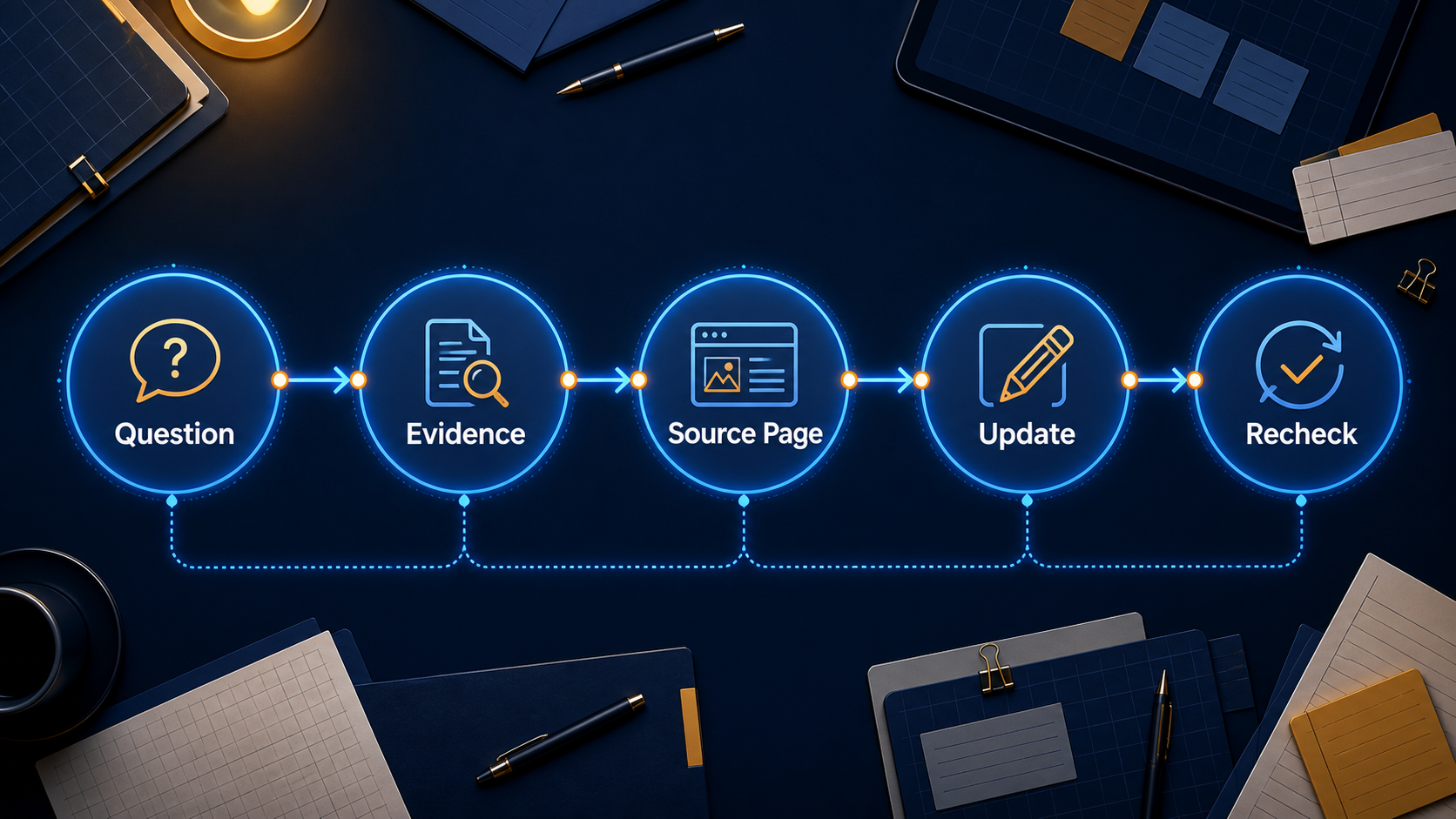
This publisher playbook builds on the page-level AEO checklist, AI search prompt taxonomy, and citation-decay guide. Use it when your main problem is not producing content, but making authoritative journalism easier to retrieve, interpret, cite, and revisit.
What is answer engine optimization for publishers?
Answer engine optimization for publishers is the process of making original journalism and evergreen editorial pages easier for AI systems to retrieve, understand, attribute, and cite. It combines question research, source-page selection, concise answers, transparent evidence, author and date signals, technical accessibility, internal linking, and repeated citation checks.
Answer engine optimization for publishers is source stewardship for AI-generated answers. It does not mean rewriting every article for robots. It means preserving the reporting, context, limitations, and attribution that make a page worth citing while giving readers and machines a clear answer path.
The job is different from ordinary traffic optimization. A publisher can rank well in search yet lose attribution when an answer engine cites a secondary summary. A useful AEO program therefore measures the cited domain and URL, not just whether the publication is mentioned.
Which publisher pages should you optimize first?
Optimize evergreen pages that combine reader demand with distinctive evidence. Start with explainers, investigations, data projects, methodology pages, recurring guides, and definitive profiles. Leave low-value rewrites, short-lived updates, and undifferentiated aggregation behind unless they support a stronger source page.
Use this decision table:
| Page type | AEO priority | What makes it defensible |
|---|---|---|
| Original investigation | High | Documents, interviews, methodology, named findings |
| Evergreen explainer | High | Clear definition, expert context, maintained facts |
| Data or research page | High | Downloadable data, methods, definitions, update history |
| Recurring guide | Medium-high | Tested steps, current details, practical decisions |
| Breaking-news live post | Medium | Fast primary reporting, but facts and URLs may change |
| Opinion column | Selective | Distinctive named perspective, not a neutral fact source |
| Commodity rewrite | Low | Little evidence that cannot be found at the original source |
Score candidates on four dimensions: commercial or civic importance, evidence uniqueness, recurring question demand, and maintenance capacity. A page that scores high on three of four should enter the first optimization batch.
How should publishers build an AI-question set?
Build the question set from reader needs, not a raw keyword export. Include definition, timeline, comparison, consequence, local-impact, methodology, and failure-mode questions. Then map every priority question to one intended article or evergreen hub so several URLs do not compete to explain the same subject.
A practical first cohort contains 30–50 questions:
- 8–12 evergreen definition and context questions;
- 6–10 consequence or “why does this matter?” questions;
- 5–8 comparisons, alternatives, or historical parallels;
- 5–8 methodology and evidence questions;
- 4–6 failure-mode questions where misinformation is common.
Natural phrasing matters. Test questions such as “why does this policy change matter?”, “how do I verify this claim?”, “what is the best source for the latest data?”, and “when should I trust a preliminary estimate?” Those are closer to how readers use AI assistants than isolated head terms.
Track the exact prompt, surface, country or language, timestamp, answer, cited URLs, and whether the intended page appeared. The AI search prompt monitoring workflow explains how to keep that cohort stable enough for comparison.
What should an AI-citable publisher article contain?
An AI-citable publisher article should contain a direct answer, original evidence, clear attribution, relevant context, visible limitations, named authorship, and a maintained date. The strongest page separates observed facts from interpretation and makes the path back to primary documents or data obvious.
Use this seven-part editorial checklist:
- Put a concise answer directly below the relevant heading.
- State who reported, measured, calculated, or alleged each important claim.
- Link to primary documents, datasets, transcripts, filings, or official records.
- Explain methodology and material limitations next to the finding.
- Use tables, timelines, and definitions where they reduce ambiguity.
- Show published and meaningfully updated dates without disguising cosmetic edits.
- Link related coverage back to the definitive source page.
Do not remove narrative, nuance, or voice merely to create extractable blocks. The direct answer helps orientation; the reporting underneath earns trust.
How do publishers prevent secondary sources from taking the citation?
Publishers improve source ownership by making the original evidence easier to find and interpret than derivative coverage. Keep the definitive URL stable, consolidate overlapping pages, expose primary materials, add descriptive internal links, and update the original page when the story develops instead of scattering essential context across disconnected posts.
When another site summarizes your investigation more clearly, an answer engine may prefer that summary. Fix the source, not just the wording:
- add a plain-language findings block near the top;
- name the dataset, sample, period, geography, and method;
- publish a methodology or corrections section;
- link later stories back to the original investigation;
- use a canonical URL and avoid accidental duplicate routes;
- preserve important documents at stable, crawlable URLs;
- add a clear correction note when a material fact changes.
For a page that used to earn citations and then disappeared, use the AI citation-decay diagnosis before commissioning a replacement.
What technical checks matter for publisher AEO?
Publisher AEO depends on ordinary technical accessibility: successful status codes, indexable HTML, stable canonicals, accurate sitemaps, descriptive links, fast rendering, and structured data that matches visible content. Paywalled publishers should expose enough permitted context and metadata for discovery without undermining the subscription model.
Check these items on every priority page:
- the canonical resolves to the intended article URL;
- headline, author, published date, modified date, and publisher are consistent;
- Article or NewsArticle structured data matches visible text;
- important evidence is present in HTML, not only an inaccessible embed;
- image and chart captions explain what the asset proves;
- the page appears in the relevant XML sitemap;
- redirects, pagination, syndication, and AMP variants do not create ambiguity;
- robots controls reflect the publisher's deliberate access policy.
Structured data describes a page; it does not guarantee an AI citation. Google’s Article structured data documentation recommends properties that help identify article titles, images, dates, and authors, while its general structured data guidelines require markup to represent visible content accurately.
How should publishers measure answer-engine performance?
Measure publisher AEO with citation rate, target-URL citation rate, source ownership, answer accuracy, and citation retention. Report these separately by question type and AI surface. A rising brand-mention rate can hide the fact that an answer engine still attributes your reporting to another domain.
Use five core measures:
| Metric | What it answers |
|---|---|
| Domain citation rate | How often is the publication cited? |
| Target-URL citation rate | How often does the intended page earn the citation? |
| Source ownership rate | How often is original reporting attributed to the publisher rather than a derivative source? |
| Answer accuracy rate | How often are material claims represented correctly? |
| Citation retention | Does the page remain cited across repeated checks? |
Compare the same question cohort before and after meaningful editorial or technical changes. Preserve raw answers and cited URLs so editors can inspect the evidence. The AEO metrics guide provides the formulas and weekly reporting structure.
What publisher AEO mistakes waste the most time?
The biggest mistakes are optimizing every page, creating near-duplicate explainers, confusing a mention with attribution, hiding original evidence in non-crawlable assets, and reporting one-off screenshots as a trend. Publishers also weaken trust when they update dates without changing the article or use unsupported AI-generated summaries.
Avoid these failure modes:
- turning headlines into awkward exact-match keywords;
- publishing a new URL whenever one AI answer looks wrong;
- letting syndicated copies become more complete than the canonical source;
- removing uncertainty or caveats from scientific, legal, or political reporting;
- marking up FAQ answers that readers cannot see;
- combining all prompts and surfaces into one visibility score;
- measuring citation gains without reviewing factual accuracy;
- failing to assign an editor who owns updates and corrections.
FAQ
Does answer engine optimization replace SEO for publishers?
No. Technical accessibility, useful reporting, internal links, authority, and reader demand still matter. Publisher AEO adds question-level measurement, cited-URL tracking, source ownership, answer accuracy, and editorial workflows designed for AI-generated answers.
Should publishers allow AI crawlers?
That is a business and rights decision, not a universal SEO rule. Publishers should distinguish search discovery, user-triggered retrieval, model training, and commercial licensing; review each crawler’s documented purpose; and apply a deliberate policy consistent with legal and revenue strategy.
Can paywalled articles earn AI citations?
Yes, but discoverability varies by access model and system. Accurate metadata, visible summaries, stable URLs, crawlable permitted content, and strong third-party references can help systems identify the source. Do not expose protected content merely to chase citations.
How often should a publisher recheck AI citations?
Check a stable priority cohort weekly during an active optimization cycle and monthly for mature evergreen coverage. Recheck sooner after a major correction, redesign, URL migration, or significant story development.
What is the best AEO metric for a newsroom?
Target-URL citation rate is the clearest page-level metric. Pair it with source ownership and answer accuracy so a citation counts only when the system credits the right page and represents the reporting responsibly.
Turn reporting authority into measurable source ownership
Start with ten evergreen pages and 30–50 reader questions. Capture the current answers, fix the strongest source pages, and recheck the unchanged cohort. Run a Tracemetry AI visibility audit to identify where your publication is cited, omitted, or replaced by secondary sources, or book a demo to build a publisher-specific monitoring workflow.
Frequently asked questions
Does answer engine optimization replace SEO for publishers?
No. Technical accessibility, useful reporting, internal links, authority, and reader demand still matter. Publisher AEO adds question-level measurement, cited-URL tracking, source ownership, answer accuracy, and editorial workflows designed for AI-generated answers.
Should publishers allow AI crawlers?
That is a business and rights decision, not a universal SEO rule. Publishers should distinguish search discovery, user-triggered retrieval, model training, and commercial licensing; review each crawler's documented purpose; and apply a deliberate policy consistent with legal and revenue strategy.
Can paywalled articles earn AI citations?
Yes, but discoverability varies by access model and system. Accurate metadata, visible summaries, stable URLs, crawlable permitted content, and strong third-party references can help systems identify the source. Publishers should not expose protected content merely to chase citations.
How often should a publisher recheck AI citations?
Check a stable priority cohort weekly during an active optimization cycle and monthly for mature evergreen coverage. Recheck sooner after a major correction, redesign, URL migration, or significant story development.
What is the best AEO metric for a newsroom?
Target-URL citation rate is the clearest page-level metric. Pair it with source ownership and answer accuracy so a citation counts only when the system credits the right page and represents the reporting responsibly.
See your own AI visibility today.
Free public report. 60 seconds. No signup. Or get started on Pro to track 250 prompts continuously.