Claude citation tracking: prompts, cited URLs, and fixes
How to track Claude citations weekly: prompt sets, cited URLs, brand mentions, competitor sources, answer accuracy, and the page fixes that improve Claude source ownership.
Claude citation tracking is where a lot of AI visibility programs get sloppy. Teams test ChatGPT, celebrate or panic, and then miss that Claude may be the assistant their best-fit buyers use for research, procurement notes, technical comparisons, and strategy work.
The fast rule: track Claude separately from ChatGPT and Perplexity. Use the same buyer prompt set, but score Claude on its own mention rate, cited sources, answer accuracy, source type, and competitor recommendations.
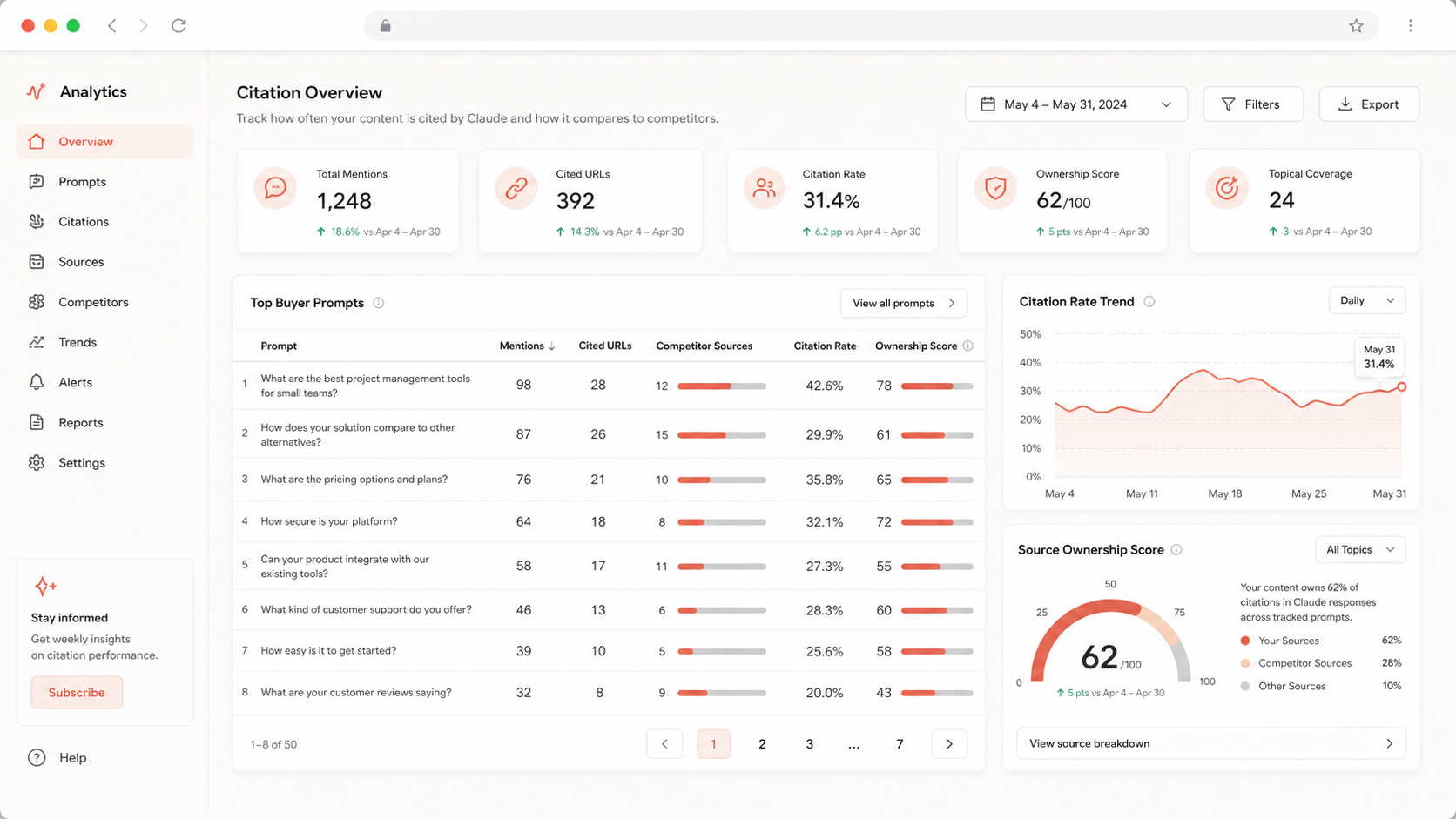
Use this guide after you have the broad AI visibility tracking workflow in place. If your immediate problem is source ownership, pair it with ChatGPT citation tracking, Gemini citation tracking, Perplexity citation monitoring, and AI answer accuracy monitoring.
What is Claude citation tracking?
Claude citation tracking is the process of measuring when Claude cites your domain, which URLs it uses as sources, which competitors it names instead, and whether the answer is accurate enough for a buyer to trust. It turns "Claude mentioned us once" into a repeatable weekly source-ownership report.
Claude citation tracking is the Claude-specific layer of AI visibility measurement. Brand mention tracking answers whether Claude names you. Citation tracking answers whether Claude gives the user a source path to your website, a competitor page, a publisher article, a document, or no source at all.
Anthropic's documentation says Claude's web search can answer with source citations, and its citations feature can point to source documents and passages when answering from provided materials. That makes citation tracking practical, but it also means you need to record the source context, not just the final generated paragraph.
When should you track Claude citations instead of only mentions?
Track Claude citations when the answer can influence a buyer's shortlist, internal memo, technical evaluation, or vendor comparison. A mention is useful. A cited source is stronger because it shows which page Claude used to support the answer.
Use this decision table:
| Prompt type | Primary metric | Why |
|---|---|---|
| "Best AI visibility tools for B2B SaaS" | Citation rate + competitor share | The answer may shape a shortlist |
| "Tracemetry vs Profound" | Answer accuracy + cited URLs | Buyers need correct tradeoffs |
| "How do I track Claude citations?" | Target URL citation rate | The workflow page should own the source slot |
| "What is GEO?" | Mention rate + citation quality | Category pages may be cited without vendor recommendation |
| "Why does Claude recommend competitors?" | Loss reason | The answer reveals missing proof or page shape |
Claude can behave differently from Perplexity because citations are not always the center of the product experience, and differently from ChatGPT because source use depends on the mode, prompt, and available tools. Keep the surface separate so one blended AI score does not hide where the real loss is.
How do you build a Claude prompt set?
Build a Claude prompt set from buyer questions, not only exact keywords. Search data can give you the category language, but Claude tests should include conversational phrasing, comparison phrasing, failure modes, and source-specific tasks.
Start with 40-80 prompts:
| Bucket | Count | Example prompts |
|---|---|---|
| Category discovery | 8-12 | "what is the best way to measure AI search visibility for a SaaS company" |
| Claude-specific | 6-10 | "how do I track whether Claude cites my website" |
| Tool shortlisting | 8-12 | "best AI visibility tools that monitor Claude and ChatGPT" |
| Comparison | 8-12 | "Tracemetry vs Profound for Claude citation tracking" |
| Alternatives | 6-10 | "best Otterly alternative for Claude and Perplexity monitoring" |
| Failure mode | 8-12 | "why does Claude cite competitors instead of my site" |
| Accuracy risk | 4-8 | "what does [brand] do and how much does it cost" |
Add entity terms naturally: Claude, Anthropic, Claude web search, citations, cited URLs, source ownership, AI visibility tracking, answer engine optimization, generative engine optimization, B2B SaaS, comparison pages, alternatives pages, pricing pages, docs, FAQ schema, and Article schema.
The prompt set should stay locked for trend reporting. Add new prompts in cohorts, not one at a time, or the team will accidentally make the score easier instead of making the site stronger.
What should you record for each Claude answer?
Record the exact prompt, answer summary, brands named, cited URLs, citation context, answer accuracy, and loss reason. Claude citation tracking is only useful when the row tells you which page to fix next.
Use this minimum row shape:
| Field | Example | Why it matters |
|---|---|---|
| Surface | Claude web search | Keeps Claude separate from ChatGPT and Perplexity |
| Prompt | "best AI visibility tools for SaaS teams" | The unit of measurement |
| Prompt bucket | comparison | Lets you weight high-intent prompts |
| Brands mentioned | Tracemetry, Profound, Peec | Feeds mention rate and share of voice |
| Cited URLs | /blog/ai-visibility-tools-compared-2026, competitor page, publisher article | Shows source ownership |
| Citation type | owned, competitor, publisher, document, none | Explains what kind of proof won |
| Answer accuracy | correct, incomplete, stale, wrong | Catches risky visibility |
| Loss reason | missing page, weak proof, stale page, unclear entity | Creates the fix queue |
Do not collapse citations into mentions. Claude can mention your brand without citing your website, cite your website for a secondary claim, or cite a third-party page that describes you badly. Those are three different problems.
How do you calculate Claude citation rate?
Calculate Claude citation rate by dividing Claude answers that cite your domain by total relevant Claude prompt runs. Then report target URL citation rate and competitor citation share so the metric points to action.
Use these metrics:
| Metric | Formula | Use |
|---|---|---|
| Claude mention rate | Claude answers naming your brand / total prompt runs | Brand presence |
| Claude domain citation rate | Claude answers citing your domain / total prompt runs | Source ownership |
| Target URL citation rate | Claude answers citing the intended page / total prompt runs | Page-level clarity |
| Competitor citation share | Competitor cited URLs / all category cited URLs | Competitive proof gap |
| Correct-answer rate | Accurate Claude answers mentioning your brand / brand-mentioned answers | Buyer trust |
| No-source rate | Answers with no useful source path / total prompt runs | Citation availability risk |
If a prompt matters commercially, sample it more than once. Claude answers can vary by mode, wording, recency, and whether the answer uses web search or provided documents. One run is a diagnostic. Repeated runs are a metric.
Why does Claude cite a competitor instead of your site?
Claude usually cites a competitor when the competitor page is easier to use as evidence for the exact prompt. The fix is not always a new blog post. Often the right move is to update the source page, clarify the entity, add proof, or link the page from stronger cluster content.
Use this failure map:
| Pattern | Likely cause | First fix |
|---|---|---|
| Competitor cited for a comparison prompt | You lack a direct comparison or alternatives page | Publish or update the comparison page |
| Publisher cited instead of your site | Third-party source looks more neutral or complete | Add stronger evidence and earn external mentions |
| Your brand mentioned, no domain cited | Claude knows the entity but not the source page | Improve page structure and internal links |
| Wrong owned URL cited | Internal topology is unclear | Link pillar, feature, pricing, and guide pages with clearer anchors |
| Old positioning repeated | Stale public copy or old third-party descriptions | Update homepage, pricing, docs, and comparison copy |
| No mention, no citation | Category retrieval is weak | Create the missing page or rewrite the existing one for the prompt |
For page structure, the same basics keep winning: a 40-80 word direct answer near the top, clear H2s, a useful table, visible FAQ, current dates, credible sources, and internal links from related pages. Google's structured data guidance is still the right mental model: structured data should clarify visible content, not hide claims the reader cannot see.
What pages improve Claude citation tracking fastest?
The fastest Claude citation gains usually come from pages that answer decision-stage prompts: comparison pages, alternatives pages, buyer guides, category explainers, pricing-adjacent pages, and specific workflow checklists. These pages give Claude a clean source when the user asks for help choosing, comparing, or fixing something.
Use this priority order:
- Fix the target page for the highest-intent loss. Do not start with generic top-of-funnel definitions.
- Rewrite the first screen. Put the direct answer, category, audience, and use case where Claude can extract it quickly.
- Add a decision table. Claude needs comparison criteria, not just paragraphs.
- Cite reliable sources for factual claims. Link to Anthropic, Google, or primary docs when discussing platform behavior.
- Add visible FAQ content. Match the FAQ schema and the visible page text.
- Clarify internal links. Link from AI visibility tracking, AI brand monitoring, content that AI cites, and schema markup for AI search.
- Re-measure the same prompt. Wait 7-14 days before calling the fix a win or failure.
The mistake is publishing a "Claude SEO" page because Claude missed you once. The better move is identifying the exact prompt, the cited competitor URL, the intended source page, and the smallest update that makes your page the more useful citation.
How should a weekly Claude citation report look?
A weekly Claude citation report should show prompt-level wins and losses, not just one executive number. The report should tell the team which source page to fix, which competitor source is winning, and whether prior fixes changed the next run.
Use this compact format:
| Section | What to include |
|---|---|
| Executive score | Claude mention rate, domain citation rate, target URL citation rate, correct-answer rate |
| High-intent losses | Comparison, alternatives, workflow, and pricing-adjacent prompts where competitors win |
| Cited source map | Owned URLs, competitor URLs, publisher URLs, documents, and no-source answers |
| Answer accuracy risks | Wrong, stale, misleading, or incomplete claims |
| Fixes shipped | Pages updated, internal links added, sources added, schema aligned |
| Next action | One page or proof gap to fix before the next run |
Roll this into your broader AI search visibility report, but keep the Claude tab separate. Claude can improve while ChatGPT is flat, and Perplexity can cite a page that Claude ignores. The action queue needs that surface-level detail.
FAQ
What is Claude citation tracking? Claude citation tracking is the process of recording whether Claude cites your domain for buyer-relevant prompts, which URLs it cites, which competitors or publishers appear instead, and whether the answer is accurate. It is the source-level measurement layer for Claude visibility.
How is Claude citation tracking different from ChatGPT citation tracking? Claude citation tracking measures Claude only. Use the same broad prompt universe, but keep Claude separate from ChatGPT because source use, answer style, and competitor recommendations can differ by surface. A blended AI visibility score hides those differences.
How many prompts should I track for Claude? Start with 40-80 prompts across category discovery, Claude-specific, comparison, alternatives, workflow, failure-mode, and pricing-adjacent intent. Use more samples for prompts that can affect pipeline or brand accuracy.
What should I do if Claude mentions my brand but does not cite my site? Treat it as a source-ownership gap. Improve the page that should support the answer with a direct answer, table, clear entity language, visible FAQ, credible sources, and internal links from related pages. Then re-measure the same prompt after 7-14 days.
Can I track Claude citations manually? Yes. A spreadsheet works for 25-40 prompts if you record prompt, date, brands mentioned, cited URLs, citation type, answer accuracy, and loss reason. Manual tracking becomes painful once you add samples, competitors, and multiple AI surfaces.
What pages help Claude cite my website? Comparison pages, alternatives pages, workflow guides, pricing-adjacent pages, category explainers, and troubleshooting posts usually help fastest because they match buyer prompts. The page must answer early, provide extractable evidence, and link naturally into the rest of the cluster.
Start with the Claude prompts buyers actually ask
Do not ask whether you are "visible in Claude" as a vague brand question. Ask which Claude prompts mention you, which cite you, which cite competitors, which answer is wrong, and which page should be fixed first.
Run the free Tracemetry audit for a quick cross-surface snapshot. If Claude is part of your buyer workflow, use Tracemetry Pro to track the full prompt set across Claude, ChatGPT, Perplexity, and Gemini, generate source-grounded briefs, and re-measure after each page ships.
Sources: Anthropic web search tool, Anthropic citations, Anthropic search results, Google structured data introduction.
Frequently asked questions
What is Claude citation tracking?
Claude citation tracking is the process of recording whether Claude cites your domain for buyer-relevant prompts, which URLs it cites, which competitors or publishers appear instead, and whether the answer is accurate. It is the source-level measurement layer for Claude visibility.
How is Claude citation tracking different from ChatGPT citation tracking?
Claude citation tracking measures Claude only. Use the same broad prompt universe, but keep Claude separate from ChatGPT because source use, answer style, and competitor recommendations can differ by surface. A blended AI visibility score hides those differences.
How many prompts should I track for Claude?
Start with 40-80 prompts across category discovery, Claude-specific, comparison, alternatives, workflow, failure-mode, and pricing-adjacent intent. Use more samples for prompts that can affect pipeline or brand accuracy.
What should I do if Claude mentions my brand but does not cite my site?
Treat it as a source-ownership gap. Improve the page that should support the answer with a direct answer, table, clear entity language, visible FAQ, credible sources, and internal links from related pages. Then re-measure the same prompt after 7-14 days.
Can I track Claude citations manually?
Yes. A spreadsheet works for 25-40 prompts if you record prompt, date, brands mentioned, cited URLs, citation type, answer accuracy, and loss reason. Manual tracking becomes painful once you add samples, competitors, and multiple AI surfaces.
What pages help Claude cite my website?
Comparison pages, alternatives pages, workflow guides, pricing-adjacent pages, category explainers, and troubleshooting posts usually help fastest because they match buyer prompts. The page must answer early, provide extractable evidence, and link naturally into the rest of the cluster.
See your own AI visibility today.
Free public report. 60 seconds. No signup. Or get started on Pro to track 250 prompts continuously.