Answer engine optimization keyword research: the practical workflow
Turn SEO keywords into measurable AI buyer prompts, map every question to a target page, score source gaps, and build an actionable AEO research sprint.
Answer engine optimization keyword research turns search terms into the questions buyers ask AI systems, then maps each question to the page you want cited. The painful mistake is copying an SEO keyword list into ChatGPT tracking: keywords reveal demand, but they do not capture the comparison, constraint, and failure-mode language that shapes an AI answer.
Use the fast rule: keep the keyword, expand it into five prompt types, and assign one intended source page before tracking anything. That gives you a useful prompt set in an hour instead of a spreadsheet full of vague questions nobody can act on.
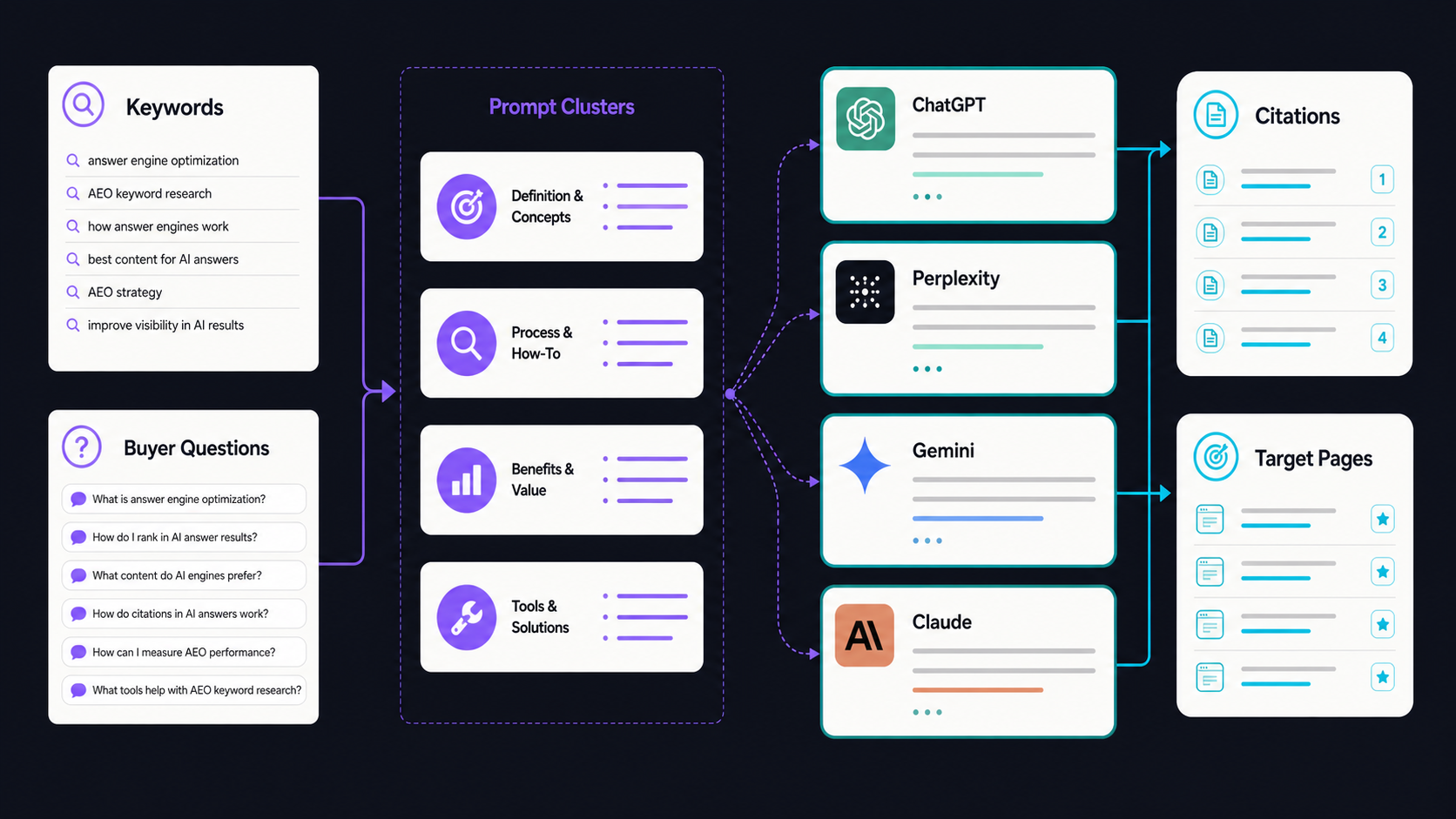
This guide connects the broader answer engine optimization strategy to the practical work of AI search prompt monitoring, prompt taxonomy, and content gap analysis.
What is answer engine optimization keyword research?
Answer engine optimization keyword research is the process of finding commercially relevant search language, expanding it into realistic buyer questions, grouping those questions by intent, and mapping each prompt to a page that can answer it with evidence. The output is not merely a keyword list; it is a measurable prompt-to-page plan.
AEO keyword research is the bridge between conventional search demand and conversational AI discovery. SEO data tells you which concepts people search for. Sales calls, support tickets, competitor comparisons, and AI-answer testing reveal how those concepts become questions with context.
Why is a normal SEO keyword list not enough for AEO?
A normal keyword list is not enough because answer engines receive complete questions, follow-up constraints, and requests for judgment. Two people searching the same head term may ask an AI assistant for a definition, a shortlist, a comparison, a troubleshooting step, or a recommendation under specific conditions.
For the seed keyword AI visibility tool, these prompts represent different jobs:
| Prompt type | Example question | Page that should own it |
|---|---|---|
| Definition | What is an AI visibility tool? | Category guide |
| Selection | What is the best AI visibility tool for a lean B2B SaaS team? | Comparison page |
| Comparison | Tracemetry vs manual ChatGPT tracking: which is more reliable? | Alternative/comparison page |
| Workflow | How do I track citations across ChatGPT and Perplexity? | Product workflow guide |
| Failure mode | Why is my brand mentioned but my website is not cited? | Troubleshooting guide |
The keyword remains useful, but the prompt supplies the buyer, condition, surface, desired outcome, and decision. That additional context determines which sources an answer engine retrieves and which page your team should improve.
How do you turn one keyword into an AEO prompt set?
Turn one keyword into a prompt set by creating definition, selection, comparison, workflow, and failure-mode questions. Add real constraints from sales and support, then remove prompts that are ambiguous, duplicative, or impossible to map to a useful page. Start with 20–40 prompts for one topic, not hundreds.
- Keep the entity explicit. Name the product category, platform, audience, format, or market so the answer cannot drift into another topic.
- Add the buyer's job. Use verbs such as choose, compare, fix, measure, migrate, prove, or integrate.
- Add a real constraint. Include company size, industry, region, budget, tool stack, or failure condition when it changes the answer.
- Vary the intent. Cover learning, evaluation, decision, implementation, and troubleshooting.
- Assign a target URL. If no page can honestly answer the prompt, decide whether to create one or remove the prompt.
For example, answer engine optimization can become “How should a B2B SaaS team start answer engine optimization with 40 prompts?”, “AEO agency vs software: which is better for an in-house content team?”, and “Why did our ChatGPT citation rate fall after a page update?” These are measurable questions with different intended sources.
Where should AEO keyword ideas come from?
The best AEO prompt ideas combine quantitative search data with first-party buyer language. Search demand helps prioritize the category, while sales calls, demos, support tickets, community discussions, competitor pages, and current AI answers reveal the wording and constraints that generic keyword tools miss.
- Search terms and related questions: establish category vocabulary and recurring demand.
- Sales calls and demo notes: reveal evaluation criteria, objections, alternatives, and buying constraints.
- Support tickets and product search: reveal failure modes and workflow questions.
- Competitor comparison pages: reveal entities, features, and claims buyers need distinguished.
- Current AI answers: reveal which sources, brands, and page formats already shape the answer.
- Site analytics and internal search: reveal pages visitors expect but cannot easily find.
Search volume is a prioritization signal, not a deletion rule. A low-volume prompt can deserve tracking when it influences a large contract, exposes a dangerous inaccuracy, or repeatedly appears in sales conversations.
How should you score AEO keywords and prompts?
Score AEO prompts on business value, buyer intent, answer risk, visibility gap, and actionability. Traditional volume can inform the score, but it should not dominate it. A prompt is valuable when the answer matters commercially and your team has a credible page or proof asset that can change the outcome.
| Factor | Score 1 | Score 3 | Score 5 |
|---|---|---|---|
| Business value | Informational edge case | Relevant use case | Core category or revenue decision |
| Buyer intent | General learning | Active evaluation | Shortlist, pricing, alternative, or vendor choice |
| Answer risk | Little consequence | Noticeable misconception | Material product, legal, financial, or brand error |
| Visibility gap | Brand already owns the answer | Mixed results | Competitor consistently recommended or cited |
| Actionability | No credible source page | Page needs substantial work | Clear target page and fix available |
A simple 1–5 rubric, reviewed by search, content, product marketing, and sales, is more useful than a precise-looking formula built on inconsistent labels.
How do you map prompts to pages without creating duplicate content?
Map every priority prompt to one intended source URL based on the question's job and the page's existing purpose. Update a relevant page when it already has the right audience and intent. Create a new page only when no current URL can answer the question completely without changing its purpose.
- Same audience, intent, and answer: update the existing page.
- Same topic but different decision: create or strengthen a dedicated comparison, pricing, or workflow page.
- Same question across many prompts: keep one source page and vary the tracked prompt wording.
- Two pages competing for the same answer: consolidate, differentiate, or set a clear internal-link hierarchy.
- No evidence for the claim: build the proof asset before publishing more copy.
The AEO content brief turns the winning prompt into a direct answer, proof block, source plan, internal links, FAQ, and re-measurement task.
What mistakes make AEO keyword research useless?
AEO keyword research becomes useless when teams track generic questions, generate hundreds of synthetic variants, blend different AI surfaces into one score, ignore cited URLs, or fail to assign an owner and target page. The prompt set then creates reporting activity without a fix queue.
- Tracking “best software” instead of naming the category, audience, and constraint.
- Treating every keyword variation as a separate prompt.
- Asking leading prompts that force the brand into the answer.
- Changing prompt wording every week and destroying the baseline.
- Counting a brand mention as a win when a competitor page receives the citation.
- Commissioning a new article for every loss before checking existing pages.
- Tracking more prompts than the team can review and improve.
The unit of work is a prompt-to-page hypothesis: for this buyer question, this URL should provide the strongest defensible answer. Measurement tells you whether that hypothesis is true.
How do you run the first AEO keyword research sprint?
Run the first sprint around one product category or buyer journey. Select 10–20 seed terms, expand them into 40–80 questions, lock the wording, capture baseline answers across priority AI surfaces, map each prompt to a target page, and select the five highest-value source gaps for action.
- Choose one category, audience, and market.
- Collect search terms plus sales, support, and competitor language.
- Expand seeds into definition, selection, comparison, workflow, and failure-mode prompts.
- Remove duplicates and prompts without a clear buyer job.
- Assign one intended source URL and one owner per prompt.
- Record raw answers, cited URLs, mentioned brands, and timestamps by surface.
- Prioritize five fixes using value, gap, risk, and actionability.
- Publish or update the pages, then repeat the unchanged prompts.
Tracemetry can connect this workflow from prompt tracking and cited-source evidence to source-grounded briefs and re-measurement. Explore the features, then use the demo to test your highest-value prompt cohort before scaling it.
FAQ
What is the difference between SEO keyword research and AEO keyword research? SEO keyword research prioritizes search terms and the pages that can rank for them. AEO keyword research expands those terms into realistic buyer questions, measures answers and citations across AI surfaces, and assigns an intended source page to each prompt. Strong programs use both rather than replacing one with the other.
How many prompts should an AEO keyword research project start with? Start with 40–80 prompts for one product, audience, and buyer journey. A smaller stable cohort is easier to review, map to pages, improve, and re-test. Expand only after the team can act on the findings consistently.
Do low-volume AEO keywords matter? Yes. Low-volume questions can matter when they carry strong purchase intent, represent a valuable account, expose a consequential error, or recur in sales and support conversations. Use search volume as one prioritization signal, not the sole gate.
Should every AEO prompt get a new article? No. Most prompt gaps should improve an existing product, comparison, category, documentation, or support page. Create a new page only when no current URL can fully answer the question without confusing its purpose.
How often should an AEO prompt set change? Keep a stable core cohort so results remain comparable. Review it monthly or quarterly, and add prompts when products, competitors, markets, buyer questions, or AI surfaces materially change. Preserve old wording and baselines when you introduce a replacement.
What should you measure after keyword research? Measure recommendation rate, citation rate, target-page citation rate, competitor share, answer accuracy, and fix-to-win movement by AI surface. Preserve raw answers and cited URLs so every score can be audited.
Frequently asked questions
What is the difference between SEO keyword research and AEO keyword research?
SEO keyword research prioritizes search terms and the pages that can rank for them. AEO keyword research expands those terms into realistic buyer questions, measures answers and citations across AI surfaces, and assigns an intended source page to each prompt. Strong programs use both.
How many prompts should an AEO keyword research project start with?
Start with 40–80 prompts for one product, audience, and buyer journey. A smaller stable cohort is easier to review, map to pages, improve, and re-test. Expand only after the team can act on the findings consistently.
Do low-volume AEO keywords matter?
Yes. Low-volume questions can matter when they carry strong purchase intent, represent a valuable account, expose a consequential error, or recur in sales and support conversations. Use search volume as one prioritization signal, not the sole gate.
Should every AEO prompt get a new article?
No. Most prompt gaps should improve an existing product, comparison, category, documentation, or support page. Create a new page only when no current URL can fully answer the question without confusing its purpose.
How often should an AEO prompt set change?
Keep a stable core cohort so results remain comparable. Review it monthly or quarterly, and add prompts when products, competitors, markets, buyer questions, or AI surfaces materially change. Preserve old wording and baselines when replacing prompts.
What should you measure after keyword research?
Measure recommendation rate, citation rate, target-page citation rate, competitor share, answer accuracy, and fix-to-win movement by AI surface. Preserve raw answers and cited URLs so every score can be audited.
Make your next SEO decision with better evidence.
Explore practical guides to AI visibility, source citations, and choosing the right tools for your team.