Answer Engine Optimization Case Study: a Reproducible Template
Build a credible AEO case study with locked prompts, baseline evidence, controlled page changes, repeated tests, and transparent before-and-after metrics.
An answer engine optimization case study should prove that a specific page change improved a stable set of AI answers. It should show the baseline, intervention, unchanged test conditions, repeated results, and business relevance. A screenshot of one favorable ChatGPT answer is not a case study; it is one observation.
Use this fast rule: if a reader cannot see the exact prompts, target pages, dates, surfaces, and before-and-after metrics, the result is not reproducible enough to trust. The template below turns an AEO win into evidence your content team, leadership, or client can inspect.
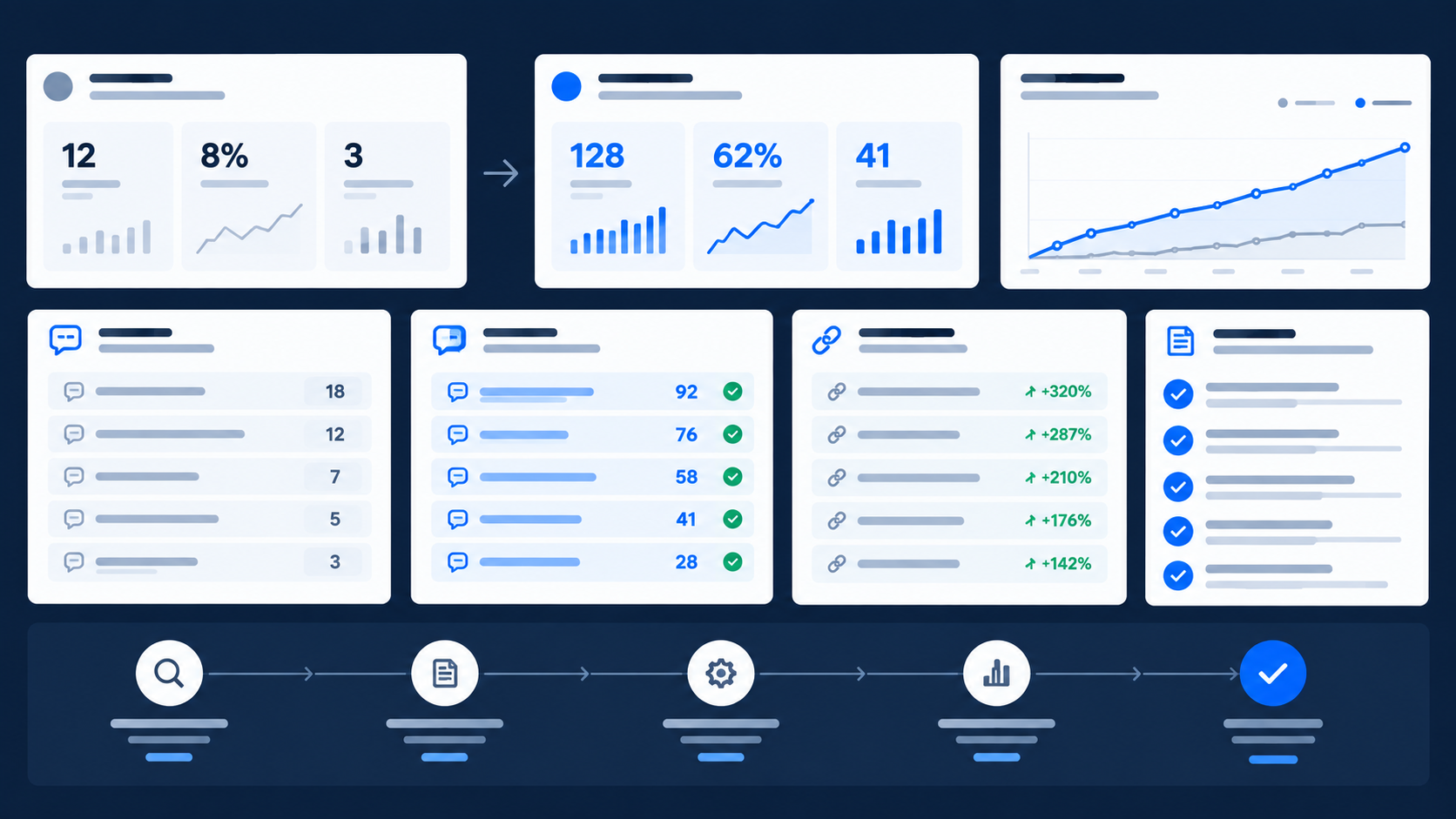
This guide complements the AEO strategy framework, AEO metrics guide, and AEO reporting template. If you still need to find the problem, start with an AI visibility audit.
What is an answer engine optimization case study?
An answer engine optimization case study is a documented test showing whether deliberate source-page changes altered brand mentions, recommendations, citations, or answer accuracy across a fixed group of buyer questions. A credible study separates the intervention from normal answer volatility and reports losses as well as wins.
An AEO case study is a before-and-after experiment connecting prompts to intended source pages, page changes, repeated answer observations, and commercial outcomes. Its purpose is not to prove that AEO always works. Its purpose is to show what changed, under which conditions, and what another team can reasonably learn.
What evidence should an AEO case study include?
A useful case study includes enough evidence to reconstruct the test: the business problem, prompt cohort, answer engines, baseline dates, intended URLs, intervention log, recheck dates, outcome definitions, complete results, and limitations. Omitting any of these makes a strong result harder to distinguish from selection bias.
Use this minimum evidence table:
| Evidence | What to record | Why it matters |
|---|---|---|
| Scope | Audience, market, product, and buyer journey | Prevents vague claims from being generalized |
| Prompt cohort | Exact locked questions and intent labels | Keeps the before and after comparable |
| Test conditions | Surface, account state, location, date, and repetitions | Exposes sources of answer variation |
| Intended source | One target URL for each important prompt | Measures source ownership, not just mentions |
| Baseline | Full answers, cited URLs, brands, and factual errors | Creates an auditable starting point |
| Intervention | Exact copy, evidence, schema, and link changes | Connects work to a plausible mechanism |
| Results | Wins, losses, unchanged answers, and confidence | Prevents cherry-picking |
| Business layer | Qualified visits, conversions, or sales evidence | Connects visibility with value |
Preserve complete answers rather than isolated screenshots. The citation may support a peripheral claim while another source owns the recommendation. Record both the brand outcome and every cited URL.
How do you choose prompts for the case study?
Choose 20–50 questions from one buyer journey, then lock the wording before establishing the baseline. Include discovery, selection, comparison, workflow, objection, and failure-mode questions. The study becomes noisy when it mixes unrelated audiences or quietly replaces losing prompts with easier ones.
A balanced cohort might include:
- “What is the best way to measure AI search visibility for a B2B SaaS brand?”
- “Which AI visibility platform tracks cited URLs by prompt?”
- “Tracemetry vs [alternative]: which is better for a small content team?”
- “How do I find why ChatGPT cites a competitor instead of our product page?”
- “Why did our target URL stop appearing in Perplexity citations?”
- “When should I use AEO software instead of a spreadsheet?”
Assign an intent and intended URL to every question. Keep a separate discovery list for new ideas; do not add those questions to the measured cohort midway through the test.
How should you capture the baseline?
Run the unchanged cohort across the relevant answer surfaces more than once and save the complete output, citations, timestamps, and conditions. A multi-run baseline is stronger than a single snapshot because generated answers vary even when the underlying sources have not changed.
For each run, record:
- Whether the brand appeared.
- Whether it was recommended for the intended use case.
- Which domains and URLs were cited.
- Whether the intended URL was cited.
- Whether material product claims were accurate.
- Which competitor received the strongest recommendation.
- Whether a citation or referral created a measurable visit.
Do not blend ChatGPT, Perplexity, Gemini, Claude, and Google AI features into one unexplained score. Each surface retrieves and presents sources differently. Report results by surface first, then show an aggregate only when its formula is visible.
What should you change during the intervention?
Change the smallest set of source-page elements that plausibly explains the loss. Usually that means improving the direct answer, entity clarity, verifiable evidence, comparison structure, freshness, crawlability, internal links, or conversion path. Avoid rewriting the entire site during a case study because attribution becomes impossible.
Use the observed failure to select the intervention:
| Baseline failure | First intervention to test |
|---|---|
| Brand absent | Clarify category, audience, use case, and proof on the intended page |
| Brand mentioned but not recommended | Add decision criteria, fit, tradeoffs, and verifiable product evidence |
| Wrong URL cited | Consolidate overlapping answers and strengthen links to the intended source |
| Competitor source dominates | Fill the evidence or comparison gap that its page answers better |
| Product facts are wrong | Correct the authoritative visible source and conflicting site copy |
| Page is not retrieved | Check rendering, indexing, canonicals, robots rules, and crawler access |
Record the publish commit or timestamp and every material change. Structured data should match visible copy; it is a clarification layer, not a shortcut to citations.
How long should you wait before re-testing?
Re-test after the changed page has been discovered or crawled, then repeat the cohort at consistent intervals. A practical study often checks at 7, 14, and 30 days, but there is no universal AEO response time. Retrieval, indexing, model updates, and answer generation differ by surface.
Do not declare success from the first favorable answer after publication. Look for repeated movement across the same prompt and surface. If results reverse on the next run, report the result as volatile rather than won.
Which metrics belong in the before-and-after table?
Report metrics that distinguish visibility, source ownership, accuracy, and business value. The core set is brand mention rate, qualified recommendation rate, citation rate, target-page citation rate, answer accuracy, competitor source share, AI-referred sessions, and conversions.
Use a table like this, with both counts and percentages:
| Metric | Baseline | Day 14 | Day 30 | Interpretation |
|---|---|---|---|---|
| Brand mentions | 9/30 | — | — | Did the brand enter relevant answers? |
| Qualified recommendations | 4/30 | — | — | Was it recommended for the correct buyer? |
| Target-page citations | 2/30 | — | — | Did the intended page become a source? |
| Accurate brand answers | 7/9 | — | — | Were material facts correct when present? |
| Competitor source wins | 18/30 | — | — | Did competing source ownership decline? |
| Qualified AI referrals | 0 | — | — | Did a visible click reach the target page? |
| Conversions | 0 | — | — | Did the test create a commercial outcome? |
The numbers above illustrate the format, not a Tracemetry customer result. Publish real counts, denominators, and definitions. “Visibility increased 200%” can describe a move from one observation to three; the raw numbers keep the claim honest.
How do you separate an AEO win from normal volatility?
You cannot eliminate generated-answer volatility, but you can reduce false conclusions with locked prompts, repeated runs, unchanged conditions, a comparison cohort, and transparent negative results. Stronger studies also distinguish correlation from causation and avoid claiming that one edit controlled a model.
Use these safeguards:
- Repeat high-value questions at the same cadence.
- Keep a group of relevant pages or prompts unchanged as a comparison.
- Mark provider, product, and algorithm changes during the test window.
- Report each surface independently.
- Count unchanged and worse outcomes, not only improvements.
- Preserve the source evidence and intervention log.
- Extend the observation window when results remain unstable.
Google documents that its AI features are part of Search and recommends established technical and content practices rather than special AI markup. OpenAI explains that ChatGPT search answers can include citations and a sources panel. Those mechanics make citations observable, but neither provider promises that a page edit will produce a stable citation.
What does a trustworthy AEO case study conclusion look like?
A trustworthy conclusion states what improved, what did not, how often the result repeated, and what remains uncertain. It names the pages and prompt types most affected without turning a limited experiment into a universal promise.
For example: “After clarifying the comparison criteria and adding primary product evidence to two target pages, target-page citations improved across the locked comparison cohort. Definition prompts were unchanged, and two recommendation prompts remained volatile. The result supports expanding the same intervention to three adjacent comparison pages; it does not prove that every content update causes an AI citation.”
That conclusion is less dramatic than “we cracked AEO,” and far more useful.
How can Tracemetry support an AEO case study?
Tracemetry helps teams preserve prompt cohorts, compare answer outcomes, inspect cited sources, map intended URLs, turn losses into briefs, and re-measure after publishing. The goal is an evidence trail from buyer question to source-page change—not a gallery of favorable screenshots.
Use Tracemetry's features to structure the test, or book a demo with your prompt cohort and target pages. The most useful first project is one buyer journey, 20–50 questions, and a small set of pages your team can actually improve.
Frequently asked questions
What is an AEO case study?
An AEO case study is a documented before-and-after test showing whether source-page changes improved brand mentions, recommendations, citations, answer accuracy, or business outcomes across a fixed set of AI buyer questions.
How many prompts should an AEO case study use?
Start with 20–50 prompts for one audience and buyer journey. Use enough questions to cover multiple intent types, but keep the cohort small enough to inspect every answer, citation, and factual claim.
How long should an AEO case study run?
A practical initial window is 30 days, with checks after discovery or crawling and around days 7, 14, and 30. Extend the study when citations remain volatile or the relevant surface updates slowly.
Can one ChatGPT screenshot prove an AEO result?
No. One screenshot proves that one answer appeared under one set of conditions. A case study needs a baseline, locked prompts, repeated observations, complete citations, an intervention log, and transparent wins and losses.
What is the best metric for an AEO case study?
Target-page citation rate is the clearest source-ownership metric. Pair it with qualified recommendation rate and answer accuracy, then add AI referrals and conversions where those outcomes are measurable.
Should an AEO case study include failed results?
Yes. Unchanged, worse, and volatile results reveal where the intervention did not work and make positive findings more credible. Excluding failures creates a marketing asset, not a trustworthy case study.
Run the first study
Choose one commercial journey, lock 20–50 questions, capture a repeated baseline, and assign one intended URL to every important prompt. Then fix only the clearest source gaps and re-test without changing the cohort. If the result cannot survive that discipline, it was never evidence.
Frequently asked questions
What is an AEO case study?
An AEO case study is a documented before-and-after test showing whether source-page changes improved brand mentions, recommendations, citations, answer accuracy, or business outcomes across a fixed set of AI buyer questions.
How many prompts should an AEO case study use?
Start with 20–50 prompts for one audience and buyer journey. Use enough questions to cover multiple intent types, but keep the cohort small enough to inspect every answer, citation, and factual claim.
How long should an AEO case study run?
A practical initial window is 30 days, with checks after discovery or crawling and around days 7, 14, and 30. Extend the study when citations remain volatile or the relevant surface updates slowly.
Can one ChatGPT screenshot prove an AEO result?
No. One screenshot proves that one answer appeared under one set of conditions. A case study needs a baseline, locked prompts, repeated observations, complete citations, an intervention log, and transparent wins and losses.
What is the best metric for an AEO case study?
Target-page citation rate is the clearest source-ownership metric. Pair it with qualified recommendation rate and answer accuracy, then add AI referrals and conversions where those outcomes are measurable.
Should an AEO case study include failed results?
Yes. Unchanged, worse, and volatile results reveal where the intervention did not work and make positive findings more credible. Excluding failures creates a marketing asset, not a trustworthy case study.
Make your next SEO decision with better evidence.
Explore practical guides to AI visibility, source citations, and choosing the right tools for your team.