Answer Engine Optimization Implementation Plan: 30 Days
A 30-day AEO implementation plan with scope, prompt baselines, source mapping, team roles, page fixes, re-testing, metrics, and acceptance criteria.
An answer engine optimization implementation plan turns AI visibility from an interesting dashboard into an owned operating system. The common failure is predictable: marketing tracks hundreds of prompts, nobody owns the cited sources, fixes sit in a backlog, and the same competitor keeps winning the answer.
Use this fast rule: start with one buyer journey, 30–50 fixed questions, one intended source per question, and five page interventions. Give each intervention an owner and a re-test date. That is enough to create proof in 30 days without launching a sprawling “AI transformation” program.
What is an answer engine optimization implementation plan?
An answer engine optimization implementation plan is a time-bound operating plan for improving how AI systems describe, recommend, and cite a brand. It defines the questions to measure, source pages that should answer them, accountable owners, interventions to ship, evidence to preserve, and dates for comparable re-testing.
AEO implementation is the work of converting prompt-level AI visibility evidence into approved changes to public sources, then measuring whether the same questions produce better answers. It is narrower than an AEO strategy: strategy chooses where to compete; implementation assigns the work and closes the loop.
What should you implement first?
Implement the smallest complete measurement-to-fix loop first. Choose one product, audience, market, and buyer journey where recommendations or inaccurate answers matter. Capture the baseline, map intended sources, ship five high-confidence fixes, and repeat the unchanged questions after those sources can be discovered again.
| If your current problem is… | First implementation task | Do not start with… |
|---|---|---|
| The brand is absent from shortlists | Track 30–50 decision-stage questions and competitors | Thousands of awareness prompts |
| AI answers cite the wrong page | Build a question-to-source map | Another broad blog post |
| Product facts are wrong | Correct the authoritative source and conflicting profiles | Cosmetic schema changes |
| Reports produce no action | Add an owner, fix, due date, and re-test date | A new composite score |
| Results vary between runs | Repeat important questions and retain raw evidence | Declaring a win from one answer |
The answer engine optimization workflow provides the recurring loop. This implementation plan adds sequencing, roles, acceptance criteria, and a 30-day deadline.
How do you build a 30-day AEO implementation plan?
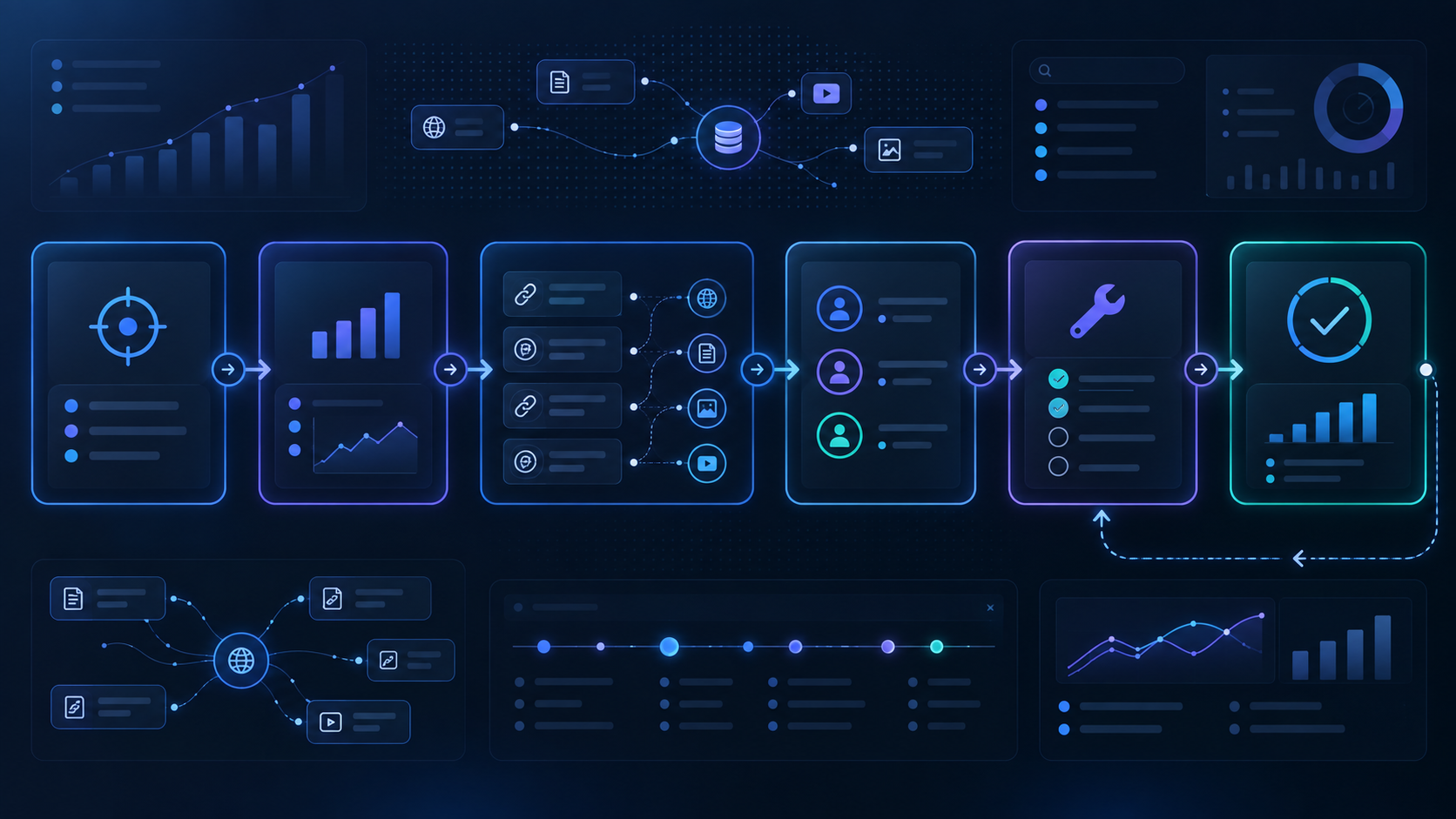
Build the plan in four weekly stages: scope and baseline, source mapping, controlled page fixes, then re-testing and decisions. Keep the question cohort stable throughout the month. A changing test set makes improvement impossible to distinguish from sampling noise.
Week 1: lock scope and baseline
- Select one commercial journey, such as category discovery, comparison, or implementation.
- Lock 30–50 natural buyer questions across discovery, shortlist, comparison, objection, workflow, and failure-mode intent.
- Capture the complete answer, cited URLs, recommended brands, material claims, surface, market, timestamp, and test conditions.
- Separate successful runs from errors and unavailable answers.
- Flag harmful or materially wrong claims for immediate correction.
Week 2: assign sources and owners
- Map each question to the public page that should provide the strongest defensible answer.
- Identify collisions where several pages compete for the same question.
- Assign a source owner, reviewer, publisher, and measurement owner.
- Classify each loss as absence, competitor recommendation, wrong claim, wrong citation, weak evidence, or inaccessible source.
- Choose five interventions with high business value, clear page fit, and manageable approval effort.
Week 3: ship controlled interventions
- Add a direct answer that matches the page's real purpose.
- Clarify the product, audience, platform, market, and use case.
- Add verifiable proof, methodology, examples, limitations, and freshness where they help the buyer.
- Repair crawl, rendering, canonical, or internal-discovery problems.
- Link supporting pages to the intended source with descriptive anchor text.
- Record exactly what changed and when it reached production.
Use the page-level AEO checklist before publishing. Do not bundle unrelated redesigns into the same intervention; a smaller change creates a cleaner learning signal.
Week 4: re-test and decide
- Repeat the same questions under comparable conditions.
- Compare recommendations, claims, cited domains, and target-page citations with the baseline.
- Label results as won, improved, unchanged, lost, or too volatile to judge.
- Keep successful changes, revise high-confidence failures, and stop low-value work.
- Carry only owned actions into the next 30-day cycle.
Discovery timing differs by surface, so a day-30 result is an observation, not proof of permanent causality. Continue rechecks at consistent intervals and preserve every raw answer.
Who should own AEO implementation?
A growth, search, or digital leader should own the program, but source accuracy must stay with the teams responsible for the underlying facts. The program owner controls scope and cadence; product, content, web, legal, analytics, and regional owners approve and maintain their parts of the source system.
| Role | Accountable for | Weekly output |
|---|---|---|
| Program owner | Scope, priorities, decision log, escalation | Ranked intervention queue |
| Measurement owner | Prompt runs, evidence, classification, comparison | Auditable baseline and re-test |
| Source owner | Accuracy and completeness of the intended page | Approved source change |
| Content or web owner | Copy, structure, links, schema, deployment | Production URL and change log |
| Reviewer | Product, legal, security, or regional approval | Recorded approval or constraint |
One person may hold several roles in a small team. The non-negotiable is accountability: every priority loss needs one intended source, one owner, one next action, and one review date.
What belongs in the implementation backlog?
The backlog should contain page-level hypotheses, not vague visibility complaints. Each item needs the buyer question, observed answer, cited competitors, intended source, diagnosed gap, proposed change, owner, priority, publish date, and re-test date.
A useful item reads: “For ‘which AI visibility platform shows cited URLs?’, our features page should be the intended source. The current answer cites two competitors and omits Tracemetry. Add a direct cited-URL explanation with a product screenshot, link it from the comparison guide, publish by Friday, and re-test after discovery.”
Avoid tickets such as “improve ChatGPT rankings.” They hide the surface, question, source, evidence, and acceptance condition. If the team cannot tell what page will change, the item is not ready.
How do you prioritize AEO fixes?
Prioritize fixes using business value, factual risk, source fit, evidence strength, implementation effort, and learning value. A high-intent question with a clearly wrong claim and an obvious authoritative page should outrank a high-volume awareness prompt with no defensible source owner.
Score each factor from 1–5, then use a simple rule:
priority = (business value + risk + source fit + evidence confidence + learning value) / effort
The number creates order, not truth. Review the top items as a team and document overrides. Search demand is one input, but broad AEO language often mixes commercial intent with unrelated optimization topics, so scope and human review matter.
How do you measure whether implementation worked?
Measure implementation with target-page citation rate, qualified recommendation rate, material-claim accuracy, and fix-to-win rate. Report each AI surface separately and keep complete answer evidence behind every percentage. Traffic and pipeline belong in a second layer because many AI interactions produce no identifiable referral.
At the intervention level, compare the same question wording and market, repeated samples rather than one favorable response, recommendation position, intended-page citations, material-claim accuracy, time to change, and persistence. For formulas, use the AEO metrics framework. The strongest report ends with a decision: keep, revise, stop, or expand.
What implementation mistakes should you avoid?
The biggest mistakes are scaling before the team can act, changing prompts during the test, publishing a new article for every loss, and treating a mention as a citation or recommendation. These choices create activity while destroying comparable evidence.
Also avoid assigning “marketing” instead of a named owner, optimizing pages that do not match intent, adding unsupported claims, bundling unrelated site changes, hiding raw answers behind a blended score, guaranteeing AI rankings, or claiming influenced pipeline as directly sourced revenue.
How can Tracemetry support the plan?
Tracemetry can support the measurement layer by organizing buyer questions, answers, citations, competitors, and changes across AI surfaces. The implementation value comes from connecting that evidence to an intended source, an owner, a page intervention, and an unchanged re-test—not from collecting more prompts for its own sake.
Review the Tracemetry features, then book a demo with one real buyer journey and 30–50 questions. The useful outcome is a working baseline and fix queue your team can act on immediately.
FAQ
How long does AEO implementation take? A focused team can establish a baseline, assign sources, and ship an initial set of interventions within 30 days. Changes in AI answers may appear later because crawling, retrieval, model behavior, and answer variability differ by platform. Use repeated 30-, 60-, and 90-day comparisons rather than promising a fixed timeline.
How many prompts should an AEO implementation start with? Start with 30–50 questions for one product, audience, market, and buyer journey. This is large enough to expose patterns and small enough to inspect every answer, map intended sources, assign owners, ship fixes, and repeat consistently.
Does every AEO loss require new content? No. Many losses should be fixed on an existing product, comparison, documentation, pricing, support, or methodology page. Create a new page only when no current source can completely serve the question without confusing its purpose.
Who owns answer engine optimization implementation? A search, growth, or digital leader should own scope, measurement, prioritization, and cadence. The team responsible for each product fact or public source should own accuracy and approval, while content and web owners implement the change.
What is the best first AEO implementation metric? Target-page citation rate is a strong first measure because it tests whether the intended source owns the answer. Pair it with qualified recommendation rate and material-claim accuracy so a citation counts only when the answer is useful and correct.
Can schema markup guarantee an AI citation? No. Valid structured data can clarify visible content for systems that use it, but it cannot guarantee retrieval, recommendation, ranking, or citation. It cannot compensate for inaccessible pages, ambiguous entities, conflicting facts, or unsupported claims.
Frequently asked questions
How long does AEO implementation take?
A focused team can establish a baseline, assign sources, and ship an initial set of interventions within 30 days. Changes in AI answers may appear later because crawling, retrieval, model behavior, and answer variability differ by platform. Use repeated 30-, 60-, and 90-day comparisons rather than promising a fixed timeline.
How many prompts should an AEO implementation start with?
Start with 30–50 questions for one product, audience, market, and buyer journey. This is large enough to expose patterns and small enough to inspect every answer, map intended sources, assign owners, ship fixes, and repeat consistently.
Does every AEO loss require new content?
No. Many losses should be fixed on an existing product, comparison, documentation, pricing, support, or methodology page. Create a new page only when no current source can completely serve the question without confusing its purpose.
Who owns answer engine optimization implementation?
A search, growth, or digital leader should own scope, measurement, prioritization, and cadence. The team responsible for each product fact or public source should own accuracy and approval, while content and web owners implement the change.
What is the best first AEO implementation metric?
Target-page citation rate is a strong first measure because it tests whether the intended source owns the answer. Pair it with qualified recommendation rate and material-claim accuracy so a citation counts only when the answer is useful and correct.
Can schema markup guarantee an AI citation?
No. Valid structured data can clarify visible content for systems that use it, but it cannot guarantee retrieval, recommendation, ranking, or citation. It cannot compensate for inaccessible pages, ambiguous entities, conflicting facts, or unsupported claims.
Make your next SEO decision with better evidence.
Explore practical guides to AI visibility, source citations, and choosing the right tools for your team.