AI search attribution model: prove influence without fake precision
Build a defensible AI search attribution model using direct referrals, assisted journeys, self-reported discovery, prompt visibility, confidence tiers, and deduplicated revenue.
AI search can influence a deal without sending a clean referral click. A buyer may ask ChatGPT for a shortlist, visit your site later through branded search, share the answer internally, and book a demo from a different device. If your attribution model only credits the last click, that entire path disappears.
Use this fast rule: separate direct, assisted, and visibility evidence. Credit revenue only when identity and journey data support it. Label everything else as influence or a leading indicator. This gives finance a defensible number and gives marketing enough evidence to improve the prompts and pages that shape demand.
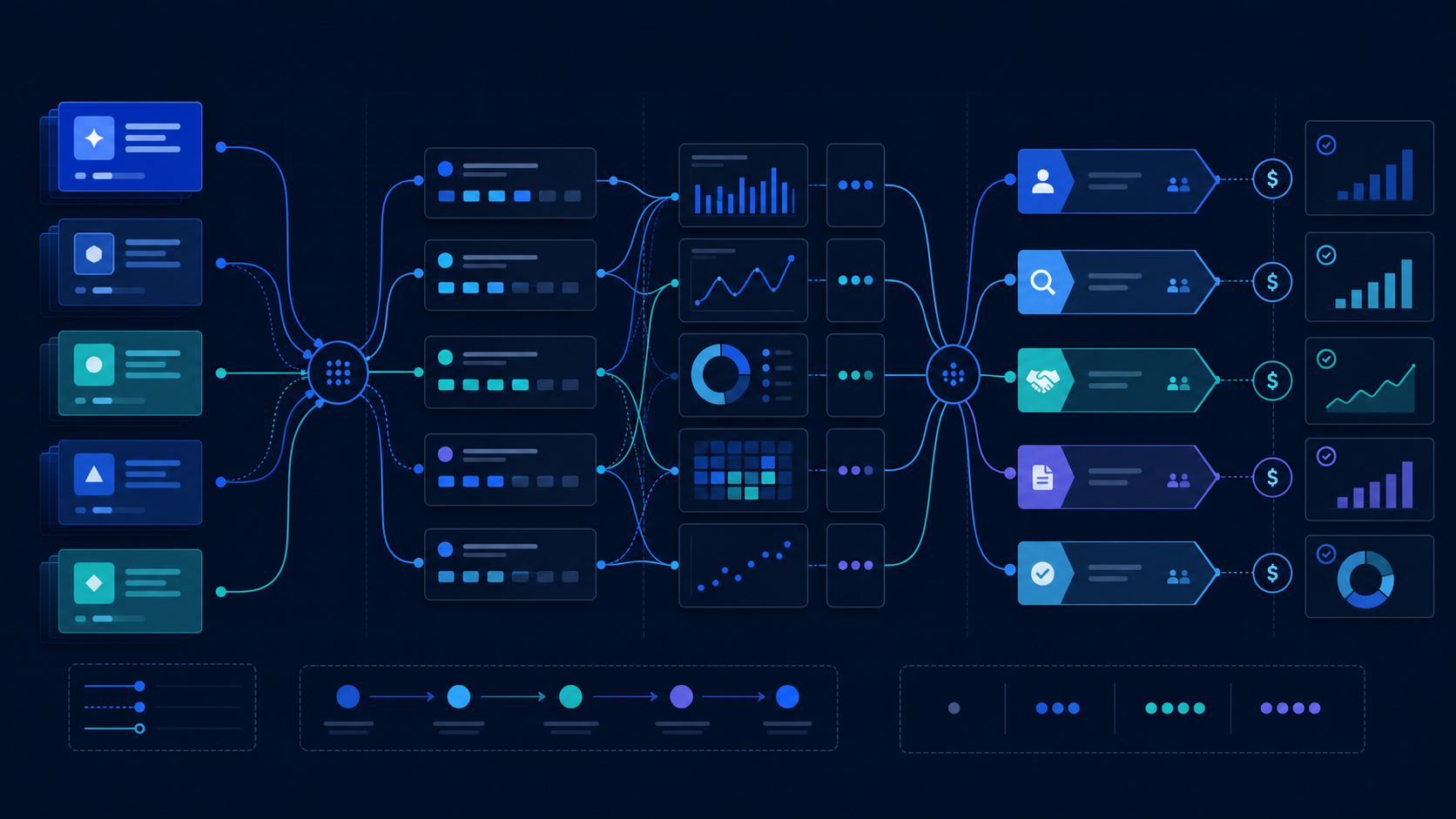
This guide shows how to build an AI search attribution model with analytics, CRM data, self-reported attribution, prompt monitoring, and confidence tiers—without pretending every AI mention caused a sale.
What is AI search attribution?
AI search attribution is the process of connecting exposure in AI-generated answers to measurable website visits, conversions, pipeline, and revenue. It combines observable referral data with assisted-touch evidence and prompt-level visibility, while assigning a confidence level to every claimed relationship.
AI search attribution is an evidence model, not a single tracking tag. Traditional analytics can identify some visits from ChatGPT, Perplexity, Gemini, Claude, and other referring domains. It cannot observe every no-click answer, copied URL, cross-device journey, or later branded search. A credible model makes that blind spot explicit.
Why does last-click attribution undercount AI search?
Last-click attribution undercounts AI search because answer engines often influence research before the trackable session begins. The final visit may arrive through Google, a bookmark, direct traffic, an email, or a salesperson’s link even when an AI answer created the shortlist.
Consider a realistic B2B path:
- A buyer asks an AI assistant for tools that monitor brand visibility in generated answers.
- The assistant recommends three vendors and cites two pages.
- The buyer sends the shortlist to a colleague without clicking.
- The colleague searches one brand name and visits its pricing page.
- A week later, procurement books a demo from a CRM email.
Last-click reporting credits email. First-click reporting may credit branded search. Neither reveals the AI recommendation unless you also collect self-reported attribution or connect the prompt cohort to later demand.
That does not justify assigning the entire deal to AI. It means the model needs more than one evidence tier.
Which evidence tiers should an AI attribution model use?
Use three evidence tiers: direct conversion evidence, assisted journey evidence, and visibility evidence. Keep them separate in dashboards and executive reporting. Combining them into one revenue number creates false precision and makes the program harder to trust.
| Tier | Evidence | What you may claim | What you should not claim |
|---|---|---|---|
| Direct | Known AI referrer followed by a conversion in the same attributable journey | AI search generated the conversion | Every later deal was caused by AI |
| Assisted | AI referral, self-reported AI discovery, or matched account activity before conversion | AI search influenced the conversion | AI deserves 100% revenue credit |
| Visibility | Brand recommendation, citation, or target-page win on a buyer prompt | AI visibility improved on measured prompts | The visibility created pipeline |
For leadership, report the tiers as separate lines:
- AI-sourced: conversions and pipeline with direct, attributable AI referral evidence.
- AI-influenced: conversions and pipeline with a documented AI touchpoint or credible self-report.
- AI-visible: high-intent prompts where the brand was recommended or the intended page was cited.
This language prevents a citation from being presented as revenue while still preserving evidence that precedes clicks.
How do you track direct AI referral traffic?
Track direct AI referral traffic by preserving the referring domain, landing page, session identifier, conversion event, and CRM identity where consent and policy allow. Create a maintained channel group for known AI referrers, but retain the raw source because platforms and referral patterns change.
Start with these fields:
| Field | Why it matters |
|---|---|
| Referrer/source | Identifies the observable AI surface |
| Landing page | Shows which page converted answer exposure into a visit |
| Timestamp | Supports journey ordering and CRM matching |
| Campaign parameters | Separates controlled links from organic referrals |
| Conversion event | Defines the business action, not merely the session |
| Account or contact ID | Connects web evidence to qualified pipeline |
| Consent/status | Keeps identity stitching within your privacy rules |
Do not rely on a static list forever. Review source/medium values monthly and inspect unexpected referrals. Some AI experiences suppress referral data, open links through intermediaries, or produce visits classified as direct.
For implementation details and channel examples, use the AI referral traffic guide.
How should self-reported attribution be collected?
Collect self-reported attribution with one short, optional question near the conversion: “How did you first hear about us?” Use an open text field or an “AI assistant” choice with a follow-up asking which assistant. Preserve the raw response instead of forcing every answer into a predefined channel.
Good responses often contain more useful evidence than a dropdown: “ChatGPT recommended you,” “Perplexity comparison,” or “coworker sent an AI shortlist.” Normalize these into a reporting category, but retain the original language for auditability.
Use the response as assisted evidence unless it can be matched to a direct attributable visit. Self-reporting has recall bias, but it catches influence that browser analytics cannot see.
How do you connect prompt visibility to pipeline?
Connect prompt visibility to pipeline at the cohort level, not by claiming that a specific answer caused a specific anonymous deal. Group prompts by intent, map each prompt to a target page and audience, then compare visibility changes with qualified visits, branded demand, conversions, and pipeline from the same market and period.
A practical sequence is:
- Lock a prompt set for category, shortlist, comparison, alternative, integration, pricing, and failure-mode questions.
- Record recommendation rate, first-named rate, cited domains, cited URLs, answer accuracy, surface, market, and date.
- Map every important prompt to one intended landing page.
- Ship a page or source improvement against a defined prompt cohort.
- Re-measure the identical prompts after the next crawl window.
- Compare high-intent visibility with direct AI referrals, self-reported discovery, demos, qualified accounts, and pipeline.
If recommendation rate rises but qualified demand does not, you have a visibility win—not a revenue win. If the same target page gains citations, receives AI referrals, and produces qualified demos, the causal case becomes stronger without becoming absolute.
Use a stable AI search prompt taxonomy so generic definition prompts cannot overwhelm commercial questions.
What attribution window should AI search use?
Use an attribution window that matches the buying cycle, then disclose it. A seven-day window may work for a self-serve product; a 30-, 60-, or 90-day assisted window is often more realistic for considered B2B purchases. Do not extend the window merely to capture more revenue.
| Buying motion | Starting window | Review rule |
|---|---|---|
| Self-serve trial or purchase | 7–14 days | Compare time from first visit to conversion |
| Sales-assisted SMB | 30 days | Review median lead-to-opportunity time |
| Mid-market B2B | 60 days | Include account-level touches where permitted |
| Enterprise | 90 days | Report influence separately from sourcing |
Run sensitivity checks. If “AI-influenced pipeline” changes dramatically when the window moves from 30 to 60 days, show both results and explain the assumption.
How do you avoid double-counting AI-influenced revenue?
Avoid double-counting by assigning each conversion one sourcing category and allowing multiple documented assists. Revenue totals should deduplicate by conversion, opportunity, or account ID. Channel influence can be multi-touch, but the sum of influenced revenue across channels should not be presented as additive sourced revenue.
Use these controls:
- One immutable conversion or opportunity ID.
- One sourced channel based on a published rule.
- A list of assisted channels with timestamps and evidence types.
- Separate person-level and account-level journeys.
- A lookback window applied consistently across channels.
- A confidence label for every AI influence claim.
- A deduplicated revenue table for finance reporting.
The dangerous shortcut is adding AI-influenced pipeline to search-influenced and content-influenced pipeline. The same deal can legitimately appear in each influence view, but it can only appear once in total pipeline.
What confidence score should each attribution claim receive?
Score confidence from the quality and proximity of evidence, not from how much revenue is attached. Direct referral plus identified conversion is high confidence. A self-report is useful assisted evidence. A visibility increase followed by broad demand growth is directional, not proof of a specific journey.
| Confidence | Example evidence | Reporting treatment |
|---|---|---|
| High | AI referrer → identified conversion within the window | AI-sourced |
| Medium-high | AI referral precedes a later CRM conversion | AI-assisted |
| Medium | Buyer explicitly reports AI discovery | AI-assisted, self-reported |
| Low-medium | Target prompt visibility and matched-account activity rise together | Cohort influence |
| Low | Total AI visibility rises while overall revenue rises | Directional only |
Never upgrade low-confidence evidence because a stakeholder wants a bigger number. The purpose of confidence tiers is to make uncertainty useful.
What should an AI search attribution dashboard include?
An AI search attribution dashboard should show sourced conversions, influenced conversions, visible high-intent prompts, target-page citations, answer accuracy, qualified referral behavior, and the evidence behind each figure. Every aggregate should drill down to journeys, prompts, answers, or CRM records.
Include these views:
- Executive outcomes: deduplicated AI-sourced pipeline, AI-influenced pipeline, and confidence mix.
- Journey evidence: referrer, landing page, conversion, account, timestamps, and assisted touches.
- Prompt visibility: recommendations, citations, competitors, accuracy, and intended page.
- Content performance: target-page citation rate, AI referrals, conversion rate, and shipped fixes.
- Experiment log: change, prompt cohort, baseline, re-test date, and outcome.
- Data quality: unknown referrers, unmatched identities, self-report completion, and tracking changes.
Pair the attribution view with an answer engine optimization report so operators can move from a business outcome to the prompt and page that needs work.
How do you build the model in 30 days?
Build the first model in four weekly stages: establish measurement rules, capture direct evidence, add assisted evidence, then connect it to prompt monitoring. Do not wait for perfect identity resolution before producing a conservative baseline.
Week 1: define the rules
- Define sourced, influenced, and visible.
- Choose conversion events and the attribution window.
- Publish the AI referrer group and deduplication rule.
- Lock a high-intent prompt set and competitor set.
Week 2: instrument direct evidence
- Validate referral capture and landing pages.
- Connect consented conversions to CRM records.
- Test source persistence across forms and scheduling tools.
- Create a data-quality report.
Week 3: capture hidden influence
- Add the self-reported discovery question.
- Normalize responses while preserving raw text.
- Add account-level assists where policy allows.
- Create confidence labels.
Week 4: connect visibility to action
- Map prompts to target pages.
- Compare recommendations and citations with qualified outcomes.
- Choose one high-intent loss to fix.
- Set the re-measurement date and success threshold.
If manual prompt capture is already slowing the team down, book a Tracemetry demo to monitor recommendations, citations, competitors, and answer accuracy against the questions your buyers ask.
What are the common AI attribution mistakes?
The common mistakes are treating every AI mention as pipeline, relying only on last click, hiding attribution windows, double-counting influenced revenue, changing prompt sets mid-test, and reporting a blended score without underlying evidence.
Before publishing an attribution result, check that:
- Direct, assisted, and visibility evidence are separated.
- Revenue is deduplicated at the conversion or opportunity level.
- The attribution window and sourcing rule are visible.
- Self-reported responses remain auditable.
- Prompt wording, surface, market, and test dates are saved.
- Branded prompts are not presented as neutral category discovery.
- Percentages include numerators and denominators.
- Correlation is not described as causation.
The best model is not the one that gives AI the most credit. It is the one a skeptical finance leader can inspect and a growth team can use to decide what to fix next.
FAQ
What is AI search attribution? AI search attribution connects exposure in AI-generated answers to observable website visits, conversions, pipeline, and revenue. It separates direct referral evidence, assisted journey evidence, and prompt-level visibility so teams do not mistake a citation or mention for a sale.
Can GA4 track ChatGPT and Perplexity conversions? GA4 can track visits when an AI platform passes recognizable referral data and the conversion occurs in a measurable journey. It cannot capture every no-click answer, copied link, cross-device journey, or later branded search, so CRM and self-reported evidence are also needed.
Should AI-influenced revenue receive full attribution credit? No. AI-influenced revenue should be reported as assisted unless direct journey evidence supports sourcing. A deal may have several legitimate influences, but sourced revenue must remain deduplicated.
How long should the AI attribution window be? Match the window to the observed buying cycle. Start around 7–14 days for self-serve products, 30 days for sales-assisted SMB, 60 days for mid-market, and 90 days for enterprise influence, then test how sensitive results are to the assumption.
How do I measure AI influence when there is no referral click? Use optional self-reported attribution, account-level journey evidence where permitted, stable prompt monitoring, target-page citation changes, and cohort comparisons. Label this as assisted or directional evidence rather than direct sourcing.
What is the best AI search attribution metric? For finance, use deduplicated AI-sourced conversions and pipeline. For growth teams, pair that with AI-assisted conversions, high-intent recommendation rate, target-page citation rate, and answer accuracy. No single metric describes the full journey.
Frequently asked questions
What is AI search attribution?
AI search attribution connects exposure in AI-generated answers to observable website visits, conversions, pipeline, and revenue. It separates direct referral evidence, assisted journey evidence, and prompt-level visibility so teams do not mistake a citation or mention for a sale.
Can GA4 track ChatGPT and Perplexity conversions?
GA4 can track visits when an AI platform passes recognizable referral data and the conversion occurs in a measurable journey. It cannot capture every no-click answer, copied link, cross-device journey, or later branded search, so CRM and self-reported evidence are also needed.
Should AI-influenced revenue receive full attribution credit?
No. AI-influenced revenue should be reported as assisted unless direct journey evidence supports sourcing. A deal may have several legitimate influences, but sourced revenue must remain deduplicated.
How long should the AI attribution window be?
Match the window to the observed buying cycle. Start around 7–14 days for self-serve products, 30 days for sales-assisted SMB, 60 days for mid-market, and 90 days for enterprise influence, then test how sensitive results are to the assumption.
How do I measure AI influence when there is no referral click?
Use optional self-reported attribution, account-level journey evidence where permitted, stable prompt monitoring, target-page citation changes, and cohort comparisons. Label this as assisted or directional evidence rather than direct sourcing.
What is the best AI search attribution metric?
For finance, use deduplicated AI-sourced conversions and pipeline. For growth teams, pair that with AI-assisted conversions, high-intent recommendation rate, target-page citation rate, and answer accuracy. No single metric describes the full journey.
See your own AI visibility today.
Free public report. 60 seconds. No signup. Or get started on Pro to track 250 prompts continuously.