ChatGPT recommendation tracking: measure who gets recommended
How to track whether ChatGPT recommends your brand, recommends competitors, cites your site without recommending you, or gives inaccurate product answers.
ChatGPT recommendation tracking shows whether ChatGPT recommends your brand, recommends competitors, omits you completely, or cites your site without treating you as the best option. That matters because buyers increasingly ask ChatGPT for shortlists before they ever visit Google, review sites, or your pricing page.
Use the fast rule: track only recommendation-shaped prompts, record the full answer outcome, and fix the highest-intent prompt where ChatGPT sends the buyer to a competitor. A screenshot is a clue. A weekly prompt set is a system.
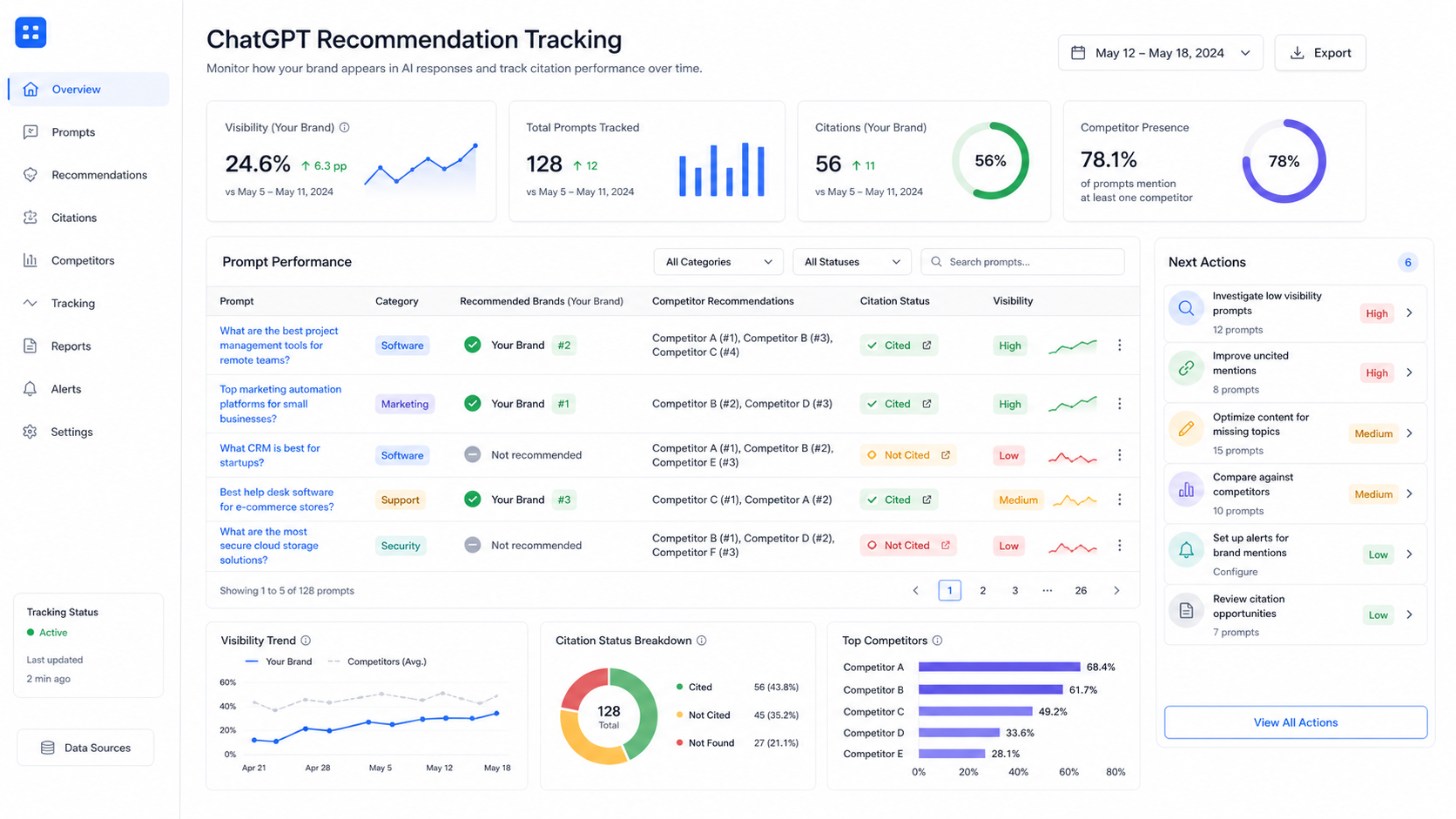
This guide sits between ChatGPT SEO prompts, ChatGPT share of voice, ChatGPT citation tracking, and ChatGPT first-named rate. Use it when the question is not just "are we mentioned?" but "does ChatGPT actually recommend us when a buyer asks what to choose?"
What is ChatGPT recommendation tracking?
ChatGPT recommendation tracking is the process of running a fixed set of buyer prompts in ChatGPT and recording which brands, products, or sources it recommends. It captures recommendation presence, competitor wins, brand order, cited URLs, answer accuracy, and the next page or proof gap to fix.
ChatGPT recommendation tracking is the outcome layer of ChatGPT SEO. Mention tracking tells you whether your brand appears. Citation tracking tells you whether your domain is used as a source. Recommendation tracking tells you whether ChatGPT is comfortable putting your brand in front of a buyer as a viable option.
OpenAI's ChatGPT Search help page says ChatGPT can answer with links to relevant web sources and may show inline citations or a sources panel. For marketers, that creates two separate jobs: earn the recommendation and earn the supporting source. Track both, but do not blend them.
Which ChatGPT prompts should you track for recommendations?
Track prompts where a buyer asks ChatGPT to choose, compare, shortlist, substitute, troubleshoot, or recommend a path forward. Do not treat pure definition prompts as recommendation prompts. They may build awareness, but they rarely prove that ChatGPT would put your brand on a buyer's shortlist.
Start with this decision table:
| Prompt type | Example ChatGPT query | Track recommendations? | Main outcome |
|---|---|---|---|
| Tool shortlist | "best ChatGPT SEO tools for a B2B SaaS team" | Yes | Which vendors make the shortlist |
| Alternative | "best Profound alternative for smaller teams" | Yes | Whether you appear as the switch option |
| Comparison | "Tracemetry vs Peec for AI visibility tracking" | Yes | Winner, caveats, and cited proof |
| Failure mode | "why does ChatGPT recommend my competitors" | Yes | Which fix the answer suggests |
| Workflow | "how do I track ChatGPT recommendations weekly" | Sometimes | Source ownership and process fit |
| Definition | "what is ChatGPT SEO" | No | Better measured with mention or citation rate |
The money prompts usually contain words like "best", "top", "recommend", "alternative", "compare", "for agencies", "for SaaS", "for ecommerce", "pricing", "workflow", or "why does..." because those are the queries where ChatGPT starts shaping a choice.
What should you record for each ChatGPT answer?
Record enough fields to explain the win or loss. A useful recommendation row should tell you who appeared, who appeared first, whether your domain was cited, why the answer leaned that way, and which page should change.
Use this minimum row shape:
| Field | Example | Why it matters |
|---|---|---|
| Prompt | "best AI visibility tools for startups" | The measurement unit |
| Prompt bucket | shortlist, alternative, comparison, failure mode | Lets you group losses by buyer job |
| Surface | ChatGPT, ChatGPT Search, or ChatGPT with Search off | Keeps retrieval behavior separate |
| Brands recommended | Tracemetry, Profound, Otterly | Feeds presence and share-of-voice metrics |
| First recommended brand | Profound | Feeds first-named rate |
| Your outcome | first, listed, cited only, absent, inaccurate | Makes the status obvious |
| Cited URLs | Your page, competitor page, publisher page | Shows the source layer |
| Loss reason | missing page, weak proof, stale page, unclear fit | Turns data into action |
| Target fix | Update pricing page, publish alternative page, add proof | Keeps the report operational |
Do not count a prompted mention as a recommendation. If the prompt says "is Tracemetry good for ChatGPT SEO?" and the answer repeats Tracemetry, that is useful for answer accuracy, not recommendation strength. Recommendation tracking should measure what ChatGPT does when it has a real choice.
How do you classify recommendation outcomes?
Classify every answer into one of six outcomes: first recommendation, listed recommendation, citation-only, competitor win, inaccurate answer, or no recommendation. This keeps the report useful even when the answer is messy.
Use this outcome map:
| Outcome | What it means | What to do next |
|---|---|---|
| First recommendation | Your brand is named first as a relevant choice | Protect the page and monitor citations |
| Listed recommendation | Your brand appears, but behind competitors | Improve positioning, proof, and comparison clarity |
| Citation-only | Your domain is cited but your brand is not recommended | Add decision language and product fit guidance |
| Competitor win | A competitor is recommended and you are absent or lower | Inspect the cited source and fix the target page |
| Inaccurate answer | ChatGPT describes your product, pricing, or use case incorrectly | Correct public facts and update source pages |
| No recommendation | The answer gives process advice but no vendor choice | Track as workflow intent, not shortlist intent |
The most useful weekly number is not a single blended "AI visibility score." It is the count of high-intent prompts where a competitor won and your next fix is obvious.
How is recommendation tracking different from SOV, citations, and first-named rate?
Recommendation tracking is broader than one metric. Share of voice measures presence against competitors. Citation rate measures source ownership. First-named rate measures position. Recommendation tracking ties those signals to the buyer outcome and the next fix.
Use this metric split:
| Metric | Formula or rule | Question it answers |
|---|---|---|
| Mention rate | Prompt runs naming your brand / total prompt runs | Does ChatGPT include us? |
| Recommendation rate | Recommendation prompts where your brand is recommended / recommendation prompts | Does ChatGPT put us forward as an option? |
| ChatGPT share of voice | Your approved mentions / total approved brand mentions | Are we named more than competitors? |
| First-named rate | Runs where your brand is first / recommendation-list runs | Are we the default option? |
| Citation rate | Runs citing your domain / total prompt runs | Does ChatGPT use our site as evidence? |
| Accurate recommendation rate | Correct recommendations / recommendation prompts | Is ChatGPT recommending us for the right reasons? |
The strongest result is first recommended, accurately described, and cited with your domain. A weak partial win is "mentioned somewhere, no citation, competitor first." Both can look positive in a lazy dashboard. Separate them.
Why does ChatGPT recommend competitors instead of your brand?
ChatGPT often recommends competitors when their public source map better matches the prompt. That can mean a clearer comparison page, fresher product details, more third-party proof, better entity language, or simply a page that answers the buyer question more directly.
Use this fix map:
| Loss pattern | Likely cause | First fix |
|---|---|---|
| Competitor recommended, you absent | Missing buyer-intent page | Publish or update the exact page the prompt needs |
| Competitor first, you second | Weaker proof or positioning | Add decision criteria, examples, screenshots, and use-case fit |
| Your page cited, competitor recommended | Source page informs the answer but does not sell the choice | Add "choose us if..." guidance and a sharper CTA |
| Wrong product facts | Stale public pages or inconsistent third-party data | Update source pages, pricing, docs, and directories |
| Answer cites a publisher or review site | Third-party proof is shaping the answer | Build reviews, comparisons, partner mentions, and directory profiles |
| Result changes every run | Prompt set or sample size is too thin | Use three samples for important prompts and report weekly movement |
OpenAI also warns that ChatGPT can make mistakes and that users should verify important information from reliable sources. That is another reason to track answer accuracy beside recommendation position. A recommendation based on the wrong facts is not a clean win.
How do you improve ChatGPT recommendation rate?
Improve recommendation rate by fixing the highest-intent prompt where a competitor is recommended and your brand is absent, lower, or inaccurately described. The fastest fix is usually a better target page, not a generic new blog post.
Use this checklist:
- Pick 40-80 buyer prompts and mark the subset that can produce recommendations.
- Run important recommendation prompts three times per weekly cycle.
- Record brands, order, cited URLs, answer accuracy, and loss reason.
- Sort losses by buyer intent before sorting by volume.
- Inspect the competitor page or publisher page ChatGPT cited.
- Decide whether the fix is page shape, missing page, stale facts, entity clarity, or third-party proof.
- Add a 40-80 word direct answer near the top of the target page.
- Add a comparison table, decision criteria, and "best for / not best for" language.
- Make product facts current: pricing, features, integrations, use cases, screenshots, and limitations.
- Add visible FAQ content that matches the questions buyers ask.
- Link the target page from related ChatGPT SEO, comparison, alternative, and reporting pages.
- Re-measure the same prompt 7-14 days after publishing.
For Tracemetry, the clean path is to run the free AI visibility audit, identify prompts where competitors are recommended, then use Tracemetry Pro to track the full set, generate source-grounded briefs, ship fixes, and re-measure the exact prompts.
What should a weekly recommendation report include?
A weekly recommendation report should show the score, the losses, and the fix queue. Leadership needs the trend. The content owner needs the prompt, cited URL, loss reason, and target page.
Use this report structure:
| Section | What to include |
|---|---|
| Scoreboard | Recommendation rate, first-named rate, citation rate, accurate recommendation rate |
| High-intent wins | Prompts where your brand was recommended or moved up |
| High-intent losses | Prompts where competitors were recommended first |
| Source layer | URLs ChatGPT cited for each recommendation |
| Accuracy issues | Wrong pricing, stale feature claims, wrong audience fit, missing limitations |
| Fix queue | Page to update, owner, publish date, re-measure date |
| Watchlist | Volatile prompts where samples disagree |
The report should end with a page decision. If the next step is always "keep monitoring," the workflow is not doing its job. Recommendation tracking should change what you publish, update, and prove.
FAQ
What is ChatGPT recommendation tracking? ChatGPT recommendation tracking is the process of running buyer prompts in ChatGPT and recording which brands, products, or sources it recommends. It tracks recommendation presence, competitor wins, brand order, citations, answer accuracy, and the next fix.
How is recommendation tracking different from ChatGPT share of voice? Share of voice measures how often your brand is named compared with competitors. Recommendation tracking classifies the actual outcome: whether your brand was recommended first, listed behind competitors, cited only, omitted, or described inaccurately.
What prompts should I use to track ChatGPT recommendations? Use shortlist, comparison, alternative, buyer-guide, workflow, and failure-mode prompts. Examples include "best [category] tools for [audience]", "[competitor] alternatives", "which tool should I use for [job]", and "why does ChatGPT recommend my competitors?"
How many prompts do I need for recommendation tracking? Start with 40-80 buyer prompts, then tag the subset that can produce recommendations. For high-intent prompts, run three samples per week so one unusual answer does not become the whole report.
Should I count a citation as a recommendation? No. A citation means ChatGPT used your domain as a source. A recommendation means ChatGPT put your brand forward as an option. Track the combined win separately: first recommended and cited.
What is the fastest way to improve ChatGPT recommendations? Fix the highest-intent prompt where a competitor is recommended and your brand is absent or lower. Update the target page with a direct answer, current facts, decision criteria, comparison content, visible FAQ text, internal links, and proof that makes the choice defensible.
Start with the recommendation gap, not the dashboard
Run the free Tracemetry audit to see where ChatGPT, Claude, and Perplexity mention your brand, cite your site, and recommend competitors. If the recommendation losses matter, use Tracemetry Pro to track the full prompt set, generate page fixes, and re-measure whether buyers now see your brand as the answer.
Sources: OpenAI ChatGPT Search, OpenAI Shopping with ChatGPT Search, OpenAI on ChatGPT truthfulness, Google AI features and your website.
Frequently asked questions
What is ChatGPT recommendation tracking?
ChatGPT recommendation tracking is the process of running buyer prompts in ChatGPT and recording which brands, products, or sources it recommends. It tracks recommendation presence, competitor wins, brand order, citations, answer accuracy, and the next fix.
How is recommendation tracking different from ChatGPT share of voice?
Share of voice measures how often your brand is named compared with competitors. Recommendation tracking classifies the actual outcome: whether your brand was recommended first, listed behind competitors, cited only, omitted, or described inaccurately.
What prompts should I use to track ChatGPT recommendations?
Use shortlist, comparison, alternative, buyer-guide, workflow, and failure-mode prompts. Examples include best category tools for an audience, competitor alternatives, which tool should I use for a job, and why does ChatGPT recommend my competitors.
How many prompts do I need for recommendation tracking?
Start with 40-80 buyer prompts, then tag the subset that can produce recommendations. For high-intent prompts, run three samples per week so one unusual answer does not become the whole report.
Should I count a citation as a recommendation?
No. A citation means ChatGPT used your domain as a source. A recommendation means ChatGPT put your brand forward as an option. Track the combined win separately: first recommended and cited.
What is the fastest way to improve ChatGPT recommendations?
Fix the highest-intent prompt where a competitor is recommended and your brand is absent or lower. Update the target page with a direct answer, current facts, decision criteria, comparison content, visible FAQ text, internal links, and proof that makes the choice defensible.
See your own AI visibility today.
Free public report. 60 seconds. No signup. Or get started on Pro to track 250 prompts continuously.