Answer Engine Optimization for Startups: a Lean AEO Playbook
A lean answer engine optimization playbook for startups: choose buyer prompts, map source pages, prioritize fixes, measure citations, and avoid wasted spend.
Startups do not lose answer-engine visibility because they lack a 40-page content calendar. They lose because AI assistants cannot find one clear, credible page that answers the buyer's question. The painful result is predictable: a larger competitor becomes the default recommendation while your product is omitted, misdescribed, or supported by somebody else's page.
Use this fast rule: pick one audience, one buying journey, and 30 high-value questions. Map every question to an existing source page, fix the ten largest gaps, and re-run the same prompts weekly. A small team can build a useful answer engine optimization program in one sprint if it refuses to optimize everything at once.
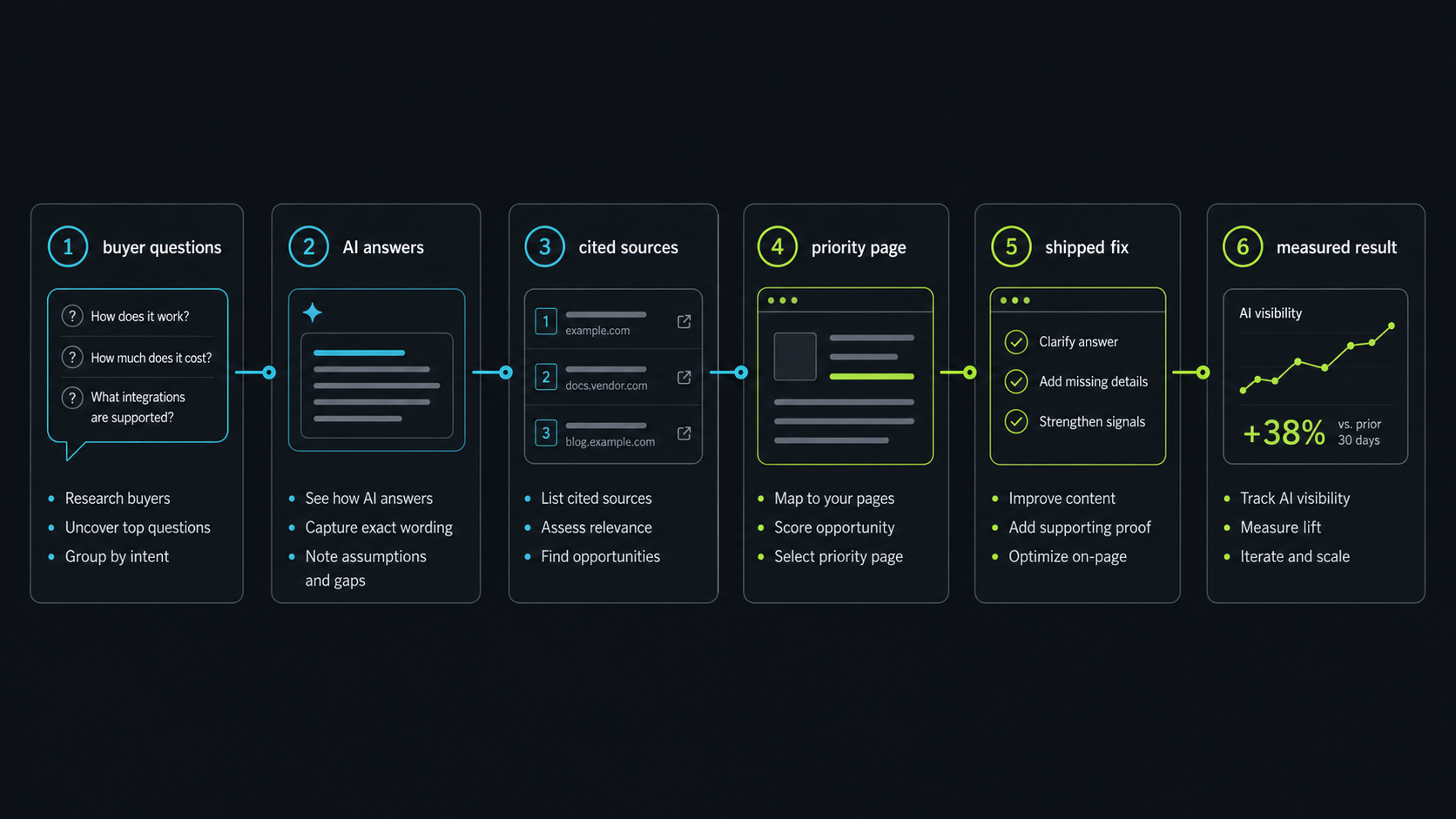
This playbook is narrower than the full answer engine optimization guide. It is designed for founders and lean growth teams that need evidence before hiring an agency, buying a large platform, or publishing dozens of new pages.
What is answer engine optimization for startups?
Answer engine optimization for startups is the process of making a young company easier for AI assistants to understand, cite, and recommend for commercially important questions. It connects a small set of buyer prompts to authoritative product, comparison, use-case, pricing, and help pages, then measures whether those answers improve after focused changes.
Startup AEO is a source-ownership and measurement discipline. It is not a separate content channel. A startup uses the pages it already needs for sales and onboarding, strengthens the evidence on those pages, and checks whether ChatGPT, Perplexity, Gemini, Claude, or Google AI features represent the company accurately.
The smallest useful system contains five parts:
- A locked cohort of 20–40 buyer questions.
- One intended source URL for every important question.
- Saved answers, citations, competitor mentions, and factual errors.
- A ranked queue of page fixes.
- A weekly re-test using unchanged prompts.
When should a startup invest in AEO?
A startup should invest in AEO when buyers already ask AI assistants to discover, compare, or validate products in its category. The strongest trigger is not funding stage or website size; it is repeated evidence that an AI-generated answer can influence a shortlist, integration decision, pricing question, or trust check.
Use this decision table:
| Situation | Start AEO now? | First move |
|---|---|---|
| Buyers ask AI for category shortlists | Yes | Track recommendation and competitor wins |
| Product is often misdescribed | Yes | Fix the authoritative product source and measure accuracy |
| Sales hears “ChatGPT recommended you” | Yes | Identify the prompts and cited pages behind the referral |
| Category has no meaningful AI-assisted research | Not yet | Strengthen normal SEO, product messaging, and customer proof |
| Product facts change weekly | Carefully | Establish one current source and a strict review owner |
| Site has no credible product or proof pages | Not yet | Build source-worthy pages before chasing mentions |
Do not wait for perfect attribution. Start when the answers influence a real buyer decision and the team can change the pages that should own those answers.
Which prompts should a startup track first?
Track prompts that could move a buyer into or out of the shortlist. Start with category discovery, use-case fit, alternatives, integrations, pricing constraints, implementation risk, and failure modes. Pull the language from sales calls, support tickets, demos, on-site search, and competitor conversations instead of generating hundreds of generic questions.
A practical 30-prompt starter set includes:
- 5 category and definition questions;
- 6 audience or use-case questions;
- 6 comparison and alternative questions;
- 5 integration and workflow questions;
- 4 pricing or procurement questions;
- 4 objections and failure-mode questions.
Make each prompt specific enough to produce a useful decision. “Best software” is weak. “What is the best AI visibility tool for a three-person B2B SaaS content team?” identifies the category, audience, constraint, and desired outcome.
Include natural questions such as “why does ChatGPT recommend our competitor?”, “how do I compare AI visibility tools without an analyst?”, “when should a startup use AEO software instead of an agency?”, and “what is the best way to measure citations with a small prompt set?” The AEO keyword research workflow explains how to connect those questions to conventional search demand without turning every variation into a new page.
Which startup pages should own AI answers?
Assign each question to the page that can prove the answer most directly. Product pages should own capabilities, integration pages should own compatibility, pricing pages should own current commercial facts, comparison pages should own tradeoffs, and help documentation should own implementation. A blog post should not become the source of truth for a fact the product page is responsible for.
| Buyer question | Intended source | Evidence it needs |
|---|---|---|
| What does the product do? | Product or feature page | Specific capability, audience, inputs, outputs, limitations |
| Does it work with my stack? | Integration or documentation page | Supported workflow, setup, permissions, current scope |
| Is it better than an alternative? | Comparison page | Fit, tradeoffs, methodology, transparent caveats |
| What does it cost? | Pricing page | Billing unit, included usage, add-ons, update date |
| Can I trust it? | Security or proof page | Controls, named evidence, customer outcomes, limitations |
| How do I solve this problem? | Use-case page or guide | Direct steps, example, decision criteria, product path |
If three pages compete for the same question, pick one primary source and link the others to it. If no page can substantiate the answer, create or strengthen the missing product source before commissioning another broad thought-leadership article.
How can a small team run an AEO baseline?
Run every prompt on the AI surfaces your buyers use, then preserve the full answer, cited URLs, brands named, timestamp, market, and test conditions. Label omissions, recommendations, target-page citations, competitor wins, and factual errors separately. A spreadsheet can support the first 20–30 prompts; automation matters once repeated runs become operationally expensive.
Follow this seven-step baseline:
- Lock the exact prompt wording and assign an intent and business value.
- Assign one intended URL and accountable owner.
- Run the prompt across two or three relevant AI surfaces.
- Save the complete response and every cited URL.
- Record whether the startup is omitted, mentioned, recommended, or cited.
- Check material claims for accuracy.
- Rank the next fix by buyer value, gap size, effort, and confidence.
Repeat consequential prompts across multiple runs before treating one response as a trend. Generated answers vary, so one favorable screenshot is evidence of an event, not proof of durable visibility. The AI visibility tracking guide provides the broader weekly measurement system.
What should a startup fix first?
Fix the highest-value question where a credible page already exists but loses because its answer, evidence, or entity scope is weak. This is usually faster than creating a new article. Put the direct answer near the top, state who the product is for, add verifiable proof, clarify limitations, and link supporting pages back to the intended source.
Use this priority order:
- Wrong material facts: correct and consolidate the authoritative source immediately.
- Competitor recommended for a high-intent question: improve comparison criteria, fit, and proof.
- Your brand mentioned but the wrong URL cited: strengthen source ownership and internal links.
- No eligible page: build the missing product, comparison, integration, or use-case source.
- Low-value informational omission: defer it until commercial gaps are covered.
For each page, add a 40–80 word direct answer beneath the relevant heading, specific examples, current dates where facts change, descriptive internal links, visible ownership, and structured data that matches the page. Schema can clarify content, but it cannot compensate for vague claims or guarantee a citation.
Should a startup use a spreadsheet, software, or an agency?
Use a spreadsheet for a one-time baseline, software for repeatable monitoring and a persistent fix queue, and an agency when the startup lacks strategy or execution capacity. The wrong choice is buying enterprise reporting before the team has defined its prompts, sources, owners, and weekly decisions.
| Option | Best for | Limitation |
|---|---|---|
| Manual spreadsheet | First 20–30 prompts and category discovery | Repeated collection becomes slow and inconsistent |
| AEO software | Weekly tracking, citations, competitors, briefs, and re-tests | Still needs an owner who can ship page changes |
| Specialist agency | Strategy, research, production, or scarce expertise | Expensive if the startup cannot approve or implement fixes |
| Hybrid | Lean team with internal product knowledge and outside execution | Requires clear ownership and shared definitions |
Start manually only long enough to understand the workflow. Move to software when collection prevents analysis or the team can no longer preserve comparable runs. Hire an agency for a specific missing capability, not as a substitute for product truth.
How do you measure whether startup AEO works?
Measure whether high-value prompts produce more accurate recommendations and citations to the intended pages. The core scoreboard is recommendation rate, target-page citation rate, answer accuracy, competitor source share, qualified AI referrals, and fix-to-win rate. Report changes by prompt cohort and AI surface instead of hiding them inside one blended score.
The most useful weekly review asks four questions:
- Which high-intent prompts did we win or lose?
- Which domains and URLs supplied the winning evidence?
- What material claims were wrong or stale?
- Which shipped page change should be kept, revised, or rolled back?
Connect referral traffic and conversions where possible, but do not pretend every AI-influenced buyer clicks a trackable source. The AEO ROI framework shows how to join prompt wins, citations, qualified sessions, and pipeline without inventing certainty.
What mistakes waste a startup's AEO budget?
The biggest startup mistakes are tracking too many prompts, publishing generic articles before mapping source pages, measuring mentions without recommendations or citations, and changing the prompt set every week. These create activity without learning. A startup wins by narrowing scope, preserving evidence, and shipping the smallest page change that can alter a valuable answer.
Avoid these traps:
- Tracking 1,000 synthetic prompts before acting on 30 real ones.
- Treating every question as a new blog-post opportunity.
- Celebrating a brand mention while a competitor receives the recommendation.
- Counting a citation to any company URL as a target-page win.
- Rewriting pages without recording the baseline or re-test date.
- Buying a dashboard with no accountable owner or publishing path.
- Using search volume as the only measure of buyer value.
FAQ
How much does answer engine optimization cost for a startup?
The first baseline can cost only team time if you test 20–30 prompts manually. Ongoing cost depends on prompt volume, surfaces, run frequency, software, content work, and outside support. Start with one commercial journey and expand only after a measured fix produces useful movement.
How many AEO prompts should a startup track?
Start with 20–40 high-value prompts for one audience and product. Keep a locked core cohort for weekly comparison and a separate discovery list for new questions. More prompts are useful only when the team can review the evidence and act on the resulting gaps.
Does AEO replace SEO for startups?
No. Crawlability, useful pages, authority, internal links, technical quality, and conversion design still matter. AEO adds prompt-level observation, citation and recommendation measurement, answer-accuracy checks, and intended-source ownership to the existing search and product-content system.
How long does startup AEO take to show results?
A focused team can establish a baseline and ship initial page fixes in two to four weeks. Durable movement may take longer because discovery, indexing, retrieval, and generated answers vary. Judge repeated results across unchanged prompts, not one favorable response.
Should an early-stage startup hire an AEO agency?
Hire an agency when it fills a specific gap in strategy, research, technical work, content, or measurement. Do not outsource ownership of product facts or buy a broad retainer before defining the buyer questions and pages that matter.
Can a startup do AEO without special software?
Yes. A spreadsheet works for the first small baseline. Software becomes valuable when weekly collection, citation capture, competitor comparisons, task routing, and re-testing take more time than interpreting and fixing the results.
Run the smallest credible startup AEO sprint
Choose one audience, lock 30 questions, assign an intended page to each, and fix the ten gaps most likely to affect a shortlist. Run a free Tracemetry AI visibility audit for the initial evidence, then use Tracemetry Pro when you need weekly prompt tracking, competitor citations, source-grounded briefs, and re-measurement in one workflow.
Frequently asked questions
How much does answer engine optimization cost for a startup?
The first baseline can cost only team time if you test 20–30 prompts manually. Ongoing cost depends on prompt volume, surfaces, run frequency, software, content work, and outside support. Start with one commercial journey and expand only after a measured fix produces useful movement.
How many AEO prompts should a startup track?
Start with 20–40 high-value prompts for one audience and product. Keep a locked core cohort for weekly comparison and a separate discovery list for new questions. More prompts are useful only when the team can review the evidence and act on the resulting gaps.
Does AEO replace SEO for startups?
No. Crawlability, useful pages, authority, internal links, technical quality, and conversion design still matter. AEO adds prompt-level observation, citation and recommendation measurement, answer-accuracy checks, and intended-source ownership to the existing search and product-content system.
How long does startup AEO take to show results?
A focused team can establish a baseline and ship initial page fixes in two to four weeks. Durable movement may take longer because discovery, indexing, retrieval, and generated answers vary. Judge repeated results across unchanged prompts, not one favorable response.
Should an early-stage startup hire an AEO agency?
Hire an agency when it fills a specific gap in strategy, research, technical work, content, or measurement. Do not outsource ownership of product facts or buy a broad retainer before defining the buyer questions and pages that matter.
Can a startup do AEO without special software?
Yes. A spreadsheet works for the first small baseline. Software becomes valuable when weekly collection, citation capture, competitor comparisons, task routing, and re-testing take more time than interpreting and fixing the results.
Make your next SEO decision with better evidence.
Explore practical guides to AI visibility, source citations, and choosing the right tools for your team.