AI answer volatility tracking: measure prompt drift before it costs deals
How to track AI answer volatility across ChatGPT, Perplexity, Gemini, Claude, and Google AI experiences: prompt drift, citation swaps, competitor swings, thresholds, and fix queues.
AI answer volatility tracking is the practice of measuring how often AI-generated answers change for the same buyer prompts across ChatGPT, Perplexity, Gemini, Claude, and Google AI experiences. The painful problem is simple: your team can fix a prompt this week, then lose the citation, recommendation, or accurate wording next week without any SEO ranking drop to warn you.
The fast rule: track volatility only on prompts where change can cost money. A definition prompt moving from paragraph one to paragraph two is noise. A shortlist prompt dropping your brand, swapping the cited URL, or recommending a competitor is a fix queue.
Use this workflow after you have baseline AI visibility tracking, AI answer accuracy monitoring, AI search sentiment monitoring, and a weekly AI visibility report. Volatility explains whether your wins are durable or just one good sample.
What is AI answer volatility tracking?
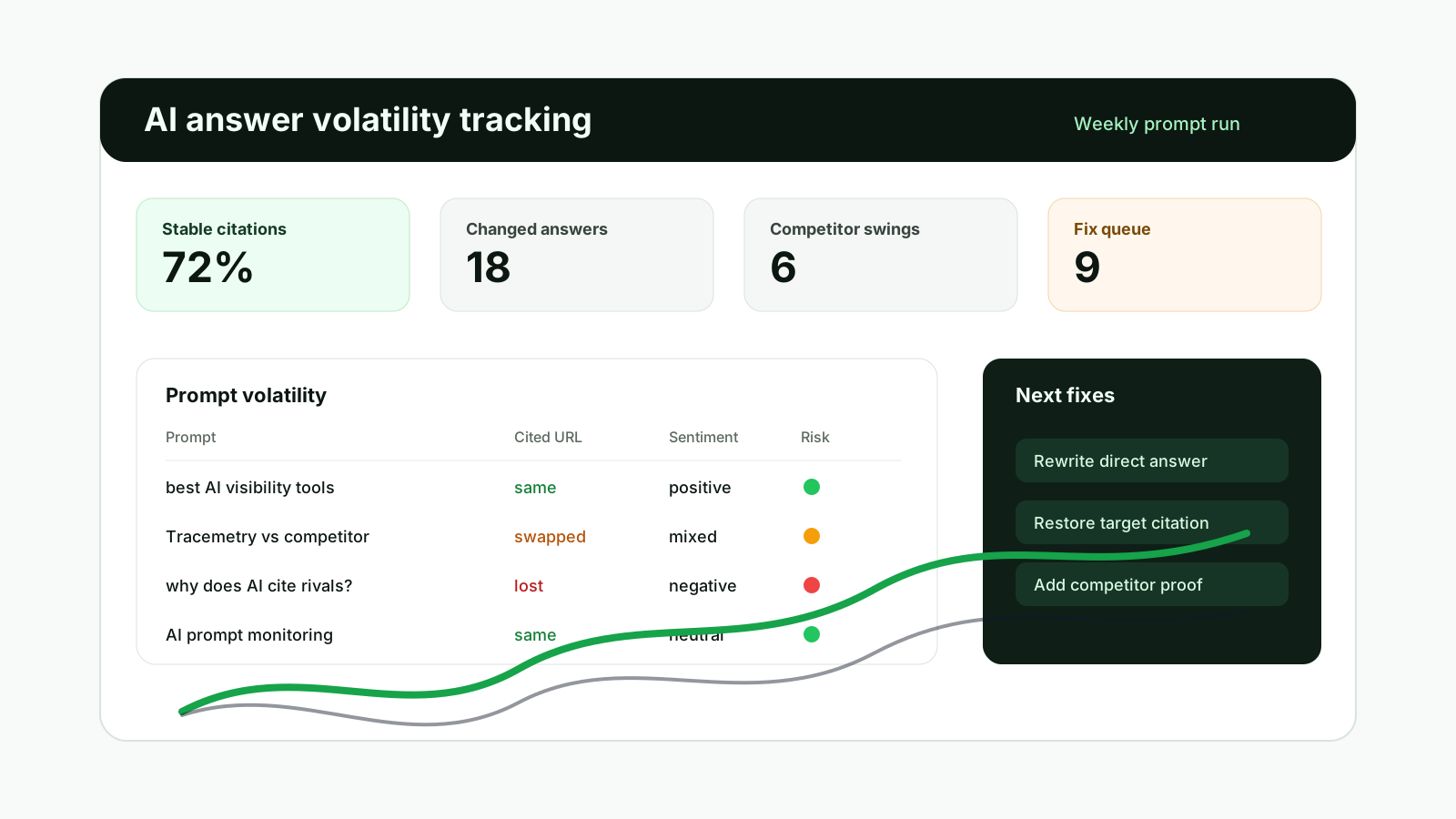
AI answer volatility tracking is the process of re-running the same prompts on a fixed cadence and measuring changes in brand mentions, recommendations, cited URLs, answer wording, competitor presence, sentiment, and accuracy. It turns "the answer looked different today" into a measurable risk score.
AI answer volatility is the amount of change in an AI-generated answer for the same prompt, surface, market, and measurement window. High volatility does not always mean performance is bad. It means you should avoid overreacting to one run and should judge source ownership over repeated samples.
OpenAI describes ChatGPT Search as using web information with source links. Google says AI features can use web content and link to supporting pages. Anthropic and Perplexity also expose web-connected answer behavior in their products. The operating takeaway is that answer systems can change as sources, indexes, retrieval choices, model behavior, and freshness signals change.
Why do AI answers fluctuate week to week?
AI answers fluctuate because generated answers are not static rankings. The assistant may retrieve different sources, summarize the same source differently, include different competitors, or update its answer after new pages, product changes, news, reviews, or crawl events.
Use this failure map before blaming the model:
| Volatility pattern | Likely cause | First check |
|---|---|---|
| Brand appears one week, disappears the next | Weak source ownership or thin category proof | Which URLs were cited before and after |
| Same brand, different cited page | Internal topology is ambiguous | Titles, H2s, canonicals, internal links |
| Competitor moves above you | Their page better matches the buyer prompt | Comparison, alternatives, and proof pages |
| Answer gets less accurate | Stale source or third-party summary became easier to retrieve | Cited URLs and product source of truth |
| Sentiment turns mixed or negative | New caveat, review, pricing page, or comparison source | The exact phrase behind the caveat |
| No citation but brand still named | Mention signal exists, source path is weak | Citation-worthy direct answers and schema |
The dumb response is rewriting every page after one bad run. The useful response is separating normal answer drift from repeatable prompt loss.
Which prompts should you monitor for volatility?
Monitor prompts where a change affects discovery, comparison, objection handling, or conversion. Start with category shortlist, alternatives, comparison, pricing-adjacent, implementation-risk, integration, and failure-mode prompts before broad definition prompts.
Build the prompt set from these buckets:
| Prompt bucket | Example AI query | Volatility risk |
|---|---|---|
| Category shortlist | "best AI visibility tools for B2B SaaS teams" | Brand drops out of the recommended set |
| Comparison | "Tracemetry vs Profound for AI visibility tracking" | Competitor becomes the safer choice |
| Alternative | "best Otterly alternative for weekly AI search reports" | Your challenger positioning disappears |
| Pricing-adjacent | "affordable AI visibility tracking for startups" | Old pricing or package assumptions return |
| Implementation | "easy AI brand monitoring tool for a small marketing team" | Setup effort gets overstated |
| Integration | "AI visibility tracking with Search Console data" | Missing or stale data-source language |
| Failure mode | "why does ChatGPT recommend competitors instead of my brand" | Wrong diagnostic advice gets repeated |
| Source-specific | "why does Perplexity cite a competitor instead of my site" | Competitor source ownership persists |
Natural entity terms help disambiguate the page: AI answer volatility tracking, AI search volatility, answer drift, ChatGPT citation changes, Perplexity citation volatility, Gemini answer monitoring, Claude answer tracking, Google AI Overviews, source ownership, cited URLs, answer accuracy, sentiment, B2B SaaS, and answer engine optimization.
How do you measure AI answer volatility?
Measure AI answer volatility by comparing the same prompt across repeated runs and scoring whether the business meaning changed. Track surface, prompt, answer text, mentioned brands, recommendation order, cited URLs, target URL citation, sentiment, accuracy, and one reason for the movement.
Use this simple scoring model:
| Metric | What changed? | Why it matters |
|---|---|---|
| Mention volatility | Your brand appeared, disappeared, or changed frequency | Shows whether visibility is durable |
| Recommendation volatility | Your rank or endorsement changed | Affects shortlist behavior |
| Citation volatility | Cited domains or target URLs changed | Shows source ownership stability |
| Competitor volatility | Competitors entered, exited, or moved above you | Explains lost prompts |
| Accuracy volatility | Correct answer became stale, incomplete, or wrong | Prevents false confidence |
| Sentiment volatility | Positive or neutral answer became mixed or negative | Reveals objection drift |
For each metric, store the previous value, current value, delta, likely source, business risk, owner, and re-measure date. A good volatility report should make the next page fix obvious.
What is a useful threshold for action?
Act when volatility repeats across two runs, appears on a high-intent prompt, changes the recommendation set, changes the cited source, or creates a wrong or negative answer. Ignore one-off wording changes on low-intent prompts unless they expose a factual issue.
Use this decision table:
| Situation | Action | Why |
|---|---|---|
| One wording change, same citation and same recommendation | Watch | The answer changed but the business meaning did not |
| Brand dropped from a bottom-funnel shortlist | Fix now | This can remove you from buyer consideration |
| Target URL lost citation to a competitor | Fix now | Source ownership moved |
| Same wrong claim appears twice | Fix now | Accuracy volatility has become a stable error |
| Competitor appears once in a broad definition prompt | Watch | Broad prompts are noisy and low intent |
| Negative caveat appears after pricing or product change | Fix now | Stale objections can spread fast |
The best threshold is not a universal percentage. It is a business rule: if the changed answer would alter what a serious buyer believes, assign it to the fix queue.
How often should you re-run prompts?
Run normal AI answer volatility tracking weekly. Use daily runs only around launches, pricing changes, rebrands, major content updates, product incidents, or a sudden competitor move. Monthly monitoring is too slow for volatile bottom-funnel prompts.
Use three cadences:
| Cadence | Use it for | Prompt set |
|---|---|---|
| Weekly | Normal monitoring and reporting | 40-150 buyer prompts |
| Daily for 14 days | Launches, pricing changes, incidents, rebrands | 20-60 high-risk prompts |
| Monthly | Leadership trend summary | Stable weighted rollup |
Do not mix daily and weekly samples in the same trend line without labeling them. A daily spike can look like a strategic problem when it is just extra sampling.
How do you reduce AI answer volatility?
Reduce harmful volatility by making the intended source page clearer, fresher, more specific, and better connected. The page should answer the prompt directly, prove the claim, expose visible FAQ content, align schema with visible copy, and receive internal links from related pages.
Use this 30-minute source-stability checklist:
- Pick the unstable prompt. Use the exact wording that changed.
- Compare old and new answers. Save answer text, cited URLs, brands, competitors, sentiment, and accuracy.
- Find the lost source. Identify whether your target URL, a competitor URL, or a third-party page moved.
- Choose one source of truth. Decide which URL should own the answer next time.
- Rewrite the direct answer. Add a 40-80 word answer under the matching H2.
- Add proof. Use a table, checklist, methodology, example, screenshot, or source-backed claim.
- Tighten internal links. Link from related pages such as AI answer accuracy monitoring, AI search prompt monitoring, and content that AI cites.
- Align schema. FAQPage and Article schema should match the visible page.
- Re-measure after the next crawl window. Use the same prompt and surface before calling the fix successful.
This is where answer engine optimization content briefs help. The brief should name the exact prompt, target URL, source proof, FAQ, schema, and re-measurement rule before writing starts.
What should an AI answer volatility report include?
An AI answer volatility report should show which prompts changed, which surfaces changed, whether the business meaning changed, which sources moved, and what should be fixed. Keep the report operational. Volatility without a fix queue is just anxiety in chart form.
Minimum report:
- Prompt and intent bucket
- AI surface: ChatGPT, Perplexity, Gemini, Claude, or Google AI Overviews
- Previous answer summary and current answer summary
- Mention, recommendation, citation, competitor, sentiment, and accuracy changes
- Previous cited URLs and current cited URLs
- Target URL citation status
- Business-risk label
- Likely source of the movement
- Recommended page fix
- Owner and re-measure date
Roll this into the weekly AI visibility score and LLM visibility benchmark, but keep the raw evidence attached. Leaders need the trend; operators need the exact prompt and cited URL.
FAQ
What is AI answer volatility tracking? AI answer volatility tracking is the process of re-running the same AI search prompts over time and measuring changes in brand mentions, recommendations, cited URLs, competitors, sentiment, and answer accuracy. It shows whether AI visibility gains are stable or fragile.
Why do ChatGPT or Perplexity answers change for the same prompt? Answers can change because the system retrieves different sources, summarizes sources differently, sees fresher web content, changes the cited URL set, or weights competitor pages differently. The practical fix is to track cited URLs and source ownership, not just the generated wording.
How is answer volatility different from AI visibility tracking? AI visibility tracking asks whether your brand appears in AI answers. Answer volatility tracking asks whether that appearance is stable over time. A brand can have good visibility in one run and still be risky if recommendations, citations, or accuracy swing every week.
How many prompts do I need to measure AI answer volatility? Start with 40-80 buyer prompts for weekly monitoring. Use fewer prompts only for a launch or incident watchlist. The prompts should cover shortlist, comparison, alternatives, pricing-adjacent, integration, implementation, and failure-mode intent.
What is the best metric for AI answer volatility? Target URL citation volatility is the best page-level metric because it shows whether the page you intended to own the answer keeps getting cited. Pair it with recommendation volatility, competitor volatility, answer accuracy, and sentiment for a complete view.
How do I reduce volatility in AI answers? Pick the unstable prompt, identify the source that moved, update the intended source page with a direct answer, proof, visible FAQ, matching schema, and internal links, then re-measure the same prompt after the next crawl or update window.
Start with the prompts that swing revenue
Run the free Tracemetry audit to see where AI answers mention your brand, cite your pages, recommend competitors, and change across key prompts. If the snapshot shows unstable recommendations or citation swaps, use Tracemetry Pro to monitor the full prompt set, assign source fixes, and re-measure the answers that influence buyers.
Sources: OpenAI ChatGPT Search, Google AI features and your website, Google structured data policies, Anthropic Claude support, Perplexity publishers program.
Frequently asked questions
What is AI answer volatility tracking?
AI answer volatility tracking is the process of re-running the same AI search prompts over time and measuring changes in brand mentions, recommendations, cited URLs, competitors, sentiment, and answer accuracy. It shows whether AI visibility gains are stable or fragile.
Why do ChatGPT or Perplexity answers change for the same prompt?
Answers can change because the system retrieves different sources, summarizes sources differently, sees fresher web content, changes the cited URL set, or weights competitor pages differently. The practical fix is to track cited URLs and source ownership, not just the generated wording.
How is answer volatility different from AI visibility tracking?
AI visibility tracking asks whether your brand appears in AI answers. Answer volatility tracking asks whether that appearance is stable over time. A brand can have good visibility in one run and still be risky if recommendations, citations, or accuracy swing every week.
How many prompts do I need to measure AI answer volatility?
Start with 40-80 buyer prompts for weekly monitoring. Use fewer prompts only for a launch or incident watchlist. The prompts should cover shortlist, comparison, alternatives, pricing-adjacent, integration, implementation, and failure-mode intent.
What is the best metric for AI answer volatility?
Target URL citation volatility is the best page-level metric because it shows whether the page you intended to own the answer keeps getting cited. Pair it with recommendation volatility, competitor volatility, answer accuracy, and sentiment for a complete view.
How do I reduce volatility in AI answers?
Pick the unstable prompt, identify the source that moved, update the intended source page with a direct answer, proof, visible FAQ, matching schema, and internal links, then re-measure the same prompt after the next crawl or update window.
See your own AI visibility today.
Free public report. 60 seconds. No signup. Or get started on Pro to track 250 prompts continuously.