Generative engine optimization tools: what to measure before you buy
How to evaluate generative engine optimization tools: prompt tracking, AI surfaces, brand mentions, cited URLs, competitor share of voice, answer accuracy, and fix workflows.
Generative engine optimization tools help you find where AI assistants mention your brand, cite your pages, recommend competitors, and repeat stale positioning. The painful part is that traditional SEO tools can show rankings and traffic, but they do not show what ChatGPT, Perplexity, Gemini, Claude, or Google AI Overviews said before the buyer clicked anything.
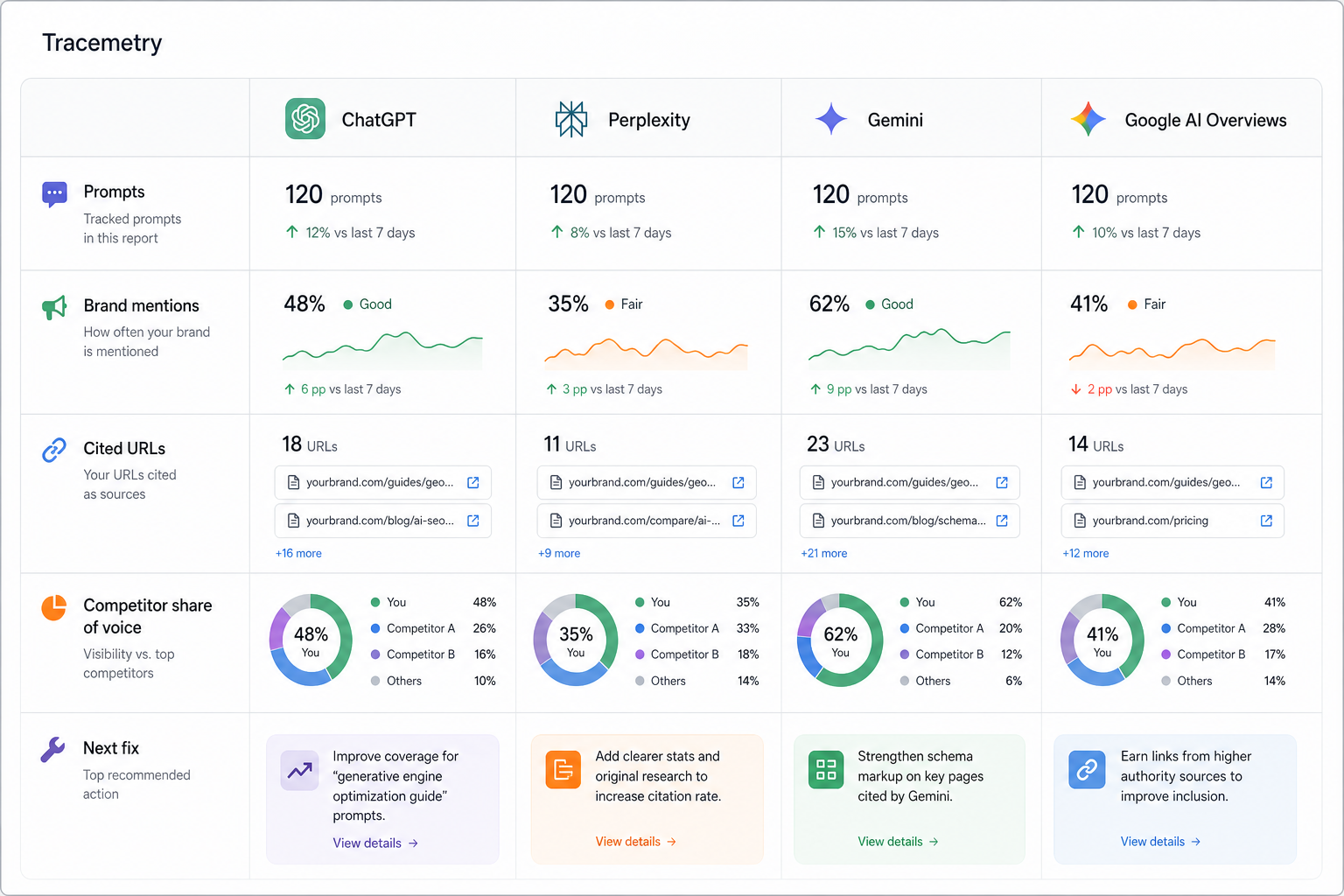
Use the fast rule: a useful GEO tool must track prompts, surfaces, brand mentions, cited URLs, competitor share of voice, answer accuracy, and the page fixes that should ship next. If a tool only gives a visibility score with no cited-source evidence, it is not enough to run an AI search program. The operating layer starts with AI search prompt monitoring: the locked prompt set and weekly answer data every tool should preserve.
This guide is for marketers, founders, and agencies choosing a tool for AI visibility measurement. If you need the broader operating model first, start with the generative engine optimization strategy, the GEO audit checklist, and the AI visibility report template.
What are generative engine optimization tools?
Generative engine optimization tools are software platforms that measure and improve how a brand appears in AI-generated answers. They run buyer prompts across AI surfaces, record brand mentions and citations, compare competitors, flag answer-quality issues, and help teams publish the pages that AI systems are more likely to cite.
Generative engine optimization tool is the measurement and execution layer for GEO. The measurement layer shows whether your brand is named, cited, and recommended. The execution layer turns losses into fixes: update a source page, publish a comparison page, add schema, clarify entity language, or earn third-party proof.
Do not confuse a GEO tool with a rank tracker. Rank trackers observe search result lists. GEO tools observe generated answers, cited URLs, and model-specific behavior. Google's documentation for AI features in Search and OpenAI's guidance on ChatGPT Search both point to a source-backed answer environment where citations, freshness, and page clarity matter.
What should a GEO tool measure?
A GEO tool should measure prompt coverage, brand mention rate, domain citation rate, source ownership, competitor share of voice, answer accuracy, and prompt-level movement. The best tools keep every metric tied to a visible prompt and cited URL so the team knows what to fix.
Use this scorecard before buying:
| Capability | What it answers | Why it matters |
|---|---|---|
| Prompt tracking | Which buyer questions were tested? | Keeps the program tied to real buying jobs |
| Surface coverage | Which AI systems were checked? | ChatGPT, Perplexity, Gemini, Claude, and AI Overviews diverge |
| Mention rate | Did the answer name your brand? | Shows shortlist presence |
| Citation rate | Did the answer cite your domain? | Shows whether your site owns the source path |
| Source ownership | Which URLs were cited? | Points to the pages to defend or improve |
| Competitor SOV | Who else appears in answers? | Shows whether the buyer shortlist is moving |
| Answer accuracy | Is the answer correct and current? | Catches positioning, pricing, and product-risk issues |
| Fix queue | What should ship next? | Turns dashboards into content and schema work |
Avoid blended "AI visibility" scores unless the platform lets you inspect the raw prompt, answer, brands, cited URLs, and scoring rule underneath. A single score is fine for executives; operators need the evidence trail.
If data quality is the deciding factor, use the AI search optimization tool data accuracy checklist to inspect raw answers, cited URLs, competitor extraction, and surface separation before a paid pilot. If you already have a shortlist, compare the finalists with the best-rated AEO tools scorecard. If the team does not have a baseline yet, run an LLM visibility benchmark first so every vendor demo is judged against the same prompts.
Which types of generative engine optimization tools exist?
Most GEO tools fall into four groups: visibility trackers, citation monitors, content workflow platforms, and full operating systems. The right choice depends on whether your team only needs measurement or also needs briefs, drafts, review workflow, and publishing support.
| Tool type | Best for | Weakness |
|---|---|---|
| Visibility tracker | Weekly mention and SOV monitoring | Often thin on content execution |
| Citation monitor | Source-level analysis for Perplexity, ChatGPT Search, and AI Overviews | Can miss broader positioning issues |
| Content workflow tool | Turning prompt losses into briefs, drafts, and updates | Needs measurement discipline or it becomes a content mill |
| Agency reporting layer | Multi-client scorecards and exports | Usually less flexible for product-led teams |
| Full GEO operating system | Measurement, briefs, drafts, review, publishing, and re-measurement | More opinionated workflow |
The category is young, so vendor labels are messy. Some "AI SEO tools" are only rank trackers with a new tab. Some "AEO tools" are content generators with no weekly measurement. The buying question is not "which label is correct?" It is "can this tool prove which AI answers changed after we shipped the work?"
How do you choose the best GEO tool?
Choose the tool that matches your operating loop: prompt set, answer capture, source analysis, page fix, publish, and re-measure. A tool that stops at reporting will tell you the problem. A tool that cannot show prompt-level evidence will make the problem impossible to trust.
Use this decision table:
| If your team is... | Choose this | Watch out for |
|---|---|---|
| Founder-led SaaS | Tool with fixed prompt sets, competitor SOV, and page recommendations | Vanity dashboards with no fix queue |
| Content team | Tool that creates source-grounded briefs from prompt losses | Generic AI drafts detached from measured gaps |
| SEO agency | Multi-client reporting, exports, white-label views, and prompt libraries | Shared prompt sets that make every client look the same |
| Enterprise brand | Raw exports, approvals, SSO, audit logs, and answer accuracy review | Black-box scores legal/comms cannot inspect |
| Technical docs/product team | Citation monitoring and source ownership by URL | Tools that ignore docs, changelogs, and support pages |
For most teams, the deciding feature is not the prettiest dashboard. It is whether the tool can answer: "Which page should we update this week, and which prompt will prove whether the update worked?"
What questions should you ask before buying a GEO tool?
Ask about prompt ownership, surface coverage, sampling depth, citation capture, raw exports, answer accuracy review, and re-measurement. Weak vendors hide behind category language. Strong vendors can explain exactly how they collect answers and how they turn losses into fixes.
Ask these before you sign:
- Can I bring my own prompt set?
- How many prompts and samples run per surface?
- Which surfaces are tracked separately?
- Do you capture cited URLs or only brand mentions?
- Can I export raw prompt, answer, citation, and scoring data?
- How do you handle answer drift and repeated runs?
- Does the tool flag wrong or stale product claims?
- Does it recommend fixes against existing URLs before creating new pages?
- Can it connect prompt losses to briefs, drafts, review, and publishing?
- How do you prove that shipped fixes changed the next measurement window?
If a tool cannot export raw answers, treat the dashboard as a demo, not an operating system. GEO is too new for blind trust. You need the evidence because the model answer will vary by surface, time, and prompt phrasing.
How should a GEO tool handle prompt sets?
A GEO tool should let you build a locked prompt set from buyer jobs: category discovery, shortlisting, comparison, alternatives, workflow, failure modes, integration, pricing-adjacent, and surface-specific questions. The wording should stay stable enough for week-over-week measurement.
Start with 40-80 prompts:
| Prompt bucket | Example AI query | What it reveals |
|---|---|---|
| Category | "what are generative engine optimization tools" | Whether the category understands you |
| Shortlist | "best GEO tool for B2B SaaS marketing teams" | Which vendors enter the buyer shortlist |
| Comparison | "Tracemetry vs Profound for AI visibility tracking" | Which competitor is preferred and why |
| Alternative | "affordable alternative to enterprise AI visibility tools" | Whether challenger positioning appears |
| Workflow | "how do I track ChatGPT citations every week" | Whether educational content earns citations |
| Failure mode | "why does Perplexity cite competitors instead of my site" | Which urgent source gaps need fixes |
| Integration | "AI search visibility tool with publishing workflow" | Whether product capabilities are understood |
| Pricing-adjacent | "GEO tool for agencies under 1000 dollars per month" | Whether commercial prompts are visible |
Entity terms should disambiguate the topic: generative engine optimization tools, answer engine optimization tools, AI search visibility tools, ChatGPT SEO tools, Perplexity citation monitoring, Google AI Overviews, Gemini, Claude, cited URLs, mention rate, citation rate, source ownership, AI share of voice, and content workflow.
What makes Tracemetry different from a normal AI visibility dashboard?
Tracemetry is built around the full GEO loop: measure prompts, identify source gaps, generate briefs, draft fixes, review them, publish, and re-measure. A normal dashboard tells you where you lost. Tracemetry is designed to make the next content or page update obvious.
That distinction matters because AI visibility changes only when the public evidence changes. If a competitor wins a high-intent prompt, the fix might be a clearer comparison page, a better FAQ block, a fresher source, a pricing page link, or a third-party citation. Tracemetry connects the prompt loss to that work queue instead of leaving it as a chart.
Use the free AI visibility audit for a quick baseline. Use pricing when you need weekly prompt tracking, source-grounded briefs, and a repeatable publish/re-measure loop.
What mistakes make GEO tools useless?
The biggest mistakes are tracking prompts you already win, blending every surface into one score, ignoring cited URLs, counting weak mentions as revenue wins, and publishing generic content that does not answer the losing prompt. Those mistakes make the dashboard look alive while the buyer shortlist stays unchanged.
Avoid these:
- Buying a tool before defining competitors and prompt buckets.
- Measuring only ChatGPT and assuming Perplexity or AI Overviews behave the same.
- Treating a brand mention without a citation as a full win.
- Changing the prompt set every week and pretending the trend is real.
- Publishing a new post when an existing page simply needs a clearer answer.
- Letting schema say more than the visible page content.
- Reporting AI traffic only, even though many AI answers influence buyers before a click.
Google's structured data guidelines are the right standard: structured data should match visible content. For GEO tools, the same rule applies to measurement. The score should reflect what the answer actually says, not what the metadata hoped the answer would say.
How do you know a GEO tool is working?
A GEO tool is working when high-intent prompt losses turn into shipped page fixes, then the same prompts show higher mention rate, higher citation rate, better answer accuracy, or weaker competitor source ownership. The proof is movement on the locked prompt set, not more dashboard screenshots.
Use this operating loop:
- Lock 40-80 prompts and the approved competitor set.
- Run the prompts across the surfaces that matter.
- Record mentions, citations, answer accuracy, and source URLs.
- Pick the highest-intent fixable loss.
- Update or publish the page that should answer it.
- Link that page from related posts, product pages, or comparison pages.
- Re-measure the same prompt after 7-14 days.
- Report movement, not activity.
For the math, use the AI share-of-voice formula. For source-level tracking, split ChatGPT, Perplexity, and Google AI Overviews when needed because each surface rewards different source patterns.
FAQ
What are generative engine optimization tools? Generative engine optimization tools are platforms that measure and improve how a brand appears in AI-generated answers. They track prompts, brand mentions, citations, competitor share of voice, answer accuracy, and the page fixes needed to improve AI visibility.
Are GEO tools different from SEO tools? Yes. SEO tools track rankings, keywords, backlinks, technical health, and search traffic. GEO tools track generated answers, brand mentions, cited URLs, AI share of voice, answer accuracy, and prompt-level movement across AI surfaces.
What is the best generative engine optimization tool? The best tool is the one that supports your operating loop: custom prompts, separate AI surfaces, citation capture, competitor SOV, raw exports, fix recommendations, publishing workflow, and re-measurement. For teams that want measurement plus execution, Tracemetry is built for that loop.
How many prompts should a GEO tool track? Start with 40-80 buyer prompts across category, shortlisting, comparison, alternatives, workflow, failure-mode, integration, and pricing-adjacent buckets. Fewer than 20 prompts is easy to cherry-pick; more than 100 is useful only when the team can act on the findings.
Do GEO tools need to track cited URLs? Yes. Cited URLs are the source layer of AI visibility. A brand mention shows shortlist presence, but a citation shows which page or domain the AI answer used as evidence. Without cited URLs, the team cannot know which page to fix.
Can I measure GEO manually? Yes, for a small program. Put 30-40 prompts in a spreadsheet, run them weekly across your priority surfaces, record brands and cited URLs, and compare movement. Manual tracking breaks down when you add more prompts, competitors, samples, surfaces, and content fixes.
The shortest path
If you are evaluating generative engine optimization tools, do not start with a giant software comparison. Start with one painful prompt: a buyer asks an AI assistant for the best tool, alternative, workflow, or fix in your category, and your brand is absent.
Run that prompt across the surfaces you care about, inspect the cited pages, update the page that should have won, and re-measure. The right tool makes that loop faster, more reliable, and easier to repeat. Run a Tracemetry audit first, then decide whether you need the full weekly workflow.
Frequently asked questions
What are generative engine optimization tools?
Generative engine optimization tools are platforms that measure and improve how a brand appears in AI-generated answers. They track prompts, brand mentions, citations, competitor share of voice, answer accuracy, and the page fixes needed to improve AI visibility.
Are GEO tools different from SEO tools?
Yes. SEO tools track rankings, keywords, backlinks, technical health, and search traffic. GEO tools track generated answers, brand mentions, cited URLs, AI share of voice, answer accuracy, and prompt-level movement across AI surfaces.
What is the best generative engine optimization tool?
The best tool is the one that supports your operating loop: custom prompts, separate AI surfaces, citation capture, competitor SOV, raw exports, fix recommendations, publishing workflow, and re-measurement. For teams that want measurement plus execution, Tracemetry is built for that loop.
How many prompts should a GEO tool track?
Start with 40-80 buyer prompts across category, shortlisting, comparison, alternatives, workflow, failure-mode, integration, and pricing-adjacent buckets. Fewer than 20 prompts is easy to cherry-pick; more than 100 is useful only when the team can act on the findings.
Do GEO tools need to track cited URLs?
Yes. Cited URLs are the source layer of AI visibility. A brand mention shows shortlist presence, but a citation shows which page or domain the AI answer used as evidence. Without cited URLs, the team cannot know which page to fix.
Can I measure GEO manually?
Yes, for a small program. Put 30-40 prompts in a spreadsheet, run them weekly across your priority surfaces, record brands and cited URLs, and compare movement. Manual tracking breaks down when you add more prompts, competitors, samples, surfaces, and content fixes.
See your own AI visibility today.
Free public report. 60 seconds. No signup. Or get started on Pro to track 250 prompts continuously.