AI search optimization agency: a buyer's scorecard
Evaluate an AI search optimization agency with a 100-point scorecard, 90-day pilot, measurement framework, key questions, and red flags.
Hiring an AI search optimization agency is easy; proving that it can change what ChatGPT, Perplexity, Gemini, Claude, and Google AI surfaces say about your brand is harder. A weak agency sells content volume and a proprietary visibility score. A strong one preserves the answers, citations, prompts, and page changes behind every claim.
Use this fast rule: shortlist three agencies, give each the same 20–40 buyer questions, and require a 90-day pilot with a fixed baseline. Choose the team that can connect every recommendation to a real AI answer, a target page, an owner, and a recheck date.
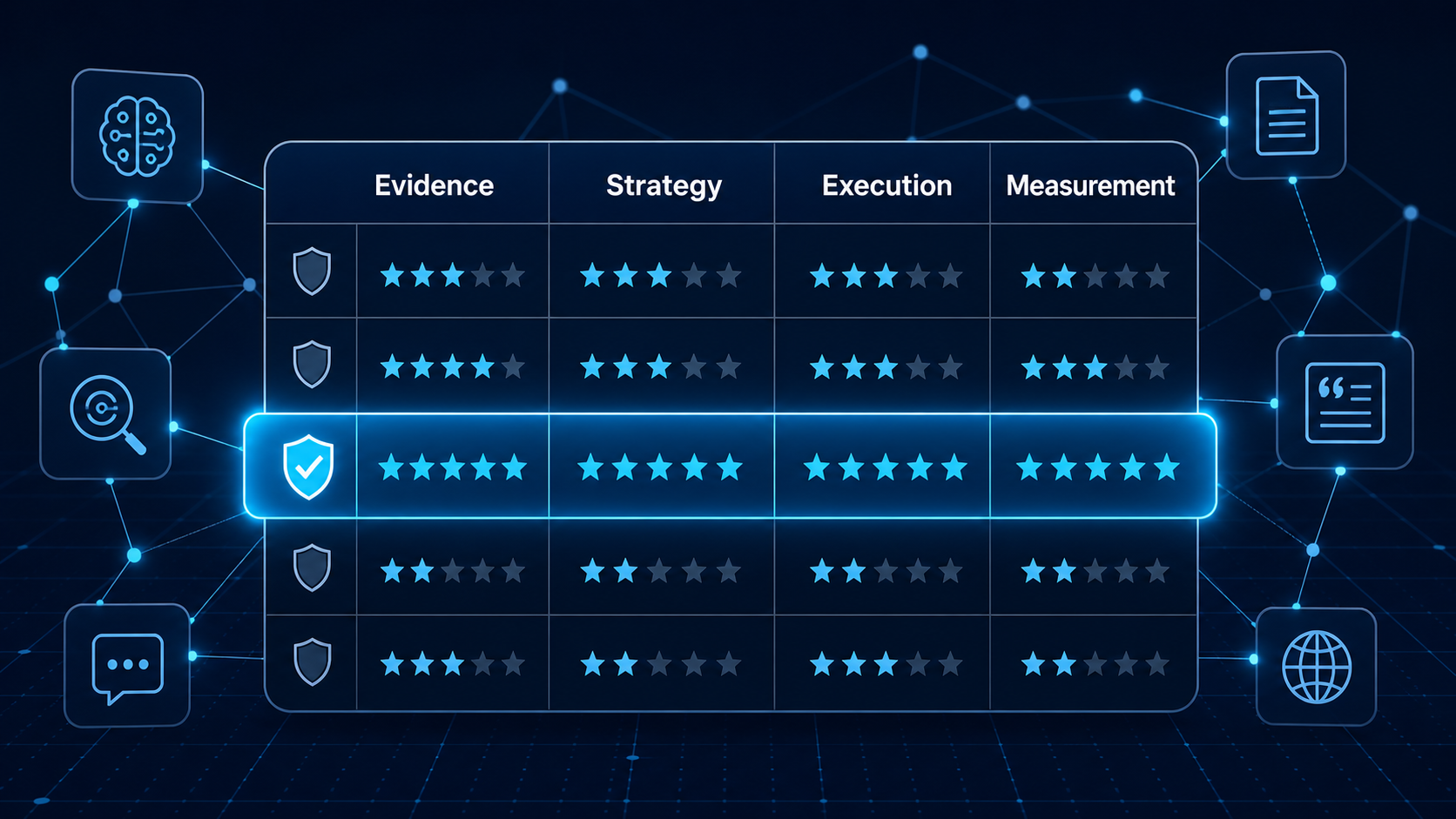
If you already know the service model you need, compare AEO pricing and use the complete AEO RFP question list. Legal teams should also compare vendors against the jurisdiction, advertising-claim, and intake controls in the law-firm AEO playbook. This guide is the shorter decision framework for building a credible shortlist.
If you are still deciding whether outside execution is necessary, use the AEO agency vs software framework before building the shortlist.
What does an AI search optimization agency do?
An AI search optimization agency measures how answer engines mention, recommend, describe, and cite a brand, then improves the pages and signals those systems can use as sources. The work usually combines prompt research, AI visibility tracking, content strategy, technical SEO, digital PR, entity clarity, publishing support, and repeated measurement.
AI search optimization is the practice of improving a brand's visibility, accuracy, recommendations, and source citations across AI-generated answers. It overlaps with SEO, but success is measured in the answers buyers receive—not only in rankings, clicks, or indexed pages.
A useful engagement should produce:
- a fixed set of commercial questions grouped by buyer intent;
- baseline answers, brand mentions, recommendations, citations, and competitors;
- a map from each priority question to the page that should answer it;
- specific content, technical, entity, and authority improvements;
- a publishing queue with owners and deadlines;
- rechecks using the same prompts and comparable test conditions;
- reporting that lets you inspect the raw evidence behind every score.
If the deliverable is merely a keyword list and twelve generic blog posts, it is ordinary content marketing wearing an AI badge.
When should you hire an AI search optimization agency?
Hire an agency when AI answers influence research or shortlisting in your category, your team lacks execution capacity, and the commercial value of better visibility justifies a structured program. Keep the work in-house when you already have SEO, content, engineering, and PR owners who can operate from reliable measurement.
| Your situation | Best operating model |
|---|---|
| No baseline and no internal owner | Agency-led 90-day pilot |
| Strong content team, weak AI measurement | In-house execution plus an AI visibility platform |
| Strong strategy, limited production capacity | Hybrid: internal owner plus agency execution |
| Multiple brands, regions, or compliance reviews | Enterprise agency with governance and evidence retention |
| Early-stage company with a small prompt universe | Founder or marketer using a focused tool and monthly review |
Do not hire an agency merely because executives heard that “AI search is the future.” First confirm that buyers ask answer engines questions your company should credibly win. A small AI visibility benchmark can establish whether the problem deserves a budget.
How do you evaluate an AI search optimization agency?
Evaluate an AI search optimization agency on evidence quality, strategic diagnosis, execution ability, and measurement discipline. Ask the agency to demonstrate the complete chain from a buyer question to the observed answer, cited sources, intended page, proposed change, published work, and comparable recheck. Score the proof, not the pitch deck.
Use this 100-point scorecard:
| Criterion | Weight | Passing evidence |
|---|---|---|
| Raw answer and citation evidence | 20 | Exact prompt, answer, source URLs, engine, market, and timestamp |
| Prompt and intent design | 15 | Questions span discovery, comparison, alternatives, pricing, and failure modes |
| Page-level strategy | 15 | Each important loss maps to one intended source page and a specific fix |
| Content and technical execution | 15 | Named owners can publish copy, schema, internal links, and crawlability fixes |
| Authority and entity work | 10 | Plan distinguishes owned-page work from third-party source influence |
| Measurement methodology | 15 | Fixed cohort, disclosed scoring rules, manual quality control, comparable rechecks |
| Commercial reporting | 5 | Visibility connects to assisted visits, conversions, sales evidence, or pipeline |
| Data ownership and governance | 5 | Exportable prompts, answers, sources, history, permissions, and review trail |
Set the weights before sales calls. Otherwise every agency will make its strongest capability sound like the only capability that matters.
What questions should you ask before signing?
Ask questions that force the agency to reveal how it collects evidence, defines success, chooses pages, ships changes, and handles volatile AI answers. The goal is not to test jargon. It is to learn whether the agency has a repeatable operating system that your team can audit and support.
Start with these ten:
- Which AI surfaces, countries, languages, and logged-in states do you measure?
- Can we inspect and export every prompt, answer, citation, timestamp, and classification?
- How do you distinguish a brand mention, recommendation, citation, and accurate answer?
- How do you keep the prompt cohort stable enough for trend comparisons?
- How do you map a lost question to the page that should own the answer?
- Which changes will your team publish, and which require our developers or experts?
- How do you validate claims that require product, legal, medical, or technical review?
- What does a weekly action queue look like, not just a monthly dashboard?
- How will you prove that a visibility improvement influenced a business outcome?
- What data and documentation do we retain if the engagement ends?
Then ask for a redacted example showing baseline evidence, recommended changes, published URLs, and the re-measured result. A case study without the underlying method proves marketing skill, not causal impact.
What should a 90-day agency pilot include?
A 90-day pilot should establish a fixed baseline, publish a focused set of changes, and re-measure the same buyer questions after discovery or recrawl. It is long enough to test the agency's evidence, execution, and communication, but short enough to avoid locking into a year of attractive reporting with no operational proof.
Days 1–30: establish the baseline
- Agree on one market, audience, offer, and business owner.
- Lock 20–40 high-intent questions before measurement begins.
- Capture answers, recommendations, citations, competitors, and inaccurate claims.
- Map priority questions to existing or missing pages.
- Select three to five fixes with clear owners and acceptance criteria.
Days 31–60: ship meaningful changes
- Improve direct answers, comparisons, definitions, proof, and FAQs where useful.
- Fix crawlability, canonicals, internal links, or structured data when evidence supports it.
- Publish missing decision pages instead of creating thin posts for every prompt.
- Pursue relevant third-party coverage when owned-page changes cannot solve the source gap.
- Keep a dated change log tied to the baseline.
Days 61–90: recheck and decide
- Repeat the unchanged prompt cohort under comparable conditions.
- Manually audit a sample of mentions, recommendations, citations, and claims.
- Separate real answer changes from prompt drift or scoring changes.
- Review assisted traffic, conversions, and sales-call evidence where available.
- Fund the next quarter only if the agency can show a credible learning and execution loop.
How should agency results be measured?
Measure agency results with a stable prompt cohort and several separate outcomes: brand mention rate, recommendation rate, target-page citation rate, answer accuracy, competitor share of voice, and commercial evidence. Never let one blended visibility score hide whether the brand was merely named, actively recommended, correctly described, or cited as a source.
At minimum, the report should answer:
- Did visibility change? Compare the same buyer-question group over time.
- Did source ownership change? Track whether the intended page became a cited source.
- Did answer quality change? Review factual accuracy, positioning, and missing qualifications.
- Did the team ship? Show published URLs and completed technical or authority work.
- Did the result matter? Look for assisted visits, branded demand, conversions, and sales evidence.
AI answers vary between runs, so one screenshot is not a trend. Repeated observations and transparent evidence matter more than false precision. The AI answer volatility guide explains how to separate genuine movement from normal variation.
What red flags should disqualify an agency?
Disqualify an agency that guarantees placement, hides raw answers, changes prompts without disclosure, or cannot connect recommendations to specific pages and evidence. Also reject contracts that require a long commitment before a controlled pilot, especially when the agency's success metric is a proprietary number you cannot independently audit.
Watch for these failure modes:
- guaranteed ChatGPT rankings or citations;
- generic prompt sets reused across unrelated clients;
- reporting that combines mentions and citations into one score;
- recommendations that always end with “publish more content”;
- no distinction between owned sources and third-party sources;
- no named execution owner on either side;
- case studies with percentages but no baseline, prompt cohort, or timeframe;
- schema presented as a guaranteed shortcut to AI inclusion;
- annual contracts that precede evidence of workflow fit;
- no plan for exporting data and documentation at exit.
Agency, consultant, or software: which should you choose?
Choose an agency when you need coordinated strategy and execution, a consultant when you need diagnosis and operating design, and software when your internal team can act but lacks reliable measurement. A hybrid usually works best for mature teams: internal experts own claims and priorities, while a platform and specialist partner accelerate evidence collection and execution.
| Option | Best for | Main risk |
|---|---|---|
| Agency | Teams that need strategy, production, technical work, and reporting | Paying for output that never becomes an internal capability |
| Consultant | Teams with execution capacity but no clear AEO operating model | Recommendations stall without a strong internal owner |
| Software | Teams that can research, publish, and review from a fix queue | Dashboards become shelfware without a weekly workflow |
| Hybrid | Teams that want control plus specialist speed | Blurred ownership unless responsibilities are explicit |
Before paying an agency to operate a black box, run a Tracemetry AI visibility audit and inspect the questions, answers, citations, and competitors behind your baseline. If your team can turn that evidence into page changes, you may need a tool rather than a retainer.
FAQ
What is an AI search optimization agency? An AI search optimization agency helps brands improve how they appear in AI-generated answers. It measures buyer questions across relevant answer engines, analyzes mentions and citations, maps gaps to target pages, coordinates content and technical improvements, and rechecks the same questions to measure change.
How much does an AI search optimization agency cost? Cost depends on prompt volume, AI surfaces, markets, content production, technical work, authority building, and reporting. A focused pilot should have a fixed scope and acceptance criteria. Compare the total cost of measurement and execution, not a dashboard fee in isolation.
How long does AI search optimization take? Use a 90-day pilot to establish a baseline, publish meaningful fixes, allow time for discovery or recrawl, and recheck the same prompt cohort. Some answer changes may appear sooner, while authority and reputation work can take considerably longer.
Can an agency guarantee rankings in ChatGPT or other AI answers? No. AI answer systems are variable and no outside agency controls their outputs. A credible provider can guarantee a transparent process, completed deliverables, preserved evidence, quality review, and consistent measurement—not a specific placement.
What is the difference between an AEO agency and an SEO agency? An AEO agency measures mentions, recommendations, citations, source ownership, and answer accuracy across AI surfaces. An SEO agency typically emphasizes rankings, search features, organic traffic, links, and conversions. Much of the technical, content, and authority work overlaps, but the observation and reporting layers differ.
Should a small business hire an AI search optimization agency? Usually only when AI-mediated discovery already matters and the business lacks time or expertise to act. A small company can first track a focused set of buyer questions, fix the highest-value pages, and recheck monthly using an AI visibility tool.
Make the agency prove the operating loop
The best AI search optimization agency is not the one with the loudest predictions. It is the one that makes the full loop visible: buyer question, observed answer, cited source, page diagnosis, shipped change, comparable recheck, and business evidence. Book a Tracemetry demo to build the measurement layer before you commit to an agency retainer.
Frequently asked questions
What is an AI search optimization agency?
An AI search optimization agency helps brands improve how they appear in AI-generated answers. It measures buyer questions across relevant answer engines, analyzes mentions and citations, maps gaps to target pages, coordinates content and technical improvements, and rechecks the same questions to measure change.
How much does an AI search optimization agency cost?
Cost depends on prompt volume, AI surfaces, markets, content production, technical work, authority building, and reporting. A focused pilot should have a fixed scope and acceptance criteria. Compare the total cost of measurement and execution, not a dashboard fee in isolation.
How long does AI search optimization take?
Use a 90-day pilot to establish a baseline, publish meaningful fixes, allow time for discovery or recrawl, and recheck the same prompt cohort. Some answer changes may appear sooner, while authority and reputation work can take considerably longer.
Can an agency guarantee rankings in ChatGPT or other AI answers?
No. AI answer systems are variable and no outside agency controls their outputs. A credible provider can guarantee a transparent process, completed deliverables, preserved evidence, quality review, and consistent measurement—not a specific placement.
What is the difference between an AEO agency and an SEO agency?
An AEO agency measures mentions, recommendations, citations, source ownership, and answer accuracy across AI surfaces. An SEO agency typically emphasizes rankings, search features, organic traffic, links, and conversions. Much of the technical, content, and authority work overlaps, but the observation and reporting layers differ.
Should a small business hire an AI search optimization agency?
Usually only when AI-mediated discovery already matters and the business lacks time or expertise to act. A small company can first track a focused set of buyer questions, fix the highest-value pages, and recheck monthly using an AI visibility tool.
See your own AI visibility today.
Free public report. 60 seconds. No signup. Or get started on Pro to track 250 prompts continuously.