Answer engine optimization RFP questions: vendor scorecard
The AEO RFP questions that expose weak vendors: prompt strategy, raw answer evidence, cited URLs, competitor source wins, page fixes, reporting, and re-measurement.
Most answer engine optimization buying processes fail because the RFP asks for the wrong thing. It asks for "AI SEO services," "GEO deliverables," or "more ChatGPT visibility" but never forces the vendor to prove how prompts, citations, competitors, source pages, and page fixes will be measured.
Use a tighter rule: an answer engine optimization RFP should test whether a vendor can turn AI-answer evidence into repeatable page work. The best answer is not the agency with the biggest acronym deck. It is the team or platform that can show the exact prompt, answer, cited URLs, competitor source, target page, fix recommendation, and re-measurement plan.
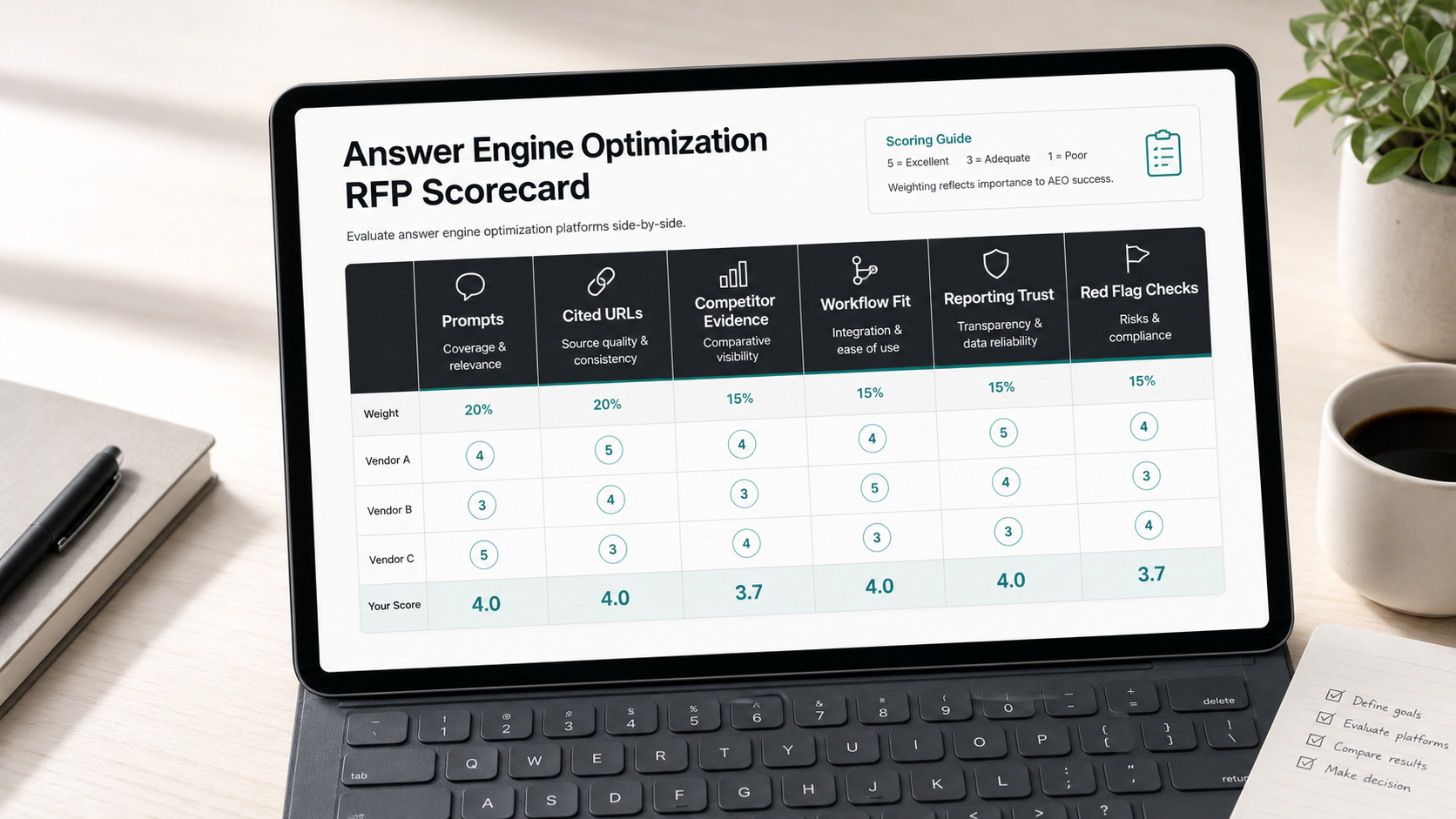
This guide sits between the answer engine optimization services buyer guide, the answer engine optimization pricing guide, and the AI search optimization agency scorecard. Use it when the task is vendor selection: deciding which agency, consultant, or AI visibility platform deserves a pilot.
What should an answer engine optimization RFP ask?
An answer engine optimization RFP should ask how the vendor defines the prompt set, captures raw AI answers, separates surfaces, extracts cited URLs, identifies competitor wins, assigns target pages, ships content fixes, and proves movement after publication. If the RFP only asks for deliverables, you will buy activity instead of evidence.
An answer engine optimization RFP is a vendor-evaluation document for choosing an agency, consultant, or platform that can improve visibility in AI answer surfaces such as ChatGPT, Perplexity, Gemini, Claude, and Google AI experiences. It should test measurement quality, workflow fit, source evidence, editorial judgment, and reporting accountability.
OpenAI describes ChatGPT search as answers with links to relevant web sources. Google says AI features in Search are connected to its normal Search systems and that site owners should focus on useful, accessible, crawlable content. The practical takeaway is simple: if a vendor cannot show which source page supported an AI answer, they cannot reliably improve that answer.
What is the fastest way to screen an AEO vendor?
The fastest way to screen an AEO vendor is to give every vendor the same 20-40 buyer prompts and ask them to return raw answers, cited URLs, mentioned brands, competitors, loss reasons, and one page-level fix queue. The vendor that produces the clearest evidence usually beats the vendor with the cleanest pitch deck.
Use this fast screen before you schedule long demos:
| RFP test | Good answer | Red flag |
|---|---|---|
| Prompt set | Custom prompts grouped by buyer intent | Generic "50 AI prompts" for every client |
| Surface coverage | ChatGPT, Perplexity, Gemini, Claude, and Google separated | One blended AI visibility score |
| Citation evidence | Raw answers and cited URLs available per run | Mentions counted without source links |
| Competitor handling | Competitors normalized and shown by prompt | Competitors hidden behind share-of-voice charts |
| Page ownership | One target URL assigned to each important prompt | "Create more content" with no URL owner |
| Fix workflow | Brief, update, publish, re-measure | Reporting only, no execution path |
| Reporting trust | Score maps back to visible evidence | Black-box score with no audit trail |
This test reduces time because you do not have to understand every feature before seeing whether the vendor can handle the actual job. It reduces effort because the same prompt set gives procurement, SEO, content, and leadership one shared comparison.
Which RFP questions expose weak AEO vendors?
The best RFP questions force vendors to explain evidence, not opinions. Ask how they collect answers, how they decide whether a brand was recommended, how they distinguish a citation from a mention, and how they know which page to fix after a competitor wins.
Ask these questions exactly:
| Question | What a strong answer includes |
|---|---|
| How do you build the prompt universe? | Buyer interviews, search vocabulary, sales questions, competitor prompts, failure-mode prompts, and intent buckets |
| How many prompts should we start with? | A pilot set of 40-80 prompts, with 20-40 acceptable for a fast diagnostic |
| Which AI surfaces do you track separately? | ChatGPT, Perplexity, Gemini, Claude, Google AI experiences, and any category-specific surfaces |
| Do you store raw answers? | Yes, with prompt, surface, timestamp, location or language settings, answer text, cited URLs, and scoring rule |
| How do you count recommendations? | Separate mention, recommendation, citation, first-named result, sentiment, and answer accuracy |
| How do you handle competitor citations? | Capture cited competitor URLs, classify loss reason, and map the fix to a target page |
| How do you choose between updating a page and creating a new one? | Update when a page already matches the prompt; create only when no existing URL can honestly own it |
| How do you prove the work moved the answer? | Re-run the same prompts after publication and compare target URL citation rate, recommendation rate, and answer accuracy |
The question most weak vendors hate is: "Show us three raw AI answers where a competitor won, the cited URL behind each answer, and the exact page fix you recommended." If they cannot answer that cleanly, the rest of the RFP will not save the engagement.
What deliverables should the RFP require?
Require deliverables that connect measurement to action: a prompt taxonomy, baseline visibility report, cited-source analysis, competitor source-gap report, page ownership map, content briefs, technical/schema recommendations, publication plan, and re-measurement report. Do not accept a monthly slide deck as the core deliverable.
Use this required deliverables table:
| Deliverable | Minimum standard | Why it matters |
|---|---|---|
| Prompt taxonomy | Prompts grouped by discovery, shortlist, comparison, alternatives, workflow, pricing, failure mode, branded, and proof | Prevents noisy blended reporting |
| Baseline report | Mention, recommendation, citation, target URL citation, competitor share, and answer accuracy by surface | Shows where the program starts |
| Source-gap analysis | Cited URLs that currently win against your target pages | Turns vague losses into page work |
| Page ownership map | One intended source URL for each high-value prompt | Prevents overlapping content |
| AEO content briefs | Direct answer, proof block, FAQ, internal links, schema, and CTA for each page | Gives writers a source plan |
| Technical checks | Crawlability, indexability, canonical, sitemap, schema, and page freshness | Keeps eligible pages eligible |
| Re-measurement | Same prompt wording after publication or update | Proves whether the fix changed the answer |
For page-level execution, the answer engine optimization checklist is the operating layer. For pre-draft alignment, use the answer engine optimization content brief. The RFP should require both when the vendor is responsible for content work.
How should you score AEO RFP responses?
Score AEO RFP responses by evidence quality first, workflow fit second, and commercial terms third. A cheaper vendor with weak source evidence can waste more money than an expensive vendor because it sends the team to fix the wrong pages.
Use this scoring model:
| Category | Weight | What to inspect |
|---|---|---|
| Evidence and data quality | 30% | Raw answers, cited URLs, timestamps, surfaces, scoring rules, exports |
| Prompt strategy | 20% | Custom prompt taxonomy, buyer intent, competitor prompts, failure modes |
| Content and page workflow | 20% | Briefs, editorial review, internal links, schema, publication, re-measurement |
| Reporting clarity | 15% | Surface separation, target URL citation rate, competitor movement, leadership summary |
| Team fit and operations | 10% | Cadence, ownership, review process, security expectations |
| Price and contract flexibility | 5% | Pilot length, exit terms, expansion path |
Do not overweight price in the first round. AEO is still a measurement-sensitive category. The wrong scoring method can make every downstream content decision look rational while being wrong.
What red flags should disqualify a vendor?
Disqualify vendors that guarantee AI rankings, hide raw answers, blend surfaces into one score, use generic prompt sets, treat mentions as recommendations, skip cited URL analysis, or cannot explain how a reported loss becomes a page fix. Those are not small gaps; they break the operating loop.
Use this red-flag checklist:
- They guarantee placement in ChatGPT, Perplexity, Gemini, Claude, or Google AI Overviews.
- They cannot export raw prompts, raw answers, cited URLs, and scoring rules.
- They report one blended visibility score without surface-level drilldown.
- They do not separate brand mentions, recommendations, citations, first-named rate, and answer accuracy.
- They count a competitor-cited answer as a win because your brand was mentioned.
- They recommend new articles before checking whether an existing URL should own the prompt.
- They have no re-measurement cadence after publishing.
- They sell AEO as link building with new language.
The simplest disqualifier: if the vendor cannot show the source path behind the answer, they cannot manage source ownership. That matters because answer engines can mention your brand while citing a competitor, publisher, marketplace, review site, or stale third-party page.
Should the RFP choose an agency, a tool, or a hybrid model?
Choose an agency when you need execution capacity, a tool when your team can act on the data, and a hybrid model when strategy should stay in-house but content production needs help. The wrong choice is buying a tool nobody uses or hiring an agency without enough evidence to manage them.
Use this decision table:
| Buying model | Best fit | Watch out for |
|---|---|---|
| AEO agency | You need strategy, writing, technical SEO, and reporting handled externally | Generic content, slow feedback loops, weak product knowledge |
| AI visibility tool | Your SEO or content team can ship fixes weekly | Data sits unused if nobody owns the workflow |
| Hybrid | You want internal strategy with external production or specialist support | Needs a clear owner for prompt set, QA, and publishing |
| Manual pilot | You are still validating demand or budget | Breaks down when prompts, surfaces, competitors, and exports scale |
For most lean B2B SaaS teams, the best first move is a tool-assisted pilot: define 40-80 prompts, track surfaces weekly, identify the top five source gaps, publish or refresh two pages, then re-measure. If that creates signal, expand into agency support only where internal execution is the bottleneck.
Tracemetry fits that pilot because it connects prompt tracking, cited URL evidence, competitor source monitoring, source-grounded briefs, publishing workflow, and re-measurement. Run the free audit for a first snapshot, then use features or pricing when you need a repeatable operating layer.
FAQ
What is an answer engine optimization RFP? An answer engine optimization RFP is a vendor-evaluation document for choosing an agency, consultant, or platform that can improve AI answer visibility. It should test prompt strategy, raw answer capture, cited URL evidence, competitor analysis, page fixes, reporting, and re-measurement.
What questions should I ask an AEO vendor? Ask how they build prompts, which AI surfaces they track, whether they store raw answers and cited URLs, how they separate mentions from recommendations, how they identify competitor source wins, and how they prove page fixes changed the answer.
How many prompts should be in an AEO vendor pilot? Start with 40-80 prompts for a useful pilot. Use 20-40 only for a fast diagnostic. Include discovery, shortlist, comparison, alternatives, workflow, pricing-adjacent, branded, proof, and failure-mode prompts so the results do not overfit broad definitions.
Should an AEO RFP require raw AI answers? Yes. Raw answers, cited URLs, timestamps, surfaces, and scoring rules are the audit trail. Without them, you cannot verify whether the vendor measured a real recommendation, a citation-only result, a competitor win, or a parsing mistake.
What is the biggest red flag in AEO services proposals? The biggest red flag is a black-box AI visibility score with no raw prompt evidence. Other red flags include guaranteed AI rankings, generic prompt sets, blended surface reporting, no cited URL analysis, and no page-level re-measurement plan.
Is an AEO tool better than an agency? An AEO tool is better when your team can act on the data and publish fixes. An agency is better when you lack execution capacity. A hybrid model often works best: internal owners keep the prompt strategy and product judgment, while outside help handles research, writing, or implementation.
Run the pilot before the annual contract
Do not let an AEO RFP become a theatrical procurement document. Give each vendor the same prompt set, demand raw evidence, score source ownership, and ask for one page fix queue. Then run a 30- or 60-day pilot before signing a long contract.
Start with the answer engine optimization services guide if you are still deciding whether to hire externally. Use which AI search optimization tool is most intuitive if the shortlist is mostly software. When you need the fastest baseline, run a Tracemetry audit and turn the first source gaps into a measurable pilot.
Sources: Google AI features and your website, Google AI optimization guide, Google structured data policies, OpenAI ChatGPT Search announcement, and OpenAI ChatGPT Search Help Center.
Frequently asked questions
What is an answer engine optimization RFP?
An answer engine optimization RFP is a vendor-evaluation document for choosing an agency, consultant, or platform that can improve AI answer visibility. It should test prompt strategy, raw answer capture, cited URL evidence, competitor analysis, page fixes, reporting, and re-measurement.
What questions should I ask an AEO vendor?
Ask how they build prompts, which AI surfaces they track, whether they store raw answers and cited URLs, how they separate mentions from recommendations, how they identify competitor source wins, and how they prove page fixes changed the answer.
How many prompts should be in an AEO vendor pilot?
Start with 40-80 prompts for a useful pilot. Use 20-40 only for a fast diagnostic. Include discovery, shortlist, comparison, alternatives, workflow, pricing-adjacent, branded, proof, and failure-mode prompts so the results do not overfit broad definitions.
Should an AEO RFP require raw AI answers?
Yes. Raw answers, cited URLs, timestamps, surfaces, and scoring rules are the audit trail. Without them, you cannot verify whether the vendor measured a real recommendation, a citation-only result, a competitor win, or a parsing mistake.
What is the biggest red flag in AEO services proposals?
The biggest red flag is a black-box AI visibility score with no raw prompt evidence. Other red flags include guaranteed AI rankings, generic prompt sets, blended surface reporting, no cited URL analysis, and no page-level re-measurement plan.
Is an AEO tool better than an agency?
An AEO tool is better when your team can act on the data and publish fixes. An agency is better when you lack execution capacity. A hybrid model often works best: internal owners keep the prompt strategy and product judgment, while outside help handles research, writing, or implementation.
See your own AI visibility today.
Free public report. 60 seconds. No signup. Or get started on Pro to track 250 prompts continuously.