Answer engine optimization for law firms: a practical playbook
A law-firm AEO workflow for tracking jurisdiction-specific questions, governing legal claims, strengthening source pages, and measuring qualified AI recommendations.
People now ask ChatGPT, Gemini, Perplexity, and Google AI experiences which lawyer handles a problem, what a claim may involve, and how to compare firms. The painful failure is not simply missing a citation. It is being recommended for the wrong jurisdiction, having an outdated fee or credential repeated, or losing a qualified inquiry to a competitor whose sources are easier to interpret.
Use this fast rule: track 40 high-intent legal questions for one practice area and jurisdiction, assign each question to one attorney-approved source page, and measure accurate recommendations separately from citations. Fix wrong facts before chasing more mentions.
This playbook builds on the local business AEO workflow, B2B source-page playbook, and AI answer accuracy monitoring guide. It is an operational framework for law-firm marketing and compliance teams, not legal advice or a promise of placement in any AI system.
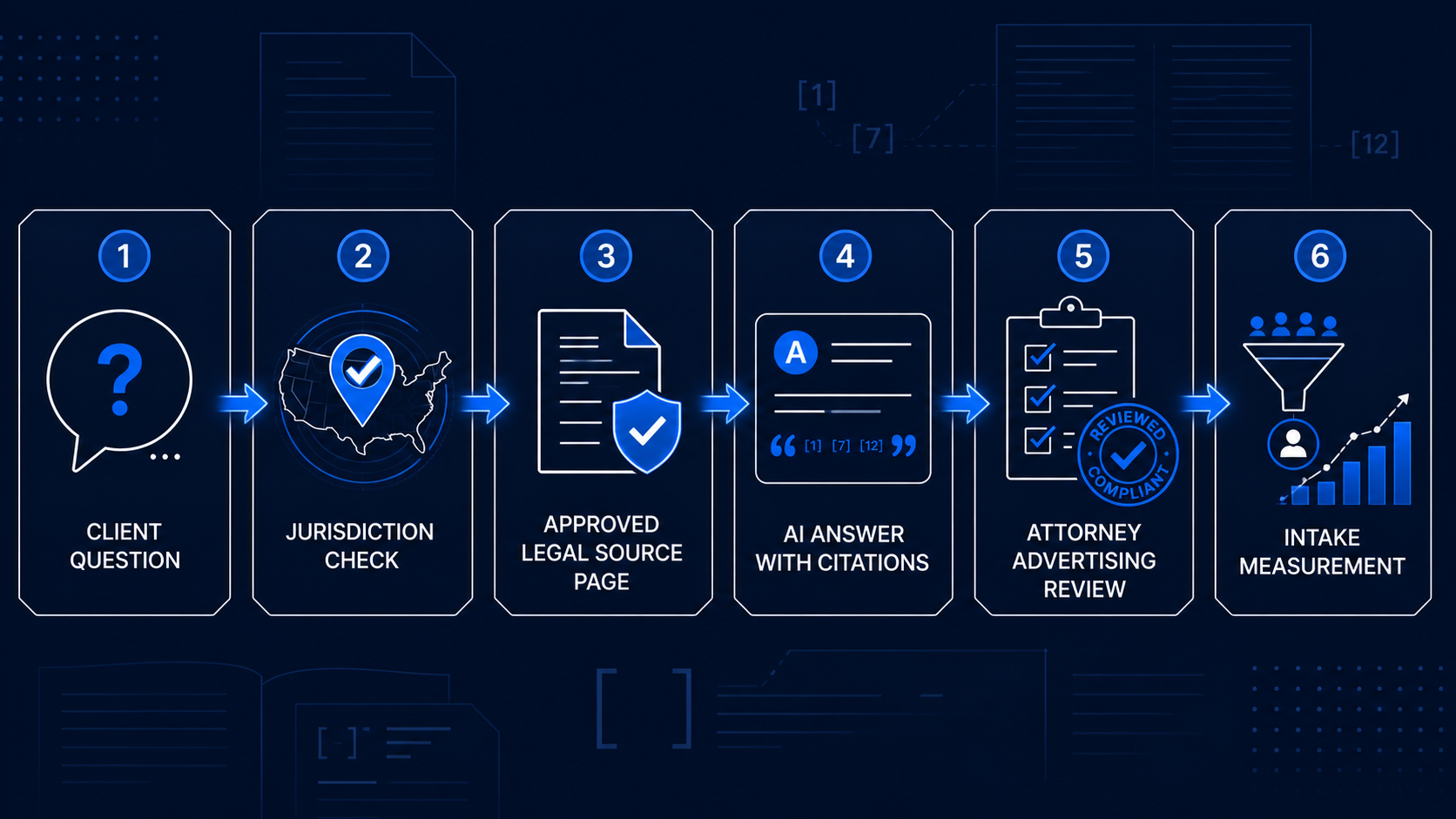
What is answer engine optimization for law firms?
Answer engine optimization for law firms is the process of improving how AI systems find, describe, cite, and recommend a legal practice. It connects prospective-client questions to accurate, jurisdiction-specific source pages, measures generated answers and citations, and routes misleading claims for attorney or compliance review.
Law-firm AEO is source-of-truth management for AI-assisted legal discovery. It complements local SEO, technical SEO, reputation work, useful legal education, and attorney-advertising review. It cannot guarantee a recommendation, determine whether someone has a claim, or replace advice from a qualified lawyer.
Which legal questions should a firm monitor first?
Monitor questions that reveal a real need and could produce a materially wrong recommendation. Start with one practice area, client type, and jurisdiction. A narrow cohort produces cleaner evidence than hundreds of generic prompts tested without location or legal context.
A practical 40-question cohort includes:
- 8 problem-recognition questions, such as “why does an insurer deny this type of claim?”;
- 8 lawyer-selection questions, such as “how do I choose a family law attorney in Austin?”;
- 6 jurisdiction and deadline questions;
- 6 fee, consultation, and process questions;
- 6 comparison and suitability questions;
- 6 failure-mode questions, such as “when should I not hire a contingency-fee lawyer?”
Include conversational wording: “what is the best way to find an employment lawyer for a small business?”, “when should I contact an attorney after an accident?”, and “how do I compare law firms if none publishes fees?” Treat every prompt as a measurement input, not a phrase that must be copied into a page.
Which page should own each law-firm answer?
Assign one primary page to each priority question. Practice-area pages should own services and scope, location pages should own jurisdiction and office facts, attorney profiles should own credentials, and editorial guides should explain decisions without competing with a conversion page.
| Prospective-client question | Best source-page owner | Facts that must stay current |
|---|---|---|
| “Does this firm handle my type of matter?” | Practice-area page | Scope, exclusions, client type, jurisdiction |
| “Can this lawyer work in my state?” | Attorney profile or location page | Admissions, offices, service area, limitations |
| “How much will representation cost?” | Fees or consultation page | Fee model, conditions, expenses, no-guarantee language |
| “What happens in the first consultation?” | Intake or consultation page | Process, documents, privacy, next step |
| “Which lawyer is best for this issue?” | Decision guide plus attorney profiles | Relevant experience, selection criteria, substantiated claims |
| “How long do I have to act?” | Attorney-reviewed legal guide | Jurisdiction, exceptions, effective date, review date |
If several pages make the same claim, choose an owner and link supporting pages to it. Do not create another near-duplicate article merely because an AI answer cited the wrong URL.
How do you build a reliable law-firm AEO baseline?
Capture the exact prompt, complete answer, cited URLs, engine, timestamp, test location, and intended source page. Then classify the result for recommendation, source ownership, jurisdictional accuracy, claim accuracy, and intake relevance. A citation is not a win if the answer describes the firm incorrectly.
Use two queues:
- Accuracy queue: wrong jurisdictions, attorney status, services, fees, deadlines, outcomes, contact details, or other consequential claims.
- Visibility queue: absent recommendations, competitor citations, weak source ownership, inaccessible pages, and unclear decision content.
Correct consequential errors first. Preserve screenshots or raw answer evidence so the team can distinguish a source correction from ordinary answer variation. The wrong AI answers response guide explains how to document and prioritize these failures.
What makes a legal page easier for AI systems to cite accurately?
A citable law-firm page answers one defined question early, identifies the relevant jurisdiction and audience, supports factual claims, and states meaningful limitations. It also gives the reader a useful next step without implying an attorney-client relationship or guaranteeing an outcome.
Use this source-page checklist:
- Put a 40–80 word direct answer below the relevant heading.
- Name the practice area, jurisdiction, client type, and factual effective date.
- Separate general legal education from advice about an individual matter.
- Keep biographies, admissions, awards, case results, fees, and office facts substantiated.
- Explain selection criteria and tradeoffs instead of declaring the firm “best.”
- Show an attorney reviewer and review date on consequential legal content.
- Link naturally to the relevant attorney, practice, location, intake, and evidence pages.
- Maintain crawlable HTML, a valid canonical, sitemap inclusion, descriptive titles, and visible-content schema.
Google's structured data policies require markup to represent visible page content. The American Bar Association's Model Rules of Professional Conduct provide a general framework for lawyer communications, but applicable advertising and ethics rules vary by jurisdiction. Have qualified counsel review claims and workflows for the markets where the firm operates.
How should firms handle jurisdiction and attorney-advertising risk?
Treat jurisdiction, credentials, outcomes, and comparative claims as governed data. Every material statement needs an owner, approved source, review date, applicable market, and escalation path. A generic disclaimer cannot repair a specific misleading claim.
Review these items before optimization work ships:
- whether the page clearly identifies the jurisdictions it covers;
- whether attorney admissions, certifications, titles, and office locations are current;
- whether testimonials, awards, and case results carry required context;
- whether “specialist,” “expert,” “best,” and comparison language is permitted and supportable;
- whether fee statements explain conditions and expenses accurately;
- whether intake copy avoids promising representation, confidentiality, or an outcome before the firm's process establishes it;
- whether time-sensitive legal explanations show a review date and meaningful limitations.
AI systems can combine claims from multiple sources. Audit major directories, profiles, press mentions, and review platforms alongside the firm's site, then correct the sources the firm controls. For third-party errors, document the discrepancy and use the platform's correction process rather than publishing contradictory copy everywhere.
Which law-firm AEO metrics matter?
Qualified recommendation rate is the clearest commercial metric: the share of relevant answers that accurately recommend the firm for the tested practice, client, and jurisdiction. Pair it with target-page citation rate, material-claim accuracy, source ownership, and qualified intake evidence.
| Metric | What it answers | Important caveat |
|---|---|---|
| Qualified recommendation rate | Is the firm suggested for a relevant matter and market? | A mention outside scope is not qualified |
| Material-claim accuracy | Are services, credentials, fees, and jurisdictions correct? | Requires human review |
| Target-page citation rate | Does the intended source page earn the citation? | A citation does not prove accurate interpretation |
| Source ownership | Which owned or third-party URL shapes the answer? | More owned citations are not always better than authoritative evidence |
| Qualified AI-assisted intake | Do suitable inquiries mention an AI discovery path? | Self-reporting and attribution are incomplete |
Do not collapse these into one opaque visibility score. Keep the underlying prompts, answers, citations, and classification rules auditable. Connect AI-assisted inquiries to signed matters only with appropriate privacy controls and honest attribution limits.
What law-firm AEO mistakes waste the most time?
The biggest mistake is publishing dozens of generic legal articles before checking whether AI answers misunderstand the firm's services, jurisdiction, or credentials. More pages create more maintenance and contradiction when source ownership is already unclear.
Avoid these patterns:
- testing prompts without a location, practice area, or client context;
- treating every brand mention as a qualified recommendation;
- copying deadline or eligibility language across unmanaged pages;
- creating city pages with no useful local or jurisdictional information;
- using schema to imply credentials, ratings, services, or reviews absent from the page;
- publishing unsupported “best lawyer” claims to match comparison prompts;
- measuring citations while ignoring wrong facts and unsuitable inquiries;
- promising that content, links, reviews, or markup will guarantee AI placement.
FAQ
Does answer engine optimization replace law-firm SEO?
No. Technical accessibility, useful pages, local profiles, authority, internal links, reviews, rankings, and conversion paths still matter. Law-firm AEO adds direct measurement of AI recommendations, citations, source ownership, jurisdictional accuracy, competitors, and material claims.
How many AI prompts should a law firm track?
Start with about 40 high-intent questions for one practice area, client type, and jurisdiction. Expand only after the team can preserve evidence, review answers, assign source pages, correct errors, and repeat the stable cohort consistently.
What is the best law-firm AEO metric?
Qualified recommendation rate is the clearest commercial metric. Pair it with material-claim accuracy and target-page citation rate so a result counts only when the firm fits the tested need, is described correctly, and the intended source appears.
Can legal schema guarantee an AI citation?
No. Structured data can clarify visible entities and facts for systems that use it, but it does not guarantee retrieval, ranking, citation, or recommendation. It cannot compensate for thin, contradictory, outdated, or misleading content.
How often should law-firm AI answers be checked?
Recheck affected prompts after material changes to services, admissions, offices, fees, personnel, or legal guidance. During a pilot, review priority questions weekly and maintain a scheduled source audit with attorney or compliance ownership.
What is the first AEO action a law firm should take?
Choose 40 high-intent questions for one practice and jurisdiction, record the current answers and citations, and flag every wrong material claim. Correct jurisdiction, service, credential, fee, and contact errors before commissioning new content.
Build an accountable legal-discovery workflow
Law-firm AEO works when marketing, attorneys, intake, web operations, and compliance share the same evidence. Start narrow, fix the most consequential inaccuracies, strengthen the intended source pages, and recheck unchanged questions. Book a Tracemetry demo to monitor AI answers, cited sources, competitors, and claim changes in one recurring workflow.
Frequently asked questions
Does answer engine optimization replace law-firm SEO?
No. Technical accessibility, useful pages, local profiles, authority, internal links, reviews, rankings, and conversion paths still matter. Law-firm AEO adds direct measurement of AI recommendations, citations, source ownership, jurisdictional accuracy, competitors, and material claims.
How many AI prompts should a law firm track?
Start with about 40 high-intent questions for one practice area, client type, and jurisdiction. Expand only after the team can preserve evidence, review answers, assign source pages, correct errors, and repeat the stable cohort consistently.
What is the best law-firm AEO metric?
Qualified recommendation rate is the clearest commercial metric. Pair it with material-claim accuracy and target-page citation rate so a result counts only when the firm fits the tested need, is described correctly, and the intended source appears.
Can legal schema guarantee an AI citation?
No. Structured data can clarify visible entities and facts for systems that use it, but it does not guarantee retrieval, ranking, citation, or recommendation. It cannot compensate for thin, contradictory, outdated, or misleading content.
How often should law-firm AI answers be checked?
Recheck affected prompts after material changes to services, admissions, offices, fees, personnel, or legal guidance. During a pilot, review priority questions weekly and maintain a scheduled source audit with attorney or compliance ownership.
What is the first AEO action a law firm should take?
Choose 40 high-intent questions for one practice and jurisdiction, record the current answers and citations, and flag every wrong material claim. Correct jurisdiction, service, credential, fee, and contact errors before commissioning new content.
Make your next SEO decision with better evidence.
Explore practical guides to AI visibility, source citations, and choosing the right tools for your team.