AEO Agency vs Software: Which Operating Model Should You Choose?
Compare an AEO agency, software, in-house, and hybrid models using a practical decision framework, cost checklist, readiness test, and 90-day pilot.
Choosing between an answer engine optimization agency and software is not really a vendor decision. It is an operating-model decision: who will inspect AI answers, decide what to fix, publish the change, and prove the answer moved?
Use this fast rule: choose software when your team can already execute from evidence, choose an agency when execution capacity or specialist judgment is missing, and choose a hybrid when internal experts must retain control while an outside team accelerates the work.
What is the difference between an AEO agency and AEO software?
An AEO agency provides people, judgment, and execution; AEO software provides repeatable measurement, evidence, and workflow. An agency can interpret losses and ship work for you. Software can monitor more questions consistently and preserve the raw answers and citations, but it still needs an accountable team to act on what it finds.
Answer engine optimization software is a platform that tracks how AI answer systems mention, recommend, describe, and cite a brand across a defined set of questions. Good software preserves the prompt, answer, cited URLs, competitors, timestamp, and scoring logic behind each metric.
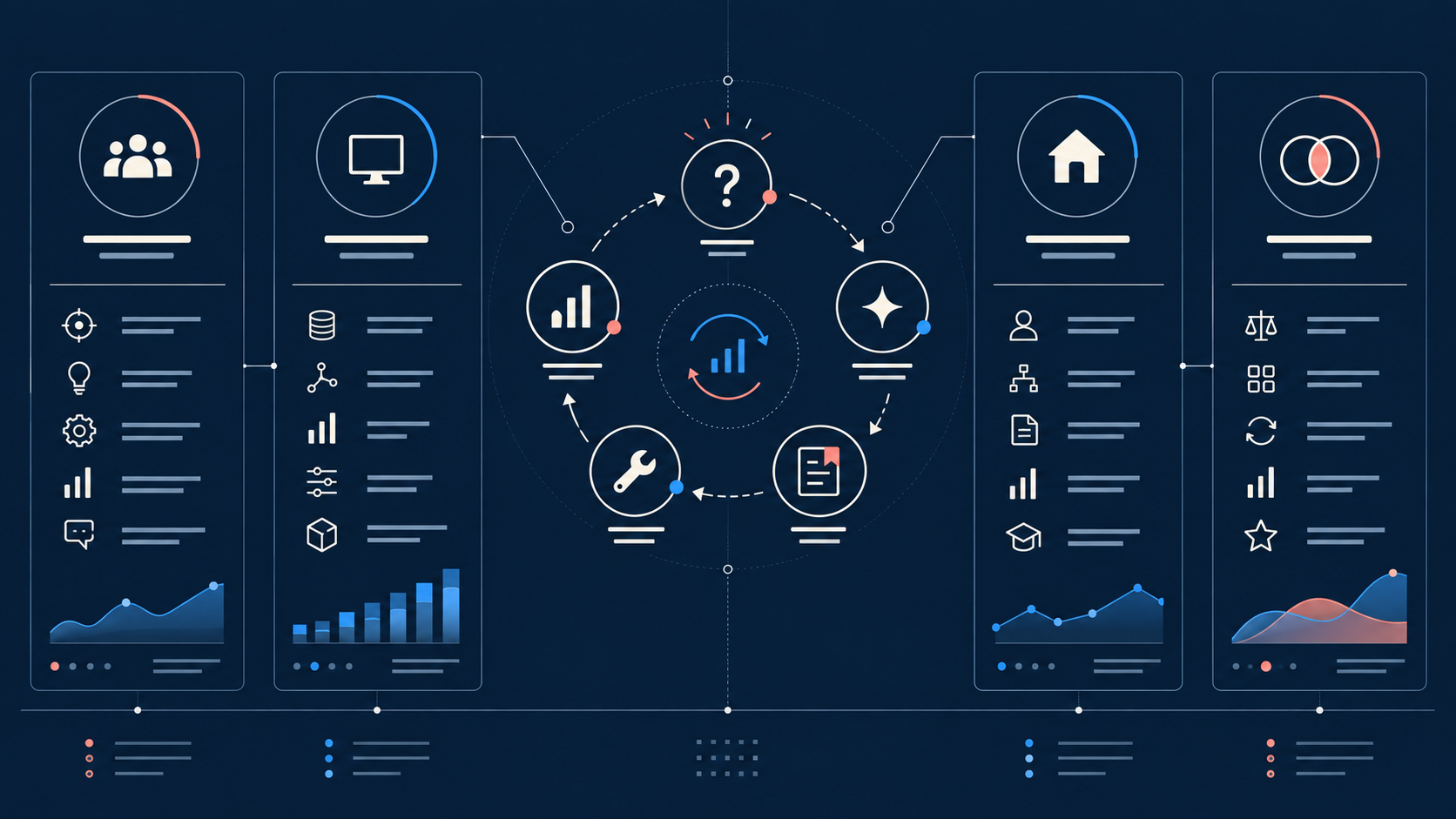
The distinction matters because neither option completes the entire loop automatically:
- Ask commercially important buyer questions.
- Preserve the answers, recommendations, and cited sources.
- Map each loss to the page that should own the answer.
- Improve the page, technical path, product facts, or third-party evidence.
- Publish and verify the change.
- Repeat the same test and judge whether the result improved.
Software is strongest at steps one, two, and six. Agencies are usually strongest at steps three through five. Your internal experts remain essential whenever the answer depends on product truth, legal approval, technical accuracy, or commercial priorities.
Should you choose an AEO agency, software, or a hybrid?
Choose the model that closes your largest capability gap. If measurement is unreliable but your SEO and content teams ship quickly, buy software. If you have evidence but fixes stall, hire execution help. If claims require internal approval and the program spans many teams, use a hybrid with one internal owner.
| Situation | Best model | Why |
|---|---|---|
| Strong SEO, content, and engineering team | Software | The team needs evidence and remeasurement, not another production layer |
| No AEO method and limited execution capacity | Agency-led pilot | External specialists can establish the baseline and ship the first fixes |
| Regulated, technical, or enterprise company | Hybrid | Internal experts control claims while specialists accelerate analysis and delivery |
| Small company with 20–40 important questions | In-house plus software | A focused owner can run a lean weekly loop without a large retainer |
| Many regions, products, or agencies | Software-led governance | One evidence layer prevents every partner from inventing its own score |
| Leadership wants strategy but the team can execute | Consultant plus software | Short-term operating design avoids permanent outsourced dependency |
Do not default to a hybrid because it sounds safest. A hybrid with vague responsibilities creates two dashboards, three meetings, and no owner. Use the AEO team structure guide to assign decision rights before adding another vendor.
When is AEO software the better choice?
AEO software is the better choice when an internal team can turn a lost answer into a page-level action and ship it. The platform should reduce the cost of collecting evidence, comparing competitors, organizing question cohorts, and rechecking outcomes. It should not merely generate a visibility score for a monthly slide.
Software is usually the right first purchase when you already have:
- an SEO, growth, or content leader who can own the program;
- writers or subject experts who can improve source pages;
- engineering access for crawlability, schema, templates, and internal links;
- a review path for product, legal, medical, or technical claims;
- a weekly cadence for prioritizing and verifying changes.
Before buying, ask to click from every chart to the exact prompt, answer, cited URL, AI surface, and timestamp that produced it. Then export the evidence. If a platform cannot support that audit trail, its attractive score may create activity without trustworthy decisions.
The AI visibility tools comparison explains the feature layer. The harder test is operational: can your team move from a competitor citation to one intended page, one owner, and one recheck date in under ten minutes?
When is an AEO agency the better choice?
An AEO agency is the better choice when the company lacks specialist judgment, production capacity, or cross-functional coordination. A credible agency should diagnose why a competitor owns an answer, propose the smallest defensible intervention, help publish it, and show the comparable before-and-after evidence.
Hire an agency when:
- no one internally can translate AI-answer evidence into a fix queue;
- content, digital PR, or technical implementation is consistently blocked;
- a new market or product needs a fast baseline and pilot;
- leadership needs an outside assessment before funding a larger program;
- multiple teams need a common methodology and facilitated rollout.
Require a controlled pilot before a long contract. Give shortlisted agencies the same 20–40 buyer questions and ask each to show the complete chain: observed answer, cited source, target page, recommended intervention, owner, acceptance criteria, and remeasurement method.
Use the AI search optimization agency scorecard for evaluation and the AEO RFP questions to expose black-box measurement, generic prompt sets, and content-volume contracts.
What does each option actually cost?
Compare total operating cost, not only the subscription or retainer. Software adds internal analysis and execution time. An agency adds management, approvals, and knowledge-transfer risk. In-house programs add payroll and opportunity cost. The cheapest invoice can become the most expensive model if nobody completes the evidence-to-fix loop.
| Cost component | Software | Agency | Hybrid |
|---|---|---|---|
| Platform and data | Primary external cost | Often bundled or marked up | Shared evidence layer |
| Strategy and diagnosis | Internal team | Agency | Joint |
| Content and technical execution | Internal team | Included or separately scoped | Split by capability |
| Product and claim review | Internal team | Still internal | Internal team |
| Program management | Internal owner | Agency plus client owner | Strong internal owner required |
| Knowledge retention | High if documented | Risk at contract end | High when evidence and decisions stay internal |
Ask for pricing against a defined scope: number of questions, AI surfaces, markets, recheck frequency, pages improved, technical deliverables, authority work, approvals, and reporting. The AEO pricing guide provides a fuller scope checklist.
How do you avoid buying a dashboard that nobody uses?
Tie the purchase to a weekly operating ritual before signing. Every week, the owner should review the highest-value lost questions, inspect the evidence, assign a small number of source fixes, verify published changes, and schedule rechecks. If no one has time or authority to do this, software will become shelfware.
Use this five-question readiness check:
- Who owns the fixed question cohort and its definitions?
- Who decides which page should own each answer?
- Who can approve and publish a change?
- Who checks that the change reached production correctly?
- Who judges the repeated answer evidence and chooses the next action?
If any answer is “the vendor,” clarify what happens when the contract ends. Your company should retain the questions, raw answers, cited sources, page mappings, change log, and decision history.
How do you avoid an agency engagement that creates dependency?
Keep source ownership, factual approval, raw evidence, and prioritization inside the company. The agency can accelerate research and execution, but an internal owner should understand why each change was selected and how the result was measured. Require exports, shared documentation, and capability transfer from the first month.
A clean responsibility split looks like this:
- Internal owner: scope, commercial priorities, source ownership, approvals, and final decisions.
- Agency: diagnosis, content or technical production, authority work, QA, and documented recommendations.
- Software: prompt runs, answer evidence, citations, competitors, trends, and remeasurement.
- Subject experts: factual truth, qualifications, and risk review.
- Analytics or revenue: referrals, conversions, pipeline evidence, and uncertainty.
This division prevents the agency from grading its own work with an invisible method. It also prevents the internal team from treating every weak result as a vendor problem when publishing or approvals were the real bottleneck.
What should a 90-day selection pilot include?
A 90-day pilot should prove the operating loop, not promise universal visibility. Lock one audience, product, market, and set of important questions. Preserve the baseline, ship three to five meaningful fixes, repeat the same tests, and document what the team learned—even when the answers do not move.
Days 1–30: establish evidence
- Lock 20–40 definition, selection, comparison, pricing, objection, and failure-mode questions.
- Capture complete answers, recommendations, citations, competitors, and material inaccuracies.
- Assign every priority question to an intended source page.
- Choose three to five interventions with owners and acceptance criteria.
Days 31–60: ship fixes
- Improve direct answers, proof, comparisons, entity clarity, and qualifications.
- Fix crawlability, canonicals, internal discovery, or schema where evidence supports it.
- Publish missing decision pages only when an existing page cannot own the question cleanly.
- Keep a dated change log and verify every production URL.
Days 61–90: remeasure and decide
- Repeat the unchanged cohort under comparable conditions.
- Inspect raw answers rather than trusting only aggregate scores.
- Separate visibility, recommendation, citation, accuracy, and commercial outcomes.
- Continue only if the model produces trustworthy evidence and completed work.
Which metrics should decide whether the model is working?
Use separate metrics for different outcomes: qualified recommendation rate for buyer visibility, target-page citation rate for source ownership, answer accuracy for factual quality, and verified fix rate for execution. Add AI referral and conversion evidence when available, but do not pretend that every influenced decision produces a trackable click.
Track qualified recommendation rate, domain and target-page citation rate, competitor source share, material-claim accuracy, time from detected loss to verified fix, percentage of fixes remeasured, and AI-referred conversions where observable.
Preserve counts and denominators behind every percentage. AI answers vary, so one screenshot is evidence of one output, not proof of a trend. The AEO metrics guide defines a practical measurement stack.
FAQ
Is AEO software enough without an agency?
Yes, when your internal team can interpret answer evidence, choose target pages, publish content and technical changes, and remeasure results. Software supplies the measurement layer; it does not replace product judgment, editorial work, engineering, or authority building.
When should a company hire an AEO agency?
Hire an agency when specialist diagnosis or execution capacity is the main constraint. Start with a controlled 90-day pilot, retain access to raw evidence, and require every recommendation to map to a specific answer, source page, owner, and recheck.
What is the best AEO operating model for an enterprise?
A hybrid is usually strongest: a central internal owner controls governance and source truth, business teams approve facts, software provides consistent evidence, and specialist agencies support execution by market or capability.
Can an AEO agency guarantee ChatGPT or AI citations?
No. An outside provider cannot control generated answers or guarantee a placement. It can commit to a transparent method, defined deliverables, verified publishing, preserved evidence, and comparable remeasurement.
How many questions should an AEO pilot track?
Start with 20–40 commercially important questions for one audience, product, market, and buyer journey. A focused cohort is easier to inspect, improve, and repeat than hundreds of loosely governed prompts.
How should we compare an AEO platform and an agency proposal?
Compare the complete cost and capability chain: evidence collection, diagnosis, content, technical execution, approvals, publishing, remeasurement, reporting, data ownership, and knowledge transfer. The proposal that closes your actual capability gap is the better value.
Choose the bottleneck, then choose the model
The right AEO model is the one that turns evidence into verified change every week. If your team can already ship, give it reliable software. If it cannot, buy targeted execution help. If factual control and specialist speed both matter, use a hybrid with one internal owner and one shared evidence layer.
Book a Tracemetry demo to inspect the questions, answers, citations, competitor sources, and remeasurement workflow your team or agency should operate from.
Frequently asked questions
Is AEO software enough without an agency?
Yes, when your internal team can interpret answer evidence, choose target pages, publish content and technical changes, and remeasure results. Software supplies the measurement layer; it does not replace product judgment, editorial work, engineering, or authority building.
When should a company hire an AEO agency?
Hire an agency when specialist diagnosis or execution capacity is the main constraint. Start with a controlled 90-day pilot, retain access to raw evidence, and require every recommendation to map to a specific answer, source page, owner, and recheck.
What is the best AEO operating model for an enterprise?
A hybrid is usually strongest: a central internal owner controls governance and source truth, business teams approve facts, software provides consistent evidence, and specialist agencies support execution by market or capability.
Can an AEO agency guarantee ChatGPT or AI citations?
No. An outside provider cannot control generated answers or guarantee a placement. It can commit to a transparent method, defined deliverables, verified publishing, preserved evidence, and comparable remeasurement.
How many questions should an AEO pilot track?
Start with 20–40 commercially important questions for one audience, product, market, and buyer journey. A focused cohort is easier to inspect, improve, and repeat than hundreds of loosely governed prompts.
How should we compare an AEO platform and an agency proposal?
Compare the complete cost and capability chain: evidence collection, diagnosis, content, technical execution, approvals, publishing, remeasurement, reporting, data ownership, and knowledge transfer. The proposal that closes your actual capability gap is the better value.
Make your next SEO decision with better evidence.
Explore practical guides to AI visibility, source citations, and choosing the right tools for your team.