Wrong AI answers about your brand: how to fix the source
A practical workflow for fixing wrong AI answers about your brand: capture evidence, find the source, update the right page, align schema, add links, and re-measure.
Wrong AI answers about your brand are not a reputation problem first. They are a source-of-truth problem. The painful version is simple: a buyer asks ChatGPT, Perplexity, Gemini, Claude, or Google AI Overviews about your category, and the answer repeats old pricing, misstates your features, recommends a competitor, or cites the wrong page.
Use the fast rule: do not start by arguing with the answer. Save the exact prompt, identify the cited or likely source, update the page that should be trusted, link to it from related pages, and re-measure the same prompt. If you cannot point to the public URL that should make the answer true, the answer engine cannot reliably do it either.
This guide extends AI answer accuracy monitoring, AI search sentiment monitoring, and AI answer volatility tracking. Use it when the question is urgent: "How do we fix the wrong thing AI keeps saying about us?"
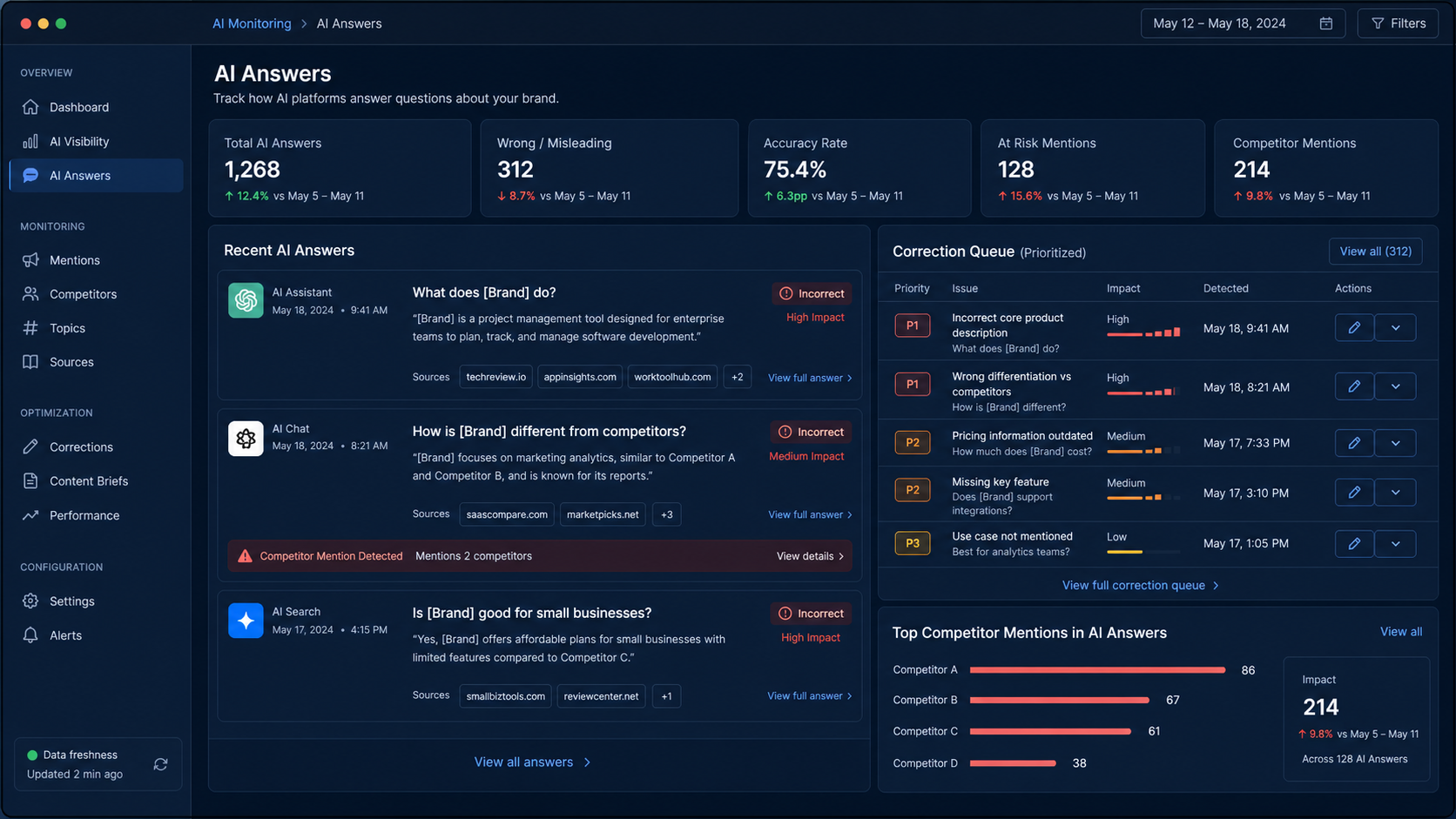
Why do AI answers say wrong things about your brand?
AI answers usually get your brand wrong because the public evidence is inconsistent, stale, vague, or easier to retrieve from a competitor than from you. The assistant may summarize an old pricing page, a third-party comparison, a weak category page, or schema that does not match visible copy.
Wrong AI answers about your brand are generated claims that misdescribe your product, pricing, audience, features, competitors, support, security, integrations, or category fit. The fix is not one magic metadata field. The fix is making the correct public source clearer than the wrong public source.
OpenAI describes ChatGPT Search as using web sources when search is active. Google says AI features use eligible web content and can link to supporting pages. Google also says structured data should represent content visible to users. That creates a practical rule: the correction has to be visible, specific, and source-backed on the page you want answer engines to trust.
What should you do first when an AI answer is wrong?
First, preserve the evidence before editing anything. Capture the prompt, surface, date, full answer, cited URLs, brands named, competitor recommendation order, and the exact wrong sentence. Then classify the error and pick the URL that should own the corrected answer.
Use this 20-minute triage:
- Save the raw answer. Keep the exact prompt, answer text, citations, surface, market, and timestamp.
- Label the mistake. Pick stale, incomplete, misleading, factually wrong, competitor-shaped, or unverifiable.
- Inspect cited URLs first. If the answer cites a page, read that page before touching your own copy.
- Find the likely source. Check pricing, homepage, product pages, docs, comparisons, directories, reviews, and old announcement posts.
- Choose one source of truth. Decide which URL should answer this prompt next time.
- Update visible copy. Add the correction in the first screen, a direct-answer block, a table, and FAQ text where useful.
- Align metadata and schema. Make titles, descriptions, canonical URL, Article/FAQ schema, and visible content say the same thing.
- Add internal links. Link to the corrected page from related pages that already have authority.
- Re-measure the same prompt. Use the same wording after the next crawl or update window.
The dumb move is rewriting ten pages because one answer looked bad. The useful move is finding the smallest source fix that makes the wrong answer less plausible.
Which wrong-answer pattern are you dealing with?
Most wrong brand answers fall into a small set of patterns. The pattern matters because each one has a different fix. A stale pricing claim is not fixed the same way as a competitor-owned comparison answer.
| Wrong AI answer pattern | Likely source problem | First fix |
|---|---|---|
| Old pricing or packaging | Old pricing page, cached docs, old listicle, outdated comparison | Update pricing, product copy, docs, and comparison pages together |
| Missing feature | Feature lives only in dashboard UI, changelog, or sales deck | Add plain feature language to the product page and relevant use-case pages |
| Wrong ideal customer | Homepage uses vague positioning or outdated ICP language | Add explicit audience, use cases, exclusions, and examples |
| Competitor recommended above you | Their comparison or review source is clearer than yours | Improve comparison, alternatives, proof, and source ownership pages |
| You mentioned but not cited | Brand awareness exists; source path is weak | Add direct answers, cited proof, tables, FAQ, and internal links |
| Wrong page from your site cited | Internal topology is ambiguous | Clarify titles, H2s, anchors, canonical URLs, and related links |
| Negative caveat repeated | Review, forum, competitor page, or old objection is easy to retrieve | Publish current proof and answer the objection visibly |
| Unsupported praise or criticism | Answer has no reliable source path | Add evidence or stop relying on that claim |
If the answer cites a competitor or publisher, do not copy their structure blindly. Identify why their page is easier to summarize: direct answer, clear table, current date, named entities, external proof, or better internal links. Then fix your page with the missing element.
How do you rewrite the source page so AI can correct itself?
Rewrite the intended source page like a retrieval target, not a brochure. Put the corrected answer near the top, use plain entity language, include a compact comparison or decision table, cite proof where factual claims need support, and keep schema aligned with visible copy.
Use this page-fix checklist:
- Add a 40-80 word answer under the H1 or first matching H2.
- Name the product, category, audience, use case, and region in normal language.
- State what changed if the answer is stale: pricing, feature coverage, integration, policy, market, or package.
- Add a table that separates "true now" from "not true" or "best fit" from "not best fit."
- Link to the canonical product, pricing, comparison, or docs page from the corrective section.
- Add visible FAQ answers that match FAQ schema exactly.
- Update
dateModified, page title, meta description, and OpenGraph copy when the correction changes the page meaning. - Link from related cluster pages such as content that AI cites, schema markup for AI search, and AI visibility tracking.
For answer engine optimization, the page should make one sentence easy to extract: "For this buyer question, this URL is the current source of truth." Do not hide that sentence in schema only. Put it where a human can read it.
Should you update your site or a third-party source?
Update your site first when the wrong answer concerns your product, pricing, features, docs, or positioning. Update third-party sources when the answer cites a review, directory, partner page, analyst list, marketplace profile, public docs mirror, or competitor comparison that contains outdated information.
Use this decision table:
| Situation | Better first move | Why |
|---|---|---|
| Your pricing is wrong | Update pricing, product, and comparison pages | Your site should be the canonical source |
| A review profile has stale facts | Correct the profile and add current proof on your site | The answer may retrieve both |
| A competitor comparison misframes you | Publish or update your own comparison page | You need a retrievable counter-source |
| A directory lists the wrong category | Update directory, partner, and profile pages | Entity categorization can spread across sources |
| A forum answer is outdated | Publish a clear source page and link to it where appropriate | You cannot control the forum, but you can create a better source |
| AI cites your wrong URL | Fix internal links, headings, canonical, and page purpose | Source selection is confused |
Owned pages are faster to fix. Third-party pages are often harder but more durable once corrected. For high-intent prompts, do both.
How long does it take for wrong AI answers to change?
Expect changes to take days to weeks, not minutes. Web-connected answers can update faster when a fresh source is crawled and retrieved, but generated answers can still vary by surface, query wording, location, user context, and which sources the assistant chooses for that run.
Use this cadence:
| Correction type | Re-measure window | What to watch |
|---|---|---|
| Owned page copy update | 7-14 days | Does the target URL get cited or summarized? |
| Pricing or product change | Daily for 14 days | Do stale claims disappear from high-intent prompts? |
| Comparison-page update | Weekly for 4 weeks | Does recommendation order or caveat language change? |
| Directory/profile correction | 2-6 weeks | Does the third-party source stop reinforcing the error? |
| New source page | 2-8 weeks | Does the page enter citations for the target prompt set? |
Do not declare success from one good answer. Use AI answer volatility tracking to confirm the correction holds across repeated runs.
What should a wrong-answer correction workflow include?
A useful correction workflow includes raw evidence, one source-of-truth URL, a visible page fix, schema alignment, internal links, third-party cleanup when needed, and a re-measure date. If the workflow does not end in a specific URL and owner, it will drift.
Use this workflow inside your weekly AI visibility process:
| Step | Output | Owner |
|---|---|---|
| Capture | Prompt, surface, answer, citations, screenshot | SEO or growth |
| Classify | Error label and business risk | Growth lead |
| Source audit | Cited URL, likely source, intended source | SEO/content |
| Fix | Page update, proof, schema, internal links | Content/product marketing |
| External cleanup | Directory, review, partner, or profile update | Partnerships or marketing |
| Re-measure | Same prompt, same surface, new answer evidence | SEO or growth |
| Report | Before/after summary and next action | Growth lead |
This is where AI brand monitoring alerts matter. You do not need an alert for every wording change. You need alerts for wrong pricing, missing features, negative competitor framing, lost citations on bottom-funnel prompts, and stale claims after launches.
FAQ
How do I fix wrong AI answers about my brand? Save the exact answer, inspect cited URLs, classify the mistake, pick the source-of-truth page, update visible copy and schema, add internal links from related pages, correct third-party sources if needed, and re-measure the same prompt after the next crawl window.
Can I contact OpenAI, Google, Perplexity, or Anthropic to correct an answer? For ordinary brand and product inaccuracies, the practical path is to correct the public sources the answer can retrieve. Platform feedback can help report a bad answer, but durable correction usually comes from clearer owned pages, updated third-party profiles, and consistent source signals.
Why does ChatGPT cite the wrong page from my site? ChatGPT or another assistant may cite the wrong page when your internal links, titles, headings, or page purposes overlap. Clarify the intended source page, make its direct answer stronger, and link to it from related pages so the source choice is less ambiguous.
Should I create a new blog post to correct a wrong AI answer? Create a new post only when no existing URL directly answers the prompt. If the wrong answer is about pricing, features, integration, support, or product fit, update the canonical product, pricing, docs, or comparison page first.
How often should I check whether the correction worked? Check high-risk prompts daily for 14 days around launches, pricing changes, incidents, or rebrands. For normal operations, re-measure weekly and require repeated improvement before calling the correction stable.
What is the best metric for wrong AI answer fixes? Use target URL citation rate plus answer accuracy. The correction is working when the intended URL is cited or clearly summarized and the answer changes from wrong, stale, or misleading to accurate enough for a buyer.
Fix the source, then re-measure
Run the free Tracemetry audit to capture how AI answers mention your brand today. If the snapshot shows stale claims, competitor framing, or missing citations, use Tracemetry Pro to monitor the full prompt set, assign source fixes, and confirm whether the same answers improve over time.
Sources: OpenAI ChatGPT Search, Google AI features and your website, Google structured data guidelines, Google structured data introduction.
Frequently asked questions
How do I fix wrong AI answers about my brand?
Save the exact answer, inspect cited URLs, classify the mistake, pick the source-of-truth page, update visible copy and schema, add internal links from related pages, correct third-party sources if needed, and re-measure the same prompt after the next crawl window.
Can I contact OpenAI, Google, Perplexity, or Anthropic to correct an answer?
For ordinary brand and product inaccuracies, the practical path is to correct the public sources the answer can retrieve. Platform feedback can help report a bad answer, but durable correction usually comes from clearer owned pages, updated third-party profiles, and consistent source signals.
Why does ChatGPT cite the wrong page from my site?
ChatGPT or another assistant may cite the wrong page when your internal links, titles, headings, or page purposes overlap. Clarify the intended source page, make its direct answer stronger, and link to it from related pages so the source choice is less ambiguous.
Should I create a new blog post to correct a wrong AI answer?
Create a new post only when no existing URL directly answers the prompt. If the wrong answer is about pricing, features, integration, support, or product fit, update the canonical product, pricing, docs, or comparison page first.
How often should I check whether the correction worked?
Check high-risk prompts daily for 14 days around launches, pricing changes, incidents, or rebrands. For normal operations, re-measure weekly and require repeated improvement before calling the correction stable.
What is the best metric for wrong AI answer fixes?
Use target URL citation rate plus answer accuracy. The correction is working when the intended URL is cited or clearly summarized and the answer changes from wrong, stale, or misleading to accurate enough for a buyer.
See your own AI visibility today.
Free public report. 60 seconds. No signup. Or get started on Pro to track 250 prompts continuously.