Perplexity ads and brand visibility: what marketers should track
How to evaluate Perplexity ads, sponsored follow-up questions, organic citation ownership, answer accuracy, and AI-search visibility before spending budget.
Perplexity ads are not just another paid search placement. They sit inside an answer engine where the user expects a cited, neutral explanation, so the hard part is not buying attention. The hard part is knowing whether paid visibility changes how buyers discover, compare, and trust your brand after the sponsored moment.
The fast decision rule: test Perplexity ads only after you can measure your organic Perplexity baseline. If you do not know your current mention rate, citation rate, cited URLs, competitor source ownership, and answer accuracy, you will not know whether a sponsored follow-up created lift or just bought impressions inside an answer you were already winning.
Use this guide when your team is asking whether Perplexity advertising belongs in the media plan, whether sponsored follow-up questions can influence category research, and how to report AI-search visibility before spending budget. For the organic layer, keep the Perplexity SEO checklist, Perplexity citation monitoring, and Perplexity citation rate benchmark nearby.
What are Perplexity ads?
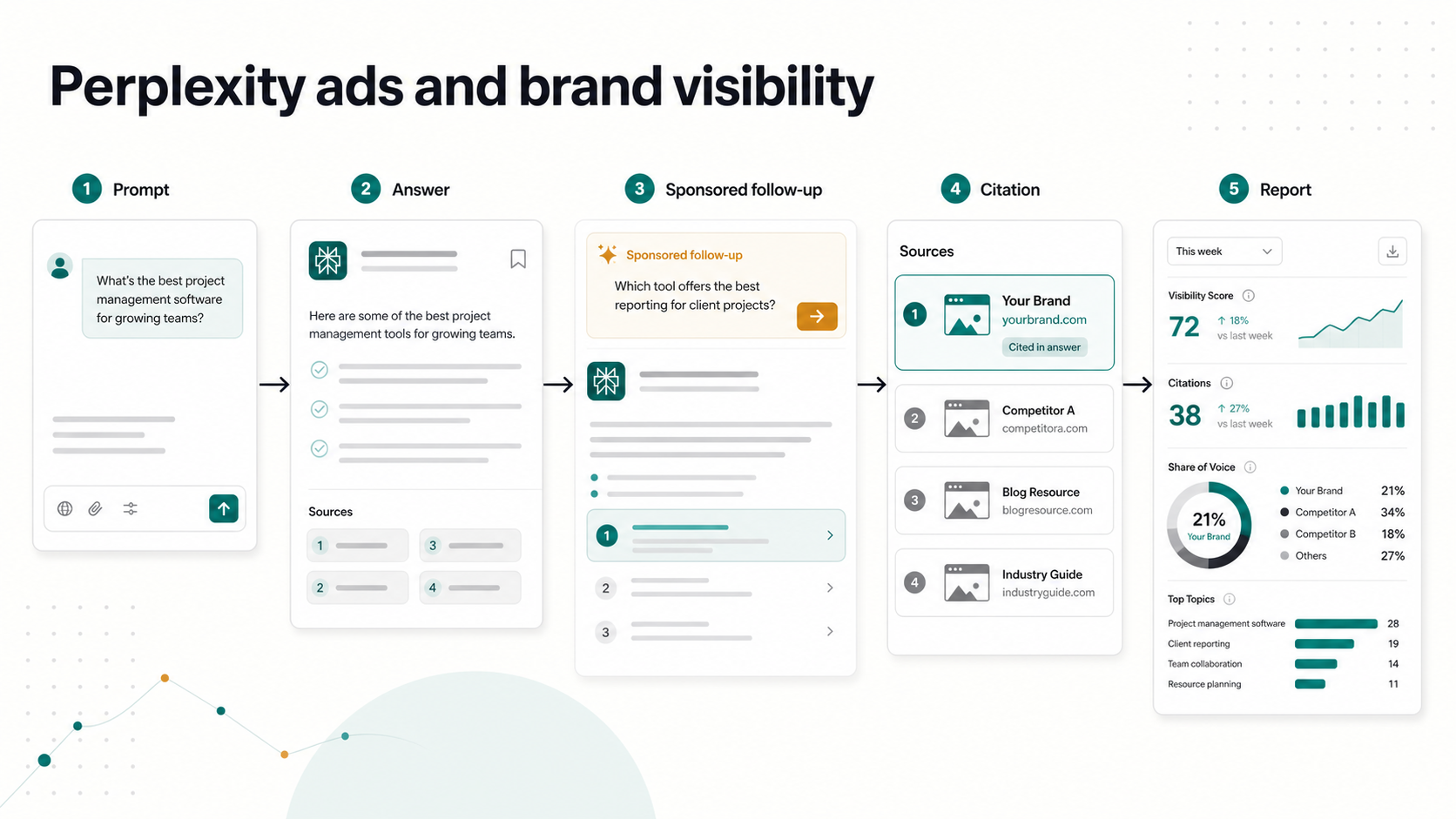
Perplexity ads are sponsored placements inside Perplexity's answer experience, first tested as sponsored follow-up questions beside or below AI-generated answers. The important detail for marketers is that Perplexity controls the generated answer experience; the advertiser is not simply writing a blue-link search ad and bidding on a keyword.
Perplexity ads are paid prompts or placements that appear around an AI answer experience, most visibly as labeled sponsored follow-up questions. Search Engine Land reported that the sponsored question is labeled and that the answer to that sponsored question is generated by Perplexity, not written directly by the advertiser.
That makes the channel closer to answer-context sponsorship than classic paid search. A buyer asks a question, reads a sourced answer, and may see a sponsored next question that nudges them toward a deeper commercial path. The ad can create attention, but the answer environment still depends on source trust, citation quality, and the user's belief that the system is not being bent by the sponsor.
Should brands advertise on Perplexity?
Brands should consider Perplexity ads when buyers already use Perplexity for category research, the team can afford a test, and organic visibility is being tracked separately. Do not use paid placements as a substitute for source ownership. If competitors are the cited sources in organic answers, the ad may create awareness while the answer still validates someone else.
Use this decision table before pitching budget:
| Situation | Paid test? | What to measure first |
|---|---|---|
| You already own citations for high-intent prompts | Yes | Incremental branded searches, demo assists, cited URL changes |
| You are mentioned but competitors are cited | Maybe | Whether paid clicks happen while competitor citations remain |
| You are absent from category answers | Not yet | Organic mention rate, source gaps, missing pages |
| The category has no Perplexity usage | No | Buyer prompt evidence across Perplexity and ChatGPT |
| Leadership wants "AI search ads" because it sounds new | No | Baseline visibility report and test hypothesis |
The painful mistake is treating Perplexity ads like Google Ads with a weirder interface. Paid search already has mature conversion tracking, auction diagnostics, and landing-page playbooks. AI answer ads have a more fragile trust layer: a user may see your sponsored follow-up, then still rely on the organic citations inside the answer to decide whether you belong in the shortlist.
How should you measure Perplexity ad visibility?
Measure Perplexity ad visibility with a before-and-after prompt set, not only media metrics. Record brand mentions, domain citations, target URL citations, competitor mentions, answer sentiment, sponsored follow-up appearance, referral traffic, assisted conversions, and whether the answer describes the product accurately.
Use this scorecard:
| Metric | Why it matters |
|---|---|
| Sponsored appearance rate | Shows whether the placement actually appeared for tracked prompts |
| Brand mention rate | Shows whether Perplexity names the brand in the answer |
| Domain citation rate | Shows whether Perplexity uses your site as a source |
| Target URL citation rate | Shows whether the intended landing page or guide supports the answer |
| Competitor source share | Shows whether paid visibility is still surrounded by competitor proof |
| Answer accuracy | Shows whether the generated answer explains the product correctly |
| Referral and assisted pipeline | Connects Perplexity exposure to business outcomes |
Run the same prompt set before launch, during the test, and after the test. Separate organic answer visibility from sponsored placement visibility. If you blend the two, the report becomes flattering and useless: you cannot tell whether the media buy lifted the brand, whether content fixes improved citation ownership, or whether Perplexity drift changed the answer.
For a small B2B SaaS test, start with 40 prompts:
| Prompt bucket | Example |
|---|---|
| Category discovery | "best AI visibility tools for B2B SaaS" |
| Comparison | "Tracemetry vs Profound for Perplexity citation tracking" |
| Failure mode | "why does Perplexity cite competitors instead of my site" |
| Workflow | "how do I monitor Perplexity citations weekly" |
| Paid context | "how should brands evaluate Perplexity ads" |
| Landing-page fit | "what tool tracks AI answer citations and source ownership" |
Add entity terms naturally: Perplexity ads, sponsored follow-up questions, AI search advertising, Perplexity citations, cited sources, AI visibility tracking, brand mentions, source ownership, answer accuracy, B2B SaaS, comparison pages, pricing pages, demo requests, and weekly reporting.
What should you fix before buying Perplexity ads?
Fix the source layer before buying Perplexity ads. Your category pages, comparison pages, alternatives pages, and proof pages should answer buyer prompts directly, cite credible sources where needed, and connect naturally to the demo or pricing path. Otherwise the sponsored moment sends people into an answer environment your competitors already own.
Pre-flight checklist:
- Lock the prompt set. Include discovery, shortlisting, comparison, alternatives, failure-mode, and pricing-adjacent prompts.
- Run the organic baseline. Capture brand mentions, cited URLs, citation order, competitors, and answer accuracy.
- Fix obvious citation losses. Start with the pages Perplexity should have cited but did not.
- Prepare the landing path. Match sponsored intent to a buyer-ready guide, feature page, pricing page, or demo page.
- Create answer-safe claims. Make sure product, pricing, integrations, and positioning are current on visible pages.
- Add internal links. Connect Perplexity pages to AI visibility tracking, AI search visibility reports, schema markup for AI search, and the relevant conversion path.
- Set the re-measure date. Review the same prompt set weekly instead of declaring victory from launch-week screenshots.
This is where organic and paid work meet. The paid placement can create a new next question, but the surrounding source graph still shapes the user's trust. If the answer cites a third-party listicle, a competitor comparison page, or an outdated article, you are paying to appear inside a conversation you do not control.
How are Perplexity ads different from Google search ads?
Perplexity ads differ from Google search ads because the user is inside a generated answer, not a results page. Google search ads compete around links and landing pages. Perplexity placements appear around an answer where citations, generated summaries, and follow-up questions all influence the user's next move.
Use this comparison:
| Area | Google search ads | Perplexity ads |
|---|---|---|
| User experience | Search results page with paid and organic links | AI answer with citations and follow-up questions |
| Creative unit | Ad copy and landing page | Sponsored question or answer-context placement |
| Trust problem | Is this ad relevant? | Is the answer still neutral? |
| Organic dependency | SEO rank and landing-page quality | Citation ownership, source trust, answer accuracy |
| Measurement | Clicks, conversions, auction data | Sponsored appearance, prompt visibility, citations, assisted demand |
| Best use | Capture known demand | Influence research and next-question paths |
Search Engine Land's launch coverage noted the core tension: Perplexity had meaningful weekly query volume, but users who choose answer engines may react differently to advertising than users on traditional search pages. That is why the measurement plan needs trust signals, not just clicks.
What should the first Perplexity ad test look like?
The first Perplexity ad test should be narrow: one audience, one category, one sponsored-question hypothesis, one matched landing path, and one locked prompt set. The goal is not to "own AI search." The goal is to learn whether paid answer-context exposure improves buyer behavior beyond organic citation work.
Run it like this:
| Step | Action | Output |
|---|---|---|
| 1 | Pick one commercial prompt cluster | Category, comparison, or workflow theme |
| 2 | Record organic visibility | Baseline mention, citation, competitor, accuracy metrics |
| 3 | Match the sponsored question | One clear next question the buyer would actually click |
| 4 | Fix the source page | Direct answer, table, FAQ, proof, internal links |
| 5 | Launch the paid test | Sponsored appearance and click evidence |
| 6 | Re-measure weekly | Organic vs sponsored lift and remaining losses |
| 7 | Decide | Scale, pause, or move budget back to source fixes |
The best sponsored follow-up question is not "Why is Acme the best platform?" That smells like an ad. A better question is closer to the buyer's next job: "How do B2B SaaS teams compare AI visibility tools?" or "What should an AI search visibility report include?" Then the answer has a reason to mention the category, the evaluation criteria, and the source pages that support the decision.
How do you report Perplexity ads to leadership?
Report Perplexity ads as an AI visibility experiment, not a mature acquisition channel. Show baseline visibility, sponsored placement evidence, organic citation changes, competitor source share, answer accuracy, traffic, assisted pipeline, and the next source fixes. The story should be: where we appeared, whether buyers could trust the answer, and what changed.
A useful one-slide report includes:
| Field | Example interpretation |
|---|---|
| Prompt cluster | "AI visibility tools for B2B SaaS" |
| Sponsored placement | Appeared on 12 of 40 tracked prompts |
| Organic mention lift | Brand named more often, but mostly in workflow prompts |
| Citation movement | Target URL cited on 6 prompts after page update |
| Competitor pressure | Two competitors still own alternatives prompts |
| Answer accuracy | Pricing answer stale in one surface; fix queued |
| Business signal | Referral traffic small; demo assists worth watching |
| Next action | Update comparison page and retest before expanding spend |
This framing keeps the channel honest. If paid visibility rises but citations stay weak, the next move is content/source repair. If citations rise without paid lift, organic GEO work is doing the heavy lifting. If both rise and assisted conversions follow, then the test has earned a larger budget.
What should you read next?
If you are not ready to advertise, start with the organic source layer. Use how Perplexity chooses sources to diagnose why another URL wins, then use why Perplexity does not cite your site for the fix workflow.
If you are already planning a paid test, run a free Tracemetry audit first. Then use Tracemetry features or book a demo if you need weekly tracking across Perplexity, ChatGPT, Claude, Gemini, and Google AI surfaces.
External references:
- Search Engine Land: Perplexity begins testing ads as sponsored follow-up questions
- TechCrunch: Perplexity brings ads to its platform
- Perplexity: AI for the Curious
FAQ
What are Perplexity ads? Perplexity ads are sponsored placements inside Perplexity's answer experience, most commonly described as labeled sponsored follow-up questions. They appear around generated answers, so marketers should measure both paid appearance and organic answer visibility.
Are Perplexity ads the same as Google search ads? No. Google search ads appear around search results and send users to landing pages. Perplexity ads appear inside an AI answer environment where citations, generated summaries, and follow-up questions affect trust and buyer behavior.
Should I run Perplexity ads before doing GEO? Usually no. Run a baseline AI visibility audit first. If you do not know your current Perplexity mention rate, citation rate, competitor source share, and answer accuracy, you cannot tell whether an ad test created real lift.
What metrics matter for Perplexity advertising? Track sponsored appearance rate, brand mention rate, domain citation rate, target URL citation rate, competitor source share, answer accuracy, referral traffic, and assisted conversions. Clicks alone miss the answer-engine visibility problem.
Can Perplexity ads fix weak organic citations? No. A sponsored follow-up can create attention, but it does not automatically make your site the cited source in the organic answer. If competitors own the cited sources, fix the source pages and internal links before scaling paid spend.
Start with the baseline
Before you buy answer-engine attention, measure what Perplexity already says about your category. Run the free Tracemetry audit to find the prompts where your brand is named, cited, missing, or described incorrectly. If the gaps matter, use Tracemetry Pro to track the prompt set weekly, generate briefs for source gaps, and separate paid lift from organic citation wins.
Frequently asked questions
What are Perplexity ads?
Perplexity ads are sponsored placements inside Perplexity's answer experience, most commonly described as labeled sponsored follow-up questions. They appear around generated answers, so marketers should measure both paid appearance and organic answer visibility.
Are Perplexity ads the same as Google search ads?
No. Google search ads appear around search results and send users to landing pages. Perplexity ads appear inside an AI answer environment where citations, generated summaries, and follow-up questions affect trust and buyer behavior.
Should I run Perplexity ads before doing GEO?
Usually no. Run a baseline AI visibility audit first. If you do not know your current Perplexity mention rate, citation rate, competitor source share, and answer accuracy, you cannot tell whether an ad test created real lift.
What metrics matter for Perplexity advertising?
Track sponsored appearance rate, brand mention rate, domain citation rate, target URL citation rate, competitor source share, answer accuracy, referral traffic, and assisted conversions. Clicks alone miss the answer-engine visibility problem.
Can Perplexity ads fix weak organic citations?
No. A sponsored follow-up can create attention, but it does not automatically make your site the cited source in the organic answer. If competitors own the cited sources, fix the source pages and internal links before scaling paid spend.
See your own AI visibility today.
Free public report. 60 seconds. No signup. Or get started on Pro to track 250 prompts continuously.