Why Perplexity does not cite your site (and how to fix it)
Troubleshoot why Perplexity cites competitors instead of your site: prompt evidence, cited URL gaps, source-page fixes, schema, internal links, and re-measurement.
Your page ranks, the product is real, and the answer still cites a competitor. That is the painful Perplexity SEO problem: you are visible enough to be considered, but not source-worthy enough to own the cited URL.
The fast decision rule is simple: if Perplexity does not cite your site, do not publish another broad "AI search" article first. Save the exact answer, inspect the cited URLs, classify the loss, fix the page that should have won, and re-measure the same prompt after it has been recrawled.
This guide is the troubleshooting layer between Perplexity citation monitoring, how Perplexity chooses sources, and the Perplexity SEO checklist. Use it when the question is not "what is Perplexity SEO?" but "why did my site lose the citation?"
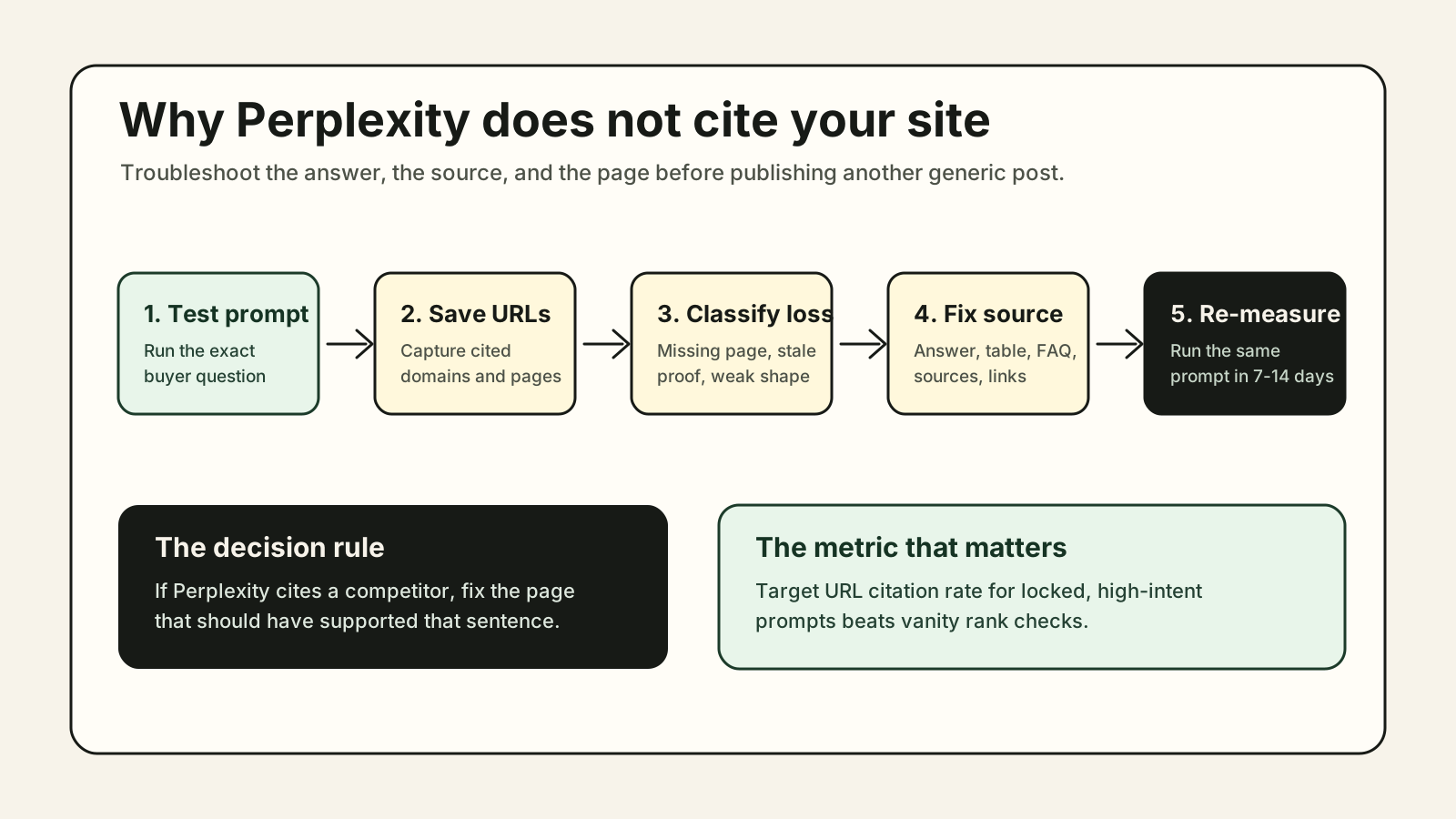
Why does Perplexity not cite your site?
Perplexity usually does not cite your site because the answer found a cleaner source for the exact prompt. The common causes are a missing page, a weak first answer block, unclear entity language, stale examples, unsupported claims, poor internal links, or schema that describes content the reader cannot see.
Perplexity's help center describes the product as an AI-powered search engine that searches the web, returns conversational answers, and includes citations with links to original sources. That means a citation loss is not only a brand-awareness problem. It is a source-selection problem at the page level.
Perplexity citation troubleshooting is the process of comparing the prompt, answer, cited URL, and your intended source page until one fix becomes obvious. The output is not a new keyword list. The output is a page-level change you can publish and measure.
What should you check first when Perplexity cites competitors?
Check whether the competitor URL answers the prompt more directly than your page. In most losses, the gap is embarrassingly visible: the competitor has the answer in the title, intro, table, FAQ, or updated proof, while your page buries the useful sentence halfway down the article.
Use this diagnostic table before changing anything:
| What Perplexity did | Likely reason | First fix |
|---|---|---|
| Competitor cited and you absent | Your matching page is missing or too broad | Create or rewrite the focused source page |
| Your brand mentioned but competitor cited | Your entity is known, but your page is weak evidence | Add a direct answer, examples, sources, and FAQ |
| Your old URL cited | Freshness, canonical, or internal topology is unclear | Update the preferred URL and link to it from related posts |
| Publisher cited instead of vendors | Third-party proof is shaping the answer | Build a source-worthy guide and earn/quote credible proof |
| Wrong page on your site cited | Internal links and titles are confusing the source choice | Clarify anchors and connect the narrow page from the broad guide |
| No citations appear | Prompt may be too conversational or unsupported by web retrieval | Test a more specific buyer prompt and track separately |
The dumb fix is adding "Perplexity AI" twenty more times. The useful fix is making one URL the obvious support for one answer.
How do you audit a Perplexity citation loss?
Audit a citation loss by preserving the evidence before you touch the page. Save the exact prompt, answer text, cited domains, cited URLs, citation order, brands named, and the sentence each citation supports. Then compare the winning URL against the page you expected Perplexity to cite.
Use this 20-minute workflow:
- Run the prompt exactly. Save wording, date, location if relevant, and the Perplexity answer.
- Record every cited URL. Do not stop at domain-level reporting; page type explains the fix.
- Map citations to claims. Note which sentence each citation appears to support.
- Open the winning page. Inspect title, intro, first H2, table, FAQ, update date, sources, schema, and internal links.
- Open your target page. Ask whether a stranger could extract the answer in 15 seconds.
- Assign one loss reason. Missing page, weak page shape, stale proof, unclear entity, weak schema, or weak topology.
- Ship the smallest useful fix. Improve the target source page, then re-measure the same prompt in 7-14 days.
If you need the baseline report first, run the free AI visibility audit. It shows which prompts name your brand, which cite your domain, and which competitor URLs are winning the source slot.
What page issues prevent Perplexity citations?
Pages lose citations when they are hard to retrieve, hard to parse, hard to trust, or hard to connect to the prompt. A page can rank in Google and still lose in Perplexity because generated answers need quotable evidence, not just a relevant URL.
Use this source-readiness checklist:
- The title and first paragraph match the prompt intent.
- A 40-80 word direct answer appears near the top.
- The page names the product, category, audience, use case, and surface clearly.
- Tables, lists, definitions, and FAQs make the answer extractable.
- Claims about platforms, standards, benchmarks, or research cite credible sources.
- Visible FAQ content matches the FAQ schema.
- Related posts link to the page using natural, descriptive anchors.
- The page has a current publish or update date when freshness matters.
- The CTA matches the problem, such as run an audit, review features, compare pricing, or book a demo.
Google Search Central says structured data gives explicit clues about a page's meaning and should describe content visible on that same page. Treat that as the baseline for AI extraction too: schema helps a clear page become easier to classify; it does not rescue a vague page.
How do you fix the page that should have been cited?
Fix the intended source page by making it the best evidence for the exact prompt. Start with the answer block, not the conclusion. Perplexity needs a concise claim it can support, a page shape it can parse, and enough source proof that the answer does not feel speculative.
Use this fix sequence:
| Fix order | What to change | Why it works |
|---|---|---|
| 1 | Rewrite the first 100-150 words around the prompt | Clarifies intent and entity match |
| 2 | Add a direct answer under the relevant H2 | Gives the answer engine a quotable block |
| 3 | Add a decision table or checklist | Makes the fix easier to extract |
| 4 | Add credible external sources for factual claims | Improves support for generated-answer citations |
| 5 | Align FAQ content and schema | Reinforces visible question-answer pairs |
| 6 | Add 2-5 internal links from related pages | Clarifies topical relationship and source priority |
| 7 | Re-measure the same prompt | Proves whether the change moved citation ownership |
If a strong page already exists, update it. If no page directly answers the prompt, create a narrow source page. Do not create five overlapping URLs for the same loss; that makes source selection muddier.
Which prompts reveal the problem fastest?
Failure-mode and decision-stage prompts reveal citation gaps faster than generic head terms. "Perplexity SEO" is useful for category coverage, but the painful commercial loss is usually a buyer asking why a competitor keeps getting cited or which tool should monitor the problem.
Start with these prompt buckets:
| Bucket | Example prompt | What it exposes |
|---|---|---|
| Failure mode | "why does Perplexity cite competitors instead of my website" | Source ownership gaps |
| Workflow | "how do I improve Perplexity citation rate every week" | Operational authority |
| Comparison | "Tracemetry vs Profound for Perplexity citation tracking" | Buyer-shortlist source control |
| Alternatives | "best Profound alternatives for AI visibility tracking" | Challenger visibility |
| Reporting | "how do I report Perplexity citations to executives" | Measurement clarity |
| Page-level fix | "what page changes help Perplexity cite my site" | Extractability and schema issues |
Add entity terms naturally: Perplexity, citations, cited URLs, source selection, citation monitoring, AI visibility tracking, generative engine optimization, answer engine optimization, source ownership, brand mentions, competitor citations, schema markup, B2B SaaS, comparison pages, product pages, and FAQPage schema.
How do you know whether the fix worked?
Measure the same prompt before and after the page fix. The useful metric is not "did traffic rise yesterday?" It is whether Perplexity now names your brand, cites your domain, cites the intended URL, moves your citation earlier, or stops citing the competitor page for the claim you now answer better.
Track these fields weekly:
| Metric | Question it answers |
|---|---|
| Brand mention | Did Perplexity name you at all? |
| Domain citation | Did it cite your site? |
| Target URL citation | Did it cite the page you fixed? |
| Citation position | Did your citation appear earlier in the answer? |
| Competitor source share | Did competitors lose cited-source ownership? |
| Answer accuracy | Did the answer describe the product correctly? |
| Remaining loss reason | Is the next issue proof, freshness, authority, or page shape? |
Perplexity can move faster than model-memory-heavy systems, but do not expect every fix to work overnight. Recrawl timing, answer drift, competitor strength, and prompt wording all matter. The point is to make the loop measurable instead of emotional.
FAQ
Why is Perplexity not citing my website? Perplexity is usually not citing your website because another URL is a clearer source for the exact prompt. Common reasons include a missing source page, buried answer, stale examples, unclear entity language, weak proof, schema mismatch, or internal links that do not tell Perplexity which page owns the question.
Can a page rank in Google but still not get cited by Perplexity? Yes. Google ranking and Perplexity citation ownership overlap, but they are not the same metric. Perplexity needs a source it can use inside a generated answer, so the page must answer early, provide extractable evidence, and support the specific claim being cited.
Should I create a new page when Perplexity cites a competitor? Create a new page only when no current URL directly answers the prompt. If an existing page almost satisfies the question, update that page first with a direct answer, table, FAQ, source citations, and internal links from related posts.
How long should I wait before rechecking a Perplexity citation fix? Recheck after 7-14 days for most page-level fixes. Use the same prompt wording and capture the same fields: brand mention, domain citation, target URL citation, citation position, competitor citations, and answer accuracy.
Does schema help Perplexity cite a page? Schema can help clarify a useful page, especially when Article and FAQ markup match visible content. It is not magic. A vague page with schema is still a vague page; a clear answer block with matching schema is easier for search and answer systems to classify.
Start with the cited URL gap
Run the free Tracemetry audit and inspect the prompts where Perplexity cites a competitor, publisher, Reddit thread, or the wrong page on your own site. If the gaps matter, use Tracemetry Pro to track prompts weekly, generate source-grounded briefs, classify citation losses, and re-measure every fix.
For the surrounding playbook, read how Perplexity chooses sources, then use Perplexity citation monitoring and the Perplexity citation rate benchmark to turn citation losses into a weekly operating system.
Sources: Perplexity Help Center: What is Perplexity?, Perplexity Help Center: Practical Tips for Using Perplexity, Google Search Central: Introduction to structured data, Evaluating Verifiability in Generative Search Engines.
Frequently asked questions
Why is Perplexity not citing my website?
Perplexity is usually not citing your website because another URL is a clearer source for the exact prompt. Common reasons include a missing source page, buried answer, stale examples, unclear entity language, weak proof, schema mismatch, or internal links that do not tell Perplexity which page owns the question.
Can a page rank in Google but still not get cited by Perplexity?
Yes. Google ranking and Perplexity citation ownership overlap, but they are not the same metric. Perplexity needs a source it can use inside a generated answer, so the page must answer early, provide extractable evidence, and support the specific claim being cited.
Should I create a new page when Perplexity cites a competitor?
Create a new page only when no current URL directly answers the prompt. If an existing page almost satisfies the question, update that page first with a direct answer, table, FAQ, source citations, and internal links from related posts.
How long should I wait before rechecking a Perplexity citation fix?
Recheck after 7-14 days for most page-level fixes. Use the same prompt wording and capture the same fields: brand mention, domain citation, target URL citation, citation position, competitor citations, and answer accuracy.
Does schema help Perplexity cite a page?
Schema can help clarify a useful page, especially when Article and FAQ markup match visible content. It is not magic. A vague page with schema is still a vague page; a clear answer block with matching schema is easier for search and answer systems to classify.
See your own AI visibility today.
Free public report. 60 seconds. No signup. Or get started on Pro to track 250 prompts continuously.