Google AI Overview SEO: how to earn source citations
How to improve Google AI Overview SEO: query tracking, cited URL analysis, Search Console signals, page fixes, schema, and weekly source-ownership reporting.
Google AI Overview SEO is the work of making your pages eligible, useful, and source-worthy when Google generates an AI Overview or AI Mode answer. The painful problem is not that your page is missing one secret tag. It is that Google may summarize the topic, cite a competitor, and leave your better page out of the answer path.
Use the fast rule: if a page already ranks, gets impressions, or matches the query intent, improve that page first. Add a direct answer, source-backed proof, a decision table, visible FAQ content, and internal links from related pages before creating a new article. If the page never seems to enter the answer path, check AI crawler tracking before assuming the copy is the only problem.
This guide shows the practical fix loop for AI Overview SEO: choose the query set, inspect citations, connect Search Console signals, update the right page, and re-measure. If you already use AI Overview tracking, this is the optimization layer that turns those observations into source-ownership work.
What is Google AI Overview SEO?
Google AI Overview SEO is the process of improving whether your content can appear as a cited, useful source inside Google's generative search experiences. It combines normal SEO fundamentals with answer-first page structure, clear entity signals, trustworthy content, schema that matches visible text, and weekly query-level measurement.
Google AI Overview SEO is not a separate technical channel from SEO. Google says generative AI features in Search are rooted in its Search systems, and its guidance still points site owners back to crawlable, indexable, helpful content. The difference is the measurement surface: you are tracking answers, citations, brands, and source ownership, not just blue-link ranking.
The practical question is: "When Google answers this query with AI, does it cite the page that should own the answer?" If the answer is no, the fix is usually page clarity, source strength, intent match, or internal context.
How do Google AI Overviews choose sources?
Google has not published a simple "source selection formula" for AI Overviews. The useful operating model is that pages must first be eligible for Search, then be strong enough for the query, and then be clear enough for the generated answer to use as supporting evidence. Treat citations as source ownership, not as a guaranteed rich result.
Start with the source path:
| Layer | What to check | What to fix |
|---|---|---|
| Eligibility | Page is crawlable, indexable, and can show a snippet | Robots, noindex, canonical, rendering, blocked resources |
| Intent match | Page directly answers the searcher's job | Rewrite the opening answer and headings around the real query |
| Source clarity | Google can identify the claim, entity, date, and page type | Add direct answers, tables, citations, author info, and schema |
| Comparative value | Page is more useful than cited competitors | Add criteria, examples, tradeoffs, limitations, and proof |
| Internal context | Related pages point to the target URL naturally | Add links from tracking, schema, reporting, and prompt posts |
Do not chase one trick. If a competitor is cited, open the cited page and compare structure. Does it answer faster? Does it include a table? Does it cite stronger sources? Does it use a clearer title? Does it match the user's exact question while your page wanders?
What should you optimize first?
Optimize the page that already has evidence before building new content. Evidence can be organic ranking, Search Console impressions, a current AI Overview citation, a competitor citation for the same query, or a page that already converts from related search traffic.
Use this decision table:
| Situation | Best move |
|---|---|
| You rank, but no AI citation | Add a 40-80 word direct answer, a useful table, sources, and matching FAQ content |
| A competitor is cited | Compare page shape, proof, freshness, schema, and internal links; then update your target page |
| Google cites your wrong URL | Add internal links and on-page wording that make the intended page the source of truth |
| You get impressions but low clicks | Improve title, meta description, answer promise, and the first screen of the page |
| No current URL matches intent | Create a focused supporting page and link it from the closest pillar |
For Tracemetry, that means an AI Overview SEO program should not start with "publish 20 AI Overview posts." It should start with the highest-value queries where a buyer asks how to choose, compare, monitor, fix, or report AI visibility and Google cites someone else.
How do you make a page easier for AI Overviews to cite?
Make the page easy to extract, verify, and classify. The fastest improvements are boring: answer the question early, use descriptive headings, cite reliable sources for factual claims, include a comparison or checklist, align schema with visible content, and link the page from related articles with natural anchor text.
Use this checklist before publishing or updating a target page:
- Put the direct answer under the H1 or first important H2.
- Define the core term in one sentence.
- Use H2s that match real searcher questions.
- Add a decision table, checklist, or short workflow.
- Cite official or reliable sources for search, analytics, policy, or technical claims.
- Keep FAQ answers visible on the page and identical in meaning to schema.
- Add Article and FAQPage schema where supported.
- Link to the page from 1-3 older posts that explain related jobs.
- Link the page to one conversion path such as features, pricing, demo, or the free audit.
Google's structured data documentation is clear that markup helps Google understand page content, but the markup should describe what users can actually read. If the schema says the page answers a question, the page should visibly answer it.
How do you connect Search Console to AI Overview SEO?
Use Search Console for query, page, impression, click, and CTR movement, then use AI Overview tracking for answer content and cited URLs. Search Console is useful for visibility evidence, but prompt and SERP inspection are still needed to see which domains the AI Overview cited.
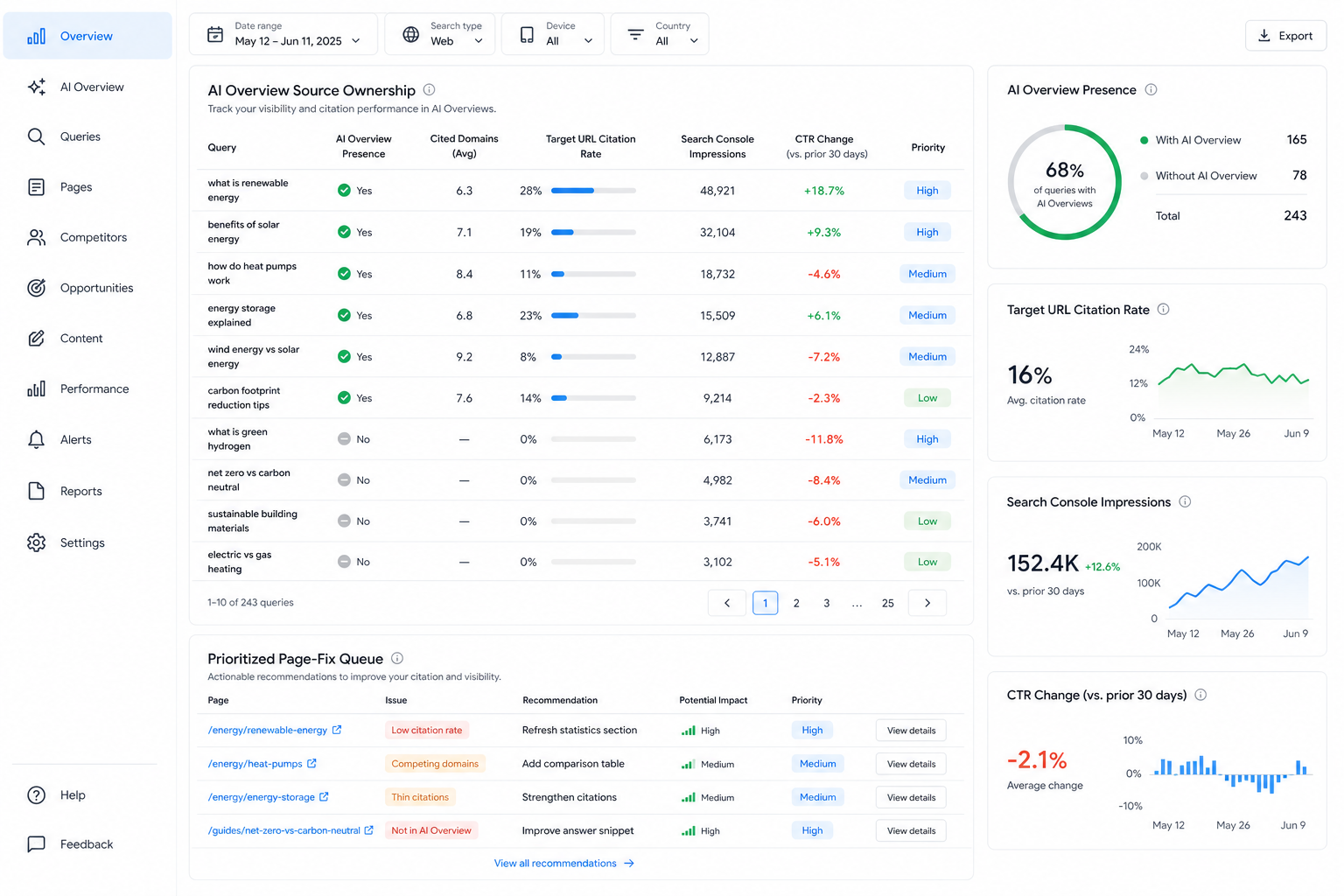
Build a weekly view with these fields:
| Field | Why it matters |
|---|---|
| Query | The search you are trying to win |
| Target page | The URL that should be cited |
| AI Overview presence | Whether the query generated an AI answer |
| Cited domains | Who Google used as sources |
| Your citation status | Domain cited, target URL cited, wrong URL cited, or absent |
| Search Console trend | Impressions, clicks, CTR, and average position movement |
| Loss reason | Missing page, weak answer, weak proof, stale copy, unclear entity, or schema mismatch |
| Next fix | The one page update to ship this week |
Google has also started rolling out generative AI performance reporting in Search Console for some properties. Use it when available, but do not wait for a perfect report. The fix loop still needs query-level inspection because you need to know what the generated answer said and which page it trusted.
What prompts and queries should you track?
Track the searches where an AI Overview would change buyer behavior. A definition query matters, but a comparison, troubleshooting, or shortlist query often matters more because it decides which sources and vendors enter the conversation.
Use a balanced set:
| Query bucket | Example phrasing |
|---|---|
| Definition | "what is generative engine optimization" |
| Workflow | "how do I track AI Overview citations" |
| Comparison | "AI Overview tracking vs AI visibility tracking" |
| Failure mode | "why does Google AI Overview cite a competitor" |
| Tool shortlist | "best AI visibility tools for B2B SaaS" |
| Reporting | "how should I report AI Overview traffic to leadership" |
| Page fix | "what is the fastest way to improve AI Overview citations" |
Conversational phrasing matters because users ask longer questions in AI search. Include exact search terms where natural, but also include "why does...", "how do I...", "what is the best way to...", and "when should I..." queries. These are the questions that expose whether your source page is strong enough.
What is the weekly AI Overview SEO workflow?
The weekly workflow is simple: pick the query set, capture AI Overview presence and citations, compare those results with Search Console movement, update the target page, then re-measure the same query after Google has time to recrawl and refresh the answer.
Follow this operating rhythm:
- Lock 40-80 priority searches across definition, workflow, comparison, failure-mode, tool, and reporting intent.
- Record whether an AI Overview or AI Mode answer appears for each query.
- Capture cited URLs, cited domains, answer themes, competitor mentions, and your brand mention status.
- Pull Search Console page and query movement for the same period.
- Pick the highest-intent loss where a page fix could plausibly change the answer.
- Update the target page with a direct answer, table, sources, schema, and internal links.
- Re-measure after publishing and record whether target URL citation rate improved.
This is the point where most teams break. They run screenshots, get excited, and never turn the loss into a page-level work item. The money is in the fix queue.
How do you report progress?
Report AI Overview SEO as source ownership, not as a vague visibility score. Leadership needs to see which queries matter, who is cited, what changed, and what the team shipped to improve the next run.
Use this compact scorecard:
| Metric | What it tells you |
|---|---|
| AI Overview presence rate | How often tracked queries produce AI answers |
| Domain citation rate | How often your domain appears as a source |
| Target URL citation rate | How often the intended page wins the source slot |
| Competitor source share | Which competitors or publishers are cited instead |
| Query CTR trend | Whether Search Console movement supports the observation |
| Fixes shipped | Whether the team actually improved source pages |
| Re-measurement delta | Whether page fixes changed answer behavior |
Tie the scorecard to your broader AI visibility report, AI visibility score, and AI referral traffic reporting. AI Overview SEO is one surface inside the larger answer-engine visibility system.
FAQ
What is Google AI Overview SEO? Google AI Overview SEO is the process of improving whether your pages are eligible, useful, and source-worthy enough to be cited or surfaced inside Google's generative search experiences such as AI Overviews and AI Mode.
Is AI Overview SEO different from normal SEO? It is not a separate technical channel. Google says generative AI features in Search rely on its core Search systems, so normal SEO foundations still matter. The difference is that you also measure generated answers, cited URLs, competitor source share, and target URL citation rate.
Does schema guarantee AI Overview citations? No. Schema can help Google understand and classify visible page content, but it does not guarantee inclusion in an AI Overview. Use structured data as a clarity layer on top of helpful, crawlable, source-worthy content.
Can Search Console show AI Overview performance? Search Console can show Search performance, and Google has begun rolling out generative AI performance views for some properties. It still should be paired with query-level AI Overview tracking because marketers need to inspect the answer text, cited URLs, and competitors.
What is the fastest fix if Google cites a competitor? Update the page that should have won. Add a direct answer, decision table, credible sources, visible FAQ, schema that matches the page, and internal links from related content. Create a new page only when no current URL matches the query intent.
How many AI Overview queries should I track? Start with 40-80 searches across definition, workflow, comparison, failure-mode, tool shortlist, and reporting intent. Fewer than 20 is useful for a quick diagnostic but usually too noisy for weekly decisions.
Build the Google AI source-ownership loop
Run the free Tracemetry audit to see where AI answers mention your brand, cite competitors, or skip your target pages. Then use Tracemetry Pro to monitor Google AI Overviews alongside ChatGPT, Perplexity, Claude, and Gemini, generate source-grounded briefs, and re-measure the page fixes that matter.
Sources: Google AI features and your website, Google guide to generative AI search optimization, Google Search Console generative AI performance reports, Google structured data introduction.
Frequently asked questions
What is Google AI Overview SEO?
Google AI Overview SEO is the process of improving whether your pages are eligible, useful, and source-worthy enough to be cited or surfaced inside Google's generative search experiences such as AI Overviews and AI Mode.
Is AI Overview SEO different from normal SEO?
It is not a separate technical channel. Google says generative AI features in Search rely on its core Search systems, so normal SEO foundations still matter. The difference is that you also measure generated answers, cited URLs, competitor source share, and target URL citation rate.
Does schema guarantee AI Overview citations?
No. Schema can help Google understand and classify visible page content, but it does not guarantee inclusion in an AI Overview. Use structured data as a clarity layer on top of helpful, crawlable, source-worthy content.
Can Search Console show AI Overview performance?
Search Console can show Search performance, and Google has begun rolling out generative AI performance views for some properties. It still should be paired with query-level AI Overview tracking because marketers need to inspect the answer text, cited URLs, and competitors.
What is the fastest fix if Google cites a competitor?
Update the page that should have won. Add a direct answer, decision table, credible sources, visible FAQ, schema that matches the page, and internal links from related content. Create a new page only when no current URL matches the query intent.
How many AI Overview queries should I track?
Start with 40-80 searches across definition, workflow, comparison, failure-mode, tool shortlist, and reporting intent. Fewer than 20 is useful for a quick diagnostic but usually too noisy for weekly decisions.
See your own AI visibility today.
Free public report. 60 seconds. No signup. Or get started on Pro to track 250 prompts continuously.