Answer engine optimization for healthcare: a patient-safety playbook
A healthcare AEO workflow for governing clinical claims, approved source pages, safe next steps, AI citations, review ownership, and patient-safety escalation.
Patients now ask ChatGPT, Gemini, Perplexity, and Google AI experiences to explain symptoms, compare providers, understand procedures, and decide when to seek care. The painful failure is not merely losing a citation. It is allowing an outdated, incomplete, or overconfident answer to shape a health decision before a clinician is involved.
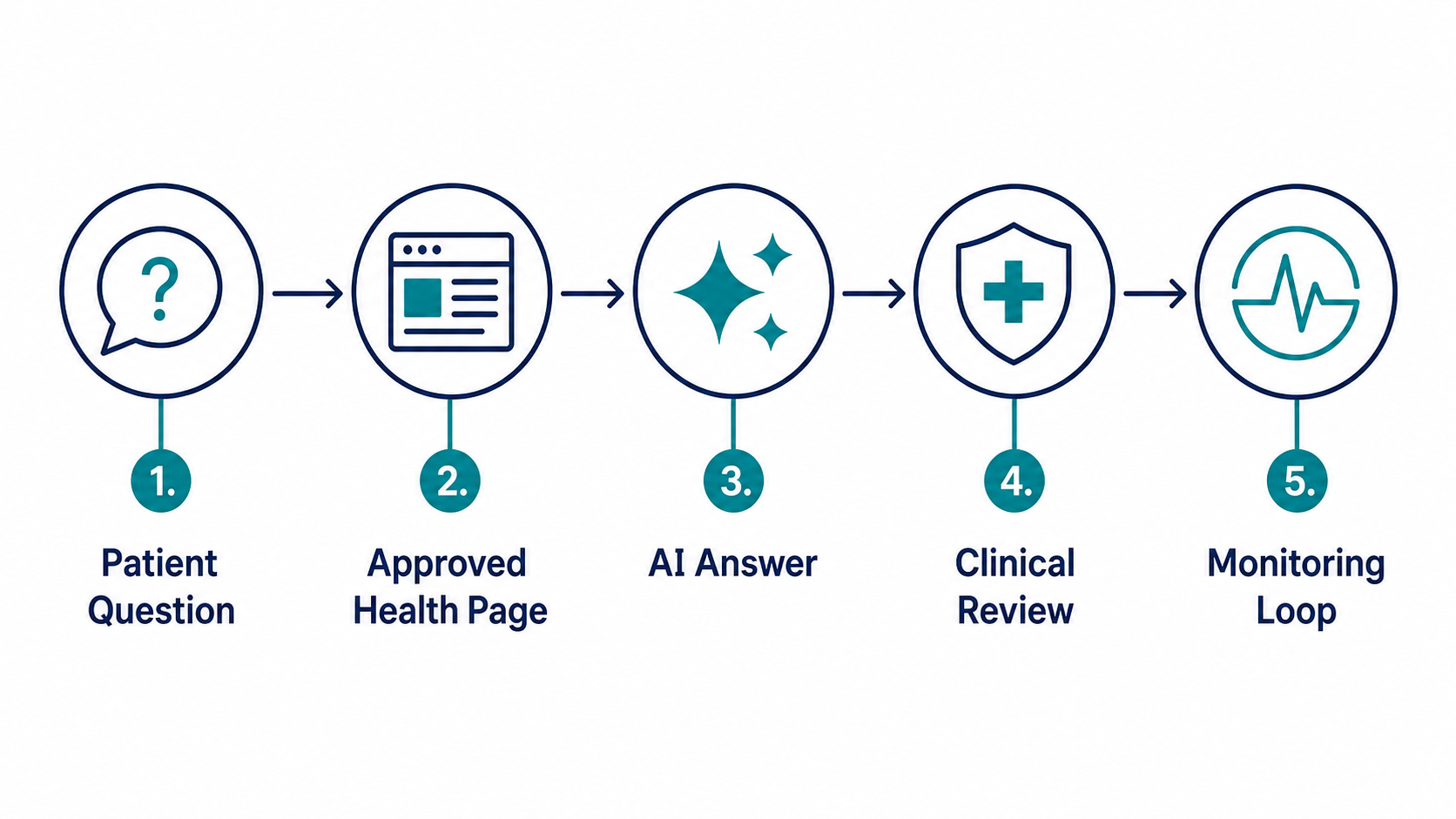
Use this fast rule: begin with 40 high-consequence patient questions, assign every factual claim to an approved source page, and separate visibility work from clinical-risk review. Recheck the unchanged questions after every material content change and at least weekly during a pilot.
This healthcare playbook extends the AI answer accuracy monitoring workflow, AEO metrics framework, and wrong AI answers response guide. It is for hospitals, clinics, health systems, digital-health products, insurers, and medical publishers managing public patient information—not for generating personalized medical advice.
What is answer engine optimization for healthcare?
Answer engine optimization for healthcare is the process of improving how AI systems find, summarize, cite, and present health information from an organization. It connects patient questions to clinically reviewed pages, measures the resulting answers and sources, and routes potentially harmful inaccuracies for rapid correction.
Healthcare AEO is source-of-truth governance for AI-assisted health discovery. It complements technical SEO, clinical content review, accessibility, reputation management, and patient safety. It cannot guarantee a citation, validate an AI diagnosis, or replace professional medical judgment.
Which healthcare questions should you monitor first?
Monitor questions where a wrong or incomplete answer could delay care, misrepresent a service, or send a patient to the wrong next step. Start with one specialty, service line, audience, and market so the baseline is reviewable and repeatable.
A practical 40-question cohort includes:
- 8 symptom and urgency questions;
- 6 condition and procedure definitions;
- 6 preparation and recovery questions;
- 6 eligibility, referral, and appointment questions;
- 6 provider, location, and service comparisons;
- 4 cost, coverage, and billing questions;
- 4 medication, device, or treatment failure-mode questions.
Use natural phrasing such as “why does chest pain need urgent assessment?”, “how do I prepare for an MRI?”, “what is the best way to choose a cardiology clinic?”, and “when should I contact a doctor after surgery?” Do not create prompts that invite the organization to endorse a diagnosis it cannot safely make.
Which page should own each healthcare answer?
Assign one primary approved page to each consequential question. Condition pages should explain general facts, service pages should own available care, location pages should own operational details, and emergency guidance should point to the appropriate urgent route. Supporting articles should link to the owner instead of duplicating changing instructions.
| Patient question | Best source-page owner | Evidence that must stay current |
|---|---|---|
| “What symptoms need urgent help?” | Clinically reviewed condition or emergency page | Red flags, limitations, emergency route, review date |
| “How do I prepare for this test?” | Procedure preparation page | Fasting, medicines, arrival, accessibility, exceptions |
| “Does this clinic provide the service?” | Service and location page | Availability, team, site, referral route, contact details |
| “What happens after the procedure?” | Recovery or discharge guidance | Expected course, restrictions, warning signs, contact path |
| “How much will care cost?” | Billing or coverage page | Scope, estimates, exclusions, insurer and market context |
| “Which treatment is best?” | Clinically reviewed education page | Options, tradeoffs, uncertainty, shared-decision guidance |
When two pages conflict, do not publish another summary. Identify the clinical owner, correct or retire the weaker page, and preserve a clear review trail.
How do you build a patient-safety AEO baseline?
Capture the complete answer, exact prompt, cited URLs, timestamp, market, language, device or account conditions, and the intended source page. Then review visibility and safety separately. An answer can cite your hospital and still omit a critical warning sign.
Score every observation across four dimensions:
- Presence: absent, mentioned, shortlisted, or recommended.
- Source ownership: whether the approved URL, another owned page, or a third party was cited.
- Clinical accuracy: correct, incomplete, outdated, misleading, unverifiable, or potentially harmful.
- Action quality: whether the answer gives an appropriate next step without pretending to diagnose the individual.
Create two queues. The optimization queue handles missing citations, weak page structure, and competitor source ownership. The safety queue handles urgent inaccuracies, missing escalation guidance, contraindication errors, and other claims needing clinical review.
What makes a healthcare page easier to cite accurately?
A strong healthcare source page answers one defined question early, identifies its audience and scope, cites authoritative evidence, names important uncertainty, and provides a safe next step. The clinical reviewer and review date should be visible wherever facts can materially affect care.
Use this source-page checklist:
- Put a 40–80 word direct answer below the relevant heading.
- State the condition, procedure, audience, location, and intended use precisely.
- Separate general education from individual diagnosis or treatment decisions.
- Place red flags and meaningful limitations beside the claim they qualify.
- Show author, clinical reviewer, last-reviewed date, and update ownership.
- Cite primary guidance or authoritative public-health sources where appropriate.
- Keep preparation, recovery, contact, and emergency instructions accessible in HTML.
- Maintain indexability, canonicals, sitemaps, descriptive links, and valid visible-content schema.
Google's structured data policies require markup to represent visible page content. The World Health Organization's guidance on ethics and governance of artificial intelligence for health emphasizes protecting autonomy, safety, transparency, and accountability. Schema can clarify a page; it cannot make an unsafe claim safe or force an AI system to cite it.
How should healthcare teams handle changing guidance?
Maintain a claim registry for information that may change: clinical guidance, preparation instructions, service availability, referral rules, locations, contact details, coverage, and emergency routes. Each record needs an owner, approved URL, evidence source, review date, and severity if wrong.
Recheck affected prompts immediately after a material update. For ordinary monitoring, prioritize:
- emergency and red-flag guidance;
- medication, contraindication, preparation, and recovery instructions;
- service availability, referral, and contact routes;
- clinician, location, cost, and coverage facts;
- general educational definitions.
Do not silently overwrite evidence. Preserve the prior answer and source set so reviewers can distinguish a resolved source problem from normal answer-engine variation.
Which healthcare AEO metrics matter?
Clinical-claim accuracy and safe-action rate matter more than raw brand visibility. Report them beside target-page citation rate, source ownership, qualified recommendation rate, and resolution time so a visibility gain cannot hide a safety regression.
| Metric | What it answers | Important caveat |
|---|---|---|
| Clinical-claim accuracy | Are consequential statements correct and current? | Requires qualified human review |
| Safe-action rate | Does the answer give an appropriate next step? | Must account for urgency and uncertainty |
| Target-page citation rate | Is the approved page used as a source? | A citation does not prove correct interpretation |
| Qualified recommendation rate | Is the organization suggested for a relevant service and market? | Avoid treating popularity as clinical suitability |
| Error-resolution time | How quickly are serious issues addressed? | Separate source correction from retrieval lag |
The AI visibility report template can hold the operating metrics, but healthcare teams should add clinical severity, reviewer, evidence source, and escalation status to every consequential error.
What healthcare AEO mistakes create the most risk?
The biggest mistake is optimizing for mentions without reviewing what the answer tells a patient to do. Other failures include copying clinical instructions across unmanaged pages, hiding urgent guidance, and assuming one correct test proves stable performance.
Avoid these patterns:
- publishing diagnosis-like answers for broad symptom prompts;
- presenting one treatment as universally best;
- omitting emergency or clinician guidance where delay could matter;
- leaving obsolete preparation, recovery, location, or referral pages accessible;
- using schema that overstates the visible content or reviewer credentials;
- measuring citations while ignoring clinical accuracy and action quality;
- allowing marketing to change clinical claims without review ownership;
- promising that markup, authority, or monitoring guarantees inclusion.
FAQ
Does healthcare AEO replace medical review or SEO?
No. Healthcare AEO adds prompt-level monitoring of AI answers, citations, competitors, source ownership, clinical accuracy, and action quality. It still depends on sound technical SEO and qualified review of consequential health content.
How many healthcare AI prompts should a team track?
Start with about 40 consequential questions for one specialty, service line, audience, and market. Expand only after the team can preserve answers, complete reviews, assign source pages, escalate risks, and repeat the stable cohort.
What is the best healthcare AEO metric?
Clinical-claim accuracy is the primary safety metric. Pair it with safe-action rate and target-page citation rate to show whether the answer is correct, gives an appropriate next step, and uses the approved source.
Can medical schema guarantee an AI citation?
No. Structured data can help systems interpret visible content, but it cannot guarantee retrieval, citation, ranking, or recommendation. It also cannot compensate for vague, conflicting, outdated, or clinically unsafe copy.
How often should healthcare AI answers be checked?
Recheck affected questions after every material clinical or operational update. During a pilot, review high-consequence questions weekly and maintain an additional scheduled source audit with clear clinical owners and review dates.
What is the first healthcare AEO action to take?
Choose 40 high-consequence patient questions and capture the current answers, citations, clinical claims, and next-step guidance. Escalate potentially harmful errors first, then assign each question to one approved source page.
Build a clinically governed monitoring loop
Healthcare AEO works when clinical governance, source pages, patient communications, and repeated answer monitoring share one system. Start with one service line, fix the most consequential errors, and preserve the evidence behind every decision. Book a Tracemetry demo to monitor answers, cited sources, competitors, and claim changes in a recurring workflow.
Frequently asked questions
Does healthcare AEO replace medical review or SEO?
No. Healthcare AEO adds prompt-level monitoring of AI answers, citations, competitors, source ownership, clinical accuracy, and action quality. It still depends on sound technical SEO and qualified review of consequential health content.
How many healthcare AI prompts should a team track?
Start with about 40 consequential questions for one specialty, service line, audience, and market. Expand only after the team can preserve answers, complete reviews, assign source pages, escalate risks, and repeat the stable cohort.
What is the best healthcare AEO metric?
Clinical-claim accuracy is the primary safety metric. Pair it with safe-action rate and target-page citation rate to show whether the answer is correct, gives an appropriate next step, and uses the approved source.
Can medical schema guarantee an AI citation?
No. Structured data can help systems interpret visible content, but it cannot guarantee retrieval, citation, ranking, or recommendation. It also cannot compensate for vague, conflicting, outdated, or clinically unsafe copy.
How often should healthcare AI answers be checked?
Recheck affected questions after every material clinical or operational update. During a pilot, review high-consequence questions weekly and maintain an additional scheduled source audit with clear clinical owners and review dates.
What is the first healthcare AEO action to take?
Choose 40 high-consequence patient questions and capture the current answers, citations, clinical claims, and next-step guidance. Escalate potentially harmful errors first, then assign each question to one approved source page.
Make your next SEO decision with better evidence.
Explore practical guides to AI visibility, source citations, and choosing the right tools for your team.